Capella's BS in Business is the undergraduate FlexPath degree built out of many small courses rather than a few large ones. At least 90 program points, a minimum of 27 earned at the 3000 level or above, six specializations, and BUS FPX 4993 Business Capstone Project at the end. Courses run 1.5 or 3 points, each passed by written assessments scored against a guide. The hard part is not difficulty. It is keeping both FlexPath slots working while courses of unequal size finish at unequal times. We draft to the Distinguished descriptors inside 24 to 48 hours and keep revising at no charge until the criteria are met. Weighing the graduate degree instead? The MBA page is next door.
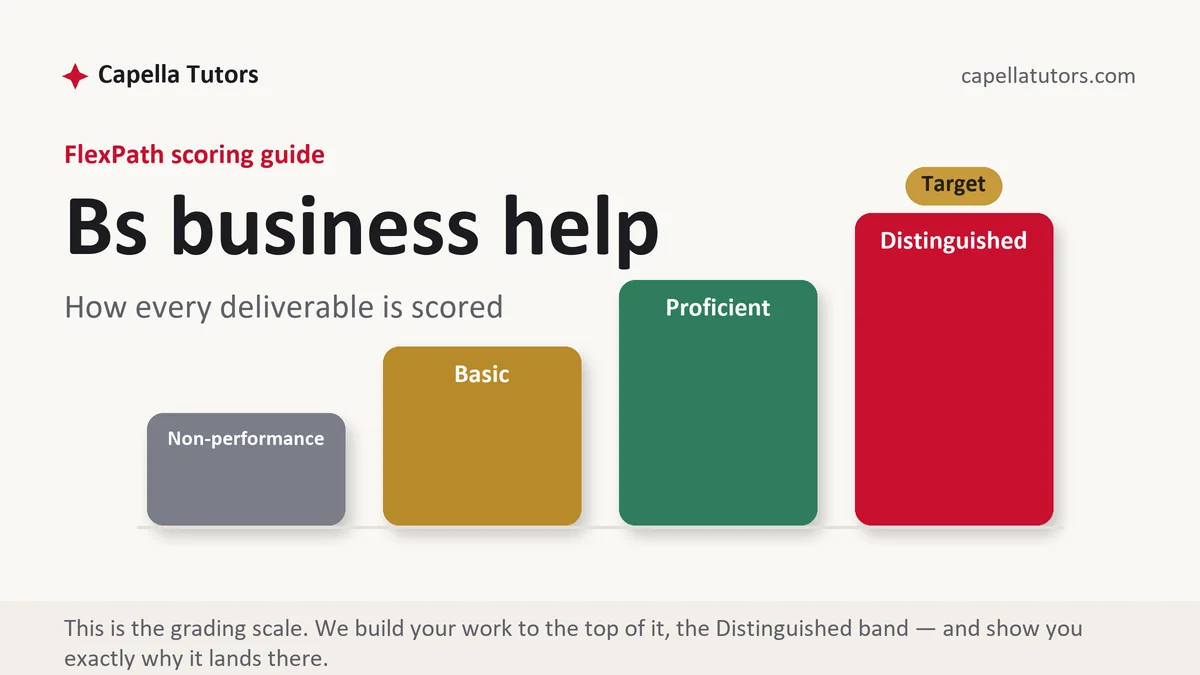
What the Capella BS in Business actually demands
Most requests for Capella BS in Business help arrive holding one prompt and no picture of the degree behind it, and at undergraduate level that gap is expensive. A graduate degree is a dozen courses taken in near enough one order. This one is a long assembly of small parts, and the assembly is where sessions get lost.
The second demand is register. Undergraduate business criteria do not want an essay about business. They want the document a workplace would recognise, a memo or a plan or a recommendation, with the arithmetic visible in the sentence rather than filed in an appendix. Defining a concept correctly is Basic in almost every criterion that names one. Running your employer through it and reaching a conclusion the definition alone would not produce is the Distinguished move.
The 90-point shape, and the 27 that decide your calendar
The degree asks for at least 90 program points, a minimum of 27 of them at the 3000 level or above. The requirement to plan against is the 27, not the 90, because it is a shape rather than a total, which is why students watching only the running count arrive near the end holding the wrong kind of points. Run the arithmetic. The eleven core BUS-FPX courses add to 24 points, but only four sit at the 3000 level, contributing 10.5 toward the 27. BUS FPX 4993 adds 3. That leaves at least 13.5 to find at the upper division, which at 3 points a course means five 4000-level courses at minimum, all from your specialization.
| Bucket | Points | Counts toward the 27 |
|---|---|---|
| Core, eleven BUS-FPX courses | 24 | Only the four at the 3000 level, 10.5 points |
| BUS FPX 4993 capstone | 3 | Yes, the last you can rely on |
| Specialization, 4000-level | 3 each | Yes, and the balance comes from here |
| General education and electives | The rest of the 90 | Mostly no, mostly transferable |
Lower-division work is what a transfer evaluation erases; upper-division work is what you sit yourself. Confirm your totals against the catalog year you enrolled under, since Capella revises program requirements.
Six specializations, and how to choose between them
The FlexPath version lists six: Accounting, Business Administration, Health Care Management, Human Resource Management, Management and Leadership, and Project Management. They differ less in difficulty than in the kind of labor they ask for, which is the axis to choose on.
| Specialization | What the work is | Pages here |
|---|---|---|
| Accounting | Statements, cost systems, tax and audit, in figures a grader can recompute | Eight, BUS FPX 4060 to 4070 |
| Human Resource Management | Policy written against law, plus pay and staffing plans | Seven, BUS FPX 4043 to 4048 and 4802 |
| Management and Leadership | Argument about organizations, drawn from a job you hold | Six, BUS FPX 4011 to 4016 |
| Project Management | Scope, schedule, cost and risk, built as artifacts | Nine, PM FPX 1000 and 4000 to 4080 |
| Business Administration | The broad option, with BUS FPX 4801 Ethics and Enterprise named | One, plus a mix from the other groups |
| Health Care Management | Sector management, with BUS FPX 3121 in the shared core | Confirm the set in your handout |
The trade, both sides. Management and Leadership is quickest for a working supervisor, because its assessments are argued rather than computed and your workplace supplies the evidence, and it is the least distinguishing line on a transcript. Accounting is slowest, because the courses build on each other and a wrong figure is wrong in a way a paragraph never is, and it is the only one that opens a credential path. Speed and weight point in opposite directions. Pick on the job you want in two years. If health care management is the target, the separate BS in Health Care Administration is a different degree.
BUS FPX 4993, the course that grades the other courses
Every course before it asks one discipline's question. BUS FPX 4993, Business Capstone Project, 3 program points, asks all of them at once about a single organization, and its criteria detect whether the answers were held together or merely filed next to each other. The implication lands early. Choose the organization in your first upper-division course, keep every model and figure in one folder, and the capstone becomes a synthesis rather than a rebuild of half the degree from memory on a flat-rate clock. Choose for retrievable evidence rather than for interest, since a firm you cannot get numbers out of turns every quantitative criterion into hedging.
Send the business course you are in
The code and the scoring guide are enough to start. First premium original sample free, back inside 24 to 48 hours.
Every BS in Business course we cover
Forty-four pages, grouped the way the degree is. Each one covers what its criteria reward and the errors that cost a level.
Core, the eleven BUS-FPX courses
Shared by every specialization; the four at the 3000 level count toward the 27. BUS FPX 1011, BUS FPX 2007, BUS FPX 2012, BUS FPX 2021, BUS FPX 2030, BUS FPX 2061, BUS FPX 2062, BUS FPX 3022, BUS FPX 3040, BUS FPX 3050, BUS FPX 3121
General education, social science
An option in the social science pool, not a fixed requirement. BUS FPX 1050
Accounting specialization
The most sequential group, and the one to start earliest. BUS FPX 4060, BUS FPX 4061, BUS FPX 4062, BUS FPX 4063, BUS FPX 4064, BUS FPX 4065, BUS FPX 4068, BUS FPX 4070
Human Resource Management specialization
Policy, pay and labor relations, applying a legal standard to a case. BUS FPX 4043, BUS FPX 4044, BUS FPX 4045, BUS FPX 4046, BUS FPX 4047, BUS FPX 4048, BUS FPX 4802
Management and Leadership specialization
Argument-shaped courses, the best second slot beside anything quantitative. BUS FPX 4011, BUS FPX 4012, BUS FPX 4013, BUS FPX 4014, BUS FPX 4015, BUS FPX 4016
Business Administration specialization
The named required course. BUS FPX 4801
Project Management specialization
Principles first, then the eight domain courses. PM FPX 1000, PM FPX 4000, PM FPX 4020, PM FPX 4030, PM FPX 4040, PM FPX 4050, PM FPX 4060, PM FPX 4070, PM FPX 4080
Capstone
Last on the transcript for most students. BUS FPX 4993
Browse the full course catalog
The working-adult pacing problem
FlexPath bills in flat 12-week sessions and allows up to two courses at a time, so the only lever you own is what occupies each slot and for how long. In a graduate program the two courses are near enough the same size. Here they are not, and that is the problem.
Work one case. A student opens a session with BUS FPX 2061 at 1.5 points in slot one and BUS FPX 3040 at 3 points in slot two. The half-size course clears in week four. Slot one is empty, and an empty slot costs what a full one costs, because the session price does not move. Eight weeks of paid capacity go nowhere. Know the next course before you submit the last assessment of the current one, so the slot refills the week it opens.
The second rule is submit-on-grade. Faculty have two business days to evaluate an attempt, and the next assessment waits on the grade. Those two days are dead time only when nothing else is in flight, so stagger submissions and keep one course always in the queue.
Where BS in Business students stall
- The 27 left to the end. Filling the total with transferable lower-division work first leaves a final year made entirely of 4000-level courses.
- Half-size courses treated as easy. A 1.5-point course carries fewer assessments, not lighter ones, and it still holds a slot for weeks.
- No transfer evaluation before the first session. Planning against 90 points you may not owe is the cheapest mistake to avoid.
- A specialization chosen after the core. The choice decides which capstone organization is workable, so making it late wastes the sequencing advantage.
- An empty second slot. The flat rate does not discount unused capacity, and most stalled sessions are one unfilled slot rather than one hard course.
How the courses sequence
You set the order in FlexPath, and not every order is a sensible one. Take BUS FPX 2007 early, since it installs vocabulary later criteria assume. Put BUS FPX 2061 and BUS FPX 2062 ahead of the Accounting group, because the 4000-level statements and cost courses read as though the fundamentals are there. PM FPX 1000 belongs ahead of the PM FPX 4000 series for the same reason. Then move into the 3000-level core deliberately, since those four are your earliest upper-division points.
The pairing rule is simpler. One course whose labor is building something, one whose labor is arguing something, which is why a Management and Leadership course partners well with an Accounting or Project Management course and badly with another of its own kind. The two-course rotation playbook walks the cadence through, the scoring guide guide covers criterion language, and the transfer credit guide is where the 90 gets shorter. Your enrollment counselor owns the question of what your agreement allows; the pacing arithmetic sits on the expedite page.
BS in Business questions students actually ask
How many courses is 90 program points?
More than most people expect, because undergraduate business courses are small. The ones here run 1.5 or 3 points, so 90 points is a long list of short courses rather than a short list of long ones. The count you actually sit is set by your transfer evaluation rather than by the catalog, since general education transfers readily and the BUS-FPX core mostly does not.
Which specialization finishes fastest?
Management and Leadership, for most working supervisors, because its labor is argument rather than computation and you can write from a job you already hold. Accounting is slowest for the same reason in reverse: the courses build on each other and a wrong number is wrong in a way an essay never is. That is a trade rather than a ranking. Confirm the required set for your specialization in your program handout.
Do I have to take BUS FPX 4993 last?
Treat it as last whatever your handout permits, because the course grades integration and integration needs material to integrate. BUS FPX 4993 is worth 3 program points and expects one organization carried across strategy, operations, finance, people and ethics at once. A student who arrives having chosen the organization and kept the earlier models writes a synthesis. One who arrives early rebuilds from memory inside a billing session. Confirm the sequencing rule with your enrollment counselor.