Whatever this course asks you to submit, send the prompt with its scoring guide and a premium original sample returns inside 24 to 48 hours, built to the Distinguished descriptors and re-added line by line by a second reader. The catalog entry reads BUS FPX 2061, Accounting Fundamentals, carrying 1.5 program points, a core course every FlexPath specialization in the BS in Business runs through, offered in FlexPath inside a degree that requires at least 90 program points with 27 or more earned at the 3000 level or higher. In Capella's catalog the course code is written BUS-FPX2061.
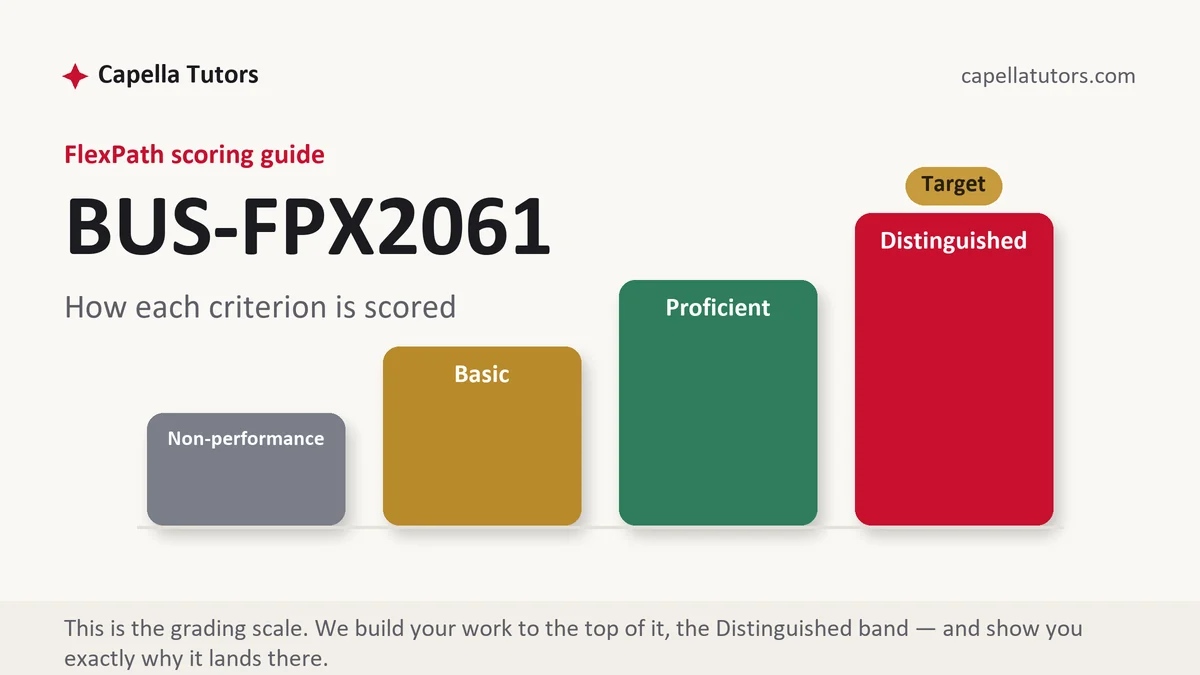
What BUS FPX 2061 actually grades
This course grades whether you can record an event correctly and then say what the record means. The assessments in this course usually give you a set of transactions, a partial set of statements, or a small business scenario, and the criteria look for the entry, the adjustment, the statement, and the sentence of interpretation that most drafts leave off. Bookkeeping accuracy is the floor rather than the target. A submission where every entry balances and no paragraph explains what the owner should conclude reads as Basic, because the column above it describes a student who can talk about the business, not only about the ledger.
The accounting equation is the spine, and it is tested constantly even when the prompt never mentions it. Assets equal liabilities plus equity, every transaction touches at least two accounts, and debits equal credits inside each entry, which together mean an out-of-balance trial balance is always an entry problem and never an equation problem. Around that sit the mechanics the criteria name directly: the difference between cash and accrual recognition, revenue recognized when it is earned rather than when the money lands, expenses matched to the period that consumed them, contra accounts such as accumulated depreciation and allowance for doubtful accounts, and the closing process that empties the temporary accounts into equity at period end.
The four statements have to articulate, and this is the point where assessments most often come apart. Net income leaves the income statement and enters the statement of retained earnings, the ending retained earnings figure appears on the balance sheet, and the ending cash on the cash flow statement equals the cash line at the top of the balance sheet. Break any one of those joins and the set stops describing a real business. Interpretation is the last strand and the one that earns the top column, since a reader wants to know whether the company can pay next month's bills, whether it earned anything after the owner's draw, and which single number would change the answer.
How we help in this course
Our 2061 drafts show the work in the order an accountant would produce it, transactions first, then the adjustments with the concept that requires each one named beside it, then the statements, then the paragraphs about what the statements say. Accounts are titled the way your textbook titles them so nothing looks imported, every column is footed, and figures in the narrative match figures in the tables. Send the transaction list, the trial balance, or the scenario, along with the guide, and the numbers in the sample are yours rather than a worked example lifted from somewhere else.
The routing behind that is the same on every order and it matters more here than on most. Eight pairs of hands see the draft, one belonging to a reviewer whose only job is to re-add the totals and confirm the statements agree with each other, another to an APA and originality check that reconciles citations against the reference list. Nothing goes out before both passes clear, the window stays at 24 to 48 hours, revisions are free until the guide is satisfied, and evaluator comments come back through the same route at no cost.
The assessments, one by one
Assessment 1
Answer the questions on the accounting environment, financial versus managerial accounting, users of accounting information. Read the full Assessment 1 manual.
Assessment 2
Answer the questions on the accounting cycle, recording and posting transactions, source documents, journals, ledgers and the trial balance. Read the full Assessment 2 manual.
Assessment 3: Completing the Accounting Cycle
Cash versus accrual reporting, adjusting entries, depreciation and book value, extending balances, the current ratio and the correct sequence of the cycle. Read the full Assessment 3 manual.
How to actually write BUS FPX 2061: where to begin
Start from the scoring guide, not the transaction list. Copy each criterion into a blank document as a heading with its Distinguished sentence pasted underneath, then work the numbers knowing which heading each result belongs to. Accounting prompts absorb effort that no criterion rewards, and an evening can go into a beautiful worksheet answering a question the guide never asked. The guide also fixes the format, and a criterion asking for a memo to the owner will not accept a spreadsheet with no sentences in it.
Then get the accrual concept demonstrated rather than defined, because a definition is worth a Basic and a demonstration is worth the column above. Take a two-truck lawn and patio contractor closing out June. It invoiced customers $18,400 for work finished that month and collected $12,900 in cash, of which $1,500 settled a May invoice. It paid $6,200 in cash for fuel, wages, and materials. It also accepted a $3,000 deposit for a patio scheduled in July, watched $600 of a prepaid insurance policy expire during the month, and owes $900 of wages earned in the final week but payable in July. Count the cash and the owner claims a profit: $12,900 collected plus the $3,000 deposit is $15,900 in, $6,200 out, $9,700 of apparent profit. Now count it properly. June revenue is the $18,400 earned in June, because the $1,500 belongs to May and the deposit is not revenue at all but unearned revenue, a liability that stays a liability until the patio exists. June expenses are the $6,200 paid plus $600 of insurance that expired whether or not anyone wrote a check plus $900 of wages the company owes, which totals $7,700. Net income is $10,700, a thousand dollars above the cash story and built from different pieces. The two entries carrying the difference are the ones the criteria hunt for: debit Insurance Expense $600 and credit Prepaid Insurance $600, then debit Wages Expense $900 and credit Wages Payable $900. Neither touches cash and both change the profit, which is the whole idea in one sentence.
Finish with the interpretation the guide asks for and most submissions omit. Say what the statements let the owner conclude, in the owner's language: the business earned $10,700 in June but holds $3,000 that has to be worked off before it is really hers, $7,000 of the month's invoices is still sitting in receivables, and the July wage run already carries $900 of June's cost. That paragraph takes ten minutes and moves more criteria than another hour of entries would.
| Section | What goes in it | What Distinguished looks like |
|---|---|---|
| Entity and period | The business, the reporting period covered, and the basis of accounting in use. | Period and basis fixed before any figure, with units named if the amounts are in thousands. |
| Transactions and entries | The events, the entries recording them, and the accounts each side touches. | Entries balanced individually, with the reason for the debit written out rather than assumed. |
| Adjusting entries | Accruals, deferrals, depreciation, and anything earned or incurred but not yet in cash. | Each adjustment tied to the concept requiring it and traced onto both statements it affects. |
| The statements | Income statement, retained earnings, balance sheet, and cash flow for the period. | The four articulated, income carried into equity, and ending cash agreeing with the balance sheet. |
| Interpretation | What the numbers say about liquidity, profitability, and the owner's stake. | A reader learns something about the business the raw statements never state outright. |
| Standards and format | The authority behind each treatment, presented in current APA. | Treatments referred to the codification or the standard instead of to a study aid. |
Developing the analysis
Accounting looks like a subject with one right answer, and part of what this course teaches is where the judgment hides. Three disagreements are worth carrying into a paper. The first is rules against principles: United States standards are comparatively prescriptive while international standards lean harder on professional judgment, and the argument about which produces more useful statements has run for decades, with inventory costing and development spending as the usual battlegrounds. The second is discretion inside accrual accounting itself, since allowances for uncollectible accounts, warranty provisions, and useful lives are all estimates chosen by management, which is exactly why a criterion will ask who selected an assumption and on what basis. The third is historical cost against fair value, and it explains why a balance sheet can show land at a figure decades out of date. Nobody expects an original position on any of it at this level. You are expected to notice when a treatment involved a choice, name the choice, and say in one sentence how the statements would look if the other option had been taken.
Citations that survive faculty review
Accounting sources rank plainly, and evaluators notice when a paper reaches for the bottom of the list. The Financial Accounting Standards Board's Accounting Standards Codification is the authority for how a transaction is treated in the United States, and a reference to the codification beats a reference to any site summarizing it. Real filings come from SEC EDGAR, free and complete, so a paper needing an actual balance sheet has no reason to invent one. The AICPA supplies the professional and ethical material when a prompt raises conduct, and the IFRS Foundation is where an international contrast should come from rather than a comparison table someone posted. Peer-reviewed accounting journals reached through the Capella library carry the research when a criterion asks for evidence rather than for a rule. Three conventions save marks. Give every statement figure its fiscal year end, since companies close in June and September as readily as December. State the units, because a total of 4,812 is meaningless until the reader knows whether it is dollars or thousands. Say so when a figure has been restated. Then run the citations both directions in current APA.
The mistakes that land Basic instead of Distinguished
- Recording a deposit as revenue. Money taken for work not yet done is a liability, and calling it income overstates the period and understates what is owed.
- Adjusting entries left out. Skipping the accruals turns an accrual statement back into a cash statement wearing the wrong heading.
- Statements that do not articulate. Net income that never reaches retained earnings leaves a balance sheet that cannot balance and a reader who stops trusting the set.
- Figures with no units. An amount with no scale beside it cannot be compared, and the criteria treat that as an accuracy problem rather than a formatting one.
- Describing the bookkeeping instead of the business. The criterion asks what the statements reveal, and a narrated list of entries is not an answer to that question.
BUS FPX 2061 questions students actually ask
I keep reversing debits and credits. Is there a rule that always holds?
There is, and it is shorter than the mnemonics. Debit means the left side of an entry and credit means the right side, nothing more, and neither word carries a good or bad meaning. Assets and expenses increase on the left. Liabilities, equity, and revenue increase on the right. Anything decreasing goes to the opposite side from the one it increases on. Test every entry twice: the left column and the right column must be equal, and the entry has to leave assets equal to liabilities plus equity. When an entry resists, name the two things that actually changed in the world before you name the accounts. Cash came in and an obligation was created, or a service was delivered and a customer now owes you, and the accounts follow from that sentence rather than the other way round.
My balance sheet will not balance. Where do I look first?
Work a fixed checklist and the error usually surfaces in a few minutes. Confirm net income was closed into retained earnings and that you used the ending figure rather than the opening one. Look for a one-sided adjusting entry, which is the most common cause, and for a prepaid or a payable recorded twice. Check that a customer deposit went to a liability rather than to revenue. Then use the arithmetic tell: divide the amount you are out by nine, and if it divides evenly, suspect a transposition such as 540 typed for 450, or a decimal slide. If the difference is exactly twice some figure in the ledger, you have posted an amount to the wrong side. Those four checks catch most of what goes wrong in an assessment of this size.
Does my assessment need a real company's financial statements?
Only if the prompt says so, and when it does, the filings are free. SEC EDGAR holds the annual report of every public company, and the financial statements sit inside it with the notes that explain the choices behind them, which is the part worth reading. Take the figures from the statements rather than from a finance portal, since portals recalculate and relabel, and note the fiscal year end and the units at the top of your work. If the prompt supplies a fictional company instead, use its numbers exactly as given and resist the urge to correct them, because the scenario's inconsistencies are sometimes the thing the criterion is testing you on.
Entries and statements due?
Send the transactions, the trial balance, and the criteria. Everything comes back footed, articulated, and explained in plain sentences, and your first premium sample costs nothing.