Send the fact pattern, the questions attached to it, and the scoring guide, and a premium original sample comes back inside 24 to 48 hours, reasoned element by element and read by a second person against the top column before it goes out. It sits on the transcript as BUS FPX 2021, Business Law Fundamentals, a 1.5-point core requirement in the BS in Business, run in FlexPath inside a 90-point degree that requires at least 27 points at the 3000 level or above. In Capella's catalog the course code is written BUS-FPX2021.
What BUS FPX 2021 actually grades
This course grades legal reasoning, not legal knowledge, and the difference decides most of the rubric. In current courserooms the assessments include "Comprehensive Case Fact Summary" and "Case Analysis: Tort Law" among others, and your scoring guide decides the exact format of each. What earns the top column is the middle: taking the rule apart into its elements and walking each element through the facts you were handed, including the facts that cut against your conclusion. You are not being asked for the right answer in the way a quiz means it. You are being asked to show the reasoning that produces an answer.
IRAC is the structure the course is built on and the structure most students compress. Issue states the legal question as a question about these facts. Rule states the governing law and where it comes from. Application is the long section, and it is long because each element of the rule gets a paragraph pairing it with the fact that satisfies or defeats it. Conclusion follows from the application and introduces nothing new. Negligence shows why the discipline matters: duty, breach, causation, and damages all have to be present, so a set of facts establishing a duty, a clear breach, and a direct causal line but leaving the harm unproven ends with the defendant winning. Writing that sentence out, rather than sliding past the weak element, is what an evaluator is hunting for.
The other graded reflex is deciding which body of law governs before you analyze anything. Contracts for the sale of goods run under Article 2 of the Uniform Commercial Code as adopted in the state, contracts for services run under common law, and a mixed transaction is settled by asking which purpose predominates. An agreement to supply and install commercial refrigeration where the equipment is $47,000 and the installation labor is $6,500 is predominantly a goods contract, and that classification changes the rules on how an acceptance carrying different terms is treated and on whether a modification needs fresh consideration. Same facts, different framework, different outcome. The classification sentence belongs near the top of every contract answer you write.
How we help in this course
Our 2021 drafts follow the structure the rubric expects. The governing law is identified and sourced in the opening section, the rule is broken into numbered elements, and the application pairs each element with the specific line from your fact pattern that meets it or fails it. Where a fact pattern is silent on jurisdiction, the sample states the assumption openly and notes where a minority rule would change the result, a habit that reads as care rather than as hedging.
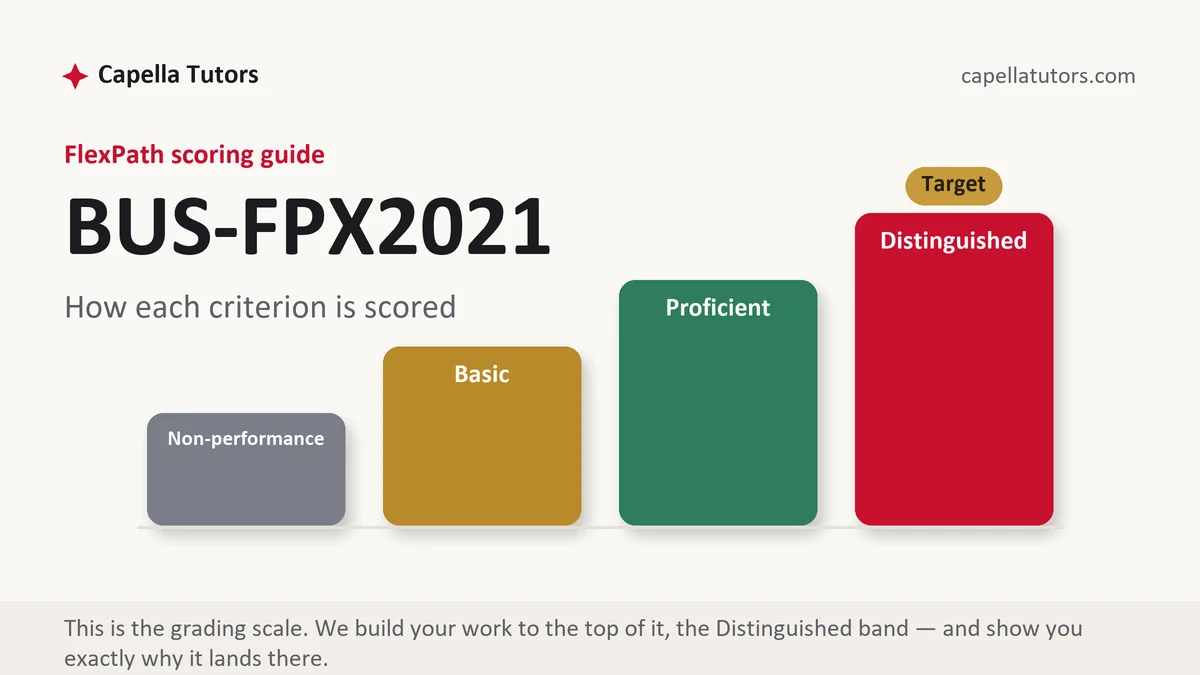
Everything around it is the studio's usual arrangement. Turnaround is 24 to 48 hours, the target is the Distinguished descriptor rather than a pass, and eight people work the file: a research analyst locates the scoring guide, the governing statutes, and any case authority the prompt invites, a subject writer builds the analysis, a scoring-guide reviewer marks the draft criterion by criterion as your faculty evaluator will, an APA and originality pass checks the citations and the reference list against each other, and an editor reads for clarity last. Free revision continues until the work satisfies the guide, and faculty comments come back through the same cycle at no cost.
The assessments, one by one
Assessment 1
Assessment 1 in BUS FPX 2021, Business Law Fundamentals, is typically where a fact pattern arrives and you have to decide whether an agreement exists before you decide who wins. Read the full Assessment 1 manual.
Assessment 2: Comprehensive Case Fact Summary
Summarize a real contract case, the disputed terms, the legal principles that apply, the strengths and weaknesses of each side. Read the full Assessment 2 manual.
Assessment 3: Case Analysis: Tort Law
Tort Law: analyze a real tort case, the torts and legal principles involved, the strengths and weaknesses of each party, the court's ruling. Read the full Assessment 3 manual.
How to actually write BUS FPX 2021: where to begin
Read the scoring guide before the fact pattern, because business law rubrics almost always separate the rule row from the application row and score them independently. That structural fact should shape the draft: a section that states the law beautifully and then applies it in three sentences loses an entire row while looking finished. Turn the criteria into headings, and inside each one write the elements as a numbered list before you write any prose, so the application cannot quietly skip one.
Then work an example the way the rubric wants it worked. A supplier emails a price for 400 units with acceptance required by Friday. The buyer replies on Thursday accepting but moving the delivery date by a week. The supplier ships on the original date. Under common law the buyer's reply is a counteroffer and no contract exists until conduct creates one. Under Article 2 the analysis runs differently, because between merchants an additional or different term can become part of the agreement unless it materially alters the deal, the offer expressly limited acceptance to its own terms, or objection follows within a reasonable time. Those are 400 units of goods, so the code governs, and the whole answer turns on the classification you made in the first paragraph. Classification, then rule, then elements against these facts, and the analysis holds.
Finish with the argument against yourself. Every fact pattern in this course is drafted so the losing side has something real to say, and a paper that never acknowledges it reads as though only half the problem was read. One paragraph is enough: name the strongest counterargument, identify the fact it rests on, and explain why another fact or another rule defeats it. That paragraph is also where a hedge belongs. If the outcome depends on how a court reads a term, say which reading you expect and what would change your answer, because a conclusion stated with the right amount of confidence scores better than one stated with too much.
| Section | What goes in it | What Distinguished looks like |
|---|---|---|
| Facts that matter | The events in order, with the facts bearing on the elements separated from background. | Legally operative facts identified as such, and irrelevant detail left out rather than summarized. |
| Issue | The legal question framed around these parties and these events. | A question narrow enough to answer yes or no, with sub-issues split out separately. |
| Rule and source | The governing law, whether statute, code, or common law, with the source named. | The correct body of law justified, and the section or doctrine cited rather than described. |
| Application | Each element of the rule paired with the fact that satisfies or defeats it. | Every element addressed, including the weak one, with facts quoted rather than loosely paraphrased. |
| Counterargument | The other side's best position and the reason it does not carry. | A real objection engaged, not a straw version raised in order to be knocked down. |
| Conclusion and remedy | The likely outcome and what the prevailing party would actually recover. | A remedy sized to the facts, with mitigation and limits acknowledged. |
Developing the analysis
Legal reasoning works by analogy, and saying so out loud improves an undergraduate paper more than any amount of extra rule statement. A court decides a new dispute by asking how closely it resembles disputes already decided, so the sentence pattern you want is that this situation resembles the decided case in one respect and differs in another, and that the difference does or does not matter given the reason the rule exists. That last clause is the one students omit. A rule has a purpose, and an application connecting back to the purpose is the difference between reciting and reasoning. Two cautions belong here as well. State law varies, so a paper asserting what the law requires without saying whose law is making a claim nobody can verify, and naming the jurisdiction or stating the assumption costs one sentence. And the hypothetical disputes used in textbooks are teaching devices rather than authority, so treat them as illustrations and reach for a real statute or a real decision whenever the criterion asks for support.
Citations that survive faculty review
Four kinds of authority are worth citing in this course and one very tempting category is not. Statutory and code text is the strongest, meaning the state statute, the relevant article of the Uniform Commercial Code as that state adopted it, or the federal statute, cited to the section rather than to the chapter. Judicial opinions come next, retrieved through a legal database available in the Capella library, with the case name, the court, and the year given so a reader can find it. Administrative material from the agency that actually enforces the area carries the working rules, so employment questions point to the Equal Employment Opportunity Commission or the Department of Labor, advertising and consumer questions to the Federal Trade Commission, and securities questions to the Securities and Exchange Commission. Restatements and treatises supply the standard formulation of a common-law doctrine when no single decision states it cleanly. What to avoid is the vast supply of law-firm marketing pages and consumer legal-advice sites, which exist to generate enquiries, frequently present one state's rule as though it were national, and are rarely current. Cite in current APA and check the list in both directions before submitting.
The mistakes that land Basic instead of Distinguished
- Rule stated, conclusion announced, application missing. The application section holds most of the marks, and two sentences will not carry them.
- Goods and services treated identically. Article 2 and common law diverge on acceptance, modification, and warranty, so the classification has to come first.
- The criminal standard applied to a civil dispute. A civil case turns on the preponderance of the evidence, and importing beyond a reasonable doubt changes who wins.
- The law described as though all fifty states agreed. Naming the jurisdiction, or stating the assumption, costs one sentence and prevents an unverifiable claim.
- No counterargument anywhere in the paper. A fact pattern with only one plausible reading would not have been assigned.
BUS FPX 2021 questions students actually ask
Do I have to cite real cases?
Your scoring guide decides, and plenty of prompts here are answered entirely from statute and code. Where a criterion asks for support, a named decision with its court and year is stronger than a general statement about what courts do, because it is checkable. Find one through the legal databases in the Capella library rather than through a search engine, read enough of it to know what the facts were, and use it the way lawyers do: state what happened in that case, state what your facts have in common with it, and state the difference. A case cited for a proposition it does not actually stand for is worse than no case at all, and faculty in this course do check.
The fact pattern never says which state. What am I supposed to do?
Say so, choose a framework, and move on. One sentence early in the rule section is enough: the facts do not identify a jurisdiction, so the analysis applies Article 2 of the Uniform Commercial Code as adopted in most states, or the majority common-law rule as stated in the Restatement. Then, at the end of the application, add a line marking the point where a minority rule would produce a different result. Two sentences of that show an evaluator you know the law is not uniform, which is one of the things the course exists to teach, and they keep you from asserting a rule that is wrong somewhere.
How do I write the application section without simply repeating the facts?
Use a pairing test on every sentence. In the application, each sentence should contain both a legal term from your rule and a fact from the prompt, and a sentence carrying only one of those belongs somewhere else. The buyer replied on Thursday is a fact and belongs in the fact statement. The buyer's Thursday reply arrived inside the stated acceptance window, which satisfies the timeliness element, is application, because the fact and the element are in one sentence doing work together. Run that test line by line the first few times you write one. It is mechanical, it takes ten minutes, and it is the fastest route out of the Basic column in this course.
Business law assessment due?
Send the fact pattern and the criteria. The analysis comes back element by element with the governing law identified. Your opening premium sample carries no fee.