Hand over the prompt and the scoring guide and a premium original sample of whatever the assessment asks for comes back inside 24 to 48 hours, drafted against the Distinguished descriptors and reviewed by a second reader who checks the artifact as well as the analysis. The transcript entry reads BUS FPX 3050, Fundamentals of Organizational Communication, worth 3 program points, a core course of the BS in Business, taught in FlexPath, and one of the upper-division courses a student uses to reach the required 27 points at the 3000 level or above inside the 90-point degree. In Capella's catalog the course code is written BUS-FPX3050.
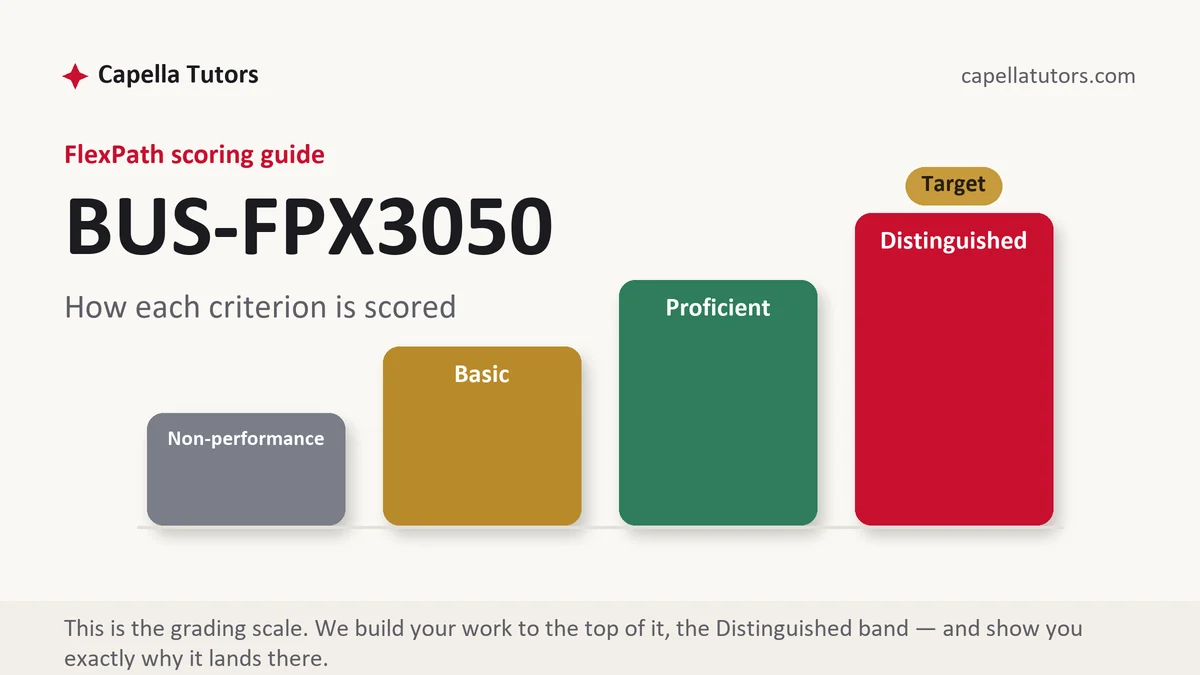
What BUS FPX 3050 actually grades
This course does not grade whether you are a good communicator. It grades whether you can locate a communication failure at a specific point in a process and design a fix a manager could implement on Monday. In current courserooms the assessments include "Communication, Ethics, and a Command Decision" and "Communicating a Team Contract Video Script" among others, and your scoring guide decides the exact format of each. Naming the stage is the whole move. A paragraph saying communication broke down is worth nothing, and a paragraph saying the message was encoded in finance vocabulary for an audience of shift supervisors, on a channel with no return path, is worth a level.
Channel choice is the second graded judgment, and it rests on a defensible logic rather than on preference. Rich channels, meaning face to face and then video, carry tone, allow immediate correction, and suit messages that are ambiguous or emotionally loaded. Lean channels, meaning written notice and posted documentation, carry precision and leave a record, and suit messages that must reach everyone identically. Layoff news delivered by email and a benefits enrollment deadline delivered verbally in a corridor are the same error made in opposite directions. Audience analysis sits underneath the choice: what this audience already knows, what it stands to lose, what objection it will raise in the first thirty seconds, and what it needs to do differently after reading.
The third graded strand is the artifact itself, because assessments here frequently ask you to produce the memo, the briefing, the plan, or the script rather than only to write about one. When that happens the document is graded twice, once as a communication and once as evidence that you can apply the concepts, so the memo needs a subject line that states the decision, the ask in the opening paragraph, the reasoning after it, and a specific action with a date attached. Measurement then closes the work, because a communication plan that cannot say what would count as working is unfinished.
How we help in this course
Our 3050 samples come with the artifact built, not described. If the assessment wants a memo, a stakeholder briefing, or a difficult conversation script, the draft contains the finished document written for the audience the prompt names, with the analysis around it explaining each choice in the vocabulary of the criteria. Tell us the organization, the audience, and the message that has to travel, and the draft will use that setting rather than a generic office.
The commercial side does not change from course to course. Each piece arrives within 24 to 48 hours, written to the Distinguished column, after passing through eight sets of hands: sources pulled by a research analyst, a draft from a business writer, a criterion by criterion review against your guide, an APA and originality pass in both directions, and a final edit that reads the artifact aloud to confirm it works as a spoken or scanned document. Revisions remain free until the guide is met, and faculty comments re-enter the cycle at no charge.
The assessments, one by one
Assessment 1: Communication, Ethics, and a Command Decision
Analyze the ethical communication issues in a real leadership scenario, then write the public communication the situation called for. Read the full Assessment 1 manual.
Assessment 2
By the second deliverable the course usually stops asking you to write about communication and asks you to produce some: a memo, a briefing, or a script for a named audience, with an analysis beside it explaining the channel and structure choices. Read the full Assessment 2 manual.
Assessment 3: Communicating a Team Contract Video Script
A script for a short video message to a team that presents a team contract, its expectations and the communication practices the team will follow. Read the full Assessment 3 manual.
How to actually write BUS FPX 3050: where to begin
Read the scoring guide first and build the document out of it. Every criterion turns into a heading, the top-column language goes underneath while you draft. The criteria usually move through the same arc: describe the situation and the audiences involved, diagnose what went wrong or what is at risk, choose channels and justify the choice, produce the message, and say how the outcome will be checked. Keep the diagnosis and the design apart in the outline, because the most common structural failure here is a paper that describes a problem for two pages and then produces a message that does not address it.
Then price something, because a communication argument carrying a number is unusual enough to be memorable. A standing weekly status meeting with 14 attendees running a full hour consumes 14 hours of paid time a week, and at a blended loaded rate of 41 dollars an hour that is 574 dollars a week, or about 29,800 dollars a year. Redesign it as a 30 minute meeting for the 8 people who make decisions, with a written summary to everyone else, and the recurring cost falls to 164 dollars a week, or roughly 8,500 dollars a year. The proposal now carries a 21,000 dollar annual argument, and the interesting part is what you say next: the saving is real only if the written summary actually reaches the six people removed from the invitation, which is exactly the measure your plan should track. That pairing, a number and the condition under which the number holds, is the move the Distinguished column keeps describing.
Upward communication deserves the same skepticism. An engagement pulse sent to 640 employees that comes back from 214 of them has a response rate of 33 percent, and the favorable score inside it describes the third of the organization willing to answer, which in most workplaces leans toward the engaged and the aggrieved and away from the quietly disengaged middle. Report the rate next to the result every time, say which direction the missing responses would most plausibly push the number, and recommend a second channel that reaches the non-respondents rather than a louder version of the first.
| Section | What goes in it | What Distinguished looks like |
|---|---|---|
| Situation and audiences | The organization, the message that has to move, and each audience with what it wants and what it fears. | Audiences separated rather than merged, with the objection each one will raise named in advance. |
| Diagnosis | The point in the process where the message fails or is likely to, with the evidence for that judgment. | A named stage and a mechanism, not a general statement that communication is poor. |
| Channel and message design | The channels chosen, the reason each fits the message, and the sequence they run in. | Richness and permanence weighed against the message, with the ordering justified. |
| The artifact | The memo, briefing, script, or plan itself, written for the named audience. | A document that stands on its own, with the ask, the reason, and the action visible in the first screen. |
| Measurement | What will be counted, from what baseline, over what period, and by whom. | A measure that could plausibly come back negative, with the response to that outcome stated. |
| Ethics and references | Candor, confidentiality, what may be withheld and on what basis, with current APA both ways. | The withholding defended on a stated ground rather than left implicit. |
Developing the analysis
Research in this field is more contested than the textbooks let on, and acknowledging that is worth a criterion. Media richness was proposed as a theory matching message ambiguity to channel capacity, and it has been argued against ever since by work showing that experienced users extract far more from a lean channel than the theory predicts. Attribute the theory to the researchers who proposed it rather than to the textbook chapter, because a grader checking your reference list sees the difference immediately. Evidence on transparency splits the same way: more information reduces rumor and raises trust up to a point, past which people stop reading and the message that matters competes with everything else sent that week. Take a position for your case. Say that this audience, with this history and this level of change fatigue, needs fewer messages on a fixed schedule rather than more, and defend it.
Citations that survive faculty review
Three kinds of source hold a communication paper together. Peer-reviewed research in management communication, organizational behavior, and applied psychology, retrieved through the Capella library in Business Source Complete and PsycINFO, supports any claim about what a practice does to behavior. Primary sources carry the frameworks, so the theorist who introduced a model gets the citation and the textbook is used for orientation only. Organizational documents give you the facts of the case, meaning the policy, the announcement, the intranet page, or the survey report, and they are cited as the organizational documents they are rather than paraphrased anonymously. One habit borrowed from the journals will sharpen your accuracy: before quoting a survey finding, find the response rate and the sampling frame, and before quoting an experimental result, check whether the participants were employees or undergraduates, since a laboratory study of students tells you less about a shift briefing than its abstract suggests.
The mistakes that land Basic instead of Distinguished
- Diagnosing the problem as poor communication. The criteria want the stage, the channel, and the mechanism, since every failure here is already one.
- An artifact written for the grader instead of the audience. A memo to shift supervisors opening with academic framing has failed by its second line.
- Channel choice made on preference. Richness and permanence are the grounds, and both belong on the page.
- A plan with nothing to measure. If nothing is counted, the evaluation criterion has no material to grade.
- Theory attributed to a textbook. The person who proposed the model is the citation, and borrowed attribution shows.
BUS FPX 3050 questions students actually ask
Does the assessment want the actual memo, or an essay about the memo?
Read the verb in the prompt and follow it literally. If it says create, draft, or prepare, the document itself is the deliverable and it is graded as a document, which means audience-appropriate length, a subject line carrying the decision, and formatting a reader can scan. If it says analyze or evaluate, the essay is the deliverable and the memo may sit in an appendix. Many prompts ask for both, and the safe structure is the finished artifact first, followed by a section explaining the channel, audience, and structural choices against the criteria.
How do I measure whether a communication plan worked?
Pick something countable that could move within the period, and take the baseline before you start. Reach is the simplest, meaning the share of the intended audience the channel demonstrably touched, and it is usually available from an intranet, an email platform, or an attendance sheet. Response rate works when the message asks for something back. State the denominator, the window, and the baseline in the same sentence as the target, then add the thing most plans omit, which is the number that would tell you the plan failed.
The conflict I want to write about involves real colleagues. Is that allowed?
Yes, once it is deidentified and kept on the behavior. Change the names, describe roles rather than people, blur any detail that would identify the workplace to a reader who knows it, and state in a sentence that the case has been deidentified. Then hold the analysis to what was said, on what channel, with what effect, because the moment a paper starts diagnosing a colleague's motives it has moved into speculation the criteria cannot reward.
Memo or communication plan due?
Send the prompt, the criteria, and the audience you are writing for. We will build the artifact and the analysis that defends it. Your first premium sample is free of charge.