Send us the prompt, the criteria and the change your organization is attempting, and a premium original sample lands inside 24 to 48 hours, written against the Distinguished descriptors, checked criterion by criterion by a second reader, and revised free until the score is where you need it. On your transcript this reads BUS FPX 4802, Change Management, worth 3 program points, part of the Human Resource Management specialization inside the FlexPath BS in Business, a degree of at least 90 program points requiring a minimum of 27 from courses coded 3000 or higher. In Capella's catalog the course code is written BUS-FPX4802.
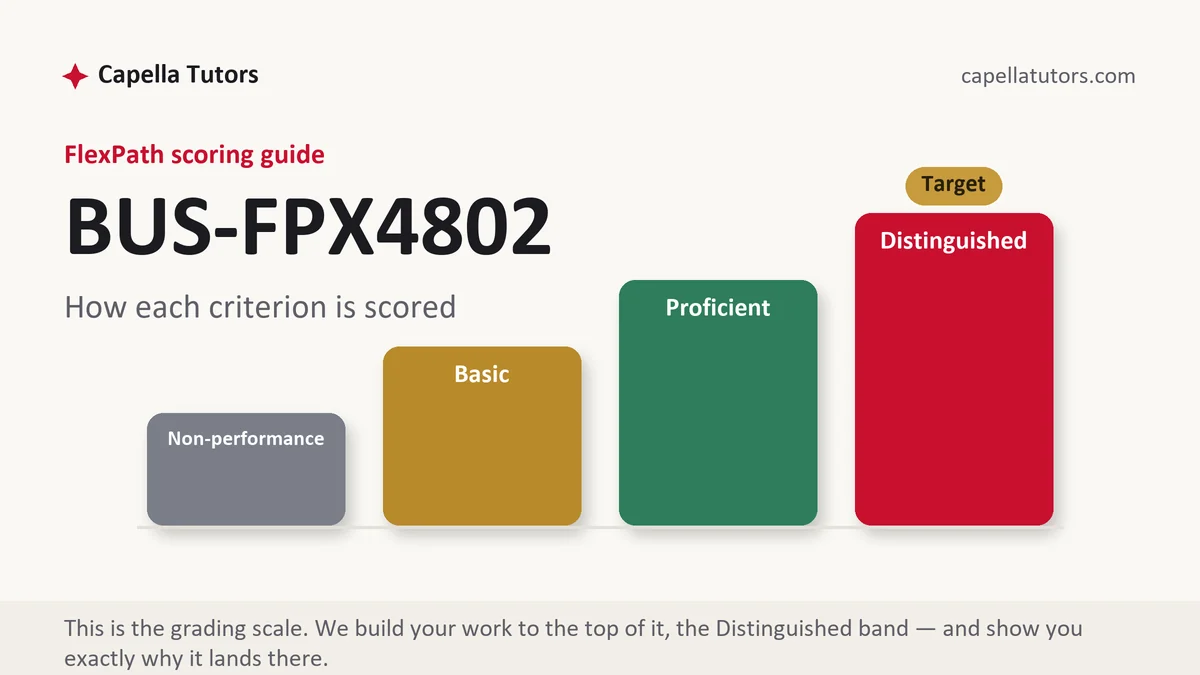
What BUS FPX 4802 actually grades
Change management is the subject most likely to produce a fluent paper that earns a middling grade, because the vocabulary is easy and the analysis is not. Anybody can write that communication matters and that people resist change. The criteria are looking for something narrower: a specific change, a specific set of people whose work it alters, a named reason each group might oppose it, and a plan whose steps could actually be carried out next month. Generic change writing is the single most common failure mode in this course and it is entirely avoidable.
The models are the scaffolding and you should use one rather than three. The unfreeze, change, refreeze sequence is old and still useful because it insists that something must destabilise the current way of working before anything new will hold. The eight-step approach is more detailed and its early emphasis on establishing urgency and building a guiding coalition captures what most failed changes skipped. The individual-level model that runs from awareness through desire, knowledge, ability and reinforcement is particularly useful when the change depends on thousands of people each doing something differently, because it locates the blockage at a stage rather than declaring resistance in general. Choose one, say why it suits this change, and apply it all the way through.
Diagnosis before design is what the criteria reward. That means assessing readiness rather than assuming it: what has happened here before, whether the last three initiatives were completed or quietly abandoned, whether people trust what leadership says, how much change is already underway, and whether anybody has the capacity to absorb another. An organization that has run four restructurings in three years has a fatigue problem that no communication plan will solve, and saying so is better analysis than pretending the next change starts from neutral. Stakeholder mapping belongs here too, sorted by how much the change affects each group and how much influence each holds.
Then resistance, which the strongest papers reframe. Opposition to a change is usually rational from where the person is standing. Somebody who spent four years becoming expert in the system being replaced is about to become a novice again. A supervisor whose team is being merged loses status. A person whose informal workaround kept the process running knows something the designers do not and is about to lose the argument. Treating those responses as information rather than as obstacles produces both a better plan and a better paper, because each specific objection points at a specific mitigation while a general statement about resistance points at nothing at all.
How we help in this course
Change deliverables from us are built around your actual initiative. Tell us what is changing, who does the work differently afterwards, who sponsors it and what has been tried here before, and the sample will contain a real readiness assessment, a stakeholder map with named groups, a communication sequence with owners and dates, and adoption measures rather than milestones. Where the prompt supplies a case, we hold every recommendation to what that organization could plausibly resource, since a plan requiring a dedicated change team in a firm of sixty people is not a plan.
The terms are the same as everywhere in the studio. One premium original deliverable inside 24 to 48 hours, an eight-person pipeline behind it, a reviewer whose only task is checking the document against the scoring guide, and revision at no charge until the criteria are satisfied. Evaluator comments come back into the cycle free. With two business days available to faculty for each submitted attempt, we plan the drafts so a resubmission still lands inside the 12-week billing session you have paid for.
The assessments, one by one
Assessment 1: Project Proposal
Propose a change management project for an organization, with an organization summary, project summary, stakeholders and timeline. Read the full Assessment 1 manual.
Assessment 2: Project Approach and Plan
Assessment 2 in BUS FPX 4802, Change Management, usually asks you to build the plan itself: the groups affected, what each one needs, the sequence of phases with owners and dates, the message every audience gets, and the reason you chose the change model you chose. Read the full Assessment 2 manual.
Assessment 3: Stakeholder Analysis and Findings
Analyze stakeholders with an inputs, processes and outputs model, assess the culture and climate for change, and judge the organization's readiness. Read the full Assessment 3 manual.
How to actually write BUS FPX 4802: where to begin
Turn the criteria into headings, then write one paragraph stating exactly what will be different afterwards, described as behaviour rather than as a system. Not implementing a new platform, but the fourteen schedulers will build rosters in the new tool instead of in spreadsheets, supervisors will approve them in the tool rather than by email, and the paper timesheet will stop being used. In current courserooms the assessments include "Project Proposal", "Project Approach and Plan" and "Stakeholder Analysis and Findings" among others, and your scoring guide decides the exact format of each.
Assess readiness with evidence before you choose a model. Ask what the organization's record with change actually is, since the answer sets your starting point. Look for the abandoned initiatives, and count them. Look for how much other change is running concurrently, because absorption capacity is finite and a workforce already handling a system migration and a restructure will not take a third thing. Ask whether the people affected have any reason to believe leadership will follow through. Then look for what is already working in your favour, since most changes have a group somewhere that wants it and finding them early is worth more than any communication.
Map the stakeholders concretely and let the map drive the plan. Name the groups, state what changes for each, estimate their influence over whether the change succeeds and their current position on it, then decide what each one needs. The people whose daily work changes most need involvement in the design and practice time. Middle managers need to know what to say when their team asks, which is the single most neglected requirement in most change plans, since a supervisor who cannot answer a question in the corridor will undermine a launch without meaning to. Senior sponsors need something specific to do rather than a request for visible support, so write down the three actions you actually want from them and when.
Build the plan with owners, dates and adoption measures, then say how it gets sustained. Milestones tell you the project is moving and adoption measures tell you whether anything changed, so include both and keep them separate. A useful adoption measure is observable within weeks: the proportion of rosters built in the new tool, the number of paper timesheets still arriving, the number of support tickets raised and what they are about. Then plan reinforcement, because most changes decay rather than fail outright. Say what happens to the old system, since leaving it available guarantees a group will keep using it, and say what the review point is, who owns it, and what would cause the organization to adjust the approach rather than push harder.
| Section | What goes in it | What Distinguished looks like |
|---|---|---|
| The change defined | What is changing, for whom, and what people will do differently once it is done. | Behaviour described specifically, so that adoption can be observed rather than inferred. |
| Readiness assessment | History with change, current concurrent initiatives, trust in leadership, capacity and capability. | Prior initiatives named and their outcomes stated, including the ones that were abandoned. |
| Stakeholder analysis | Groups affected, what changes for each, their influence, and their current position. | Positions supported by evidence, with the specific interest behind each objection identified. |
| Approach and model | The change framework chosen, why it fits, and how its stages map onto this initiative. | One model applied throughout, with a stated reason for preferring it to the obvious alternative. |
| Plan and communication | Phases, dates, owners, the message for each group, the channel, and what managers are given. | Middle managers equipped with answers before the announcement rather than after it. |
| Measures, sustainment and references | Adoption measures, review points, reinforcement, what happens to the old way, and APA both ways. | Adoption tracked separately from milestones, with a named owner and a decision point built in. |
Developing the analysis
The most quoted claim in this field is that a large majority of change initiatives fail, and it is worth handling that statistic carefully rather than opening with it. The figure has circulated for decades, its original basis is thin, and the definition of failure varies so widely between the studies that repeat it that the number carries little information. Citing it uncritically is a small signal to an evaluator that the sources were not examined. The underlying observation, that organizational changes frequently do not deliver what was promised, is well supported by more careful work and can be made without the folklore. The models themselves deserve similar treatment. The stage frameworks are practitioner tools developed from consulting experience rather than tested theories, and their sequential logic implies an orderliness that real organizations rarely display, since stages overlap, reverse and repeat. That does not make them useless, since a checklist derived from experience is genuinely valuable, and it does mean a paper should present a model as a structure for thinking rather than as a validated process. The research that holds up better is narrower and more useful: evidence on how procedural fairness affects acceptance, on the effect of participation in design on later commitment, and on the relationship between what employees have been told and what they believe. Anchor the argument there, and be honest that the change literature is heavily weighted toward large organizations, so a plan for a firm of forty people has to be reasoned from principles rather than copied from a case.
Citations that survive faculty review
Cite the change models to their originators, since the stage frameworks, the individual change model and the earlier field theory work all have identifiable sources that textbooks compress into a diagram. Peer-reviewed organizational behaviour and management journals through Business Source Complete and ABI/INFORM carry the evidence on participation, fairness and commitment, and this is the material that distinguishes an argued paper from a described one. Where the change involves a workforce reduction, restructuring or a transfer of employees, the legal obligations are primary sources: the Department of Labor covers advance notification requirements for larger layoffs, and the Equal Employment Opportunity Commission covers the discrimination exposure that selection for redundancy creates. Society for Human Resource Management material is appropriate for practice guidance on communication and on managing employee response. Where you need evidence about a named public company's restructuring, the filings on SEC EDGAR will describe it in the firm's own words along with the charges taken, which is more solid than press coverage. Treat consultancy change surveys as what they are, marketing research conducted by firms selling change services, and if you use one, name the publisher in the text. Avoid repeating the widely circulated failure-rate statistic without attribution and a note on its basis. End with a two-way APA check so that every source named in the narrative appears in the list and nothing sits in the list unused.
The mistakes that land Basic instead of Distinguished
- A change described in general terms. Without naming what people will do differently, nothing in the plan can be measured or even checked.
- Resistance treated as an attitude problem. Most objections have a specific interest behind them, and finding it is what produces a usable mitigation.
- Two or three models mentioned in passing. Naming frameworks is reading, and the criterion is asking for one applied consistently to this situation.
- Middle managers left out of the communication plan. Supervisors answer the questions the announcement creates, and a plan that never briefs them has left the gap where it hurts most.
- No plan for what happens to the old way. If the previous system stays available, a portion of the workforce will keep using it and adoption will stall quietly.
BUS FPX 4802 questions students actually ask
Can I write about a change that has already happened?
Yes, and a retrospective analysis is often stronger because you can test the plan against what actually occurred. Structure it as a diagnosis rather than a story: what the change was, how it was approached, what went as intended, where it stalled, and which specific decision or omission produced each outcome. Apply your chosen model to the events and use it to locate the failure point, since a framework that shows where a change stopped is doing more work than one that merely labels the stages. Then write the counterfactual, which is where the marks are. Say what you would have done differently at each point and why, with enough specificity that the alternative could have been executed. Avoid writing it as a complaint about the people involved, because a paper that reads as grievance loses the analytical criterion regardless of how accurate it is.
How do I do a readiness assessment if I cannot survey anybody?
Use observable evidence instead of asking people, which is what an experienced practitioner does first anyway. Count the initiatives launched in the last three years and note how many were completed. Look at whether previous commitments were honoured. Look at turnover in the affected area and at how long the average person has been doing the work, since a long-tenured group has more invested in the current method. Note how many other projects are competing for the same people right now. Check whether the people who will use the new process were involved in choosing it. Those five observations produce a defensible readiness picture with no survey at all. State your method and its limits in two sentences, then use the findings, because a readiness section that concludes the organization is somewhat ready has told the reader nothing.
What measures belong in a change plan?
Separate three kinds and name each. Activity measures confirm the plan is being executed, such as briefings delivered and staff trained, and they are the easiest to collect and the least informative. Adoption measures show whether behaviour changed, such as the share of transactions now going through the new route, the volume of exceptions, or how many people are still using the old method, and these are where the criterion about measurement is usually satisfied. Outcome measures show whether the change delivered the benefit that justified it, which typically takes a quarter or more to appear and needs a stated baseline to be meaningful. Give each measure an owner, a frequency and a threshold that would trigger a conversation, since a measure nobody reviews is a number nobody acts on and the plan will drift back toward the old way without anyone deciding that it should.
Change plan or readiness analysis due?
Send the prompt, the criteria and the change you are working on. We map the stakeholders, choose the model and build the adoption measures. First premium sample free.