Give us the prompt, the criteria, and the company or scenario you were assigned, and a premium original sample arrives inside 24 to 48 hours, aimed squarely at the Distinguished column and checked by a second reader first. Your transcript will show BUS FPX 2007, Introduction to Business Perspectives, 3 program points, a core requirement of the BS in Business and one of the earliest you are likely to meet, taken in FlexPath inside a degree built on at least 90 program points of which no fewer than 27 must come from the 3000 level or higher. In Capella's catalog the course code is written BUS-FPX2007.
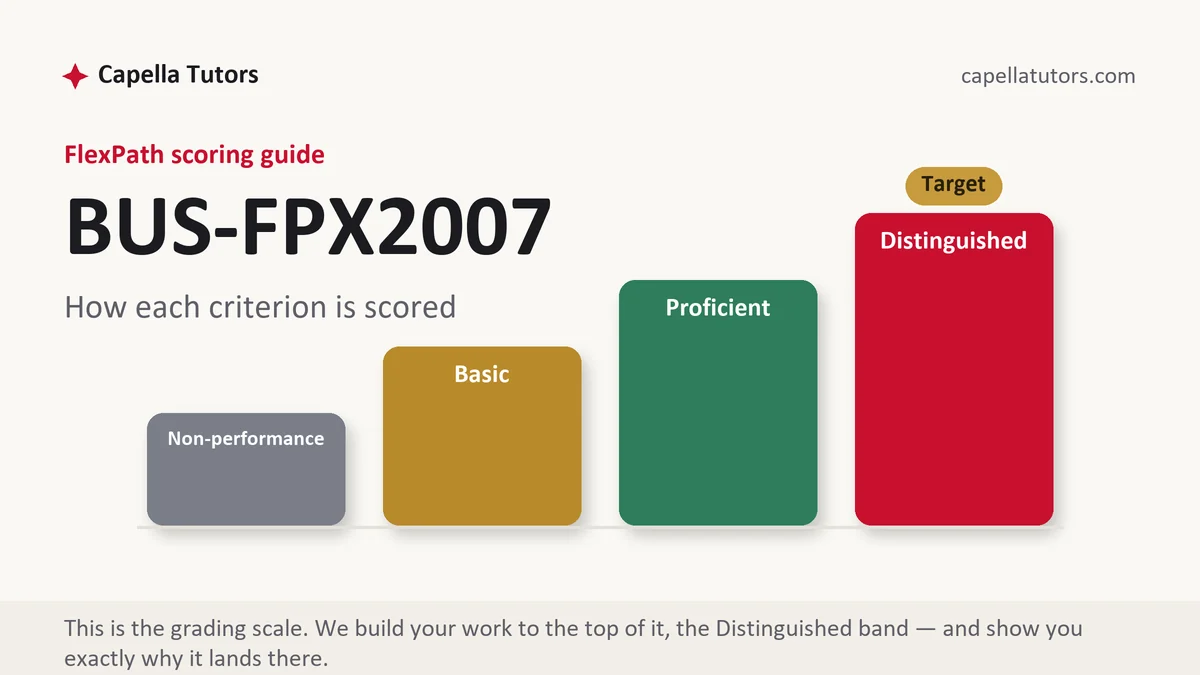
What BUS FPX 2007 actually grades
This is the survey requirement, and survey courses are graded on precision rather than on coverage. In current courserooms the assessments include "Business Environment Analysis" and "Business Ethics and Social Responsibility" among others, and your scoring guide decides the exact format of each. Listing marketing, finance, operations, human resources, and accounting is the Basic answer, and it is what most first drafts contain. Following one choice from the department that made it into the department that pays for it, and naming the trade-off that choice created, is the answer the top column was written for.
Ownership form is the other block of graded content, and the graded parts are narrower than the textbook chapter suggests. What faculty ask about is liability exposure, how the profit is taxed, how capital is raised, and how easily ownership transfers. Two people opening a food truck as a general partnership are each personally answerable for a contract the other signs, which is a live risk with a leased vehicle and a supplier account. The same pair forming a limited liability company narrow that exposure while the profit still passes through to their individual returns. Incorporating opens the door to outside investors and adds a separate entity to file for. None of that comparison requires legal training, and a criterion about business structures is asking for exactly those four dimensions applied to the situation in the prompt.
The third strand is the environment the business sits in. An outside scan of political, economic, social, technological, environmental, and legal conditions is the usual vehicle, and it gets filled in with adjectives more often than with facts. So does stakeholder analysis. A stakeholder list is not an analysis, and the criterion becomes answerable the moment you name two parties whose interests genuinely collide, say which one the decision favors, and say what the other one loses. Ethics and corporate responsibility rows work the same way. A statement that a firm should act responsibly cannot be marked; a statement that a supplier audit program would add a stated cost per unit and close a specific reputational exposure can be argued with, which is what makes it gradable.
How we help in this course
Samples for 2007 are built on companies with retrievable numbers. If your prompt leaves the choice to you, we pick a firm that files publicly so the revenue, the segments, and the risk disclosures come from documents rather than from a marketing page, and if your instructor assigned a scenario we work inside the scenario and label every figure we had to construct. The functional connection your criterion asks for is drawn explicitly, with the department that decided, the department that absorbed the consequence, and the number that links the two.
Service terms do not change from course to course. The draft is with you within 24 to 48 hours, written toward the Distinguished descriptors, and eight people have worked on it before it is sent: a research analyst assembles your scoring guide and the filings or industry data the prompt requires, a subject writer produces the draft, a scoring-guide reviewer grades it against each criterion exactly as your evaluator will, an APA and originality reviewer checks that citations and references match in both directions, and an editor makes the final pass. If it does not clear the guide we revise at no cost, and anything faculty return comes back into the same process free.
The assessments, one by one
Assessment 1
The opening deliverable in Introduction to Business Perspectives usually asks you to establish a business and judge the form it operates under, which means liability exposure, how the profit is taxed, how capital is raised, and how easily ownership transfers, applied to the situation in front of. Read the full Assessment 1 manual.
Assessment 2: Business Environment Analysis
Describe a chosen organization, its mission and vision and their key components, the organizational structure that suits it, and its business environment. Read the full Assessment 2 manual.
Assessment 3: Business Ethics and Social Responsibility
Examine two key functional areas of an organization, the ethical principles that guide their daily operations, and the role of critical thinking. Read the full Assessment 3 manual.
How to actually write BUS FPX 2007: where to begin
Take the scoring guide apart before you choose a company. Each criterion becomes a heading, the Distinguished sentence goes underneath it, and the count of criteria tells you the count of sections you owe. Introductory business prompts are almost always multi-part, and the parts are rarely equal, so read the verbs and give the heaviest verb the most space. Analyze, evaluate, and recommend all demand something past description, and a section that answers a describe verb well while ignoring an evaluate verb in the same row cannot reach the top column.
Learn to count the tasks inside a prompt sentence. Take a line reading: analyze how the company's supply chain decisions affect its market position and recommend one improvement. That is three obligations, not one. You owe an account of the supply chain decisions, an argument connecting them to market position, and a specific improvement with a cost and a consequence attached. Students answer the first, gesture at the second, and shrink the third into a line in the conclusion. Writing the three as three headings before drafting anything makes the omission impossible.
Then attach numbers to the connection. A regional bakery adding a wholesale line to supply four grocery stores is a good test case, because the decision refuses to stay inside one department. Operations needs a second production shift and refrigerated transport. Marketing is now selling to a buyer who negotiates on price and shelf placement rather than to a walk-in customer. Finance discovers that a wholesale invoice paid on 45-day terms ties up working capital the retail till released the same afternoon. Write those three consequences with a figure each, even an estimated figure you have labeled as one, and the criterion about interrelationships answers itself.
| Section | What goes in it | What Distinguished looks like |
|---|---|---|
| The business | What it sells, to whom, where, and at roughly what scale, with the source of those facts. | Scale and market established from filings or published data rather than from the company's own description. |
| Ownership and structure | The legal form and what it means for liability, taxation, capital, and transfer of ownership. | The form judged against this situation instead of defined, with the alternative weighed. |
| Functional areas | The departments the decision touches and the order in which it touches them. | A decision traced across at least two functions with the trade-off named. |
| Outside environment | The conditions beyond the firm that constrain it, each supported by evidence. | Conditions ranked by how much they actually bind, with the top one defended. |
| Stakeholders and ethics | Who is affected, what each party wants, and where those wants conflict. | A genuine conflict identified and resolved, with the cost to the losing party stated. |
| Recommendation and sources | The proposed action with a cost, an owner, a timeline, and current APA references. | A recommendation an owner could act on, supported by sources that are not the company's own marketing. |
Developing the analysis
There is a live argument underneath almost every prompt in this course, and naming it is the cheapest way to sound like somebody who has read something. One position holds that a company's obligation runs to its owners, that its job is to earn a return inside the rules, and that social spending directed by managers is spending other people's money on causes the owners did not choose. The version of that position associated with Friedman's 1970 essay in the New York Times Magazine is stated more carefully than its reputation suggests, and quoting it accurately is worth more than dismissing it. The competing position, set out in Freeman's 1984 work on strategic management, holds that a firm depends on a web of parties whose cooperation it needs, and that treating employees, suppliers, communities, and customers as constraints rather than as participants eventually costs the owners money too. Your recommendation assumes one of these whether you say so or not. Say so in a sentence, then add what a reader holding the other view would object to. The same discipline applies to competitive frameworks: the five forces model came from Porter's 1979 article, and a five forces table filled with unsupported adjectives is decoration rather than analysis.
Citations that survive faculty review
Sources in this course sort into three tiers, and the tier you draw from tells an evaluator how seriously to read the claim. Company filings are the primary tier, and for a public firm that means the annual report on Form 10-K retrieved from the Securities and Exchange Commission's EDGAR system, where revenue by segment, risk factors, and the discussion of competition all sit in a document the company is legally answerable for. Independent market and industry data occupy the second tier, meaning industry research reports available through the Capella library, trade association publications, and government economic data, and anything about market size or share belongs there. Peer-reviewed business scholarship is the third tier and carries the frameworks along with any general claim about how firms behave. A press release and an About page belong in none of those tiers as evidence, though they are perfectly good evidence of what the company wants believed, and writing that qualification into the sentence turns a weak source into a usable one. Run the reference list both ways in current APA before you submit.
The mistakes that land Basic instead of Distinguished
- A company profile where an analysis was requested. History, founders, and product lines are context, and context is not a criterion.
- Functions listed but never connected. The interrelationship is the graded object, and five paragraphs standing apart do not create one.
- A framework filled with adjectives. Strong, moderate, and high are ratings, and a rating with no fact behind it is unsupported.
- The company's own site as the only source. A firm describing itself cannot be the evidence that the description is accurate.
- A recommendation with no cost and no owner. An action nobody is assigned and nobody has priced is a wish.
BUS FPX 2007 questions students actually ask
The prompt says analyze, but everything I write comes out as description. What is the difference?
Description says what is there. Analysis says what follows from it, and the test is whether your sentence contains a because, a therefore, or a comparison that could turn out to be wrong. The company operates in three regions is description. The company earns most of its revenue in one region while carrying costs in three, which is why a downturn in that one region moves the whole result, is analysis, because a reader can check the revenue split and disagree with the inference. A practical fix: after every paragraph of facts, write one sentence beginning with the words which means, then delete those two words and keep the sentence. If you cannot write it, the paragraph is not yet answering an analyze verb.
Can I write about the company I work for?
Yes, on two conditions. The first is that you can support the claims that matter, either from public information or from things any employee could observe, because a criterion asking for evidence is not satisfied by knowledge you are unable to share. The second is confidentiality: keep internal financials, customer names, and anything covered by an agreement out of the paper, and add one line saying details have been generalized. Where you need a figure you cannot disclose, use an order of magnitude or a constructed estimate and label it clearly in the sentence. Papers written about a familiar employer usually score well on the application rows precisely because the operational detail is real.
How recent do my sources need to be?
Split the question by what each source is doing. Anything describing the current state of a company or a market should come from the last two or three years, and for financial figures the most recent annual filing is the expectation rather than a bonus. Anything establishing a framework can be as old as the framework, so citing a 1979 article for the five forces or a 1984 book for stakeholder theory is correct rather than dated, and citing a recent blog post that repeats them is the actual error. When a scoring guide sets a currency requirement it is almost always aimed at the first category, and reading it that way keeps you from discarding the sources that carry the most weight.
Business perspectives assessment due?
Send the prompt, the criteria, and the company you were given or the one you are considering. We will pick sources that can be checked. The premium sample you start with is on us.