Send the prompt, the scoring guide and the company you have been assigned, and a premium original sample returns inside 24 to 48 hours, written against the Distinguished descriptors, read again by somebody whose only job is checking criteria coverage, and revised free until the score is where you need it. On the transcript this is BUS FPX 4015, Strategic Planning and Implementation, worth 3 program points within the Management and Leadership specialization of the FlexPath BS in Business, a degree of at least 90 program points requiring a minimum of 27 at the 3000 level or above. In Capella's catalog the course code is written BUS-FPX4015.
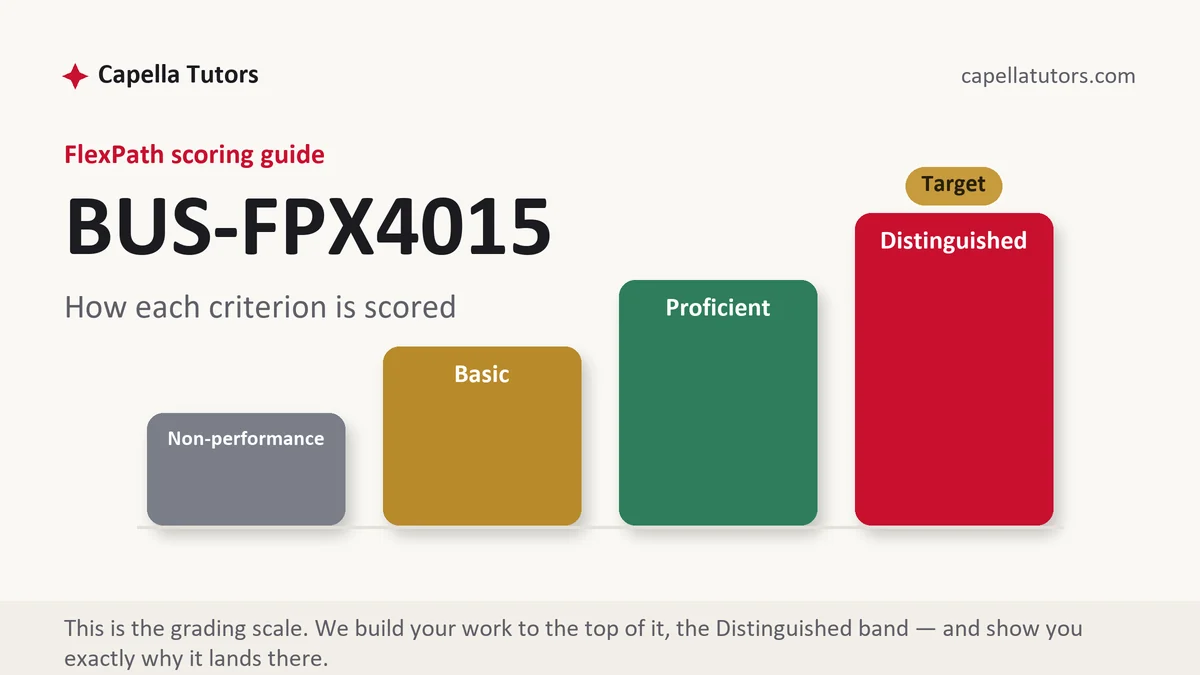
What BUS FPX 4015 actually grades
Strategy assessments are graded on whether your analysis produces a decision. Most submissions contain a great deal of analysis and no decision. A four-quadrant grid gets filled in, five industry forces get described, a page of internal strengths appears, and then the recommendation arrives from somewhere else entirely, unconnected to anything above it. The criteria are built to catch exactly that. Every analytical tool in this course exists to narrow the set of sensible options, and if your conclusion would have been the same without the analysis, the analysis did no work.
The external side wants structure rather than atmosphere. Examining an industry means asking how easy it is to enter, how much power buyers and suppliers hold, what substitutes exist and how the existing firms compete, and each of those questions has an answer with evidence behind it. Buyer power is high when there are few buyers, switching costs are low and the product is undifferentiated, and you can usually demonstrate all three from public information. The wider environment, political, economic, social, technological, legal and ecological, is graded on relevance rather than completeness. Two forces that genuinely bear on this firm, developed properly, beat twelve listed once each.
The internal side is where the useful distinction lives. Not every strength is an advantage. A resource matters strategically only if it is valuable to customers, rare among competitors, hard to copy, and actually exploited by the organization, and most items on a typical strengths list fail at least two of those tests. An experienced workforce is not rare. A well-known brand might be. A proprietary distribution agreement with three years to run is valuable and rare and copyable the moment it expires, which is itself a finding worth writing. Running your internal list through that filter is one of the highest-value hours you can spend on this course.
Then implementation, which is half the course title and about a fifth of the average submission. A strategy that names no owner, no sequence, no budget and no measure is a wish. The criteria expect actions with dates, a person or role attached to each, an estimate of what it costs, a statement of what has to happen before something else can start, and a set of indicators that will show progress before the results arrive. Add the risks and what you will do about them, since a plan that assumes everything proceeds as written is the one thing an experienced evaluator knows to be false.
How we help in this course
Strategy drafts from us reach a conclusion and then defend it. We build the industry and internal analysis so that each section ends with an implication rather than a summary, then choose between the realistic options and say why the runner-up lost. Send the company, any financial data you have been given and the constraints in the prompt, and the recommendation will fit that firm's size and resources rather than describing what a much larger competitor could afford to do. Where the deliverable includes an implementation plan, it arrives with owners, sequence, cost and measures already in it.
Commercial terms do not vary by subject. One premium original deliverable inside 24 to 48 hours, an eight-person pipeline behind it, a reviewer reading only for the scoring guide, and revision at no charge until the criteria are met. Anything your faculty evaluator writes back goes into the next pass without a further fee. An evaluator has two business days for each submitted attempt, so we sequence the work to leave room for a resubmission inside the same 12-week billing session.
The assessments, one by one
Assessment 1: SWOT Analysis
Assessment 1 sits at the analysis stage of Strategic Planning and Implementation: one company, the industry around it, the resources inside it, and a conclusion the later work can stand on. Read the full Assessment 1 manual.
Assessment 2: EFE and IFE Matrix
Build external and internal factor evaluation matrices for a company with weights and ratings, analyze the results. Read the full Assessment 2 manual.
Assessment 3: BCG Matrix
Classify a company's divisions or products as stars, question marks, cash cows or dogs by market share and growth, chart them, and recommend strategy for each. Read the full Assessment 3 manual.
How to actually write BUS FPX 4015: where to begin
Lay the scoring guide out as headings first, then choose your firm carefully if the choice is yours. A publicly traded company with a filed annual report gives you segment revenue, margins, stated strategy and a risk factors section written by people with legal exposure, which is the richest free source of strategic evidence available. A private firm or your own employer gives you access and detail but no verifiable figures, and you will have to construct or estimate. Either works. In current courserooms the assessments include "SWOT Analysis", "EFE and IFE Matrix" and "BCG Matrix" among others, and your scoring guide decides the exact format of each.
Make every tool end in a conclusion. The way to force this is a single sentence after each analytical section beginning with a phrase like what this means for the recommendation. If you have described high buyer power in a fragmented supplier market, the implication is that competing on price is a losing position and differentiation or a focused niche is the only defensible direction, so write that down. A four-quadrant table with nothing underneath it is the most common structural fault in strategy papers, and the fix takes one sentence per section.
Then decide, and show the option you rejected. A recommendation looks arbitrary until the reader sees what it was chosen over. Set out two or three realistic directions, judge them against the same criteria, and be explicit about the trade-offs: expanding a product line spreads fixed costs and dilutes focus, entering a new region raises revenue potential and adds regulatory and logistics cost, acquiring a competitor buys share and buys integration risk. Attach numbers where you can, even estimated ones with the basis stated, since a strategy paper with no financial dimension at this level reads as incomplete. Then commit to one and say what makes it the right fit for this firm's resources.
Build the implementation as a plan somebody could work from. Phases with dates, an owner by role for each action, what it costs, what depends on what, and the point at which you would stop and reconsider. Include the measures, and pick ones that move early: a strategy whose only indicator is annual revenue gives you no information for a year. Leading indicators such as pipeline conversion, unit cost, retention or time to market tell you within a quarter whether the plan is working. Finish with the two or three things most likely to go wrong and the response to each, since the criteria in this course generally reward a risk section that names something real rather than listing competition and economic conditions.
| Section | What goes in it | What Distinguished looks like |
|---|---|---|
| Company and position | What the firm sells, to whom, at what scale, and how it currently makes money. | Financial or operational figures that fix the firm's actual size and constraints rather than describing it in general terms. |
| External analysis | Industry structure, competitive rivalry, and the wider forces that genuinely bear on this business. | Each force evidenced and each section closing with a stated implication for the decision. |
| Internal analysis | Resources and capabilities, tested for value, rarity, difficulty of imitation and whether they are used. | A short list of genuine advantages, with the popular strengths that fail the test explicitly discarded. |
| Options considered | Two or three realistic directions, compared on the same criteria, with trade-offs stated. | A rejected option explained well enough that the reader sees why it lost. |
| Recommendation | The chosen direction, its fit with the firm's resources, and the financial shape of it. | Numbers attached, estimated openly where necessary, with the basis of each estimate declared. |
| Implementation and references | Phases, dates, owners by role, dependencies, cost, leading measures, risks, and APA both ways. | A sequence somebody could act on, with early indicators and a stated point of reconsideration. |
Developing the analysis
Strategy frameworks are analytical scaffolding rather than evidence, and the strongest undergraduate papers make that distinction visible. The five forces model describes an industry at a moment and says almost nothing about how fast that structure is changing, which matters when the threat to a firm comes from a business that does not yet appear in its industry classification. The resource-based view explains persistent advantage well and has been criticised for being difficult to test, since the properties that make a resource valuable are often identified after the firm has already succeeded with it. A four-quadrant strengths and weaknesses grid is the weakest of the standard tools, because it imposes no discipline at all and will accept any assertion typed into it, which is precisely why so many submissions use it and so few gain marks from it. Use these tools and say what they miss. The other honest caution concerns the source material: annual reports are written to persuade investors, press releases describe intentions rather than results, and a firm's own account of its strategy is a claim rather than a fact. Where you can, test a stated strategy against something observable, such as where the capital expenditure actually went or which segment the revenue actually grew in, and note the gap when the two disagree. That single move, comparing what a company says with what its numbers show, does more for a strategy paper than another framework would.
Citations that survive faculty review
For a public company the annual report and the quarterly filings on SEC EDGAR are the primary sources and belong in the reference list as such, since they carry segment results, risk factors and the management discussion that explains performance in the firm's own words. Industry structure needs something wider, and the Capella library gives you access to industry research databases along with Business Source Complete and ABI/INFORM for peer-reviewed strategic management research. Government statistics anchor market claims that would otherwise be assertions, with the Census Bureau useful for industry size and concentration, the Bureau of Labor Statistics for employment and wage trends in a sector, and the Bureau of Economic Analysis for the wider economic picture. Where regulation shapes the strategy, cite the agency rather than a news article about it. Frameworks are attributed to their authors, so the competitive forces work, the generic strategies argument and the resource-based view each go to their original publication. Business press coverage from established outlets can establish that an event happened and should not be used as evidence that a strategy worked. Company blogs, investor relations marketing pages and consultancy trend reports are advertising. Run current APA in both directions, and give every figure in the paper a visible origin.
The mistakes that land Basic instead of Distinguished
- Analysis that never reaches an implication. A completed framework with no sentence saying what it means for the decision has produced nothing the recommendation can stand on.
- A recommendation the firm cannot afford. Proposing a national expansion for a business with eleven employees shows the analysis never registered the firm's actual scale.
- Only one option presented. Without a rejected alternative the reader cannot tell whether a choice was made or a preference was recorded.
- An implementation section made of intentions. Actions with no owner, no date and no cost are not a plan and the criterion says so plainly.
- Generic risks listed. Competition and economic uncertainty apply to every firm on earth, and naming them tells the evaluator you did not look for the real ones.
BUS FPX 4015 questions students actually ask
Which company should I choose when the prompt lets me pick?
Choose one whose numbers are public and whose business is simple enough to describe in a paragraph. A single-segment public company is ideal, because the filings give you revenue, margin, stated strategy and a candid risk section without the complication of allocating results across five unrelated divisions. Avoid the very largest conglomerates, since any analysis of them turns into a survey, and avoid firms so small that no verifiable information exists. Your own employer is a legitimate choice if you can write about it without disclosing anything confidential, and in that case say early in the paper which figures are estimated. The worst choice is a company you admire, because affection produces a paper that concludes the firm should carry on as it is.
How specific do the financial estimates have to be?
Specific enough to be checked and honest enough to be labelled. Nobody expects an undergraduate strategy paper to contain an audited forecast, but a recommendation with no cost attached is not a business proposal. If you are proposing three new locations, put a figure on the fit-out, a figure on the staffing, a figure on the expected revenue per site and a sentence saying where each number came from, whether that is a comparable in the filings, a published industry average or an assumption you are declaring. Then test it: say what happens to the case if revenue per site comes in twenty percent below your estimate. A reader who can see your arithmetic and your assumptions will accept an estimate. A number with no origin gets marked down even if it happens to be right.
What belongs in implementation rather than in the recommendation?
The recommendation says what the firm should do and why it is the right fit. Implementation says how it happens, in what order, with whom, and at what pace. Keep the justification out of the plan and keep the mechanics out of the recommendation, because mixing them makes both harder to grade. A practical test is that the implementation section should read as though the decision has already been taken and nobody needs persuading, so it contains phases, dates, owners, dependencies, budget lines, communication points and measures. If a sentence in the plan is arguing for the strategy, it belongs in the previous section. If a sentence in the recommendation is describing who does what in week three, move it down.
Strategy paper or implementation plan due?
Send the prompt, the criteria and your assigned company. We build the analysis so it reaches a decision, then plan the decision. First premium sample free.