Send the prompt, the scoring guide and any pricing the scenario gives you, and a premium original sample returns inside 24 to 48 hours with the buying decision computed rather than asserted, a contract type defended as a deliberate allocation of risk, an evaluation matrix built before the bids arrive, and a closeout checklist that actually closes something, with free revisions until the criteria clear. Course identity: PM FPX 4070, Procurement Management in Project Management, worth 3 program points in the Project Management specialization of the FlexPath BS in Business, a degree of at least 90 program points requiring a minimum of 27 at the 3000 level or above. The PM-FPX sequence is shared with Capella's information technology degrees, so this code turns up on more than one program plan. In Capella's catalog the course code is written PM-FPX4070.
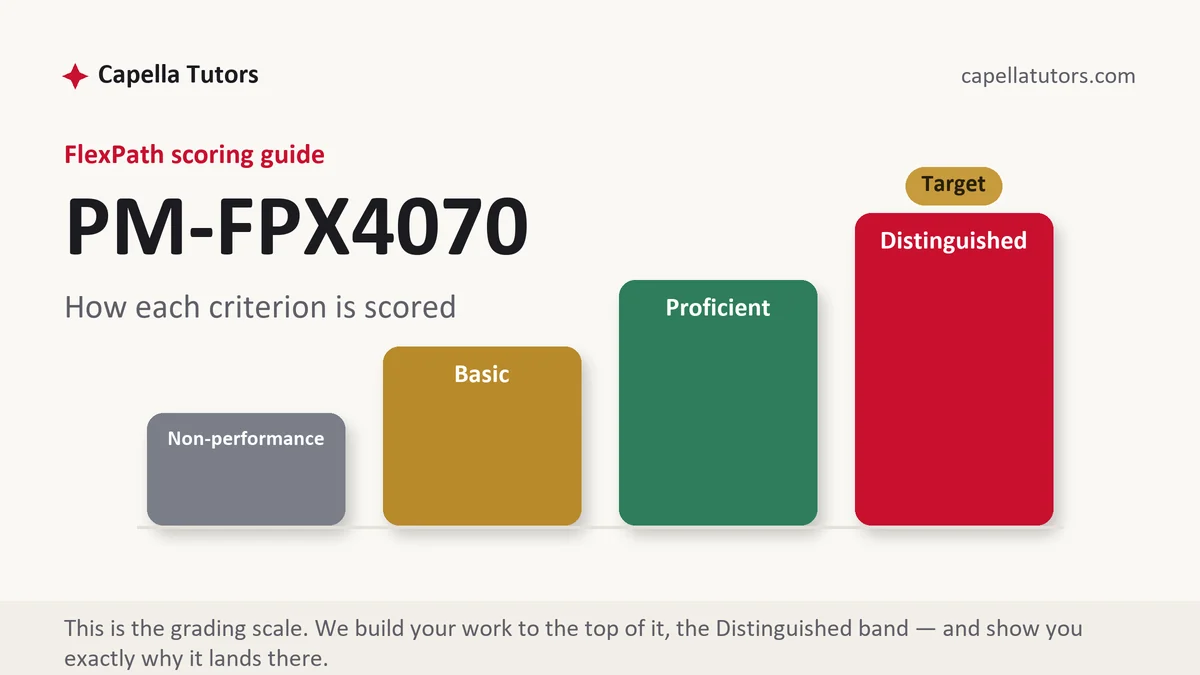
What PM FPX 4070 actually grades
The first thing graded is whether the decision to buy was made or assumed. Most submissions open with a supplier already chosen, which skips the criterion. A make or buy analysis compares the total cost of producing something internally against the total cost of acquiring it, over the volume the project actually needs, and it then adds the factors price cannot express: who owns the result, who carries the warranty, whether the capability is worth keeping after the project ends, and how long the supplier needs before delivery starts. Procurement lead time is part of the schedule, and a plan that shows a component arriving before a realistic solicitation and award cycle could finish has failed a criterion in a place nobody was watching.
Then contract type, which this course treats as the central intellectual move rather than a vocabulary list. Every contract form is a decision about who carries the risk of cost growth. A firm fixed price puts it entirely on the supplier and prices that transfer into the quote, which works when the specification is precise and punishes everybody when it is not. Cost reimbursable forms put it on the buyer and are correct when the work cannot be specified in advance, such as research or a discovery phase, at the price of needing real oversight. Incentive and time and materials arrangements sit between, and the criteria want the reason for your choice stated in terms of specification maturity, not in terms of preference.
Solicitation and selection are graded on process discipline. Requirements become a statement of work precise enough that two suppliers would bid on the same thing, the request goes out in the right instrument for what you are buying, and the evaluation criteria with their weights are written down before any bid is opened. Selecting on price alone is not a finding, it is the absence of a method, and evaluators mark the absence.
Administration and closeout carry the last block of marks and are the most frequently skipped. Acceptance criteria, inspection rights, the remedy when something fails, the change order route, invoice approval and the record of what was actually delivered are the mechanics of getting what you paid for. Contract closure is a formal act with its own checklist, and a project that ends without it leaves warranties unstarted, retention unreleased and claims unresolved.
How we help in this course
Send the scenario, the quantities and any quoted prices, and the analysis comes back computed: a breakeven volume with the arithmetic in view, a recommended contract type with the risk allocation spelled out, a weighted evaluation matrix scored across the bidders in the prompt, and the administration and closure sections most drafts leave as headings. Where the prompt gives no numbers, we construct a defensible set and label them, because an evaluator will accept a declared estimate and will not accept a figure that appeared from nowhere.
Nothing about the commercial side changes for a procurement course. One premium original deliverable inside 24 to 48 hours, eight people from research through final proofread, and one reviewer who does nothing except recompute the figures and check every criterion has a home in the document. Revision is free and uncapped, faculty feedback is folded in at no charge, and because an evaluator has two business days on an attempt, we schedule so a resubmission still fits within the same flat 12-week billing session.
The assessments, one by one
Assessment 1
The first thing graded is whether the decision to buy was made or assumed, and most drafts open with a supplier already chosen. Read the full Assessment 1 manual.
Assessment 2
This course treats the contract type as the central intellectual move rather than a vocabulary list, because every contract form is a decision about who carries the risk of cost growth. Read the full Assessment 2 manual.
Assessment 3
Administration and closeout carry the last block of marks in this course and are the sections most frequently left as headings. Read the full Assessment 3 manual.
How to actually write PM FPX 4070: where to begin
Lay the scoring guide out as headings, then decide what you are actually buying, because the answer changes every later section. The assessments in this course usually ask you to plan and manage the acquisition of goods or services for a project, and your scoring guide decides whether that arrives as a make or buy analysis, a procurement management plan, a statement of work, a source selection exercise, or an administration and closeout plan for a contract already in place.
Start with the breakeven, because most drafts assert the buying decision and lose the criterion on the first page. Say producing the component internally costs $18,000 in tooling and setup plus $46 per unit in labor and materials, while a supplier quotes $71 per unit with no setup charge. The lines cross at 720 units, since $18,000 divided by the $25 per unit difference is 720. A forecast of 500 units says buy, a forecast of 1,200 says build, and a forecast of 700 says the decision is being made on something other than price, which is the moment to bring in the factors that do not fit the spreadsheet. Write them explicitly: who holds the intellectual property, who is liable if the component fails in the field, whether the organization wants this capability in eighteen months, and what the supplier's twelve week lead time does to your schedule.
Then choose the contract type and prove you understand it by working the numbers. Under a fixed price incentive arrangement with a target cost of $400,000, a target fee of $40,000, a ceiling price of $500,000 and an eighty twenty split of overruns, a supplier who spends $430,000 has overrun by $30,000, the buyer absorbs $24,000 of that and the supplier gives up $6,000 of fee, so the fee falls to $34,000 and the price becomes $464,000. Cost growth stops being shared at $475,000 of supplier cost, because beyond that the buyer is paying the ceiling of $500,000 whatever happens and the supplier carries every additional dollar alone. A paper that shows that arithmetic has demonstrated the concept the criterion is about, which is that a contract is a machine for allocating risk, and it has done so in two sentences that no summary of contract types can match.
Then build the evaluation before the bids arrive, since criteria written after the fact are not criteria. Publish the weights: technical approach 40, price 25, past performance 20, and schedule 15. Score price with a formula rather than an opinion, so the lowest compliant bid takes the full 25 and the others scale against it. Then run the matrix. Bidder A is cheapest and takes 25 on price but scores 22 on technical, 10 on past performance and 9 on schedule, totalling 66. Bidder B scores 34, 15, 18 and 12 for a total of 79. Bidder C lands at 77. The recommendation is now defensible in front of anybody, including the finance manager who wanted the cheapest quote, because the paper can say what the extra money buys. Add the negotiation objectives you would take into the award conversation, which is where a good submission mentions payment terms, warranty length and the remedy for late delivery rather than only the price.
Then write the part that separates a complete submission from a partial one, which is administration and closure. Acceptance criteria belong in the contract, with inspection rights, the remedy when a deliverable fails, a holdback or retention if the risk warrants it, a change order procedure with a named approver, and an invoice approval chain that ties payment to delivered value rather than to elapsed time. That tie is worth doing arithmetically: a supplier who has invoiced $92,000 of a $220,000 contract while your acceptance log shows $71,500 of deliverables accepted is returning about 78 cents of accepted work for each dollar billed, and that ratio, not the date on the invoice, is what should gate the next payment. Then close properly. Final acceptance against the specification, every change order priced and signed, retention released, claims settled or formally recorded, the warranty start date written down, a supplier performance evaluation left behind for the next buyer, and the contract file archived where an auditor could find it. Say who does each of those and when, and the closeout criterion is answered rather than gestured at.
| Section | What goes in it | What Distinguished looks like |
|---|---|---|
| Procurement scope and make-or-buy | What the project needs from outside, the volumes, and the comparison of building against buying. | A breakeven volume computed, with the qualitative factors that override price named separately. |
| Requirements and specification | The statement of work, the acceptance criteria, the standards and the delivery expectations. | Requirements precise enough that two suppliers would bid on the same scope with the same understanding. |
| Contract strategy | The contract type chosen, the reason, the payment structure, and where risk sits under it. | The choice argued from specification maturity, with the sharing arithmetic shown for any incentive form. |
| Solicitation and source selection | The instrument used, the bidders approached, the weighted criteria and the scored comparison. | Weights fixed before bids are opened and a recommendation that explains what the extra money buys. |
| Administration and quality | Inspection, acceptance, change orders, claims, payment approval and performance monitoring. | Payment tied to accepted deliverables, with a remedy written for the failure most likely to occur. |
| Closeout and references | Final acceptance, retention release, claim resolution, warranty start, records, current APA both ways. | A closure checklist with owners and dates, plus a supplier evaluation written for the next project. |
Developing the analysis
Procurement is the course where an undergraduate paper most easily overreaches, so mark the boundary between analysis and legal advice. Contract law differs by jurisdiction, standard terms are drafted by counsel for a reason, and the right sentence in your recommendation is that the final instrument goes to legal review before signature. Within that boundary there is plenty to argue. In the United States the sale of goods is generally governed by Article 2 of the Uniform Commercial Code while services fall under common law, which is why a contract mixing hardware and installation needs its obligations separated rather than blended. The economics are worth citing properly too: the transaction cost tradition explains the make or buy decision better than a breakeven line does, because it asks how specialized the asset is, how uncertain the requirement is and how hard performance is to measure, and it predicts that highly specific, hard to monitor work is expensive to buy no matter what the unit price says. Cost reimbursable contracting has a known agency problem, since the party spending the money is not the party whose money it is, and the standard responses of audit rights, incentive fees and reporting obligations belong in your administration section rather than in a footnote. Be skeptical of savings claims in the trade press, where a reported percentage saved is usually measured against a first quoted price rather than against a market rate, and the source is often the supplier of the procurement platform being described.
Citations that survive faculty review
Use five kinds of source and keep them in their lanes. Professional practice standards and procurement practice guides supply the process and terminology, cited with publisher and edition. When the scenario is public sector, the Federal Acquisition Regulation is the authority for competition requirements, contract types and the treatment of unsuccessful bidders, and it should be cited by part and section rather than through a summary article. Peer-reviewed supply chain, operations and project management journals through the Capella library carry the empirical claims, with Business Source Complete and ABI/INFORM the practical entry points. For the legal framing, cite the Uniform Commercial Code article itself rather than a blog explaining it, and attribute the transaction cost argument to its original author instead of to the textbook chapter that condenses it. Supplier proposals, your organization's contract templates and its purchasing policy are all citable evidence when named and dated with confidential terms removed. Procurement software vendors, sourcing consultancies publishing benchmark savings and certification study sites are not sources. Run current APA in both directions, and give every price in the paper a visible origin, whether that is a quotation in the scenario, a published rate, or an assumption you declare.
The mistakes that land Basic instead of Distinguished
- A buy decision with no breakeven. Asserting that outsourcing is cheaper without the volume arithmetic skips the first criterion in the assessment.
- Cost reimbursable chosen for a defined scope. Paying a supplier's costs for work that could have been specified hands over money and control for no gain.
- Evaluation criteria written after the bids. Weights chosen once the prices are known are a justification for a preference rather than a selection method.
- Acceptance left to the deliverable description. Without inspection rights and a stated remedy, disputing a poor deliverable becomes a conversation instead of a contractual right.
- A project that ends without closing the contract. Unreleased retention, an unstarted warranty and an open claim are real money left on the table, and the criterion asks for the checklist.
PM FPX 4070 questions students actually ask
Which contract type should I recommend when the prompt does not say?
Let the maturity of the specification choose it, and say that is what you did. If you can describe the deliverable precisely enough that two suppliers would price the same thing, a firm fixed price is right, and the supplier's risk premium is the cost of the certainty you are buying. If the work is genuinely exploratory, a cost reimbursable form with a fixed fee is honest, and it obliges you to fund oversight, audit rights and progress reporting because you are now carrying the cost risk. When the scope is broadly known but the effort is not, an incentive form splits the difference and makes the sharing explicit, which is why the arithmetic behind the share ratio and the ceiling belongs in your paper. Time and materials suits small, urgent or hard to scope work and should always carry a not to exceed value, otherwise it is an open account. State the reason in one sentence tied to the specification, and the criterion is satisfied.
How do I score bids when the cheapest is not the best?
With weights you committed to before you looked. Decide what matters and by how much, publish it, then score each proposal on each dimension and let the total speak. The discipline is in scoring price mechanically rather than emotionally, so the lowest compliant offer takes the full allocation and the rest scale down proportionally, which prevents the common trick of scoring price by impression. Then say what the difference costs in plain terms: if the recommended bidder is $34,000 more expensive and scores thirteen points higher on technical approach and past performance, translate those points into consequences, such as a shorter integration period or a supplier who has delivered this exact work twice before. A recommendation that names the premium and what it buys survives a finance review. One that says the higher bidder offers better quality does not.
What does closing a contract actually involve?
More than the last invoice. Verify that every deliverable in the statement of work has been received and formally accepted, with the acceptance recorded rather than assumed, and that every change order has been priced, approved and incorporated so the final contract value is a number both parties recognize. Settle or formally document any outstanding claim, release retention if you held it, and confirm the date the warranty period starts, since a warranty that quietly began at delivery rather than at acceptance can expire before anybody notices. Write a short performance evaluation of the supplier for whoever buys next, covering quality, responsiveness and whether the price held. Then archive the file, meaning the contract, the correspondence that changed anything, the acceptance records and the payment history, because a procurement that cannot be reconstructed later is a problem for audit and for the next negotiation with the same firm.
Make-or-buy analysis or contract plan due?
Send the scenario, the quantities and any quotes. We compute the breakeven, defend the contract type, score the bids and write the closeout. First premium sample free.