Send the prompt, the scoring guide and the scenario, and a premium original sample returns inside 24 to 48 hours with a register whose entries carry a cause, a probability, a dollar impact, a response, a trigger and one owner, plus the reserve arithmetic that backs the number, and revisions are free until every criterion is satisfied. The transcript entry is PM FPX 4060, Risk Management in Project Management, 3 program points within the Project Management specialization of the FlexPath BS in Business, a degree of at least 90 program points that requires a minimum of 27 at the 3000 level or above. The PM-FPX courses also sit inside Capella's information technology programs, which is why students from two different degrees end up in the same code. In Capella's catalog the course code is written PM-FPX4060.
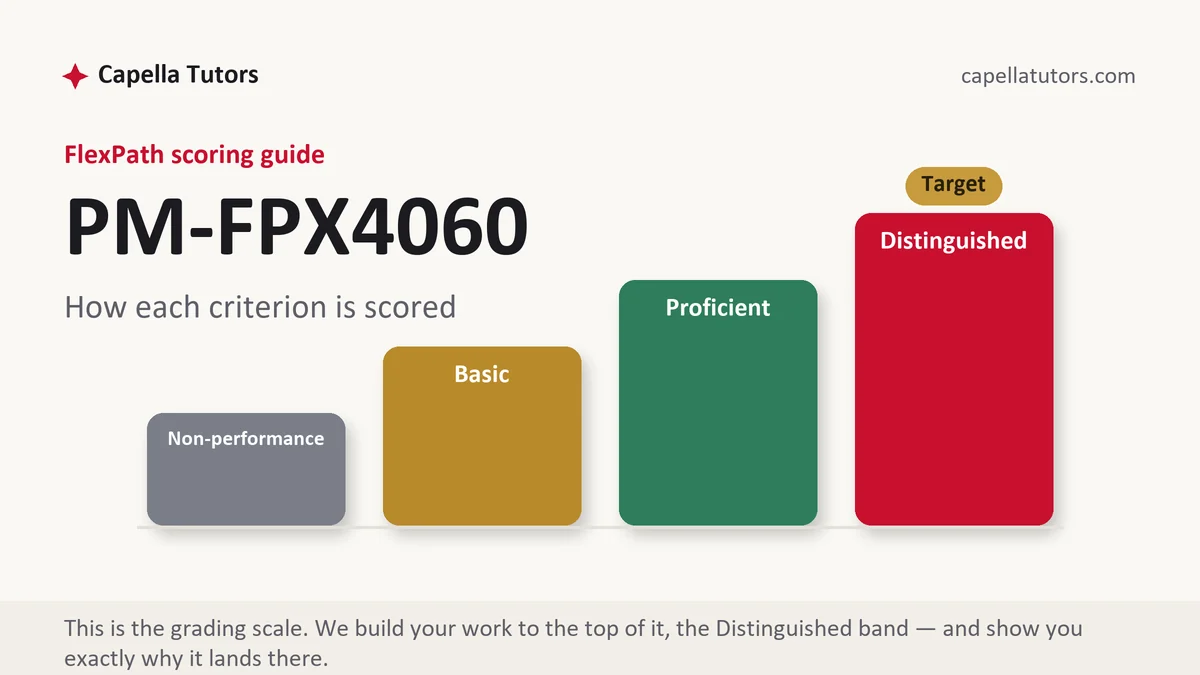
What PM FPX 4060 actually grades
The first criterion is usually the distinction most drafts blur. A risk is an uncertain event that has not happened, an issue is one that has, and the two need different documents and different management. A register listing that the server migration is behind schedule is not a risk register, it is a status report, and evaluators mark it as such. Alongside that sits the framing question of how much risk the organization will accept, since the same event is worth mitigating in a hospital and worth accepting in a marketing pilot, and a paper that never states the tolerance it is working to has no basis for any of its response decisions.
Then the identification and the writing. Risks are graded on whether each entry contains a cause, an uncertain event and a consequence, which is the structure that makes the entry actionable. Vendor delay is a label. Because the vendor's only integration engineer is committed to another client until the fifteenth of March, the interface build may start three weeks late, which would push user testing into the branch year end freeze, is an entry somebody can own, price and monitor. The identification methods matter too, and the criteria expect more than a brainstorm: assumption analysis, checking the schedule for single points of failure, reviewing what went wrong on comparable projects, and asking the people doing the work rather than the people planning it.
Analysis is graded in two layers. The qualitative layer needs scales defined before the matrix is drawn, so that high probability means a stated range rather than a feeling, and impact is defined separately for cost, schedule, quality and safety because a risk can be trivial for one and severe for another. The quantitative layer needs arithmetic: expected value on the entries that can be priced, a reserve built from those figures rather than from a round percentage, and a clear separation between contingency for the risks you have identified and management reserve for the ones you have not.
Last is what happens after the register is written. Responses are graded on type and on economics, triggers on whether they name an observable event, owners on whether they are one person rather than a department, and monitoring on whether the register has a review cadence and a route to the sponsor. Closure counts here too: risks that expired, risks that occurred and what they cost, and reserve returned unused.
How we help in this course
Give us the scenario and any figures the prompt supplies, and the register comes back with entries written in cause and effect form, scales defined in the document, expected values computed, and a reserve total you can defend in a sentence. Every response is tested against its own cost, so the paper says why some risks are being accepted deliberately, which is the move that most reliably separates a top submission from a competent one. If the assessment wants a matrix, a decision tree or a monitoring plan, those come built rather than described, with the arithmetic visible so a reader can check it.
The commercial side is the same as everywhere else on the site. One premium original deliverable inside 24 to 48 hours, an eight-person pipeline, and a dedicated reviewer who recomputes every number in the document before it goes out, because a register whose expected values do not add to the reserve total loses more than one criterion. Revisions are unlimited and free, faculty feedback is incorporated without a new charge, and delivery is timed against the two business days an evaluator has so a resubmission still lands inside the same 12-week billing session.
The assessments, one by one
Assessment 1: Project Proposal
Propose a project with its business objectives, evaluation criteria, preliminary requirements, cost estimate and schedule, risks, assumptions and approvals. Read the full Assessment 1 manual.
Assessment 2
Analysis is graded in two layers here and the second one is where most submissions retreat into adjectives. Read the full Assessment 2 manual.
Assessment 3
A register written once for a grade is the failure this part of the course exists to prevent. Read the full Assessment 3 manual.
How to actually write PM FPX 4060: where to begin
Build the register template before you write any prose, because in this course the table is the deliverable and the narrative explains it. The assessments in this course usually ask you to identify, analyze and plan responses to the risks in a project you choose or one described in a scenario, and your scoring guide decides whether that arrives as a full risk management plan, a register with analysis, a quantitative exercise, or a briefing to a sponsor about a single serious exposure.
Write each entry in three parts and refuse to accept a label. Cause is something true today, event is the uncertain thing, consequence is what it does to cost, schedule, quality or reputation. That structure does work for you immediately, because the cause tells you where a preventive response would go, the event tells you what a trigger should watch for, and the consequence tells you what number to put in the impact column. Test each entry by asking whether two readers would estimate the same probability from what you wrote, and if they would not, the entry is still a label.
Then quantify, because this is where the marks are and where most submissions retreat into adjectives. Give the entries you can price a probability and a dollar impact and add them. A 30 percent chance of a $48,000 rework bill is an expected value of $14,400. A 15 percent chance of a $120,000 contractual penalty is $18,000. A 55 percent chance of $9,000 in expedited shipping is $4,950. One opportunity sits on the other side, a 25 percent chance of saving $30,000 by reusing a module another team already built, which is worth $7,500 against you. Net exposure is $29,850, and that figure, not a flat ten percent of the budget, is what a defensible contingency reserve looks like. Say in the paper that the number is only as good as the estimates behind it, and name the two entries whose impact you are least sure of.
Then test every response against its own price, because a criterion in this course is effectively asking whether you noticed that some risks are cheaper to keep. Mitigating that first risk costs $12,000 and takes the probability from 30 percent to 10 percent, which removes 0.2 of a $48,000 impact, or $9,600 of expected loss, for a certain spend of $12,000. Accept it instead, fund it from the reserve, write a trigger that watches for the rework signal, and say plainly why you declined to mitigate. Transfer works differently, since insurance or a fixed price clause moves the impact to somebody else for a premium, and the two tests are whether the premium sits below your expected loss and whether the counterparty could actually absorb the event. Avoidance changes the plan itself and usually costs scope or time, which needs stating rather than assuming. Every response also creates residual exposure and sometimes a new secondary risk, and writing those down is what a top column looks like in practice.
Then govern what you built, because a register written once for a grade is the failure this course is designed to prevent. Set the review cadence and say who attends. Report reserve consumption against progress in the same table as the cost figures, since a project that has spent 70 percent of a $29,850 contingency while 35 percent of the work is complete is not unlucky, it is under-reserved, and that comparison belongs in front of the sponsor in month two rather than month six. Name the escalation threshold in advance. Then close the register formally at the end: which risks expired without occurring, which occurred and what they actually cost against what you estimated, how much reserve went back, and the two entries you would carry straight into the next project of this type. That last comparison, estimated impact against actual, is the cheapest credibility a project manager can buy.
| Section | What goes in it | What Distinguished looks like |
|---|---|---|
| Context and tolerance | The project, its objectives, and how much variation the organization is willing to accept on each of them. | Tolerance stated per objective, so every later response decision has something to be measured against. |
| Identification | The methods used and the resulting entries, each with a cause, an uncertain event and a consequence. | Entries a second reader could price, drawn from assumptions, dependencies and comparable past projects. |
| Qualitative analysis | Probability and impact scales defined numerically, the matrix, and the resulting priority order. | Scales defined before the matrix is applied, with impact defined separately for cost, schedule and quality. |
| Quantitative analysis | Expected values, the reserve calculation, and any decision tree or range analysis the prompt requires. | Arithmetic shown, a reserve derived from it, and the weakest estimates named openly. |
| Responses, triggers and owners | Response type for each priority entry, its cost, the trigger, the owner, and the residual exposure. | Responses tested against their own cost, with at least one deliberate acceptance explained. |
| Monitoring, closure and references | Review cadence, reporting, escalation thresholds, register closure, and current APA both ways. | Reserve drawdown reported against progress, and closure that compares estimated impact with actual. |
Developing the analysis
Say what the standard techniques can and cannot support, because risk is the area where confident presentation hides weak method. A probability and impact matrix uses ordinal categories, and multiplying a category numbered three by a category numbered four produces a ranking that only means something if the scales were defined in advance and applied consistently; published critiques of risk matrices show they can rank a smaller exposure above a larger one when the category boundaries are drawn carelessly, so define your boundaries in the document and the criticism no longer applies to you. Expected value is the right tool for a portfolio of small risks and the wrong tool for a single event that would end the project, since an expected loss of $18,000 is meaningless comfort if the actual event is a $120,000 penalty the organization cannot absorb, which is why tolerance belongs beside the arithmetic. Estimates themselves are the weakest link, and the research on optimism in planning is worth citing rather than paraphrasing: people anchor on an initial figure, adjust too little, and reliably underestimate duration and cost for work they have not done before, which is the argument for forecasting from a class of comparable completed projects instead of from the plan in front of you. Simulation output deserves the same caution, since a distribution built from invented ranges and independent assumptions produces a confident curve about nothing when the real risks are correlated. Finish the section by naming the assumption in your own analysis most likely to be wrong.
Citations that survive faculty review
Four source types carry this paper. The professional practice standards and risk practice guides define the process and the vocabulary, cited with publisher and edition. Peer-reviewed research through the Capella library supports the analytical claims, with Business Source Complete and ABI/INFORM for project management and operations research and the decision science literature for anything about estimation bias or elicitation. Sector data gives your impacts a defensible magnitude, and it should come from the body that collects it: federal statistical agencies for wage and price movement, regulator or agency publications for penalty structures, and published incident or breach cost studies when your scenario is technology, quoted with their method and sample rather than as a single headline figure. Frameworks and findings get primary attribution, so the work on judgment under uncertainty and the reference class approach to forecasting go to their original authors. Your own organization's documents are legitimate evidence when named and dated, including a real register or a change control policy with confidential detail removed. Vendor reports on the state of risk in an industry are marketing with a chart on the front, and certification exam sites are not literature. Run current APA in both directions and make sure every number in the register can be traced to a citation, an internal document, or a stated assumption.
The mistakes that land Basic instead of Distinguished
- Risks written as one-word labels. Weather, staffing or vendor is a category rather than an entry, and nobody can own, price or monitor a category.
- A matrix applied to scales nobody defined. High and medium mean whatever the writer felt that day, so the priority order cannot be defended when it is questioned.
- A reserve set as a round percentage. Ten percent of the budget is a habit, not an analysis, and the quantitative criterion is asking for the arithmetic underneath.
- Mitigation attached to everything. Spending $12,000 to remove $9,600 of expected loss is a loss, and a paper that never accepts a risk has not weighed one.
- Entries with no trigger and no owner. A response with nobody watching for the signal and nobody accountable for firing it will not happen, and the register knows it.
PM FPX 4060 questions students actually ask
What is the difference between a risk and an issue?
Tense, and the paperwork that follows from it. A risk has not happened and is described with a probability, so it lives in the register with a response waiting behind a trigger. An issue has happened, its probability is now one hundred percent, and it belongs in an issue log with an owner, an action and a resolution date. Mixing them is the most common structural fault in a submitted register, and it costs marks in two places, because the risk criterion sees entries that are not risks and the monitoring criterion sees no evidence that anything is being tracked forward. The useful test is to read the entry aloud with the word may in it. If the sentence still makes sense, it is a risk. If it sounds absurd because the thing already occurred, move it to the issue log and, if it matters, add the risk that the issue is not resolved in time.
How do I put numbers on a risk when I have no data?
Estimate openly and show the basis, because an honest estimate with a stated origin outscores a precise figure from nowhere. Impact is usually easier than probability, since a three week delay can be costed from the team's weekly burn, a penalty from the contract clause, and a rework from the hours the work took the first time. Probability can come from three places: how often the thing happened on comparable past projects, what the people who do this work say when asked separately rather than in a group, and the structure of the plan itself, since a task with a single qualified person on it and no float is more likely to slip than one with two people and a fortnight of slack. Write the reasoning in one line next to the number. Then say which figures would change your recommendation if they moved, which is the sensitivity move faculty reward and most students skip.
Does every risk need a mitigation plan?
No, and saying so deliberately is one of the strongest sentences a paper in this course can contain. There are four positions available for a threat: avoid it by changing the plan, reduce it by spending something, hand the impact to somebody who can carry it, or accept it and hold a reserve. Acceptance is a decision rather than a failure to decide, and it is the right answer whenever the cost of the response is greater than the expected loss it removes, or when the risk is small enough that managing it consumes more attention than it deserves. What acceptance still requires is documentation: the entry stays in the register, the reserve carries the money, a trigger says what you are watching for, and an owner is named so somebody notices when the trigger fires. Passive acceptance, meaning the risk is not written down at all, is the version that costs marks.
Risk register or quantitative analysis due?
Upload the scenario with whatever figures it gives you, and the entries come back in cause and effect form, the exposure computed, and the reserve sized from that arithmetic. First premium sample free.