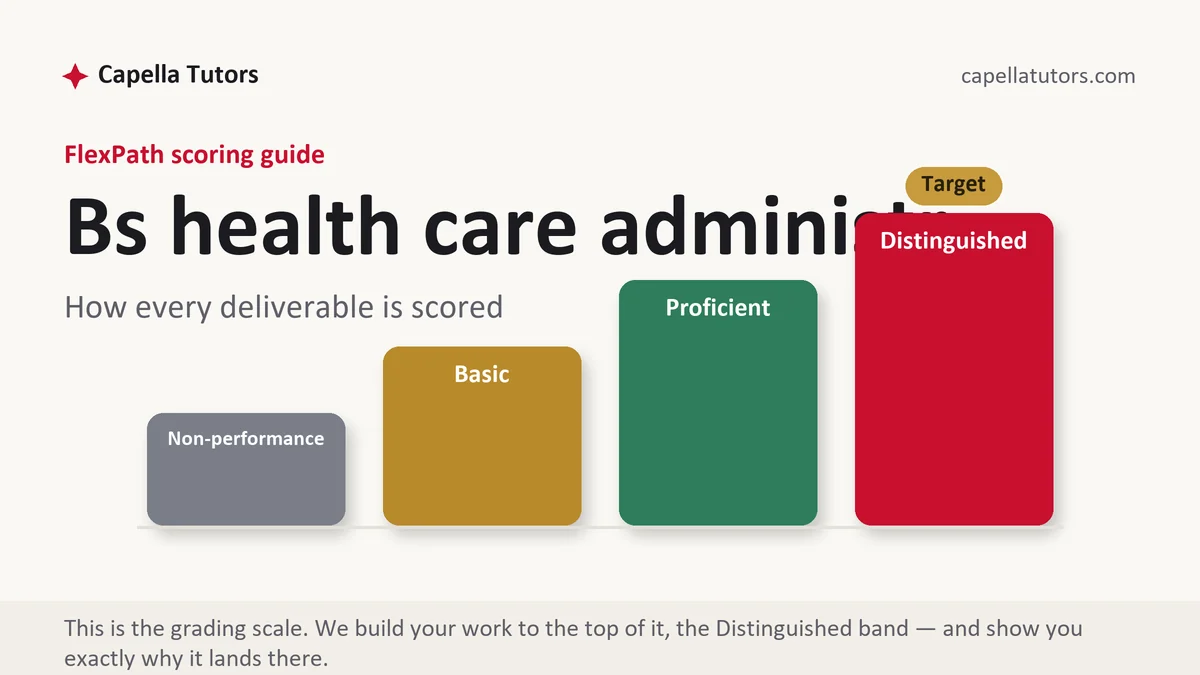
Capella's BS in Health Care Administration is a management degree set in hospitals. At least 90 program points, a minimum of 27 at the 3000 level or above, eight BHA core courses, and one of two specializations, Leadership or Health Information Management. No practicum, no residency, no field experience. The culminating course is BHA FPX 4020, restricted to your final quarter and not meetable by transfer or prior learning. We write to the Distinguished column, back inside 24 to 48 hours, revised free until every criterion clears.
What the Capella BHA actually demands
Students searching for Capella BS Health Care Administration help arrive with one assessment open and a sense that the degree is about health care. It is about organizations. The patient appears here as a safety outcome, a data point, a cost and a regulatory obligation, almost never as someone you are treating. Front-line staff know how the floor runs and lose criteria on scope, since one department is not a system. Career changers write clean prose and lose criteria on the sector, since health care is paid by third parties under rules no other industry learns.
Then the framing readers get wrong most often. This is a non-clinical degree. It carries no clinical hours, licenses nothing, and qualifies nobody to assess or treat. It prepares you to write about scheduling, budgeting, compliance, records, quality reporting and workforce planning. Learning that in week one is free. Learning it inside a finance course is not.
The 90-point shape, and the 27 that has to sit high
The program is set at a minimum of 90 program points with at least 27 at the 3000 level or above. The first number is what people plan around. The second is what ruins plans. The major courses are easier to count than the total. The BHA core runs eight courses worth 18 points, four of them half-size at 1.5 points each in two pairs: delivery history beside current trends, and financial management beside financing and reimbursement. The capstone adds 3. The specialization adds 18 on the Leadership track or 27 on Health Information Management. What is left inside the 90 is general education and elective requirement, and your program evaluation is the authority on which of it you still owe.
Leadership or Health Information Management
The specialization is the only structural choice in this degree. Both tracks open on the same two courses, so switching early costs less than it feels like it should.
| Leadership | Health Information Management | |
|---|---|---|
| Courses in the specialization | 6 | 9 |
| Specialization points | 18 | 27 |
| Shared opening pair | BHA FPX 2102, BHA FPX 2106 | The same two |
| What the coursework is | Operations and process improvement, population health, health economics, workforce planning | Terminology, data ethics and compliance, health information systems, electronic records, statistics, decision support |
| Upper-level points reached from major courses | 24 of the required 27 | 27 exactly |
Read the last row twice, because it is the whole decision. Add the 12 upper-level points inside the core to the capstone's 3 and both tracks start from 15. Leadership contributes 9 more and lands on 24, three short, so a Leadership student has to place a 3000-level course elsewhere on purpose. Health Information Management contributes 12, lands on exactly 27, and settles the requirement by itself.
That does not make it the better track. It is three more courses and 9 more points, and a statistics course and a records systems course cannot be drafted from argument alone. Leadership is shorter and friendlier to a transfer package already mapped, and its three-point gap is trivial to close when you see it coming and painful in your final quarter. If certification is part of your reasoning, verify eligibility with the certifying body, since it turns on programmatic accreditation rather than course titles.
No practicum, no residency, and one capstone rule
The program carries no practicum, no residency and no field experience hours. No preceptor to recruit, no site agreement to route through a compliance office, no hour log to defend. Set beside a nursing degree, where placement paperwork routinely closes a term late, that is a whole category of delay removed.
What replaces it is one course with two hard rules. BHA FPX 4020 is restricted to the final quarter and cannot be satisfied by transfer credit or prior learning assessment. So it cannot be pulled forward to fill a light session, and a heavy transfer package still leaves it owed in full at the end. The bottleneck moves rather than disappearing: a project capstone needs a real organization and figures you may use. Choose one early and reuse it wherever a course permits.
Send the BHA course you are in
The code and the scoring guide are enough to start. First premium original sample free, back inside 24 to 48 hours.
Every BHA course we cover
Twenty-two pages, both specializations. You take the core, the capstone and one specialization block, so no student sees all of these.
Core, the eight BHA courses
BHA FPX 2002, BHA FPX 2003, BHA FPX 2006, BHA FPX 3001, BHA FPX 3004, BHA FPX 3008, BHA FPX 3009, BHA FPX 3010
Shared by both specializations
Leadership specialization
BHA FPX 2110, BHA FPX 3108, BHA FPX 3112, BHA FPX 4104
Health Information Management specialization
HIM FPX 1610, HIM FPX 2660, HIM FPX 2670, HIM FPX 3620, HIM FPX 3640, HIM FPX 4630, HIM FPX 4650
Capstone
Browse the full course catalog
The register health administration faculty grade
Most scoring guides here climb one verb ladder: describe, explain, apply, recommend. The jump sits between explain and apply, and that is where the Proficient ceiling forms. A Basic answer in a regulation course names the regulation and paraphrases what it requires. A Distinguished answer names the regulation, names the body that enforces it, states what the organization in the scenario is doing that falls short, and says what has to change and who signs off. Same length. The second could be handed to a manager. Two habits cover that distance: attach a source or a stated assumption to every number, and keep citations and references symmetrical, where undergraduate APA marks cluster. The scoring guide guide and the FlexPath writing manual cover the method criterion by criterion.
Where BHA students stall
Rarely in the opening courses. The stall lands in the middle, and pairing causes it. A student on the Leadership track runs BHA FPX 3008 beside BHA FPX 3009, reasoning that 1.5 points next to 1.5 points is the lightest slot on offer. Both are money courses. Both want the same evening, a statement on one screen and a calculation on the other. Six weeks in, both sit half finished. An attempt goes in, faculty have two business days to evaluate it, and under submit-on-grade the next assessment waits on that grade, so the delay in one course cannot be absorbed by the other. Pair a finance course with regulation instead, and argument work fills the wait the numbers created.
- The 27 checked at the end. Count upper-level points at enrollment and again halfway, not in the final quarter, when a Leadership student can be three short with nothing left open.
- Two finance courses in one session. Half-size points, full-size reading.
- A capstone organization chosen during the capstone. Figures take longer to obtain than to analyze.
- A specialization picked on a job title. Read all nine Health Information Management titles first.
- An empty evaluation queue. The two-business-day window costs nothing when something else is in flight.
How the courses sequence
FlexPath lets you set the order, which is not the same as every order working. The two half-size 2000-level courses go first, since they install the vocabulary everything after them assumes. Take regulation before patient safety and quality, since quality reporting is largely a regulatory obligation. Put the essentials of the healthcare system course early, since it is the spine the specialization hangs on. Run financial management before financing and reimbursement, and research methods well before the capstone. The capstone goes last, and that is a rule rather than a preference.
The pairing math is fixed by the format. Up to two courses at a time, sessions billed flat across twelve weeks, and the only lever is what fills each slot. The pair that works holds one course whose labor is building something, a budget, a process map, a statistic, beside one whose labor is arguing something. Stagger submissions so one course always has an attempt in the queue. The two-course rotation playbook works through the cadence and the expedite page carries the pacing math.
BHA questions students actually ask
Does the Capella BS in Health Care Administration require a practicum or clinical hours?
No. There is no practicum, no residency and no field experience requirement, and no clinical hour count attaches to the program. The culminating experience is BHA FPX 4020, a capstone project restricted to your final quarter that cannot be met by transfer credit or prior learning. You still need an organization to build it around and permission to use its figures, a sourcing problem rather than a placement one. Requirements are revised between catalog years, so confirm yours in your own.
Leadership or Health Information Management, which specialization should I pick?
Pick on the coursework, then check the arithmetic. Leadership is six courses and 18 points, operations, population health, economics and workforce planning. Health Information Management is nine courses and 27 points, terminology, data ethics, systems, records, statistics and decision support. The tiebreaker is the upper-level minimum: Health Information Management reaches 27 points at 3000 and above from major courses alone, Leadership reaches 24. If certification matters, confirm eligibility with the certifying body rather than inferring it from course titles.
Is this a clinical degree, and can I use it to work with patients?
No, and this is the most common misunderstanding about the program. Health care administration is an administrative field. The degree carries no clinical hours, confers no license, and does not prepare anyone to assess, diagnose or treat. Its subject is how a health care organization is regulated, financed, staffed, measured and improved. That is useful work, it is not patient care, and the two are not rungs on one ladder.