Send the prompt, the scoring guide, and any inventory results you were asked to use, and a premium original sample lands within 24 to 48 hours, mapped to the top column of your rubric and reviewed by a second person before delivery. The course code is BUS FPX 2012 and the full title is Leadership Fundamentals, worth 1.5 program points as a core requirement in the BS in Business, taught in FlexPath within a degree of at least 90 program points that reserves a minimum of 27 for courses at the 3000 level or above. In Capella's catalog the course code is written BUS-FPX2012.
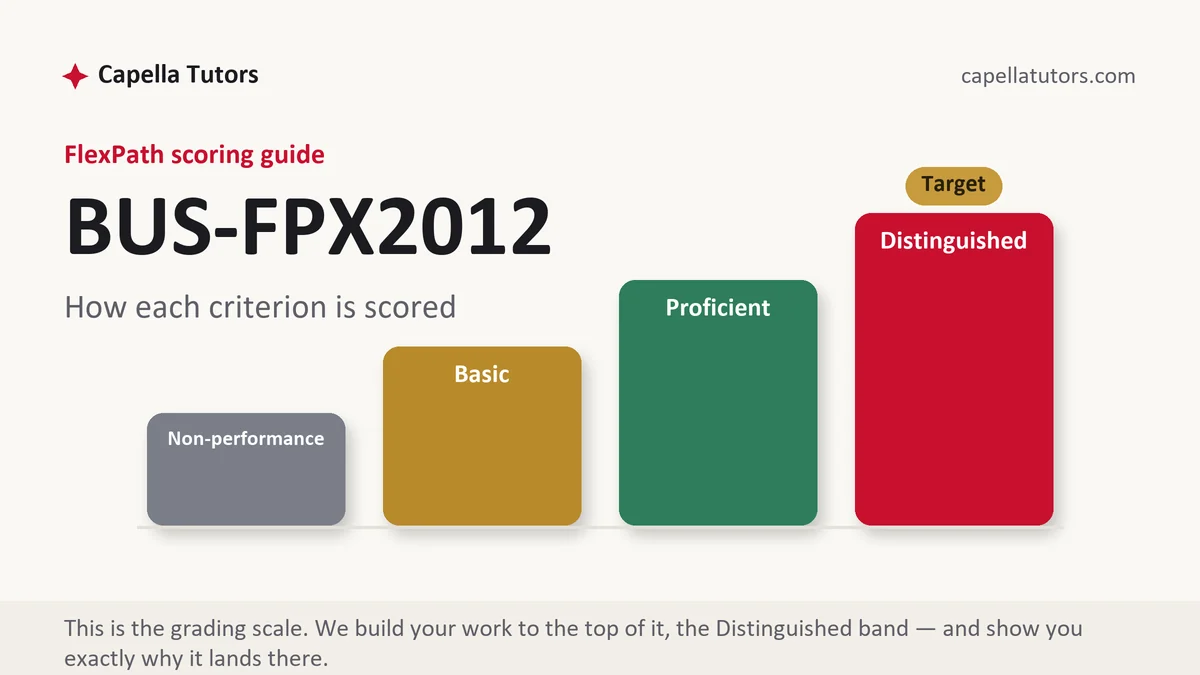
What BUS FPX 2012 actually grades
Management Fundamentals grades what a manager does with resources. This course grades what a leader does with people, and the criteria will not accept the first as an answer to the second. In current courserooms the assessments include "Establishing a Positive Work Environment" and "Transformational Leadership in New Product Launches" among others, and your scoring guide decides the exact format of each. Calling somebody inspiring is a compliment, and compliments sit in the Basic column. Identifying the construct, stating the behaviors the construct predicts, and pointing at occasions when the person did or did not produce them is the analysis being asked for.
The theories arrive in families, and faculty grade whether you can tell them apart and attribute them. Trait research asked what leaders are like and produced weak, unstable answers. The behavioral studies replaced it by asking what leaders do, and gave the field the two dimensions of initiating structure and consideration. Contingency work added the situation, through Fiedler's matching of style to situational favorability, through the readiness-based situational model associated with Hersey and Blanchard, and through House's path-goal theory, which treats a leader's job as clearing obstacles between effort and reward. The transformational and transactional distinction came from Burns in 1978 and was turned into a measurable model by Bass in the mid-1980s. Servant leadership traces to Greenleaf's 1970 essay. Leader-member exchange moved attention off the leader and onto the quality of each individual relationship. Every one of those has an owner and a date, and using one without either is how a citation row goes wrong.
Self-assessment appears in most versions of this course, and it is graded on evidence rather than on candour. If you completed an instrument, name it, report what it returned, and then do the part almost everyone skips: give two specific incidents that support the result and one that contradicts it. A score is a claim about you, and a claim in this degree needs support like any other. Then convert the finding into a development plan a reader could audit, which means an action, a frequency, a period, and a measure that will move if the plan works.
How we help in this course
Our 2012 drafts are built out of incidents. Tell us who the leader is, what you have actually seen them do, and which theory your criterion names, and the sample matches specific behavior to specific components of the construct rather than describing a personality. Where a prompt calls for self-assessment we work from the results you report rather than inventing a profile, and where you have no instrument results the draft says plainly which pieces you need to supply.
Beyond the drafting itself, the arrangement is our usual one. Delivery falls inside 24 to 48 hours, the target is Distinguished, and the file passes through eight sets of hands: a research analyst pulls your scoring guide and the primary leadership sources the criteria point to, a subject writer drafts, a scoring-guide reviewer scores each row as an evaluator would and sends anything short of the top column back, an APA and originality pass verifies every citation both ways, and an editor closes. Revisions carry no charge until the work meets the guide, and returned faculty feedback runs through the same cycle for free.
The assessments, one by one
Assessment 1: Establishing a Positive Work Environment
A message to a team on why a positive workplace culture matters and how leaders and team members will build it, with a summary table. Read the full Assessment 1 manual.
Assessment 2: Transformational Leadership in New Product Launches
Describe an organizational change, how a leader would empower teamwork for innovation, the traits and style needed, and strategies for collaboration and engagement. Read the full Assessment 2 manual.
Assessment 3
The closing deliverable in Leadership Fundamentals usually asks for a development plan, and a plan is graded on whether it could visibly fail: an action, a frequency, a period, a barrier, and a measure that moves if the plan works. Read the full Assessment 3 manual.
How to actually write BUS FPX 2012: where to begin
Build the outline from the criteria, and expect three kinds of row in a leadership rubric: one asking you to explain a theory, one asking you to apply it to an actual leader or to yourself, and one asking for a development or action plan. They are scored separately, which means a beautiful theory section cannot rescue a thin plan. Put the Distinguished wording under each heading before you write, and check at the end that every heading holds content answering the verb inside it.
Here is the contrast that decides the application row. The weak sentence says my manager is a transformational leader because she motivates the team and cares about people. The strong version takes the model apart and tests it. Idealized influence: she took the blame publicly for a missed delivery caused by a decision she had approved. Inspirational motivation: she reframed a tedious data cleanup as the thing that would end the weekly reconciliation everybody hated, and repeated it at every stand-up for a month. Intellectual stimulation: she asked the two most junior analysts to propose the new process and adopted their version. Individualized consideration: she moved one person's schedule permanently after a single conversation about a caregiving commitment. Then add the honest qualification, that her use of contingent reward around quarter end is transactional rather than transformational, and that this is a different mechanism rather than a failure. Four components, four incidents, one qualification, and the row is answered.
Write the development plan as something with a number in it. A goal to communicate better cannot be marked. A commitment to hold a fifteen-minute individual conversation with each of six team members every second week for one quarter, to record how many issues arrive as unplanned escalations, and to compare that count against the eleven logged last quarter can be marked, because it fails or succeeds visibly. Attach a barrier and a mitigation to each goal as well, since the criterion usually asks what could stop you, and answering that with time constraints alone reads as a placeholder.
| Section | What goes in it | What Distinguished looks like |
|---|---|---|
| The leader and setting | Who is being analyzed, the team or organization, and your vantage point on them. | A defined relationship and period, so a reader knows what you were in a position to observe. |
| The theory | The construct chosen, its originator, its components, and why it fits this case. | The theory attributed and dated, with a reason a competing construct was set aside. |
| Behavioral evidence | Specific occasions, decisions, and words, tied to individual components of the model. | One incident per component, including at least one that complicates the fit. |
| Self-assessment | The instrument used, the result it returned, and what you make of it. | Results read against observed behavior rather than accepted at face value. |
| Development plan | Goals, actions, frequency, timeframe, barriers, and the measure of success. | Each goal measurable and dated, with a stated way of knowing it failed. |
| Sources and format | Original leadership works and peer-reviewed journals, in current APA. | Primary statements cited directly, with instrument documentation included wherever an inventory was used. |
Developing the analysis
The leadership literature is popular, which is exactly why it needs handling with care, and a paragraph showing that you know the criticisms tends to move a criterion by itself. Transformational leadership is the most cited model in the field and also the most contested. Reviewers have pointed out that its four components correlate so highly with one another that they may not be four separate things, that the standard measures ask followers to rate a leader they have already decided they like, and that most of the evidence comes from surveys taken at a single moment, which cannot separate a leader causing performance from performance making a leader look good. Servant and authentic leadership attract similar complaints about measurement. None of that makes the models useless, and none of it means you should avoid them. The move that reads as competence is to apply the construct, cite one methodological objection to it, and then say why the construct still explains the case in front of you better than the alternatives, or why in this instance it does not.
Citations that survive faculty review
Three source types belong in a leadership paper, and one very common type does not. Original statements of the theories carry the definitions, so cite Burns for the transforming and transactional distinction, Bass for the model built on top of it, Greenleaf for servant leadership, and House for path-goal theory, rather than a textbook paragraph or a training slide restating them. Peer-reviewed journals reached through the Capella library, particularly the leadership and applied psychology titles, carry evidence about whether a style is associated with an outcome, and any claim about performance, turnover, or engagement needs to come from there. Instrument documentation is the third type and is the one most often forgotten: if you used an inventory, cite the source of the inventory and say what it measures, because a score reported without its instrument is a number with no units. What does not belong is the enormous supply of leadership content marketing published by consultancies and coaching firms, which is written to sell a service and routinely attributes ideas to whoever popularized them most recently. Then verify the list against the text in both directions in current APA.
The mistakes that land Basic instead of Distinguished
- Praise standing in for analysis. Admiration is not a construct, and a criterion asking for theory cannot be answered with warmth.
- Transformational used to mean charismatic or well liked. The model has named components, and using the word loosely shows the source was never opened.
- A self-assessment score with nothing behind it. An instrument result is a starting claim, and the row is asking what evidence supports or undercuts it.
- Development goals with no measure and no date. A plan that cannot fail cannot be evaluated, and evaluators score it accordingly.
- Every theory named and none applied. A survey of the field is a background section, and it usually crowds out the application the rubric weighted most.
BUS FPX 2012 questions students actually ask
Can I analyze a leader I have never worked with?
You can, and public figures are permitted in most versions of this prompt, but the evidence problem gets harder rather than easier. Analyzing somebody at a distance means your incidents come from interviews, documented decisions, filings, and reporting, and every one of them has to be cited. A leader you worked under gives you something no public source will: specific occasions with a date, a room, and a consequence you watched, which is exactly what the application row rewards. If you do go with a public figure, choose one with a documented record of decisions rather than one who is merely famous, and build the paper around three or four decisions you can source.
What if the leader I want to write about is a poor one?
That is often the stronger paper. The criteria ask you to apply a construct, and a construct explains failure as well as it explains success, sometimes more clearly. A manager who runs entirely on contingent reward and corrective action is a legitimate case study in transactional leadership, and the analysis writes itself once you stop treating the model as a compliment. Keep the tone analytical rather than aggrieved, describe behavior rather than character, remove identifying details, and make sure the development section addresses what the situation needed rather than what the person deserved.
Is this course a repeat of Management Fundamentals?
No, and treating it as one costs marks in both. Management Fundamentals is about the functions that get work organized: planning a period, structuring a unit, allocating resources, and checking output against a standard. This course is about influence, which is the question of why anyone follows the plan once it exists. The overlap is real, and the honest position is that the same person performs both, but the criteria here are written in the vocabulary of theory, behavior, and follower response. If your draft is full of budgets, schedules, and spans of control and thin on how people were moved, you are answering the other course's rubric.
Leadership assessment due?
Send the prompt, the criteria, and any inventory results you have. The draft comes back with a theory attached to real incidents. We do not charge for the premium sample you begin with.