Send the prompt with your scoring guide attached and a premium original sample lands inside 24 to 48 hours, written straight at the Distinguished descriptors, with the breakdown checked to make sure it rolls up and free revisions running until the criteria are satisfied. The course sits on your transcript as PM FPX 4020, Integration and Scope Management, worth 3 program points, one of the Project Management specialization courses in the FlexPath BS in Business, a degree requiring 90 program points or more and at least 27 of them from the 3000 level upward. In Capella's catalog the course code is written PM-FPX4020.
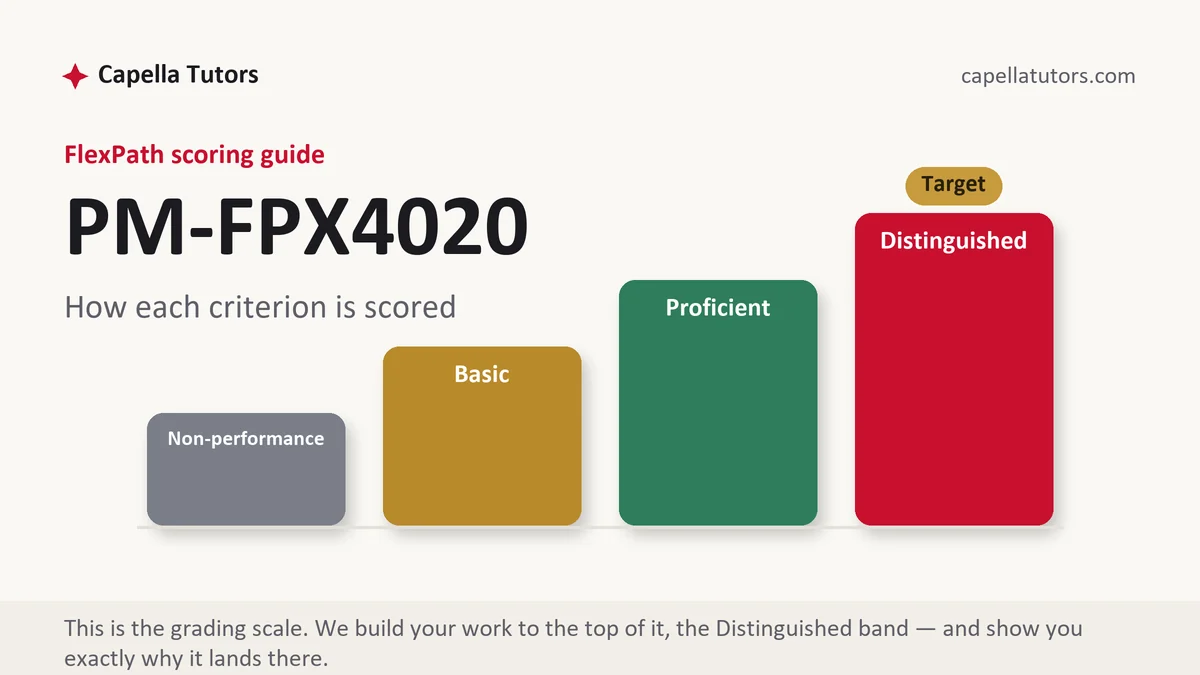
What PM FPX 4020 actually grades
Integration is the part of the job that nobody else on the team does, and the criteria are built around whether you can see it. Every other area produces a plan of its own, and integration is what makes those plans one document that does not contradict itself. That means the project management plan graded here is not a schedule with a cover page. It is the set of subsidiary plans plus the baselines they agree on, plus the decision about how changes get approved, plus the record of who signed what. Assessments test this by handing you a situation where two plans disagree, a delivery date that the procurement lead time cannot support, or a quality standard the budget never funded, and watching whether you resolve it or describe it.
Change control is the second graded habit and it carries more marks than its length suggests. A documented process has four parts and students routinely produce two of them: a request written down, an impact assessment covering cost, schedule, risk and quality, a decision by somebody with the authority to make it, and an updated baseline if the answer is yes. Missing the last part is the expensive one, because a project running against an out-of-date baseline reports variances that mean nothing. The criteria also want a threshold, which is the figure below which you decide alone and above which the sponsor decides, and a paper that names that figure sounds like it was written by somebody who has held the job.
Scope is the other half of the course and it splits in two. Product scope is the set of features and characteristics the result must have. Project scope is the work required to deliver them, which includes the plan, the testing, the training and the handover that no customer thinks to ask for and every schedule needs. Requirements come first, gathered from named sources with a way of knowing each one is met, then the scope statement with its deliverables, acceptance criteria, constraints, assumptions and its list of exclusions, then the breakdown and its dictionary. Those three together are the scope baseline, and the criteria for validation and control both refer back to it, so a weak baseline damages sections you have not written yet.
How we help in this course
Send the scenario and we build the documents in the order they depend on each other. Requirements arrive numbered, sourced and prioritized. The scope statement carries acceptance criteria written so a reader could test them, and an exclusions list that says plainly what the project will not deliver. The breakdown decomposes by deliverable, each package gets a dictionary entry, and the package totals are added up to prove they equal the account above them. Where the assessment supplies a change request, we cost it rather than discuss it.
Studio terms apply here as everywhere. Each deliverable comes back in 24 to 48 hours as a premium original sample, eight people handle it between the first research pass and the last proofread, and one reader spends their entire pass comparing your scoring guide against the file clause by clause. On a course this table-heavy we add a second check that every total in a table matches every total quoted in the prose. Revisions are unlimited and free, faculty comments are worked in at no charge, and since an evaluator has two business days per attempt we build the delivery date around leaving room for one more.
The assessments, one by one
Assessment 1: Project Selection and Business Case
Make the business case for a project, with business objectives, requirements, budget and schedule overview, risks, contingencies, assumptions and constraints. Read the full Assessment 1 manual.
Assessment 2
This deliverable builds the front half of the scope baseline, and everything later in the course leans on it. Read the full Assessment 2 manual.
Assessment 3
This is the arithmetic end of the scope course. Read the full Assessment 3 manual.
How to actually write PM FPX 4020: where to begin
Read the criteria and work out which document each one is asking you to produce, then build the documents in dependency order rather than in the order the criteria are printed. Requirements before scope statement, scope statement before breakdown, breakdown before anything that mentions cost or acceptance. The assessments in this course usually ask you to develop integration and scope artifacts for a scenario or for a project you know, and your scoring guide decides whether that arrives as a plan, a set of tables, a change analysis or a memo to a sponsor.
Give every requirement an identifier and keep them traceable. A row that reads R-07, requested by the accounts payable supervisor, serving the objective of cutting invoice approval time, priority high, verified by a timed test of ten invoices, is doing four jobs at once, and a matrix of those rows lets you prove two things an evaluator looks for. Every requirement has work attached to it somewhere in the breakdown, and every package in the breakdown traces back to a requirement. Anything failing the second test is work somebody added because it seemed like a good idea, which is the polite definition of gold plating.
Then make the breakdown add up, because this is the arithmetic the scope criteria actually test. Suppose the project has four deliverables. The first decomposes into packages estimated at 6,200, 4,800 and 9,500 dollars, which is 20,500. The second holds 12,750 and 3,400, which is 16,150. The third is a single package at 8,900. The fourth holds 5,600 and 2,250, which is 7,850. The four accounts total 53,400 dollars, and that figure is the whole of the project because the rule is that the children of a box equal the box, no more and no less. If your narrative later mentions training that appears in no package, the breakdown is wrong rather than the narrative, and the fix is a new package with an owner rather than a sentence explaining the gap.
Then cost the change request instead of debating it. A sponsor asks for two extra report screens in week 5 of a 16-week project. Estimated at 62 hours of development and testing at a blended 48 dollars an hour, the request costs 2,976 dollars, and because the reporting work sits on the critical path it adds 5 working days to the finish. Contingency stands at 4,000, so approval leaves 1,024 dollars to cover the remaining 11 weeks, which is the sentence that turns an administrative note into advice. Offer three options: approve and move the date, approve and remove a package of similar size, or defer the request to a later phase. Then show the revised baseline, because a change approved without a baseline update makes every variance report after week 5 meaningless.
| Section | What goes in it | What Distinguished looks like |
|---|---|---|
| Charter and authority | Sponsor, business need, the manager's authority over people and money, and the approval record. | Authority stated in figures, so a reader knows which decisions need somebody else. |
| Requirements | Numbered requirements with source, objective served, priority and the method that verifies each. | A matrix traceable both ways, from requirement to package and from package back to requirement. |
| Scope statement | Deliverables, acceptance criteria, constraints, assumptions and an explicit list of exclusions. | Acceptance criteria written so somebody other than the author could test them. |
| Work breakdown and dictionary | Deliverable decomposition, package owners, definitions of done, and the rolled-up totals. | Totals that reconcile at every level, with a dictionary entry for each package rather than a label. |
| Integrated change control | The request form, the impact assessment, the approval threshold, and the baseline update step. | An impact assessed across cost, schedule, risk and quality, with the revised baseline shown. |
| Validation, closure and references | Who accepts each deliverable and how, the handover, the lessons record, current APA both ways. | Acceptance mapped to the scope statement criteria, so finished means agreed and dated. |
Developing the analysis
Two claims turn up in almost every scope paper and both need handling with care. The first is that requirement defects are cheapest to fix early, usually accompanied by a dramatic multiplier for the cost of fixing one after release. The underlying idea is sound and the specific multipliers come from a small number of old studies in particular software settings, so quote the source and the setting or make the argument qualitatively instead. The second is that scope creep causes most project failures, which is asserted far more often than it is measured. What the research does support is more interesting: requirements elicited from a narrow set of stakeholders tend to miss constraints that surface later, and projects with clear acceptance criteria agreed in advance have fewer disputes at handover. Distinguish creep from change while you are at it, since they are not the same thing. Change is a request that went through a process and produced a new baseline. Creep is work that entered the project without either. A paper that draws that line and then shows how its own control process enforces it is making an argument rather than repeating a warning.
Citations that survive faculty review
Anchor the process vocabulary in a standard and name its edition, since integration and change control language differs slightly between the Project Management Institute guide and ISO 21502, and a paper that borrows from both without saying so looks careless. For the requirements half of the course there is a better source than a general project text: the business analysis body of knowledge published by the International Institute of Business Analysis covers elicitation and traceability in the detail this assessment wants, and ISO/IEC/IEEE 29148 gives testable criteria for what a well-written requirement looks like. Research claims belong to peer-reviewed journals reached through Business Source Complete and ABI/INFORM in the Capella library, where the empirical work on requirements quality and change control lives. Where a real organization is in play, its published annual report or a government contracting notice will describe scope in the organization's own language, which beats paraphrasing. Software vendor pages describing their own change management module are marketing rather than evidence. Close with the two-way APA check before you submit.
The mistakes that land Basic instead of Distinguished
- A breakdown that does not reconcile. If the packages under a deliverable do not sum to it, every estimate built on the breakdown inherits the gap.
- No exclusions list. Saying what the project will not deliver prevents more arguments than any other sentence in the scope statement.
- Acceptance criteria written as adjectives. User friendly cannot be tested, and a criterion nobody can test cannot be validated at handover.
- Change approved without a baseline update. The variance reports that follow are measuring against a plan the project no longer has.
- Requirements with no source. A requirement nobody asked for is either an assumption or gold plating, and both need to be labelled as such.
PM FPX 4020 questions students actually ask
What is the difference between validating scope and checking quality?
Different people, different questions, and the criteria in this course frequently test whether you know which is which. Checking quality is internal and asks whether the thing was built correctly against the specification, so it happens in your own team before anybody outside sees the work. Validating scope is external and asks whether the customer accepts the result as the thing they asked for, so it produces a signature or a written acceptance rather than a test report. Work usually passes through both in that order, since sending an unchecked deliverable to a sponsor turns an internal defect into a public one. Write the acceptance step into your plan with a named approver and a stated turnaround, because a deliverable nobody has formally accepted is still open no matter how finished it looks.
Where does a requirements traceability matrix actually come from?
You build it as you collect requirements, not afterwards as a formatting exercise. Each requirement gets an identifier the moment it is recorded, together with who asked for it, the business objective it serves, its priority, and how anybody will know it was met. Once the breakdown exists you add the work package that delivers it, and once testing is planned you add the check that proves it. The value shows up twice. It tells you whether every requirement has work attached, and it tells you whether every piece of work traces back to a requirement, which is how gold plating gets caught before it is paid for. If a row has no source and no objective, question whether it belongs in the project at all.
How do I handle a change the sponsor calls small?
Cost it in writing, then let the sponsor decide with the number in front of them. Small is a description of the request and not of its effect, and the honest reply is an estimate of hours, money, schedule impact and risk, delivered the same day so the process does not look obstructive. Say which activity absorbs the work, whether it falls on the critical path, and what happens to the contingency that pays for it. Then offer the alternatives you would offer a paying client: do it now and move the date, do it now and drop something of equal size, or log it for a later phase. Approving or declining is the sponsor's job. Making the consequence visible before the decision is yours.
Scope baseline or change analysis due?
Send the scenario, the criteria and any requirements you have collected. We will number them, decompose them and make the totals reconcile. First premium sample free.