Hand over the prompt and the criteria attached to it, and an original premium sample comes back within 24 to 48 hours, written against the Distinguished wording in your own guide and read by a second person before it reaches you. On a transcript the course appears as BUS FPX 2030, Marketing and Sales Fundamentals, worth 3 program points, a core requirement shared by all six FlexPath specializations in the BS in Business, delivered in FlexPath inside a degree that asks for at least 90 program points with at least 27 of them at the 3000 level or above. In Capella's catalog the course code is written BUS-FPX2030.
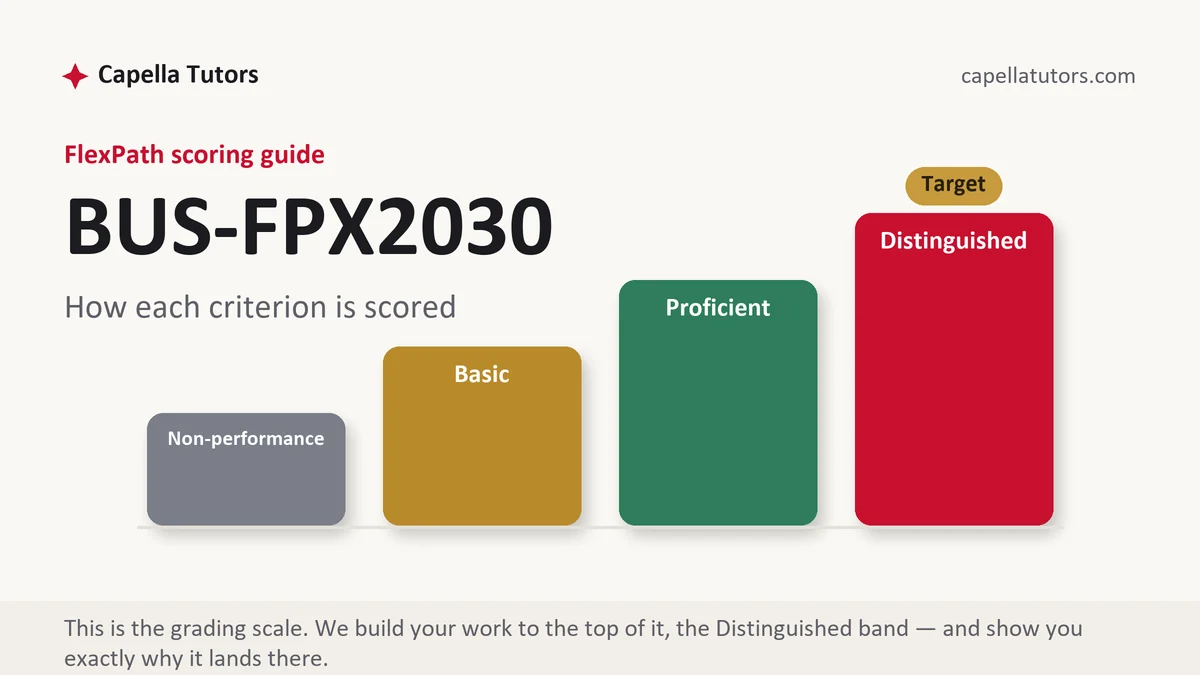
What BUS FPX 2030 actually grades
Marketing is graded here as a set of decisions with a named buyer at the end of them. In current courserooms the assessments include "New Product Analysis", "Place Analysis" and "Price Analysis" among others, and your scoring guide decides the exact format of each. Criteria read for three things at once: a segment defined on something that predicts buying rather than something that merely describes a population, an offer positioned against a specific alternative the buyer would otherwise choose, and a selling process described as countable steps. A draft that talks about consumers sits in the Basic column. A draft that talks about a buyer with a budget, a deadline, and a reason to switch sits above it.
The mechanics being tested are ordinary and the errors are predictable. Segmentation runs on demographic, geographic, psychographic, and behavioral variables, and a segment only earns its place in a paper if it can be measured, reached, and served at a profit, which is the test most drafts skip. The mix is product, price, place, and promotion, and undergraduate work reliably overweights the last one, spending pages on advertising ideas while price gets a sentence, even though price is the only element of the four that brings money in. On the selling side the criteria want prospecting, qualifying, the objection you expect and your answer to it, the close, and the follow-up work that produces a second order rather than a single transaction. Personal selling and advertising are alternatives with different costs per contact, and saying which one this offer justifies is worth more than describing both.
The third strand is arithmetic, which surprises people who chose marketing to avoid it. Cost per click, conversion rate at each stage, average order value, gross margin, the cost of acquiring one customer, and what that customer is worth across the relationship are the working vocabulary, and the criteria treat them as claims that have to be supported the same way any other claim is supported. Definitional discipline matters too. Total category size is not the segment you can serve, share of market is not share of wallet, and a lead is not a qualified opportunity, and an assessment that uses those pairs interchangeably loses a criterion without the writer noticing.
How we help in this course
Our 2030 drafts name the customer and then stay loyal to that choice. Every segment we put on the page carries a size and a source, positioning statements name the competitor they intend to displace, and any campaign we describe arrives with a spend, a conversion assumption, and the gross profit left standing after cost of goods. Tell us the offering, the scenario figures your prompt supplies, and whether your instructor wants a consumer or a business buyer, and the sample argues that product instead of a generic one.
Eight people touch the file before you see it. A research analyst pulls your scoring guide and the market sources it points at, a business writer drafts, a criterion reviewer marks the result the way a Capella evaluator marks it, an APA and originality pass reconciles every citation with the reference list, and an editor takes the last read. Delivery stays inside 24 to 48 hours, revision costs nothing until the work clears the guide, and anything your evaluator sends back re-enters the same queue free.
The assessments, one by one
Assessment 1: New Product Analysis
Propose a new product for a real company, define its target market, brand identity and positioning, and explain the product strategy for success. Read the full Assessment 1 manual.
Assessment 2: Place Analysis
Analyze a company's sales markets and distribution channels, explain how distribution creates competitive advantage, and recommend a place strategy for the new product. Read the full Assessment 2 manual.
Assessment 3: Price Analysis
Analyze a company's pricing strategy and market position, the trade-off between profit and market share, and recommend pricing for the new product. Read the full Assessment 3 manual.
How to actually write BUS FPX 2030: where to begin
Open the scoring guide first and build the document out of it. Each criterion becomes a heading, the Distinguished sentence goes underneath in brackets, you write only under those headings, and the brackets come out at the end. Marketing has a specific failure mode that makes this ordering more useful than usual: the subject invites enthusiastic paragraphs about brand and experience that no criterion asked for, and an evaluator hunting for your segmentation analysis should not have to find it inside a paragraph about storytelling.
Then put numbers under the strategy, because that is what separates the columns. Take a regional coffee roaster running one paid campaign for a subscription bag. The budget is $4,800 and clicks cost $2.40, so the campaign buys 2,000 visits. Six percent of those visitors place a first order, which is 120 new customers, and $4,800 divided by 120 puts the cost of acquiring one of them at $40. The average first order is $62 and the gross margin on a bag is 55 percent, so that order contributes $34.10 and the customer is still $5.90 short of covering what it cost to find them. The second order closes the gap, since another $34.10 lifts cumulative contribution to $68.20 against $40 of acquisition cost. Subscribers on this account average 3.2 orders in their first year, so first-year contribution runs to $109.12 per customer and $69.12 of that survives acquisition, which is $8,294 across the 120 customers on $4,800 of spend. Now move one input and watch the verdict move with it: at a four percent conversion rate the same budget buys 80 customers, acquisition costs $60 each, and contribution per customer drops to $49.12. That single sensitivity is usually the difference between a plan an evaluator believes and a plan they merely read.
Close every recommendation with what it costs and what it gives up. A marketing plan that only lists what the company will start doing reads as a wish list, and the criteria are looking for a trade-off you accepted on purpose: the segment you decided not to chase, the channel you cut to fund the one you kept, the price you refused to discount and the volume that decision forfeits. State the measure that would tell you the plan is failing and the date you would check it, because a plan with no failure condition cannot be managed.
| Section | What goes in it | What Distinguished looks like |
|---|---|---|
| Introduction and the offering | The product or service, the company behind it, and the decision the assessment asks you to make. | The decision stated in the opening paragraph so every later section reads as evidence for it. |
| Market and customer | Who buys in this category, how many there are, what they spend, and how they choose. | Figures carrying a year and a source, each finding followed by what it implies for the offer. |
| Segmentation and target | Segments built on variables that predict purchase, with one of them selected. | The chosen segment sized in dollars or units and the rejected ones named with the reason. |
| Positioning | The claim, the buyer it is aimed at, and the alternative it is meant to displace. | A claim a named competitor could argue with, and the buyers you accept losing. |
| Mix and sales process | Product, price, place, promotion, and the stages a buyer passes through before paying. | Price defended with margin arithmetic and a funnel written as countable stages. |
| Metrics, sources, and format | How success gets measured, over what period, in current APA. | Targets with numbers and dates, plus a measure that would reveal the plan failing. |
Developing the analysis
Marketing research argues with itself, and an undergraduate paper gains from noticing the argument rather than reporting one side of it as settled. Attribution is the cleanest live example. Last-click measurement credits the final ad a buyer touched and is easy to compute, multi-touch models spread the credit across earlier contacts and rest on weighting assumptions nobody can verify from outside, and holdout testing, where a matched group is deliberately not shown the advertising, is the only approach that isolates what the spending actually caused. The three methods routinely disagree about the same campaign. A second dispute worth borrowing is whether brand advertising repays itself on the horizon its advocates claim, since the effects accumulate over years while the measurement window usually closes in a quarter. Nobody is asking you to resolve either question. You are being asked to say which measurement your recommendation depends on and what a skeptical reader would say about it, and two sentences of that reads as judgment rather than summary.
Citations that survive faculty review
Four kinds of source do different work in a marketing assessment. Peer-reviewed marketing scholarship through the Capella library, the Journal of Marketing and the Journal of Consumer Research among them, supports any claim about how buyers behave. Industry and syndicated data, the IBISWorld, Statista, and Mintel material the library licenses, carries category size, growth, and competitive share. Primary company material, filings on SEC EDGAR and the firm's own published prices, covers anything a company charges or claims about itself. Federal statistics, principally Census County Business Patterns and the Bureau of Labor Statistics Consumer Expenditure Survey, give you population and spending figures that cost nothing and date themselves. Two habits keep a marketing reference list defensible. Attach a year to every market number, and credit each framework to the people who published it rather than to the textbook that reprinted it. Treat a vendor white paper as a sales document and never let it carry a criterion. Then check the list both ways in current APA.
The mistakes that land Basic instead of Distinguished
- A target market that includes everyone. Adults aged 18 to 65 is a census bracket, not a segment, and no mix decision can follow from it.
- Promotion doing all the work. Three pages of advertising ideas beside one line on price loses the criterion, because price is the element that brings the money in.
- Market figures with no year. A category size without a date cannot be verified and cannot be set against anything else.
- A funnel with no numbers. Awareness, interest, desire, action is a label set until a conversion rate is attached to each step.
- Segmentation and mix cited to the course text. Both ideas belong to named authors who published them, and the criteria expect that attribution rather than the reprint.
BUS FPX 2030 questions students actually ask
Can I write about the company I actually work for?
If the prompt allows a real organization, use yours, because the specificity the top column rewards is far easier to reach when you already know the price list, the objections, and who says no. Two cautions apply. Strip anything your employer would treat as confidential, and say in a line that figures have been rounded or estimated where you did that, since an evaluator prefers a labelled estimate to a suspiciously precise number. Keep the analysis honest about the business rather than flattering to it, because a paper that concludes the current marketing is already correct rarely has anywhere to put a recommendation, and the recommendation is usually worth its own criterion.
How much pipeline does a sales target actually need?
Work backwards from the quota and let the arithmetic set the number. A representative carrying a $180,000 quarterly target on an average deal of $12,000 has to close 15 deals. If one qualified opportunity in four ends in a sale, 60 opportunities have to enter the quarter, which is $720,000 of pipeline standing against a $180,000 target, or four times coverage. Write it in that order, quota, deal size, win rate, coverage, and the sales section of your paper stops being a description of activity and becomes a plan with a shape. If your scenario gives you a longer sales cycle, add the lag: opportunities that have to close in the third quarter were created in the first.
Where do I get market size numbers without buying a research report?
The library first, then the government, then the companies themselves. Capella licenses industry databases that publish category revenue and growth for exactly this purpose, and the citation is straightforward because those reports carry a date and an author. Federal data fills the gaps at no cost, with establishment counts and payroll by industry from the Census Bureau and household spending by category from the Consumer Expenditure Survey. Public companies disclose segment revenue in their annual filings, so two or three competitors read together will bracket a category even when nobody publishes the total. Build the estimate from the pieces, show the addition, and label it as an estimate, which is a stronger move than quoting a headline number from a press release.
Marketing assessment due this week?
Send the prompt, the criteria, and the offering you were assigned. The segments come back sized and the campaign comes back costed. First premium sample free.