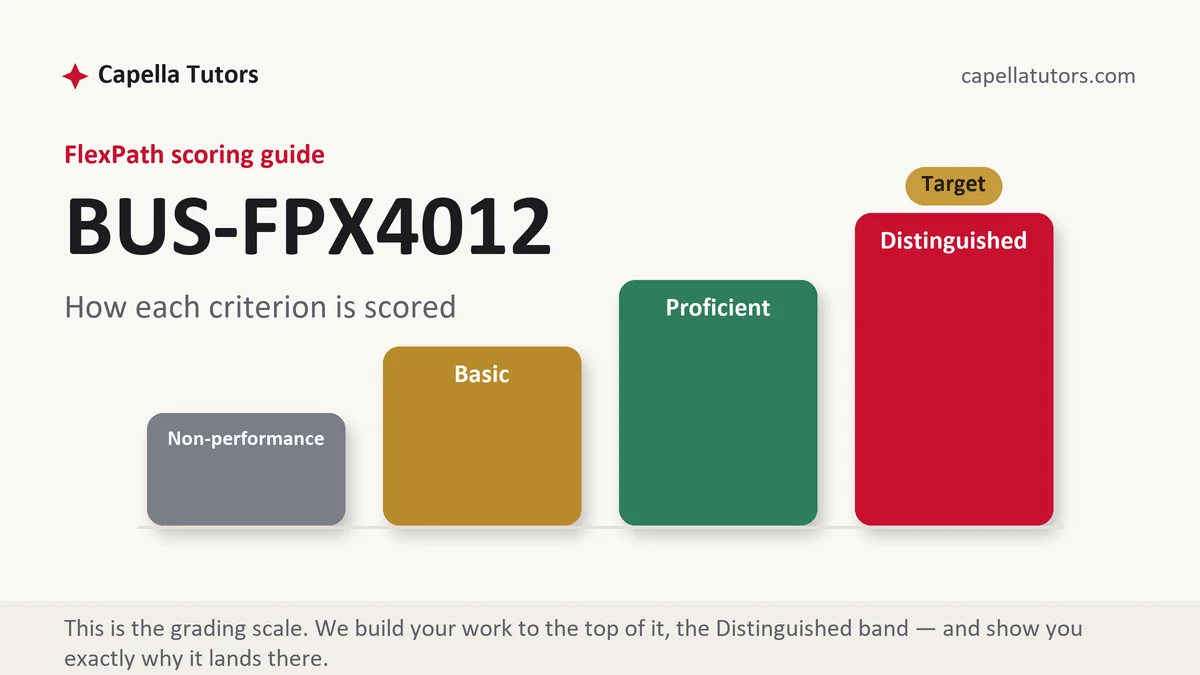
Hand over the prompt, the scoring guide and any self-assessment results you have been given, and a premium original sample returns inside 24 to 48 hours, aimed at the Distinguished column, read a second time against the criteria before it reaches you, with revisions included until the grade is right. On the transcript this course reads BUS FPX 4012, Leadership in Organizations, worth 3 program points, one of the Management and Leadership specialization courses in the FlexPath BS in Business, a degree of at least 90 program points that requires a minimum of 27 points from courses coded 3000 or above. In Capella's catalog the course code is written BUS-FPX4012.
What BUS FPX 4012 actually grades
This course asks a narrow question in a lot of different ways: can you tell the difference between a leadership theory and a leadership opinion. Every learner arrives with views about what makes a good boss, usually assembled from two managers they admired and one they did not. The criteria are indifferent to those views. What earns marks is picking a named model, saying what it claims, applying it to a situation with enough detail that the application could be wrong, and then saying what the model does not explain. That last move is the one almost nobody makes and the one the top column keeps describing.
Expect the major families to appear. Trait approaches, which keep coming back under new names and keep running into the fact that the same person leads well in one setting and poorly in another. Behavioural work separating concern for task from concern for people. Contingency and situational models, which say the right behaviour depends on the readiness of the followers or the favourableness of the setting. Transformational and transactional leadership, usually framed as inspiration against exchange, where the honest reading is that most working managers run on exchange and reach for inspiration occasionally. Servant leadership, authentic leadership, and the exchange quality between a leader and each individual follower. You are not being asked to like one of these. You are being asked to choose one for a stated reason.
Power and influence sit underneath all of it, and the assessments treat them as separate from leadership on purpose. Authority granted by a job title is one source of compliance, and it is the weakest one available for anything that requires effort rather than presence. Control of rewards, control of consequences, recognised expertise, and personal regard all produce different behaviour in the person on the receiving end, and a manager who reaches for the same source every time gets predictable results. A paper that traces a real influence attempt back to the source it drew on, then says what it cost, is doing what the criteria want.
The self-assessment strand catches more students than the theory does. Courses like this hand you an instrument, ask what it says about you, and then grade whether you can be specific and unembarrassed about a weakness. Writing that you are occasionally too committed to the work is a non-answer and reads as one. Writing that you avoid conflict, that in one specific instance you let an underperforming team member run for two quarters because the conversation felt unpleasant, and that this cost the rest of the team their patience, is the kind of material a development plan can actually be built on.
How we help in this course
Drafts for 4012 are written around your situation rather than around a theory. Tell us the organization, the people you influence, whether you hold formal authority or none at all, and what the instrument results said, and the analysis will fit a manager in your position. Where the prompt supplies a case, we work from its facts and resist the temptation to import a better example. Where the deliverable includes a development plan, we make the actions dated, observable and small enough to be believed.
Terms match every other course we take on. A premium original sample inside 24 to 48 hours, eight people between the brief and the file you receive, one reviewer whose only job is checking each paragraph against a criterion row, and free revision until the descriptors are met. Faculty comments re-enter the cycle at no charge. With two business days available to an evaluator for each attempt, we pace the work so a second submission still lands inside your billing session.
The assessments, one by one
Assessment 1: Future of Organizing
Critically analyze an assigned reading on new ways of organizing and leading, evaluate its claims and analogies. Read the full Assessment 1 manual.
Assessment 2: Interview Pitch
A short pitch inviting leaders to be interviewed about leadership, and the interview questions you will ask them. Read the full Assessment 2 manual.
Assessment 3: Interviews with Leaders
Report your interviews with organizational leaders, summarize their answers, and analyze their leadership against course theories. Read the full Assessment 3 manual.
How to actually write BUS FPX 4012: where to begin
Rebuild the scoring guide as your document skeleton before you decide which theory you like. Each criterion becomes a heading, the Distinguished language goes under it, and you write only into those spaces. In current courserooms the assessments include "Future of Organizing", "Interview Pitch" and "Interviews with Leaders" among others, and your scoring guide decides the exact format of each. Choosing your framework before reading the criteria is the most common way to produce a good essay that scores in the middle.
Then pick one theory and commit. A paper that surveys six models applies none of them, and breadth here reads as hedging. Take the situation in front of you and ask what actually varies in it. If the team members differ sharply in how much they know and how confident they are, a situational model earns its place because it predicts different behaviour toward different people. If the problem is a group that meets its numbers and has stopped caring, the transformational and transactional distinction gives you something to say. If the complaint is that one part of the team gets access and the rest does not, the leader-member exchange literature is describing exactly that. Name the theory, state its claim in your own words, then apply it.
Apply it with evidence a reader could dispute. This means incidents with dates, decisions with outcomes, and quotations of what was actually said where you can supply them. Say the team missed its target for three consecutive months, that the manager responded by increasing reporting frequency, and that two of the six people left within the quarter. Now the theory has something to explain. Vague application is the single largest source of lost marks in this course, because a criterion asking you to analyze leadership behaviour cannot be satisfied by a paragraph describing leadership behaviour in general.
End with a development plan that could fail. That means each action is specific enough to check: not improve communication, but hold a fifteen-minute one-to-one with each of the four direct reports every fortnight, starting next month, with the agenda set by them. Attach a measure to each action, name what support or permission it needs, and give it a date. Then include the part most students omit, which is how you will know it is not working and what you will do then. A plan with a review point and a stated fallback reads as a manager's document. A plan that is a list of aspirations reads as an assignment.
| Section | What goes in it | What Distinguished looks like |
|---|---|---|
| Situation and role | The organization, the team, your position in it, and the leadership problem being examined. | Enough concrete detail that a reader could disagree with your reading of the situation. |
| Theory selection | The model chosen, its central claim, and the reason it fits this situation rather than another. | A stated reason for rejecting the obvious alternative model, not just a case for the one chosen. |
| Application | The theory mapped onto specific incidents, decisions and behaviours with dates and outcomes. | Application precise enough to be falsified, including where the model predicts badly. |
| Power and influence | Which sources of influence were used, on whom, and what each attempt cost or produced. | Influence traced to a source and to an effect, with the cheaper alternative named. |
| Self-assessment | Instrument results, what they suggest, and a weakness described with a real consequence attached. | A limitation stated plainly and supported by an incident rather than softened into a strength. |
| Development plan and references | Dated actions, measures, support needed, a review point, and current APA both ways. | Actions small enough to be credible, each with a way of telling whether it worked. |
Developing the analysis
The honest position on leadership research is that its effect sizes are modest and its instruments are contested, and saying so improves a paper rather than weakening it. Much of the evidence rests on questionnaires where the same person rates both the leader's behaviour and their own satisfaction, which guarantees some of the correlation before any leading happens. Transformational leadership in particular has been criticised for measures that overlap with outcomes, so a finding that inspirational leaders have engaged teams is partly a finding that the words mean similar things. Situational models are popular in practice and have thinner empirical support than their popularity suggests. None of this makes the frameworks useless, and the useful move is to treat a theory as a lens that makes certain features of a situation visible rather than as a law that predicts results. Say which features your chosen model brings into focus, then name one thing it leaves out, whether that is the resource constraint the manager cannot change, the market conditions the team is working against, or the simple fact that a person can be effective with one group and ineffective with the next. A paper that holds a framework and its limits at the same time is doing undergraduate business analysis at the level the criteria describe.
Citations that survive faculty review
Go to the primary sources for frameworks. If you are writing about transformational leadership, the originating authors are what a faculty member expects to see in the reference list, and the same applies to situational models, leader-member exchange and the bases of social power, each of which has an identifiable first publication that textbooks paraphrase. Peer-reviewed journals in management and applied psychology, reached through Business Source Complete or ABI/INFORM in the Capella library, supply evidence on whether an approach works and are where you should look for meta-analytic summaries rather than single studies. Practitioner sources have a narrower job: the Society for Human Resource Management for what organizations actually do about leadership development, the Bureau of Labor Statistics for occupational and turnover figures, and company filings on SEC EDGAR when you are writing about a named public firm and need something more solid than a press release. Popular business books and leadership blogs can suggest an idea and should not be the authority for a claim, since neither survives a reader asking who measured it. Instruments you completed for the course are cited to their publisher. Run current APA in both directions before you submit.
The mistakes that land Basic instead of Distinguished
- Several theories mentioned and none applied. A tour of the models shows reading, and the criterion is asking for one framework carried all the way through a situation.
- A situation described too vaguely to analyze. Without names, numbers, dates or outcomes there is nothing for the theory to bite on.
- A self-assessment with no real weakness in it. A limitation phrased as a virtue tells the evaluator you avoided the exercise.
- Influence discussed without naming its source. Saying a manager persuaded the team skips the question of what the persuasion rested on.
- A development plan of intentions. Actions without dates, measures or a review point cannot be assessed and were not really planned.
BUS FPX 4012 questions students actually ask
What if I do not manage anyone?
Write about influence without authority, which is harder and scores just as well. Most people lead something before they supervise anybody: a shift, a project, a committee, a training rotation, a family business decision. Pick one where you had responsibility for an outcome and no power to compel anybody, then examine what you actually used. Expertise, reliability, personal relationships and the ability to frame a problem are all real sources of influence and all available to somebody with no direct reports. If you genuinely have nothing, analyze a leader you have worked under closely enough to describe their decisions, and say clearly that you are writing as an observer. The criteria assess whether you can apply theory to behaviour, and observed behaviour qualifies.
Should the paper be written in the first person?
For a self-assessment or a development plan, yes, and trying to avoid it produces contorted prose. Sentences like the writer observed a tendency toward conflict avoidance read worse than saying you avoid conflict. For an analysis of an organization or a case, keep it third person and let the evidence carry the argument. Some prompts contain both, in which case switch register at a heading rather than inside a paragraph. Check your scoring guide for wording about professional communication, since that criterion is where formatting, tone and mechanics get graded, and a paper that is right about leadership and sloppy about APA loses a whole row for reasons that have nothing to do with the subject.
How much of the grade rests on the theory being the right one?
Very little, as long as you argue for the one you chose. There is rarely a single correct model for a situation, and an evaluator is looking for a defended selection rather than a lucky one. What loses marks is choosing a framework and then writing as though any other would have done, or applying a model whose claim does not match the facts you described. If you say the problem is a team with wide differences in experience and then apply a model that treats all followers identically, the mismatch is visible. State the fit in one sentence near the start, name the alternative you passed over and why, and the selection criterion is answered before the analysis begins.
Leadership paper or development plan due?
Send the prompt, the criteria and your instrument results. We will pick the framework, apply it to your situation and make the plan checkable. First premium sample free.