Hand us the prompt and the criteria and a premium original sample returns within 24 to 48 hours, mapped domain by domain to the Distinguished column, with every performance figure recalculated by a second reader and unlimited free revisions until the score arrives. The transcript entry is PM FPX 4000, Foundations of Project Management Domains, 3 program points, carried by the Project Management specialization of the FlexPath BS in Business, a degree that needs at least 90 program points with 27 or more of them earned at the 3000 level or above. In Capella's catalog the course code is written PM-FPX4000.
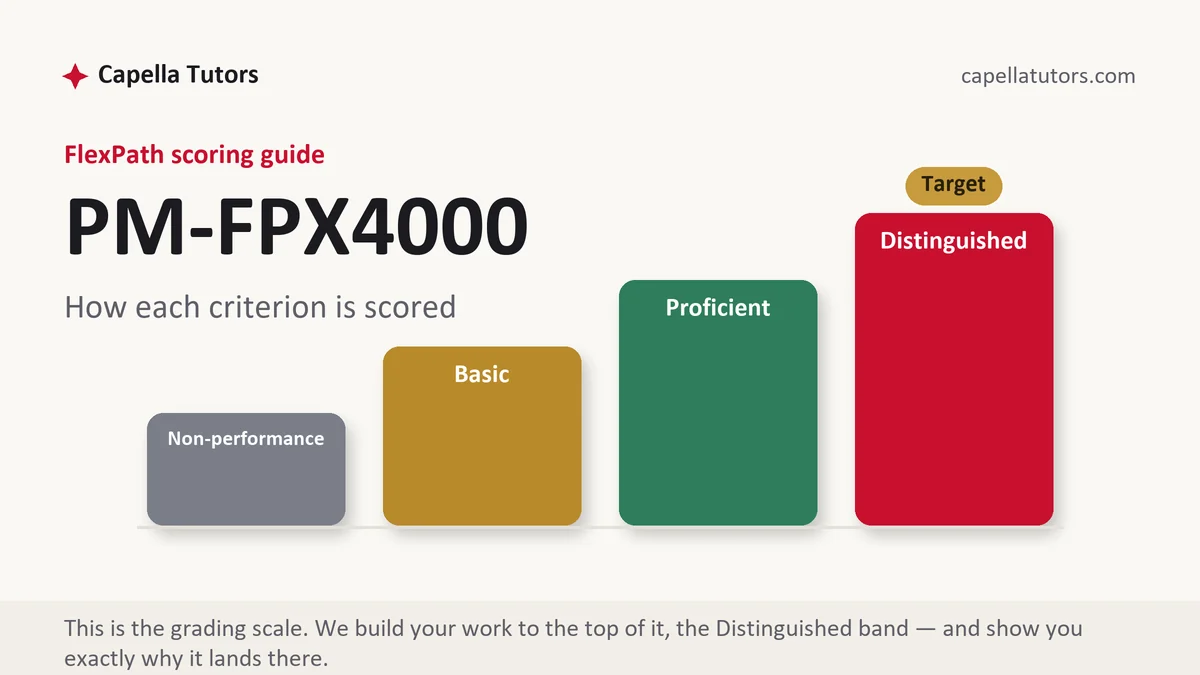
What PM FPX 4000 actually grades
This course is the map of the discipline, and the map has two axes that students collapse into one. Along one axis sit the stages of effort, initiating through closing, which describe when something happens. Along the other sit the subject areas, scope and schedule and cost and quality and resources and communications and risk and procurement and stakeholders, which describe what the work is about. Every real activity has a coordinate on both. Approving a supplier is a procurement matter happening in executing, and revising a budget after an approved change is a cost matter happening in monitoring and controlling. Criteria that ask you to classify are checking for both coordinates, and answers giving only one land in the middle of the scale no matter how well written they are.
The second thing graded is coverage without padding. A domains course asks you to demonstrate that you know what each area contributes, which tempts students into writing a paragraph of definition per area and calling it an analysis. Definitions earn nothing on their own. What earns the top column is showing what each area produces for one specific project and how those outputs connect: the scope statement feeding the breakdown, the breakdown feeding the estimates, the estimates feeding the baseline, the baseline feeding every variance figure reported afterwards. When a paper treats the areas as nine unrelated essays, the connective failure is visible in a page.
Third comes tailoring, which is where a 4000-level course separates itself from an introduction. No sensible manager applies every process to every project, so the criteria want a defended decision about what to use and what to leave out, based on the size, the risk, the regulatory exposure and how well the requirements are understood. That includes choosing a delivery approach. Predictive, iterative, incremental and hybrid arrangements each suit different conditions, and the answer the evaluator is looking for is a rationale rather than a preference. Alongside it sits measurement, since a domain about performance is asking for numbers that tell a sponsor whether to intervene, and uncertainty, which is where risk stops being a list and becomes a way of choosing between options that might not work.
How we help in this course
Give us the project, the prompt and any figures the scenario supplies, and the draft comes back organized the way the criteria are organized, one domain at a time, with a worked artifact under each rather than a definition. Where the assessment wants a comparison of delivery approaches, you get the conditions listed, the choice made and the switching point named. Where it wants performance reporting, you get the indices computed from the numbers in your scenario and a plain reading of what they mean for the sponsor.
The commercial terms do not change between courses. One premium original deliverable per assessment inside 24 to 48 hours, eight people between the research and the final proofread, one of whom does nothing except match the document against your uploaded scoring guide line by line, and a separate arithmetic pass on any table containing money or dates. Revisions cost nothing and have no cap, faculty feedback comes back into the same cycle free, and because two business days is the window an evaluator has for each attempt, we set your delivery date so a second attempt still fits comfortably inside the billing session.
The assessments, one by one
Assessment 1
This is the classification deliverable, and it is graded on coordinates rather than on definitions. Read the full Assessment 1 manual.
Assessment 2
This deliverable is where the course stops describing the discipline and asks you to choose from it. Read the full Assessment 2 manual.
Assessment 3
This is the deliverable with arithmetic an evaluator can check, which makes it the easiest one to score well and the easiest one to fail quietly. Read the full Assessment 3 manual.
How to actually write PM FPX 4000: where to begin
Start by deciding which project you will carry through every section, then refuse to change it. Domain assessments punish students who illustrate scope with a software rollout, cost with a construction example and risk with something from the reading, because the criteria are looking for integration and a shifting example makes integration impossible to demonstrate. The assessments in this course usually ask you to work across the domains for a single project, real or given, and your scoring guide decides whether that arrives as a report, a matrix, a set of short analyses or a briefing to a sponsor.
Write the tailoring decision as an argument with conditions attached. A twelve-week internal reporting upgrade with two part-time contributors and a known specification does not need a procurement plan, a formal change board or a risk register with forty entries, and saying so with reasons is stronger than producing all three badly. Set out the criteria you tailored against, note what you dropped, and name what would have to be true for you to add it back. That last sentence is the one that moves the criterion, because it proves the decision was reasoned rather than convenient.
Then make the measurement domain quantitative, since it is the only part of this course with arithmetic that can be checked. Take a project budgeted at 96,000 dollars over 16 weeks. At the end of week 6 the plan said 36,000 dollars of work should be finished, the work actually finished is worth 30,000, and 34,500 has been spent. The cost variance is 4,500 dollars unfavorable and the schedule variance is 6,000 dollars behind, which most drafts report and stop. Convert both to indices and they start talking: 30,000 over 34,500 gives a cost performance index of 0.87, so every dollar spent is buying 87 cents of progress, and 30,000 over 36,000 gives a schedule index of 0.83. Divide the budget by the cost index and the forecast at completion is roughly 110,400 dollars, an overrun near 14,400 if performance holds. Now say which index you would attack first and what you would tell the sponsor to approve. A page that produces the forecast and then makes a recommendation from it is answering the performance criterion completely.
Finish with uncertainty handled as decision-making rather than as a list. Rank the threats by exposure so the reader can see which ones justify spending money, and put a number on at least one: a supplier slipping two weeks on a path with no float costs whatever two weeks of the team costs, and that figure is what tells you how much a second supplier is worth. Say which opportunities you would chase as well as which threats you would fund, since the top column usually asks for both. Then name the assumption most likely to be wrong and show the plan still works if it moves, because a plan that survives one of its own assumptions failing is what a Distinguished descriptor is describing.
| Section | What goes in it | What Distinguished looks like |
|---|---|---|
| Project and context | The single project used throughout, its sponsor, its objective, its constraints and its environment. | One example carried across every domain, so the sections visibly describe the same work. |
| Domain map | Each subject area with what it contributes here, placed against the stage where the contribution happens. | Both coordinates named, with the output of one area shown feeding the input of the next. |
| Tailoring and approach | What was kept, what was dropped, the delivery approach chosen and the conditions behind the choice. | A rationale tied to requirement stability, change cost and customer availability, with a switching point stated. |
| Planning artifacts | The scope statement, breakdown, estimates and baseline that the later measurement depends on. | A chain of documents where each figure can be traced back to the artifact that produced it. |
| Measurement and control | The metrics, the variances, the indices, the forecast, and the threshold that triggers escalation. | Indices computed and interpreted, with a forecast and a named action rather than a table alone. |
| Uncertainty, governance and references | Ranked threats and opportunities with responses and owners, the decision rights, current APA both ways. | Exposure quantified for the top items, with the response priced against the loss it prevents. |
Developing the analysis
The honest version of this subject includes an argument about its own foundations, and saying so is worth marks. The dominant standards began as descriptions of process, accumulated detail through successive editions, and then moved toward principles and performance domains partly because practitioners complained that the process catalogue had become unusable on small projects. That history is a fact about committees rather than a finding from research, and treating a practice standard as though it were evidence is the most common weakness in papers at this level. The academic literature takes a different line, arguing that no single method fits every project and that the useful question is which conditions make which practices pay. Studies comparing structured and lighter governance generally find the benefit depends on complexity, novelty and the cost of a late change, which is exactly the argument your tailoring section should be making. Be careful with the certification bodies as evidence too. A qualification demonstrates familiarity with a vocabulary and not that the vocabulary produced a result, so cite the standard for terminology and the journals for outcomes, and keep the two roles apart in your writing.
Citations that survive faculty review
Cite frameworks at their origin and outcomes from research. The Project Management Institute standard and guide, named with the edition, is the reference for process vocabulary and domain structure, and ISO 21502 gives an alternative that is not owned by a membership body, which is useful when a criterion asks you to compare frameworks. Adaptive material has primary sources too, and they are short: the Agile Manifesto and the Scrum Guide are both available free from the people who wrote them, so quoting a consultancy paraphrase of either is an avoidable error. Empirical claims belong to the journals, with the International Journal of Project Management and Project Management Journal reachable through Business Source Complete and ABI/INFORM in the Capella library. Where you need sector figures, the Bureau of Labor Statistics carries employment and wage data by occupation, and a public company's filings on SEC EDGAR will describe capital programs in the company's own words. Keep certification exam guides and vendor tool documentation out of the reference list, then check current APA in both directions before submitting.
The mistakes that land Basic instead of Distinguished
- Definitions where analysis was asked for. Explaining what the risk area covers is not the same as showing what it produced for this project.
- A different example in every section. Integration cannot be demonstrated across projects that have nothing to do with each other.
- Tailoring asserted without conditions. Saying a process was not needed earns nothing unless you say what would make it needed.
- Variances reported without indices or a forecast. Two dollar figures describe the past, and the sponsor is asking about the finish.
- An approach chosen by preference. Naming agile or predictive without the requirement conditions behind it reads as a habit rather than a decision.
PM FPX 4000 questions students actually ask
What is the difference between a process group and a knowledge area?
One is when the work happens and the other is what the work is about, and they cross each other like rows and columns. Initiating, planning, executing, monitoring and controlling, and closing are stages of effort, and they repeat rather than run once. Scope, schedule, cost, quality, resources, communications, risk, procurement and stakeholders are subject areas, and each of them has something to do in several of those stages. Cost has planning work when you build the budget, executing work when you commit money, and controlling work when you compare the two. If a criterion asks you to map an activity, name both coordinates. Saying that estimating the budget is a planning process in the cost area answers the question. Saying it is planning answers half of it.
How do I choose between a predictive and an adaptive approach in the assessment?
Argue it from the requirements rather than from preference, because the criteria are testing the reasoning and not the answer. Ask three questions in writing. How well are the requirements known at the start, how expensive is a change once the work is under way, and how often can the customer actually look at something and react. Stable requirements with costly late change, such as a building fit-out or a regulated filing, point predictive. Requirements that will be discovered, with cheap iteration and an available customer, point adaptive. Most real projects answer differently for different parts, which is why a hybrid is a legitimate recommendation as long as you say which component uses which and why. State the condition that would make you switch, and the criterion is answered at the top level.
Do I have to use the terminology from the newest edition of the standard?
Use whichever edition your course materials use, name it, and stay inside it for the whole document. The vocabulary has shifted over successive editions, most visibly from a process-heavy structure toward principles and performance domains, and a paper that mixes the two reads as though it was assembled from search results. Consistency is what an evaluator can see. If your scoring guide names a domain and your course reader still teaches knowledge areas, write to the scoring guide and add one sentence noting that the area maps onto the domain, which shows you know both rather than that you confused them. Cite the edition in the reference list so the reader can check the terms you are using against the source you are using.
Domain analysis or tailoring paper due?
Send the scenario and the criteria. We will carry one project across every domain and compute the performance figures. First premium sample free.