Send the prompt and the scoring guide, and a premium original sample comes back inside 24 to 48 hours, drafted against the Distinguished descriptors, checked by a second reader who does nothing but match paragraphs to criteria, and revised free until the score lands. The transcript entry is BUS FPX 4011, Virtual Team Collaboration, carrying 3 program points inside the Management and Leadership specialization of the FlexPath BS in Business. That degree asks for at least 90 program points overall, and no fewer than 27 of them must sit at the 3000 level or higher, which this course does. In Capella's catalog the course code is written BUS-FPX4011.
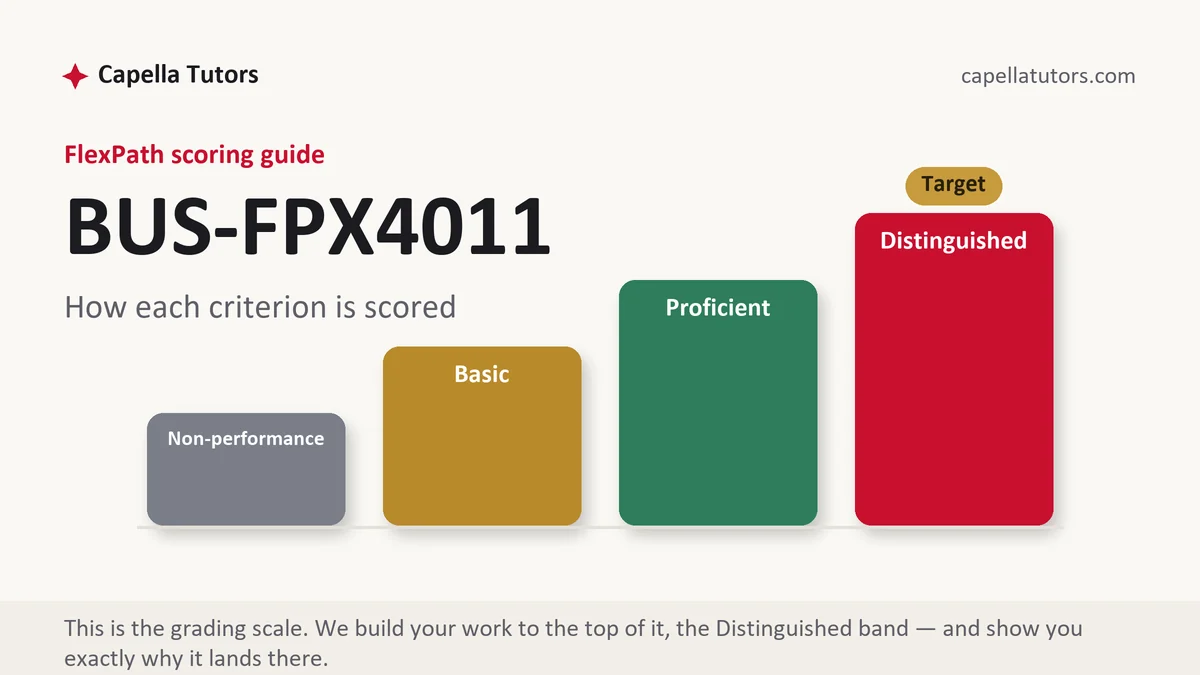
What BUS FPX 4011 actually grades
The subject of this course is a team that never shares a room, and the criteria are written to find out whether you understand why that changes the work rather than just the tooling. A co-located team repairs itself constantly through accident. Somebody overhears a wrong assumption and corrects it, a puzzled expression stops a bad plan, a two-minute conversation at a desk replaces an email thread that would have run three days. Strip those accidents out and every repair has to be designed on purpose. Assessments here reward the student who can name the specific accident that has gone missing and replace it with a stated practice.
Communication mode is the first thing graded, and most drafts treat it as a matter of taste. It is a matter of cost. Synchronous contact buys you speed and reading of tone, and it charges everybody the same hour regardless of how much of the meeting concerns them. Asynchronous contact buys you a record, time to think, and participation from people six hours out of phase, and it charges you latency measured in working days. A team spread from Manila to Denver has perhaps two overlapping working hours, so a decision that needs three rounds of back and forth costs a week if it runs by email and ninety minutes if it runs in one scheduled call. Say which mode each kind of work gets and why, and half the communication criterion is already answered.
Trust is the second strand, and it behaves differently at a distance. Face to face, trust grows slowly out of familiarity. On a virtual team it usually starts high, borrowed from role and reputation, then erodes the first time somebody goes quiet for two days. That fragility is why responsiveness norms matter more than personality. A team that agrees a message will be acknowledged within one business day has converted an unspoken expectation into something a member can be held to, and silence stops being read as indifference. Expect the criteria to look for norms of that shape rather than for a sentence saying trust is important.
The last strand is disagreement, which virtual teams handle badly by default. Written conflict escalates because the reader supplies the tone, and a terse reply sent at eleven at night reads as anger to somebody who cannot see the sender was simply tired. Task disagreement is useful and relationship friction is not, and the distance between them is short when everything is in text. A strong paper proposes a rule for moving a thread to a call once it passes a set number of exchanges, names who has authority to make the call, and says how the outcome gets written back into the record so the people who were asleep can see what was decided.
How we help in this course
Work on 4011 starts with your actual team, if you have one. Tell us the countries, the working hours, the tools your employer has already licensed, and who reports to whom, and the deliverable will describe that arrangement rather than a generic distributed team from a textbook. If the assessment supplies a scenario instead, we hold every later recommendation to the details in that scenario, because the fastest way to lose a criterion here is to propose a daily stand-up for a team the prompt says spans eleven time zones.
The commercial terms are the same as everywhere else in the studio. One premium original deliverable inside 24 to 48 hours, an eight-person pipeline running from brief to finished file, a dedicated reviewer reading only for the scoring guide, and unlimited revision at no charge until the criteria are met. Faculty feedback comes back into the same cycle free. Since an evaluator has two business days to return a verdict on a submitted attempt, we schedule the work so a resubmission still fits comfortably inside your 12-week billing session.
The assessments, one by one
Assessment 1: Success Factors in Virtual Collaboration
Analyze how an organization supports virtual teams through HR policies, training, standard processes, collaboration technology, culture and leadership. Read the full Assessment 1 manual.
Assessment 2: Communications and Technology
Assessment 2 of BUS FPX 4011, Virtual Team Collaboration, is the design deliverable: having read a distributed team, you now write the rules it will run on, channel by channel, with response expectations and decision rights attached. Read the full Assessment 2 manual.
Assessment 3: Leadership and Trust in Virtual Teams
The elements of virtual team success, behaviors that build and undermine trust, and principles of effective virtual leadership. Read the full Assessment 3 manual.
How to actually write BUS FPX 4011: where to begin
Turn the scoring guide into your outline before you write a word of prose. Copy each criterion into the document as a heading, paste the Distinguished wording underneath it in a colour you will delete later, then write only into those headings. In current courserooms the assessments include "Success Factors in Virtual Collaboration", "Communications and Technology" and "Leadership and Trust in Virtual Teams" among others, and your scoring guide decides the exact format of each. Any paragraph you cannot file under a heading is a paragraph nobody is grading.
Then write the coordination arithmetic down, because it is the part that separates a real recommendation from a wish. Take a five-person team sitting in Manila, Warsaw, London and Denver. Manila and Denver share no ordinary working hours at all, London and Warsaw overlap almost completely, and the widest window everybody can reach without somebody working at midnight is about one hour. That single fact decides everything downstream. It means the weekly synchronous meeting is expensive and has to be reserved for decisions rather than status, it means status travels in writing, and it means a rotating meeting time is a fairness question you should raise before somebody else does. Put the numbers in the paper. A reader can check an overlap window and cannot check an adjective.
Design the handoff next. Distributed work only gets faster than co-located work when a piece of it moves while its owner sleeps, and that requires the handoff to carry everything the next person needs. Say what the artifact is, where it lives, what state it must be in before it moves, and what the receiver does if it arrives incomplete. A team that hands off through a shared document with a written status line loses hours. A team that hands off through a chat message loses a day every time somebody misses it. This is where a criterion about technology gets answered properly, since the tool matters far less than the rule attached to it.
Close on accountability, which is where these papers usually thin out. Name the decisions the team makes together and the decisions one person makes alone, because consensus at a distance is slow enough to stall a project. Set a response expectation with a number attached, set an escalation path, and say how work gets seen without anybody being watched. Then say what you will measure. Cycle time on handoffs, the proportion of decisions made without a meeting, and how long threads run before they are resolved are all observable, and a recommendation with an observable measure beside it reads as management rather than opinion.
| Section | What goes in it | What Distinguished looks like |
|---|---|---|
| Team and context | Who is on the team, where they sit, the hours they work, the reporting lines, and what the team is being asked to produce. | Time zones stated as a real overlap window in hours, with the constraint that creates named explicitly. |
| Diagnosis | The coordination problems present, separated into communication, trust, technology and accountability. | Each problem tied to a specific feature of the arrangement rather than to distributed work in general. |
| Communication plan | Which exchanges are synchronous, which are written, the cadence of each, and the channel assigned to each purpose. | Mode chosen for a reason the reader can test, with the cost of each choice acknowledged. |
| Norms and trust | Response expectations, availability signalling, meeting conduct, and how new members are brought in. | Norms written as behaviours somebody can be held to, not as values on a list. |
| Conflict and decisions | How disagreement is surfaced, who decides what, and the route from a stalled thread to a resolution. | A stated trigger for escalation and a named decision owner for each class of decision. |
| Measures and references | What will be tracked, who reviews it, on what cycle, plus current APA in both directions. | Measures the team can actually observe, with a review point set before the plan is written. |
Developing the analysis
The research on distributed work is not one settled body, and treating it as one is what keeps a paper in the middle columns. Studies of virtual team performance are split between laboratory work with student teams assembled for an afternoon and field studies of real organizational teams, and those two designs answer different questions. A lab finding that text-only groups reach worse decisions tells you something about strangers with no shared history and very little about an engineering team that has worked together for three years and simply sits in four countries. The media richness argument, that leaner channels suit simpler messages, is a useful starting frame and has been complicated repeatedly by evidence that experienced teams adapt lean channels to rich purposes given time. Use that tension rather than hiding it. State which condition your team resembles, cite work matching that condition, and say plainly where the evidence you are leaning on came from a setting unlike yours. Then commit to a recommendation anyway, since a paper that catalogues caveats and declines to advise anybody reads as evasion, and the Distinguished column is describing judgment rather than caution.
Citations that survive faculty review
Peer-reviewed management and organizational behaviour journals reached through the Capella library, principally Business Source Complete and ABI/INFORM, carry the evidence for anything you claim about how teams behave, and a search filtered to the last five years will keep you clear of findings written before remote work became ordinary. Frameworks belong to their originators, so cite the author who proposed a model rather than the textbook chapter summarising it, and if you are naming stages of team formation or a set of cultural dimensions, the primary work is what a faculty member checks. Practitioner bodies supply defensible norms and survey data, with the Society for Human Resource Management useful on remote policy and the Bureau of Labor Statistics useful for anything about how much of the workforce actually works from home, since that figure is widely misquoted. Vendor material from collaboration software companies can describe what a tool does and should never be cited for whether it works, because the publisher sells the answer. Keep consultancy blog posts out of the reference list entirely. Then run current APA in both directions, confirming every in-text citation appears in the list and every entry in the list appears in the text.
The mistakes that land Basic instead of Distinguished
- A plan with no time zones in it. Distributed coordination is arithmetic before it is anything else, and a plan that never states the overlap window has not engaged the problem.
- Tools listed instead of practices designed. Naming a chat platform and a video service is inventory, and the criterion is asking what rule governs their use.
- Everything scheduled synchronously. A daily meeting across a wide spread means somebody is always working at an unreasonable hour, and the paper never says who.
- Trust treated as a personality outcome. Reliability at a distance comes from responsiveness norms and visible progress, not from warmth.
- No decision rights assigned. A team where every question needs everybody stalls at the first disagreement, and the plan should have said who decides.
BUS FPX 4011 questions students actually ask
How do I write this if I have never worked on a virtual team?
Use a team you have been part of and move it, in writing, to a distributed arrangement. Take a group you know well, a shift team, a committee, a project at a previous employer, then place its members in three locations and work out what breaks. The status conversation that happened in a corridor now needs somewhere to live. The manager who could see who was struggling now needs a signal. The quick decision made by two people standing up now involves waiting for somebody to wake up. That exercise gives you concrete material, and stating openly that the scenario is constructed costs nothing, since the criteria assess your analysis rather than your employment history. What loses points is a paper about a team so vague the reader cannot tell how many people are on it.
Does the assessment want a team charter or a report?
Your scoring guide decides, and the two are not interchangeable. A charter is written to the team in the second person and states what members will do, so it holds norms, response times, meeting rules, decision rights and an escalation path. A report is written to a manager about the team and holds diagnosis, options, a recommendation and support for it. Read the criteria for the verb. Words like establish, define or agree point at a charter, while analyze, evaluate or recommend point at a report. When a prompt asks for both, write the report and attach the charter as a labelled section rather than mixing the two registers, because a document that switches between advising a manager and instructing a team reads as unfinished.
How much does the technology choice actually matter to the grade?
Less than students expect. Criteria about technology are usually asking whether you matched a channel to a purpose, not whether you picked the fashionable product. A defensible answer sorts communication into a few types, then assigns each one a home and a rule: decisions in a scheduled call with a written summary posted afterwards, status in a shared document updated before a stated cutoff, quick questions in chat with an acknowledgement expected inside a working day, anything needing a record in email. Add one sentence on what the organization already licenses, since a recommendation that requires new procurement is a recommendation nobody implements. Name products if you like, but the marks live in the rules attached to them.
Virtual team deliverable due?
Send the prompt, the criteria and the shape of your team. We will build the overlap window, the handoff design and the norms around it. First premium sample free.