Send the prompt and the scoring guide and a premium original sample returns inside 24 to 48 hours with the iterative artifacts genuinely built, a backlog whose items carry acceptance criteria, a sprint plan sized against real capacity, a forecast expressed as a range with the arithmetic shown, and a definition of done that means something, with free revision until the criteria are met. On the transcript this is PM FPX 4080, Agile Project Management, worth 3 program points inside the Project Management specialization of the FlexPath BS in Business, a degree of at least 90 program points that requires a minimum of 27 at the 3000 level or above. The PM-FPX codes are shared with Capella's information technology programs, which is why this course is populated by students from two different degrees. In Capella's catalog the course code is written PM-FPX4080.
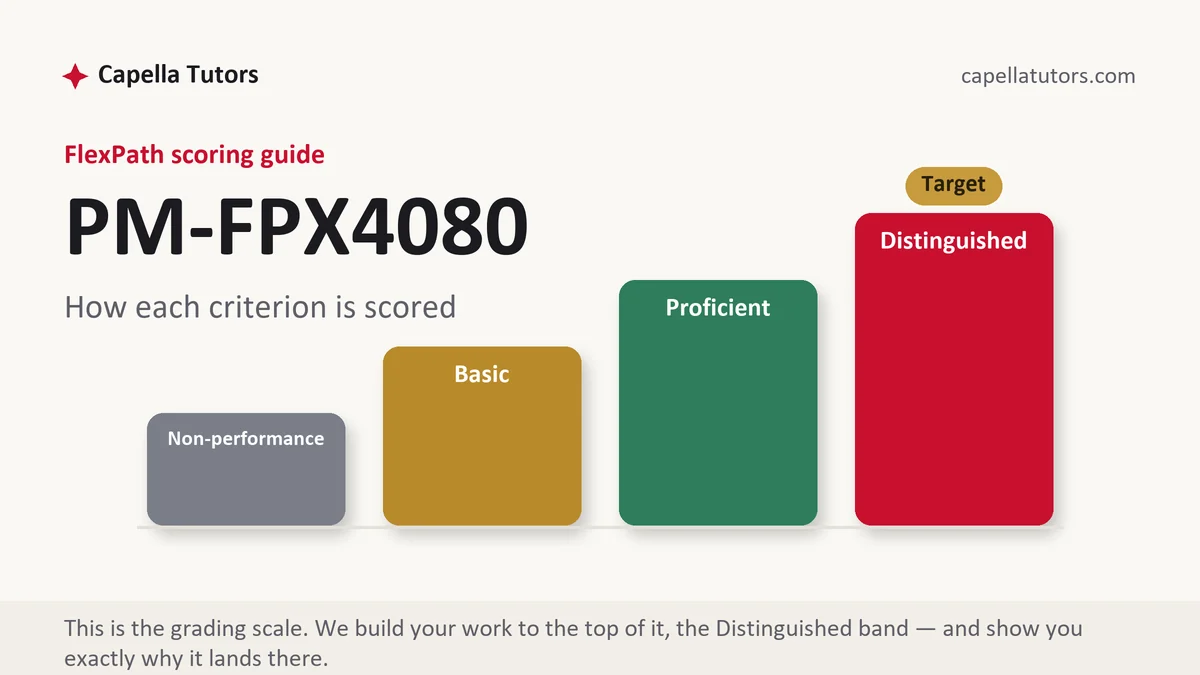
What PM FPX 4080 actually grades
The first criterion is usually suitability, and it catches submissions that treat iterative delivery as obviously superior. An approach is a choice, and the graded version of that choice compares the work in front of you against the conditions each approach needs. Iterative delivery earns its keep when requirements are genuinely uncertain, when the customer can be available continuously, and when working increments can be released and learned from. It struggles when the deliverable is physical and sequential, when a regulator requires the specification approved before build, or when the customer representative is a committee that meets monthly. Saying which of those conditions your scenario satisfies, and which it does not, is the whole criterion.
The artifacts are graded on craft rather than on presence. A backlog item is not a task list entry, it is a statement of who needs something, what they need and why, with acceptance criteria specific enough that two people would agree whether the work is finished. Items should be independent enough to reorder, small enough to finish inside an iteration, and valuable enough that somebody would notice their absence. A definition of done applies to every item and covers the things people quietly skip, meaning tested, reviewed, documented and deployable, and it is the artifact that makes the word complete mean the same thing twice.
Planning and events are graded on mechanics. Iteration planning starts from capacity rather than ambition, which means counting the hours the team actually has after leave, support duties and meetings, then committing to work that fits. The review demonstrates working output to the people who asked for it and collects their reaction, the retrospective examines how the team worked and produces improvements with owners, and confusing the two is a common and visible error. Roles carry authority: somebody owns priority order, somebody owns the process, and the team owns how the work gets done.
Last is reporting, because these courses sit inside a business degree and the sponsor still wants a date and a number. Progress measured by accepted items rather than by effort spent, a forecast that shows uncertainty as a range, and a chart that reveals added scope instead of hiding it are what the top column is describing.
How we help in this course
Give us the product or project in the prompt and the drafts come back with the backlog written rather than gestured at, each item carrying acceptance criteria in a testable form, sized relative to a reference item so the numbers are internally consistent, and ordered with a stated reason for the order. Sprint plans are built from a capacity figure we show you, forecasts are ranges with the velocity arithmetic visible, and any chart described in the paper is described accurately enough that you could draw it. If the assessment wants a comparison against a plan-driven approach or a hybrid governance model, the argument is made from the conditions of your scenario rather than from enthusiasm.
Delivery works the same way here as on every other course we cover. One premium original deliverable inside 24 to 48 hours, eight people from research to final proofread, a reviewer checking the document against your scoring guide criterion by criterion, and unlimited free revision until it lands. Faculty comments are worked in without a new invoice. Evaluators have two business days on a submitted attempt, so the schedule we work to leaves room for one resubmission inside the same 12-week billing session, and we will pace two courses at once if that is how you are running your term.
The assessments, one by one
Assessment 1: Comparing Agile to Waterfall
The first criterion in this course catches submissions that treat iterative delivery as obviously better. Read the full Assessment 1 manual.
Assessment 2: Comparing Agile Methodologies
Explain how methods such as Scrum and Extreme Programming reflect the Agile Manifesto, compare their principles and practices, and how each uses people. Read the full Assessment 2 manual.
Assessment 3: Project Schedule and Product Backlog
These courses sit inside a business degree, so a sponsor still wants a date and a number, and this deliverable is where iterative work has to answer both honestly. Read the full Assessment 3 manual.
How to actually write PM FPX 4080: where to begin
Read the scoring guide and work out which artifacts it wants, because a paper about agile values earns far less than a paper containing a real backlog. In current courserooms the assessments include "Comparing Agile to Waterfall", "Comparing Agile Methodologies" and "Project Schedule and Product Backlog" among others, and your scoring guide decides the exact format of each.
Write the items properly, because everything downstream inherits their quality. Name the person who benefits, the thing they need and the reason it matters, then attach acceptance criteria that describe an observable outcome: given a teller with an open till, when a refund above the approval limit is entered, then the transaction is held and the duty manager is notified. Criteria in that shape can be tested, demonstrated at a review and argued about before the work starts rather than after. Split anything too large to finish in one iteration, and split it by outcome rather than by technical layer, since half a feature that nobody can use is not a delivery. Order the backlog by value against effort and say why the top three are on top, because a backlog with no stated ordering logic is a wish list.
Then forecast honestly, which means a range and not a date. Five completed iterations delivered 26, 31, 22, 34 and 29 points, an average of 28.4. With 284 points remaining in the release backlog, the average says ten more iterations, the slowest observed rate says thirteen and the fastest says nine, so at two weeks each the honest forecast is eighteen to twenty six weeks with twenty weeks as the planning number. Then say what would narrow the range: a stable team, scope removed from the release, or two more iterations of data. A submission that reports a single date from an average velocity has hidden the uncertainty the technique exists to reveal, and the criterion notices.
Then handle the reporting question this business degree cares about, which is how iterative progress translates for a sponsor who thinks in budgets. Earned value still works if you agree what counts as earned. Take a release budget of $336,000 and a backlog of 480 points, which prices a point at $700 for planning purposes. After six iterations the team has 168 accepted points, so the value earned is $117,600 while the actual cost of those six iterations is $148,000. The cost performance index is 0.79 and the release is trending toward roughly $423,000. Two cautions belong in the same paragraph. Points are relative rather than absolute, so the price per point drifts as a team calibrates, and scope added mid-release changes the denominator, which is why a chart that plots completed work against a moving total scope line tells the truth better than one that only counts work remaining. A paper that reports the index and then names both cautions has done the interpretive work the top column asks for.
Finish with quality and with the end of the release, since both are graded and both are usually thin. Technical quality is a schedule item in iterative delivery, not a phase, so say what the team does inside every iteration to keep the increment releasable, and be specific about the cost of not doing it, because deferred defects and shortcuts compound into a slowdown that shows up as falling velocity rather than as a visible problem. Retrospectives count only if they produce a small number of changes with an owner and an iteration by which they will be visible. Then plan the release itself: what is trained, who supports it afterwards, what the rollback plan is, and which measure you will read two weeks after go live to know whether the thing was worth building. That last question is the one iterative delivery is supposed to be good at answering, and most submissions never ask it.
| Section | What goes in it | What Distinguished looks like |
|---|---|---|
| Approach selection | The nature of the work, requirement volatility, customer availability, and the approach chosen. | The choice argued against the conditions each approach needs, including the conditions this project fails. |
| Backlog and items | Items written from the user's position, ordered, with testable acceptance criteria and a definition of done. | Acceptance criteria two readers would score identically, and an ordering rule stated rather than implied. |
| Iteration planning | Capacity in hours or points, the commitment, the sizing method, and the goal for the iteration. | Commitment derived from measured capacity, with the sizing anchored to a named reference item. |
| Forecasting and reporting | Velocity history, the remaining work, the forecast, and the charts used to show progress. | A forecast given as a range with its arithmetic shown and the conditions that would narrow it. |
| Quality and technical practice | What keeps the increment releasable, how defects are handled, and how shortcuts are tracked. | Quality work scheduled inside every iteration, with the cost of deferring it stated in delivery terms. |
| Retrospective, release and references | Improvement actions with owners, the release plan, support handover, and current APA both ways. | A small number of improvements with owners and a dated release plan carrying one post-release measure. |
Developing the analysis
Be exact about what kind of document each of your sources is, because this field mixes manifestos, framework guides and research and grades you on telling them apart. The 2001 manifesto is a short statement of values written by seventeen named practitioners, and it is a primary source for what they asserted rather than evidence that the assertions hold. Framework guides are prescriptive documents revised by their owners on their own schedule, so cite the version and the year, since a claim about what a framework requires can be true of one edition and false of the next. Numbers claiming that iterative delivery succeeds several times more often than plan-driven delivery come from association and vendor surveys whose respondents opt in, whose projects are self reported and whose definition of success moves between editions, so name the report, the year and the sample or drop the claim entirely. The peer-reviewed empirical work is more careful and more interesting, particularly the studies finding that team stability and colocation explain much of the benefit attributed to method, and the persistent finding that velocity is a capacity observation rather than a productivity measure, which means comparing two teams by it is meaningless and rewarding a team for raising it produces inflated estimates within two iterations. One more honest limitation belongs in a strong paper: most published evidence comes from software, so a submission applying iterative delivery to construction, clinical operations or a marketing program should say which parts transfer and which do not.
Citations that survive faculty review
Five categories serve this paper. The manifesto and the framework guides are primary documents, cited with author or owner, version and year. Peer-reviewed research belongs in the argument wherever you claim an effect, and the Capella library reaches IEEE Xplore and the ACM Digital Library for empirical software engineering work alongside Business Source Complete and ABI/INFORM for the management side. Professional practice standards remain relevant even here, since the practice guides published for iterative and hybrid delivery are the bridge between this course and the rest of the specialization and are the right citation for governance in a regulated setting. Techniques get attributed to whoever introduced them, so the user story format, relative estimating by planning poker and the burnup and burndown conventions each go to their original author or publication rather than to a tool's help page. Tool documentation is citable for one thing only, which is how that tool behaves. Consultancy transformation reports and coaching blogs are marketing, and a certification exam site is never a source. Where your scenario is your own workplace, name and date the internal artifacts you draw on, and remove anything confidential. Then run current APA in both directions and make sure any velocity or cost figure in the paper is traceable to a stated assumption.
The mistakes that land Basic instead of Distinguished
- Agile asserted rather than argued. Calling the approach flexible and modern skips the suitability criterion, which wants the conditions of this project tested.
- Backlog items with no acceptance criteria. Without a testable outcome the review has nothing to accept and the definition of done has nothing to apply to.
- Velocity presented as a productivity target. It measures how much this team completes in an iteration, and turning it into a goal inflates estimates instead of output.
- A single date forecast from an average. Reporting one finish date from one average discards the range that makes the technique worth using.
- Reviews and retrospectives treated as one meeting. One inspects the product with the people who wanted it, the other inspects the way of working, and merging them loses both.
PM FPX 4080 questions students actually ask
Is agile the right answer for the scenario I was given?
Sometimes, and the paper is stronger when you say where it is not. Ask four questions of the scenario. Are the requirements likely to change as people see working output, or are they fixed by a contract, a regulation or physics. Can somebody with authority to decide priorities be available every week, or does that authority sit with a committee. Can the work be delivered in slices that are individually usable, or does value only arrive at the end, as with a building or a single migration. Does the organization tolerate a plan that commits to a direction rather than to a date. Two or three yes answers point to iterative delivery, one or none points to a plan-driven approach, and a split points to a hybrid where the phases are sequential and the build inside them is iterative. Write the answers, then choose, and the criterion asking you to justify the approach has been answered with evidence from the scenario rather than with preference.
How do I estimate in story points with no real team?
Anchor to a reference item and stay internally consistent, which is all a grader can check anyway. Pick one small, well understood item from your backlog and declare it two points, then size everything else against it by asking whether an item is about the same, roughly double, or several times larger, using a spaced scale so you are not pretending to a precision you do not have. Never convert points to hours in the paper, because the moment you do, the estimate stops being relative and starts being a promise. State the assumption behind the velocity you then use, whether that is a stated figure from the scenario, an assumption about a team of a given size, or an observation from the first iterations you describe. Then show the forecast as a range. Faculty are grading whether you understand relative sizing and empirical forecasting, not whether your invented team is fast.
What do I put in a burndown chart if the project is hypothetical?
Plausible data with the assumptions stated, and preferably a burnup instead. Describe the axes precisely: iterations along the bottom, work remaining or work completed up the side, an ideal line for reference and an actual line that behaves like real work, which means it is flat for a few days, drops when items are accepted, and occasionally rises. A burnup adds a second line for total scope, and when that line moves the chart shows the reader that scope was added rather than that the team slowed down, which is exactly the distinction a sponsor needs and the reason it is the better choice for an assessment. Say in one line where the numbers came from, then interpret the picture instead of leaving it to speak for itself: name the iteration where the gap opened, give the likely cause from your own scenario, and say what you would change next.
Backlog, sprint plan or release forecast due?
Send the prompt and the scoring guide, and the items come back carrying testable acceptance criteria, sized against one reference item, with the release forecast given as a range and its arithmetic in view. First premium sample free.