Hand over the prompt and the scoring guide for anything this course asks you to submit, and a premium original sample returns within 24 to 48 hours, written against the Distinguished wording in your own rubric and read by a second person before it reaches your inbox. The registrar lists it as BUS FPX 1011, Management Fundamentals, a 1.5-point core requirement inside the BS in Business, delivered in FlexPath as part of a 90-point degree that expects at least 27 of those points at the 3000 level or higher. In Capella's catalog the course code is written BUS-FPX1011.
What BUS FPX 1011 actually grades
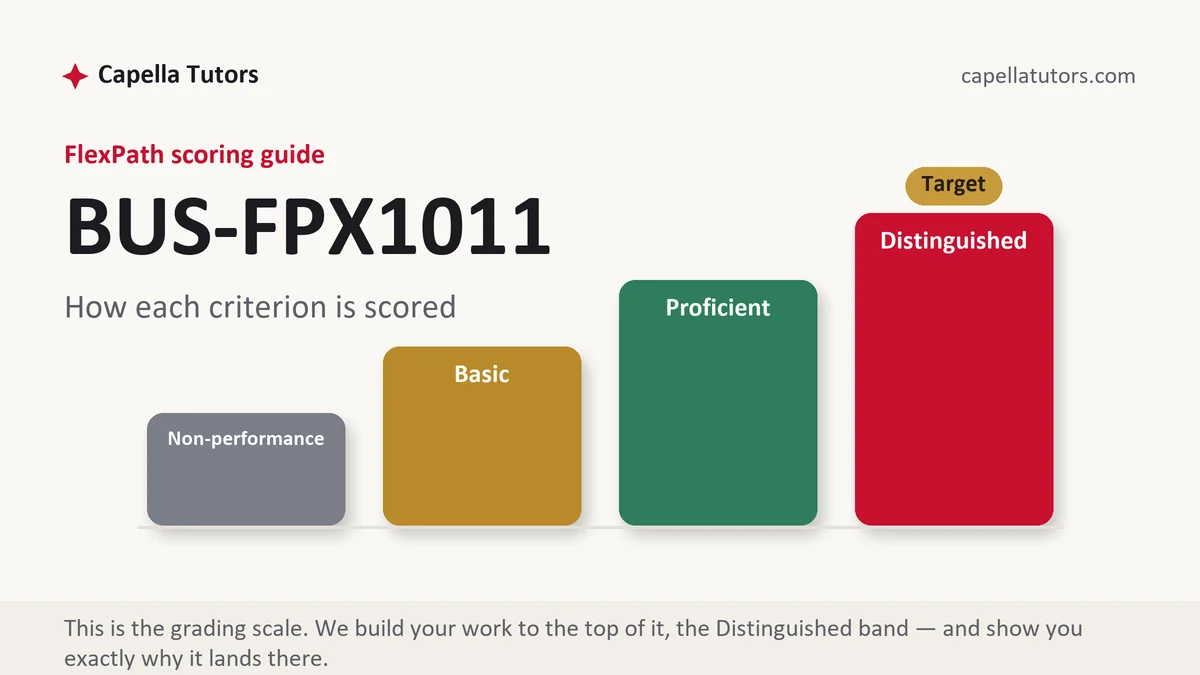
Management Fundamentals is where the degree stops treating management as a job title and starts treating it as a set of activities somebody can watch you perform. The assessments in this course usually hand you a workplace situation and ask what a manager should do about it, so the criteria read for three things at once: the function you are operating in, the framework you are operating with, and the decision you actually reached. A Basic response defines planning, organizing, leading, and controlling accurately and stops there. The column above it shows one of those functions running inside a named unit, with a resource committed and a result someone could check.
Vocabulary carries more weight here than beginners expect, because the terms are the criteria. Span of control, delegation as against abdication, line authority as against staff authority, centralization, departmentalization, and the gap between an objective and an aspiration all appear as graded language. Controlling is the function students describe worst. Control is a loop with four parts: a standard set in advance, a measurement taken against it, a comparison, and a corrective action. A supervisor who reports that order accuracy improved has not controlled anything. A supervisor who set a standard of 98 percent accuracy, measured 94.2 percent across four weeks and 1,860 orders, traced the gap to a labeling step performed at the end of a shift, moved that step earlier, and then measured again has run the loop and can be graded on it.
The third strand is attribution. Introductory management runs on borrowed ideas, and faculty grade whether you know whose ideas they are. The administrative functions come from Fayol, the time and motion tradition from Taylor, the finding that attention and social conditions move output from the Hawthorne studies, and the observation that real managerial days are short, fragmented, and verbal rather than reflective from Mintzberg's account of managerial roles. Naming the source is half of it. The other half is the contingency point that none of this works everywhere, so a paper recommending a wider span of control owes a sentence on what makes the work routine enough to supervise that way.
How we help in this course
Our 1011 samples are written around whatever workplace you give us. Tell us the unit, the headcount, what it produces, and who reports to whom, and the draft applies the function your criterion names to that unit rather than to a generic company. Every framework in the sample is attributed to the person who built it and dated, every recommendation carries a cost or a time commitment, and any control you propose arrives with the standard it will be measured against.
The terms are the same ones every course on this site runs on. Work returns inside 24 to 48 hours, pitched at the Distinguished column, after eight people have handled it. A research analyst reads your scoring guide and pulls the management sources the criteria imply, a subject writer drafts, a scoring-guide reviewer scores the draft row by row the way a Capella evaluator will, an APA and originality pass reconciles every citation against the reference list in both directions, and an editor reads last for sense and structure. Revision is free until the work clears the guide, and faculty feedback re-enters the same cycle at no charge.
The assessments, one by one
Assessment 1
Act as a manager organizing an event or initiative, describe the characteristics and behaviors of effective managers. Read the full Assessment 1 manual.
Assessment 2
Examine the characteristics, behaviors and strategies an effective sales manager needs to increase sales, using management principles and evidence. Read the full Assessment 2 manual.
Assessment 3
The closing deliverable in Management Fundamentals usually asks you to pull the course together around one management problem, and the controlling function is almost always what carries it: a standard set in advance, a measurement taken against it, a comparison, and a correction. Read the full Assessment 3 manual.
How to actually write BUS FPX 1011: where to begin
Build the document out of the scoring guide before you write a word of prose. Copy each criterion into an empty file as a heading, drop the Distinguished sentence underneath it in square brackets, and write nothing that does not sit under one of those headings. Introductory management criteria almost always pair two verbs in the same row, something like describe and apply, or identify and evaluate, and the applied verb is where the marks live. If a row asks you to explain a function and assess its use in an organization, you owe two things under that heading, and a paper that answers only the first is capped no matter how well it is written.
Read the prompt the way you would read an invoice. Underline every verb addressed to you, count them, and give each one a paragraph with its own topic sentence. Business prompts routinely hide three tasks inside a single sentence, and students answer the easiest one and lose the other two. A prompt asking you to identify a management challenge in your organization, apply a relevant framework, and recommend an action contains three graded pieces, and the recommendation is the piece most often reduced to a closing line.
Here is the same paragraph written twice. The weak version says planning matters because it gives the organization direction and helps managers set goals. The version that earns the top column says a fourteen-person inbound service desk set a quarterly objective of answering 80 percent of calls within 30 seconds, committed two additional part-time positions and a revised break rotation to reach it, tracked the figure weekly against a baseline of 61 percent, and would release the second position if the number held above target for six consecutive weeks. Same function, but now there is a horizon, a resource, a measure, and an exit condition, which is what an evaluator means by application.
| Section | What goes in it | What Distinguished looks like |
|---|---|---|
| The situation | The organization, the unit, the people involved, and the problem stated as something observable. | Enough operational detail that a reader could picture the unit and check the claim. |
| The function at issue | Which of planning, organizing, leading, or controlling the situation belongs to, and why. | One function named and defended, with a reason the others are secondary here. |
| The framework | The model applied, its originator, and the conditions under which it holds. | The framework attributed to its source and bounded, not offered as universal advice. |
| Evidence | Counts, dates, or observations showing the problem exists rather than asserting it. | Two or three figures, each with the period and the population they describe. |
| The recommendation | The action, who performs it, what it costs in money or hours, and when it starts. | A named owner, a start date, and the measure that will say whether it worked. |
| Sources and format | Peer-reviewed management work and original statements of the frameworks, in current APA. | Original works cited directly, with the reference list and the text agreeing both ways. |
Developing the analysis
Management theory does not agree with itself, and noticing that is worth a criterion. One lineage descends from Taylor and treats work as something that can be measured, standardized, and improved from outside the job. A second descends from the Hawthorne studies and the human relations writers who followed, and treats output as a function of attention, group norms, and how people read their supervisor. A third, the contingency tradition, refuses both and argues that the right structure depends on the technology, the size of the unit, and how stable the surroundings are. Mintzberg's observational work sits uncomfortably beside all of them, because the managers he watched spent their days in short verbal exchanges rather than in the orderly cycle of planning and controlling that textbooks describe. Nobody expects you to resolve that in a lower-division paper. You are expected to say which tradition your recommendation comes from, and to add a sentence naming what somebody from a different tradition would do instead. Two sentences of that read as thinking, and they move a criterion more reliably than another paragraph of description.
Citations that survive faculty review
Three kinds of source do three different jobs here, and mixing them up is the most common citation problem in the course. Original statements of a framework carry the idea itself, so cite Mintzberg's own account of managerial work, Fayol on the administrative functions, or Herzberg on motivation, rather than a textbook chapter summarizing them, because a summary of a summary is what a Basic reference list looks like. Peer-reviewed management and organizational behavior journals, retrieved through the Capella library and Business Source Complete rather than through a general search, carry the evidence that a practice works, and every claim about an outcome should come from there. Applied material, meaning Bureau of Labor Statistics occupational data, professional bodies such as SHRM, and published company reporting, carries the facts about your setting. One habit protects the whole list: if you cannot say what the author actually did to produce the claim you are citing, you are citing a summary. Then run the two-way check in current APA, every in-text citation present in the list and every entry cited somewhere in the text.
The mistakes that land Basic instead of Distinguished
- Defining a function instead of showing it run. The definition is the setup, and on its own it sits in the Basic column.
- A framework with no owner. An idea presented as common knowledge is an idea the evaluator cannot verify.
- Control with no standard. Improvement claimed against no baseline is an opinion about the past.
- Leadership language inside a management row. Influence and motivation belong to BUS FPX 2012, and borrowing them here leaves the actual criterion unanswered.
- One source carrying the whole paper. A single textbook cited eleven times reads as one reading rather than as research.
BUS FPX 1011 questions students actually ask
I do not have a management job. Can I still use my own workplace?
Yes, and it usually produces a better paper than a company you researched. What the criteria need is not authority, it is observation: a unit you can describe, a decision somebody made, a resource that got committed, and an outcome you watched. A shift lead, a team coordinator, a volunteer committee, or the department sitting next to yours all supply that. Keep names and confidential figures out, say in one line that identifying details have been changed, and label any number you estimated rather than read off a report. Faculty are not checking whether you run the department. They are checking whether you can see a management function operating in front of you and describe it in the vocabulary of the course.
How much of the paper should be definitions?
About a sentence each, placed the first time a term appears, with no block of definitions at the front. The pattern that scores is define and then immediately apply inside the same paragraph, so the evaluator meets the term and its use together instead of hunting for the application eight paragraphs later. If a criterion explicitly asks you to explain a concept, give it a short paragraph rather than a sentence, but still attach it to your setting before the paragraph ends. Definitions are cheap to write and cheap to read, which is exactly why a paper made mostly of them lands in the middle of the rubric.
Does an introductory management paper need numbers?
Two or three, and each one needs a denominator and a window. Turnover of eight people means nothing. Eight departures from a team of thirty-one over twelve months is a rate near 26 percent and can be compared with something. The same goes for error counts, wait times, and overtime hours. Where a real figure is out of reach, construct one from what you can observe, state the assumption in the sentence itself, and keep it consistent everywhere else in the paper. A small number of well-specified figures does more for a criterion than a page of adjectives, and figures that disagree with each other do more damage than none at all.
Management assessment due?
Send the prompt, the criteria, and a short description of your workplace. The sample comes back applied to your unit rather than to a generic firm. The premium sample you order first is free of charge.