Send the prompt, the criteria and the fact pattern you have been given, and a premium original sample returns inside 24 to 48 hours, written to the Distinguished descriptors, with every computation rechecked and every conclusion tied back to the standard, plus revisions at no cost until the criteria are met. This course appears on your transcript as BUS FPX 4062, Intermediate Financial Accounting Topics and Trends, worth 3 program points, part of the Accounting specialization within the FlexPath BS in Business, a degree of at least 90 program points requiring 27 or more at the 3000 level and above. In Capella's catalog the course code is written BUS-FPX4062.
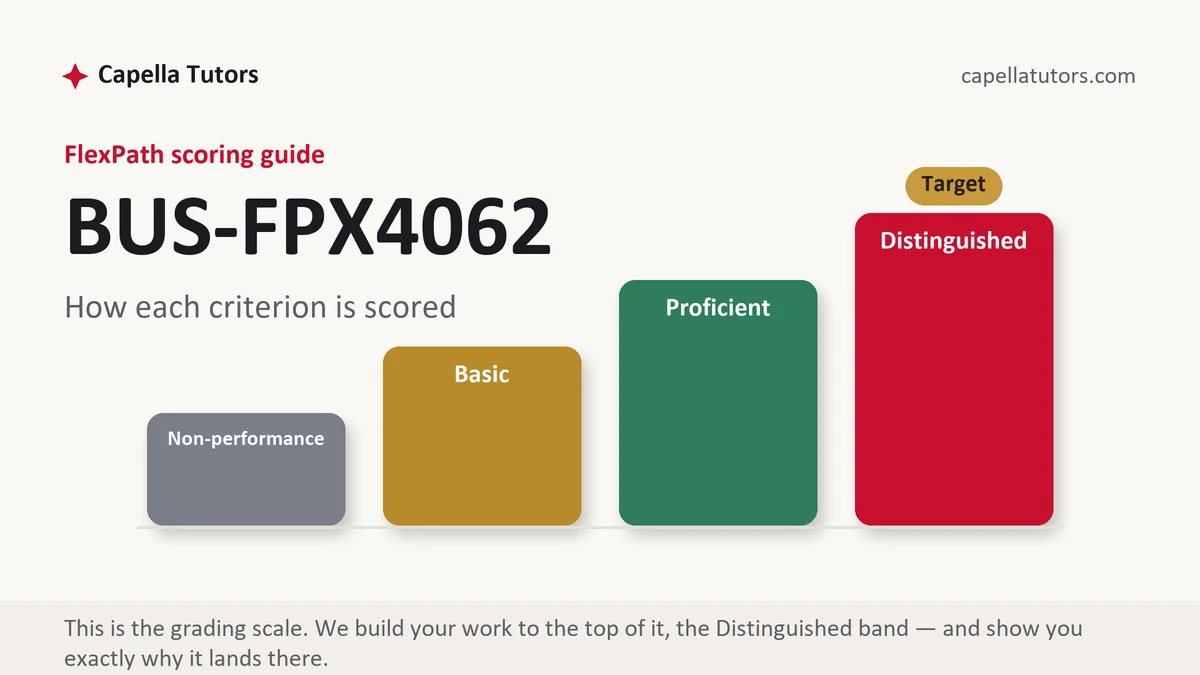
What BUS FPX 4062 actually grades
Intermediate accounting is where the answers stop being obvious and start requiring an argument. The introductory course teaches how to record a transaction whose treatment nobody disputes. This one hands you transactions where reasonable people disagree, and the criteria reward the student who reaches a defensible position and shows the reasoning that got there. Expect the phrase in accordance with to appear in the guide, and expect it to mean that a conclusion without a standard behind it will not score regardless of whether it happens to be correct.
Revenue is the largest topic and the current model runs in five steps that the assessments will expect you to work through in order. Identify the contract, identify the separate performance obligations in it, determine the transaction price, allocate that price across the obligations by their standalone selling prices, and recognise revenue as each obligation is satisfied. The interesting cases live in steps two and three. A sale bundling equipment with a year of support contains at least two obligations, and revenue for the support belongs to the year rather than to the day of sale. Variable consideration such as rebates, refunds or performance bonuses has to be estimated and constrained so that a significant reversal is not probable, which is a judgment you have to make and justify.
Asset measurement carries the rest of the weight. Receivables are reported at the amount expected to be collected, which requires an allowance estimated either from ageing the balances or from a percentage of sales, and the two produce different figures from the same data. Inventory measurement depends on the cost flow assumption chosen, and in a period of rising prices first-in first-out reports higher income and higher ending inventory than the alternatives, which is a reporting consequence rather than a change in what physically moved. Write-downs to net realisable value cannot be reversed under United States rules, which is a difference from international treatment worth knowing.
Then long-lived assets and the judgments around them. Whether an expenditure is capitalised or expensed depends on whether it extends the asset's life or capacity rather than maintaining it, and that decision moves income immediately. Depreciation method, useful life and salvage value are estimates, and changing an estimate is applied going forward rather than by restating the past. Impairment testing asks whether the carrying amount is still recoverable and, if not, writes it down to fair value. Leases now bring nearly all arrangements onto the balance sheet as a right-of-use asset and a corresponding liability, which ended a long era of off-balance-sheet financing and is exactly the sort of trend the course title is pointing at.
How we help in this course
Work in this course is written as a technical memo whether or not the prompt uses that word. Send the facts and the criteria, and the sample will state the issue, identify the applicable guidance, apply it to the specific facts, show the computation, reach a conclusion and note the disclosure that follows. Where the situation genuinely admits more than one treatment, we present the alternative and say why it was rejected, since a criterion asking you to evaluate a treatment is asking for the comparison rather than the outcome.
Our arrangement in this subject includes the same extra verification we run on every numerate course. One premium original deliverable inside 24 to 48 hours, an eight-person pipeline, a reviewer checking coverage against the scoring guide, and a reconciliation pass over every figure and every cross-reference. Revisions cost nothing until the criteria are met and faculty feedback re-enters the cycle free. Since an evaluator has two business days per submitted attempt, we schedule so that a second submission still lands inside your 12-week billing session.
The assessments, one by one
Assessment 1
The opening deliverable in Intermediate Financial Accounting Topics and Trends usually hands you a contract and asks you to work the revenue model through in order: identify the contract, identify the separate obligations inside it, determine the transaction price, spread it across those. Read the full Assessment 1 manual.
Assessment 2
The middle deliverable in Intermediate Financial Accounting Topics and Trends usually asks you to measure an asset whose carrying amount depends on an estimate or on a choice. Read the full Assessment 2 manual.
Assessment 3
The final deliverable in Intermediate Financial Accounting Topics and Trends usually turns on a judgment about a long-lived asset: whether an expenditure was an improvement or a repair, what depreciation follows from the answer, and how an arrangement the company does not own ends up on its balance sheet. Read the full Assessment 3 manual.
How to actually write BUS FPX 4062: where to begin
Convert the criteria into headings, then write the issue in one sentence as a question before anything else. Something like whether the extended warranty sold alongside the equipment is a separate performance obligation, and if so how much of the transaction price it should carry. The assessments in this course usually ask you to apply a reporting standard to a set of facts, compute the resulting amounts and explain the treatment, and your scoring guide decides whether that arrives as a memo, a set of entries with commentary, an analysis of published statements or a research paper.
Find the guidance before you form a view, because working backwards from an intuition into a standard produces papers that cite selectively. Read the recognition criteria, the measurement guidance and the disclosure requirements for the topic, and note the scope exceptions, since a surprising number of intermediate problems turn on the transaction falling outside the standard the student assumed applied. Then apply the guidance element by element to your facts. If the standard has five steps, your section has five subsections, and an evaluator can see that each one was answered.
Show the numbers in full, because the computation is usually where the criterion actually sits. Take a contract selling equipment and two years of support for 96,000 dollars, where the equipment sells separately for 84,000 and the support for 21,000. The standalone prices total 105,000, so the equipment carries 84 over 105 of the transaction price, which is 76,800, and the support carries 19,200, of which 9,600 belongs to each year. The entry at delivery therefore recognises 76,800 of revenue and 19,200 of contract liability, and 800 releases to revenue each month afterwards. Set the allocation out in a small table so the arithmetic is inspectable rather than asserted.
Finish with disclosure and with the effect on the statements, since both are commonly worth a criterion and both are commonly omitted. Say what the notes have to explain, whether that is the judgments made in identifying obligations, the method used to estimate the allowance, the depreciation policy or the discount rate applied to a lease liability. Then say what the treatment does to the reported figures, naming the effect on revenue in the period, on total assets, on liabilities and on any ratio a lender would look at. A memo that reaches a technically correct answer and never mentions that the chosen treatment moves the current ratio has stopped one step short of being useful.
| Section | What goes in it | What Distinguished looks like |
|---|---|---|
| Issue statement | The accounting question written as a question, with the relevant facts and dates isolated. | A question narrow enough that the standard applied to it produces a single answer. |
| Authoritative guidance | The applicable standard, the specific criteria it sets, and any scope exception considered. | Guidance cited to the source and quoted only where the exact wording decides the outcome. |
| Application | Each criterion in the standard answered against the facts, in the order the standard sets them. | Every element addressed explicitly, including the ones that are satisfied without difficulty. |
| Computation | The measurement worked through with amounts, rates, periods and allocations shown. | Arithmetic set out in a table a reader can follow and reproduce independently. |
| Alternative treatment | Any defensible different answer, the argument for it, and why it was not adopted. | A genuine alternative examined rather than a straw position dismissed in a sentence. |
| Conclusion, disclosure and references | The treatment adopted, the entries, the note disclosures required, and APA both ways. | The effect on reported results and on the ratios a user would notice stated plainly. |
Developing the analysis
The trends part of this course title is an invitation to say something about why reporting rules change, and the honest answer is usually that a previous rule let economically similar transactions be reported differently. Lease accounting is the clearest recent example. For decades the classification test meant that two companies with nearly identical obligations could show very different balance sheets depending on how the contracts were drafted, and analysts responded by estimating the missing liabilities themselves, which is a strong signal that the reporting was not serving its users. The move to bring right-of-use assets and lease liabilities onto the balance sheet closed that gap and increased reported assets and liabilities substantially for retailers and airlines without changing anything about their operations. Revenue recognition followed a similar logic, replacing a patchwork of industry-specific rules with a single principles-based model, and the trade-off there is worth naming: a principles-based standard produces more comparable outcomes in theory and requires more judgment in practice, which shifts the burden onto disclosure and onto the auditor. That trade-off between rules and principles is the intellectual spine of the subject and a good paper will engage with it rather than describing the current requirement as though it were permanent. Where you can, look at how a real company disclosed a transition, since the note explaining the effect of adoption is often the clearest available statement of what the old rule was hiding.
Citations that survive faculty review
The Accounting Standards Codification is the primary authority and should be cited by topic rather than paraphrased, since the whole point of an intermediate course is that you can locate and apply the actual requirement. The Financial Accounting Standards Board also publishes the basis for conclusions accompanying each update, which explains why the board decided as it did and is unusually useful when a criterion asks you to evaluate a standard rather than apply it. Filings on SEC EDGAR give you real note disclosures, and reading how two companies in the same industry describe the same policy is the fastest way to understand where judgment enters. The Securities and Exchange Commission also publishes staff guidance and comment letters, which show precisely where registrants have got things wrong. For international comparison, the International Accounting Standards Board is the source, and the differences on inventory reversal, development costs and revaluation are worth citing specifically. The American Institute of Certified Public Accountants and the Journal of Accountancy carry practitioner explanation that is reliable and appropriately cited as professional commentary rather than as authority. Peer-reviewed accounting research supports claims about how users respond to a reporting change. Do not cite summary websites, exam-prep providers or unattributed online outlines for a technical requirement, since they are frequently out of date. Verify current APA in both directions.
The mistakes that land Basic instead of Distinguished
- A conclusion with no standard behind it. Intermediate criteria are written around authoritative support, and a correct answer with no citation still misses the row.
- Performance obligations not separated. Recognising a bundled sale entirely at delivery overstates current revenue and understates what is owed to the customer.
- Estimates presented as facts. Useful life, salvage value and the allowance are judgments, and a paper that never says so has missed what the course teaches.
- The allocation arithmetic hidden. A stated amount with no visible computation cannot be checked, and the measurement criterion depends on being able to check it.
- Disclosure ignored. Recognition and measurement are two thirds of the answer, and the note is where the judgment is explained to a reader.
BUS FPX 4062 questions students actually ask
How do I cite the accounting standards properly?
Cite the codification by its topic and section reference rather than by the name of the old pronouncement, and give enough of the reference that a reader can find the exact paragraph. Quote sparingly and only where the specific wording is what decides your answer, since a memo that reproduces half a page of standard and then adds two sentences of application has the proportions backwards. Everything else should be your own restatement of the requirement followed immediately by its application to your facts. If your assessment allows the basis for conclusions, it is often the better citation when the criterion asks why a rule exists rather than what it requires. Check your scoring guide for a required citation style, because some prompts ask for the codification reference inline while others want it in the APA reference list, and following the wrong convention costs a communication criterion for no good reason.
What if two treatments both look defensible?
Then you have found the actual assessment. Present both, apply the standard's criteria to each, and identify the specific fact that tips the balance, because in nearly every case there is one. If the question is whether an expenditure extends an asset's useful life or merely maintains it, the deciding fact might be an engineering estimate, a change in capacity, or how the company has treated identical work before. Reach a conclusion and state it plainly, then say what additional information would change it. Refusing to conclude is the one response that definitely loses marks, and hedging every sentence reads as an attempt to be right by covering everything. Consistency also matters as a supporting argument: a company that has expensed similar work for five years needs a reason to capitalise it now, and saying so strengthens whichever answer you choose.
Can I use a real company's financial statements for this?
Yes, and it improves almost every assessment in the course. Public filings are free, and the notes contain exactly the material the criteria are about: revenue recognition policy, the components of the allowance, inventory method, depreciation lives, lease discount rates and impairment testing assumptions. Pick a company with a straightforward business so the notes are readable, and compare two in the same industry if the prompt allows, since the differences between them are where the judgment becomes visible. Cite the filing properly with the company, the form type, the period and the retrieval source. One caution: use the notes rather than the summary pages of a financial data website, because the aggregated figures on those sites are often reclassified in ways the company did not intend and you will end up explaining a number that does not appear anywhere in the actual statements.
Technical accounting memo due?
Send us the facts along with the scoring guide. We locate the guidance, apply it step by step and show the computation in full. First premium sample free.