Upload the prompt and the scoring guide and a premium original sample comes back inside 24 to 48 hours, written to the Distinguished descriptors, with every duration and dependency recomputed by a second reader and revisions included until the criteria clear. The transcript line reads PM FPX 1000, Project Management Principles, worth 1.5 program points, a core requirement in both of the FlexPath specializations that carry it, taken inside a 90-point undergraduate degree that also asks for at least 27 points at the 3000 level or above. In Capella's catalog the course code is written PM-FPX1000.
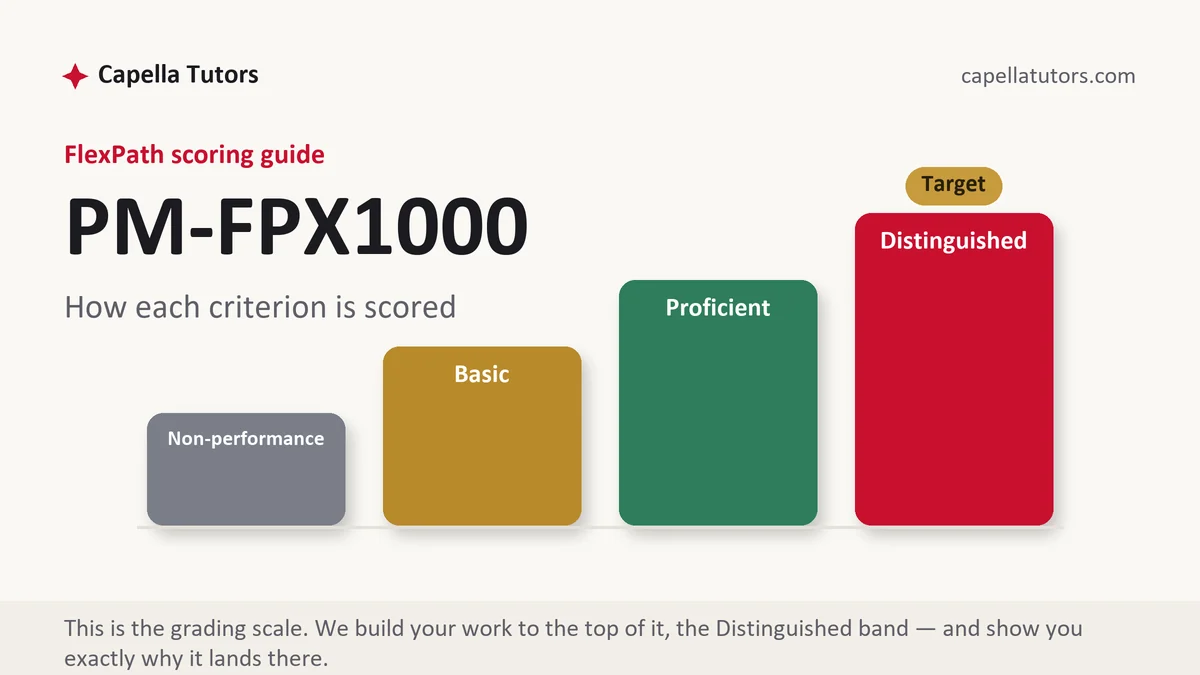
What PM FPX 1000 actually grades
The opening criterion is usually a definition question wearing a scenario, and it sorts the class quickly. You are handed a piece of work and asked whether it is a project, and the answer turns on two tests: does it end, and does it produce something that did not exist before. Remodeling a store passes both. Opening the store every morning passes neither. Moving a customer list onto new software is a project, and running the Monday reports that software produces is operations. Name the test the scenario satisfies and the test it fails, because a criterion asking you to distinguish wants the boundary rather than a tour of both sides.
Next comes the shape of the work over time. Initiating, planning, executing, monitoring and controlling, and closing are five kinds of activity that overlap, not five weeks in a row, and evaluators notice when a student treats them as a calendar. Monitoring runs the whole way through, and planning restarts every time something moves. What earns marks is whether each artifact belongs where you put it. A charter carrying a fully detailed schedule was written by somebody who has not understood what a charter is for, and a closing section that introduces new deliverables reads the same way.
Then the planning package, at introductory depth but with real structure behind it. Expect to produce a charter, a stakeholder list with something said about each entry, a work breakdown, an activity list with dependencies, a defensible duration, a short risk list, and a statement of how progress gets reported. None of these has to be long in PM FPX 1000. All of them have to agree with each other, and agreement is where the marks actually move: the outputs promised in the charter become the top boxes of the breakdown, the activities build the packages under those boxes, and the finish date falls out of the network instead of being written in first and justified afterwards. Scope, time and cost move together, so any change to one gets paid for somewhere, and the criteria reward the student who prices that trade rather than describing it.
How we help in this course
Tell us the project you picked, a community event, a small office relocation, a website rebuild, a stockroom reorganization, and the draft arrives with the documents built rather than discussed. The charter names a sponsor and a spending limit. The breakdown decomposes to packages somebody could accept. The activity list carries dependencies you could defend out loud, and the end date follows from those dependencies rather than from the week your assessment is due.
Terms match the rest of the studio, with one habit added for a course full of dates. A premium original sample inside 24 to 48 hours, an eight-person pipeline running from research to final proofread, and a reader whose only job is to add the durations up again and confirm that the finish date in the paragraph matches the finish date in the table. Revisions are free until the criteria clear and faculty comments come back into the cycle at no cost. Because an evaluator has two business days on each attempt, we time your submission so one resubmission still fits inside the 12-week billing session.
The assessments, one by one
Assessment 1
The opening deliverable asks you to prove the work is a project before you plan it, then write the document that gives it authority. Read the full Assessment 1 manual.
Assessment 2
This is the deliverable where the plan stops being prose and becomes structure. Read the full Assessment 2 manual.
Assessment 3
The closing deliverable is the arithmetic one. Read the full Assessment 3 manual.
How to actually write PM FPX 1000: where to begin
Turn the scoring guide into headings before writing anything, then decide what each heading has to contain in physical terms: a table, a diagram, a list, a paragraph. The assessments in this course usually ask you to take a project of your own choosing or one supplied in a scenario and produce its early planning documents, and your scoring guide decides which documents those are and how far each one has to go. Where a criterion uses a verb like develop or construct, prose alone will not satisfy it.
Build the breakdown by deliverable and stop at a package one person can own. The rule that keeps students out of trouble is that the boxes under any parent must add up to the whole of that parent, no more and no less, so if four top-level outputs decompose into nineteen packages then those nineteen are the entire project, and anything you later remember was needed is proof the breakdown was wrong. Size the packages so each runs between a day and two working weeks. Smaller than that and you have written a to-do list. Larger and nobody can tell whether it is on track.
Then take the schedule from the network. Say activity P runs 5 days and Q runs 3, both able to start immediately, R runs 7 days and cannot begin until P is done, S runs 4 days and follows Q, T runs 6 days and needs both R and S complete, and U runs 2 days after T. Path P, R, T, U totals 20 days. Path Q, S, T, U totals 15. The project takes 20 days, that longer path is critical, and the Q and S branch carries 5 days of float. Two conclusions follow and both belong in the paper. Paying overtime to finish S early changes the delivery date by nothing at all. And if Q slips more than 5 days the critical path jumps to the other branch, which is the point where the schedule needs replanning rather than encouragement.
Then price the trade the sponsor is asking for. If those 20 days have to become 17, the only candidates are activities on the critical path, and each candidate needs a number beside it. Adding people is the reflex answer and the one the criteria most enjoy catching, because coordination grows faster than the team: five people carry ten communication channels between them, nine people carry thirty six, and the newcomers spend their first week being told what the other seven already know. State what compression costs, state what it puts at risk, and state what you would do instead. A recommendation with a figure attached reads as a decision, and one without reads as an opinion.
| Section | What goes in it | What Distinguished looks like |
|---|---|---|
| Charter | Sponsor, business reason, objectives, spending limit, boundaries and what is deliberately excluded. | Approval by a named person on a named date, with the exclusions written as plainly as the inclusions. |
| Stakeholders | Who is affected, what each one controls, what each one wants, and how often they hear from you. | Entries that carry influence and interest, so the reporting plan follows from the register. |
| Work breakdown | Outputs decomposed into packages, each with an owner and a one line definition of done. | Decomposition by deliverable, with the children of every box adding to the whole of that box. |
| Activities and schedule | Durations, predecessors, the paths through the network, the critical path and the float on the rest. | A finish date derived from the longest path, with float quoted and compression aimed only where it works. |
| Cost and risk | A simple cost estimate with its basis, plus risks carrying a likelihood, an effect and a named owner. | Estimates traceable to a rate or a comparison, and risks written as cause and effect rather than worry. |
| Reporting, closure and references | What gets reported to whom and how often, how the project ends, current APA in both directions. | A closing test tied back to the charter objectives, so finished means agreed rather than abandoned. |
Developing the analysis
Be careful about where the authority in this subject comes from. The published bodies of knowledge are consensus documents assembled by committees of practitioners and revised on their own timetable, so they record what experienced managers agree is good practice rather than what a study demonstrated. Citing one is fine, provided you cite it as guidance and name the edition, since the vocabulary shifts between editions and a criterion written against one can look unanswered if you use another. Be warier still of the failure statistics that decorate introductory project papers. Figures claiming most projects run late or over budget usually trace to practitioner surveys whose respondents chose themselves and whose definition of failure moves from year to year, so give the survey, the year and the definition, or leave the number out. The research offers something better anyway: work on optimism in estimating shows people predicting their own tasks are wrong in a consistent direction, and that checking a new plan against how long comparable finished projects actually took beats reasoning forward from the plan alone. Use one of those findings to justify a decision inside your own schedule.
Citations that survive faculty review
Four kinds of source carry weight with an evaluator here. Professional standards come first, meaning the Project Management Institute guide and standard cited with its edition, and ISO 21502 where you want an international reference not tied to one association, both used for process and definitions rather than as proof that a technique works. Peer-reviewed journals come second, reached through the Capella library in Business Source Complete or ABI/INFORM, where the International Journal of Project Management and Project Management Journal hold the empirical work on estimating and team performance. Public data comes third and is more useful in a first course than students expect, since Bureau of Labor Statistics wage figures let you cost a resource honestly instead of inventing a rate. Workplace documents come fourth and count as evidence once you name and date them. A certification cram site, a software vendor blog, or a consultancy summary of a framework whose original you could have read instead are not sources. Then run the two-way check, every citation present in the reference list and every reference cited at least once, in current APA.
The mistakes that land Basic instead of Distinguished
- A work breakdown made of verbs. Listing tasks instead of deliverables leaves nothing in the plan that anyone could accept or sign off.
- A schedule with no dependencies. If nothing depends on anything then everything is critical, and the float criterion becomes unanswerable.
- Durations from nowhere. An estimate with no rate, no comparison and no stated assumption cannot be defended the moment a criterion asks you to justify it.
- A stakeholder list that is only names. Each entry has to say what that person controls and what they need to hear, or the reporting plan floats free of it.
- A charter written after the plan. Approval is what turns the document into a mandate, so a charter containing the finished schedule has the sequence backwards.
PM FPX 1000 questions students actually ask
Do I need project software, or will a spreadsheet do?
A spreadsheet is fine and usually clearer at this level. The criteria want the logic, which means an activity table with a predecessor column, a duration column, and a calculated finish that matches the path you called critical. Scheduling software draws a better bar chart and hides the arithmetic, which is unhelpful when a criterion asks you to explain where the end date came from. If you do use a tool, export the activity table as well as the chart and keep the predecessors visible. Whichever you choose, make the same figures appear in the narrative and in the table, because the quickest way to lose a criterion is to write four weeks in a sentence sitting above a table that adds to five.
What can I use as my project if I have never run one?
Pick something small you can describe honestly and finish on paper. A department move, a fundraising event, an onboarding program for new hires, a switch from one scheduling app to another. Each has deliverables, dependencies and somebody who approves the money, and each is easier to plan credibly than an invented corporate transformation. Access matters more than size, since you have to be able to say who signs off, who does the work, and what finished looks like. If the prompt supplies a scenario, use the scenario and resist improving it, because the criteria were written against the facts it gives you. Where the scenario is silent, state the assumption in one sentence and carry it through every later section unchanged.
How detailed does the work breakdown have to be?
Deep enough that every package has an owner and an estimate, and no deeper. Three levels is normally right for an introductory deliverable: the project, its major outputs, and the packages that make each output real. A fourth level is worth adding only where one output is genuinely more complicated than the others, and an uneven breakdown is acceptable for exactly that reason. The test is not how many boxes you drew. It is whether somebody could take one box, know what they were being asked to produce, and tell you the day it was done. If you cannot write a one line definition of done for a package, it is too big or too vague, and the schedule built on it will not hold.
Charter or first schedule due?
Send the prompt, the criteria and the project you picked. We will decompose it, calculate the path and show the working. First premium sample free.