Give us the prompt, the criteria and the performance problem you are working on, and a premium original sample arrives inside 24 to 48 hours, written to the Distinguished descriptors, checked against every criterion row by a second reader, and revised at no cost until the score lands. Your transcript will show BUS FPX 4047, Employee Training and Development, worth 3 program points, sitting in the Human Resource Management specialization of the FlexPath BS in Business, which requires at least 90 program points overall and a minimum of 27 from courses coded 3000 or above. In Capella's catalog the course code is written BUS-FPX4047.
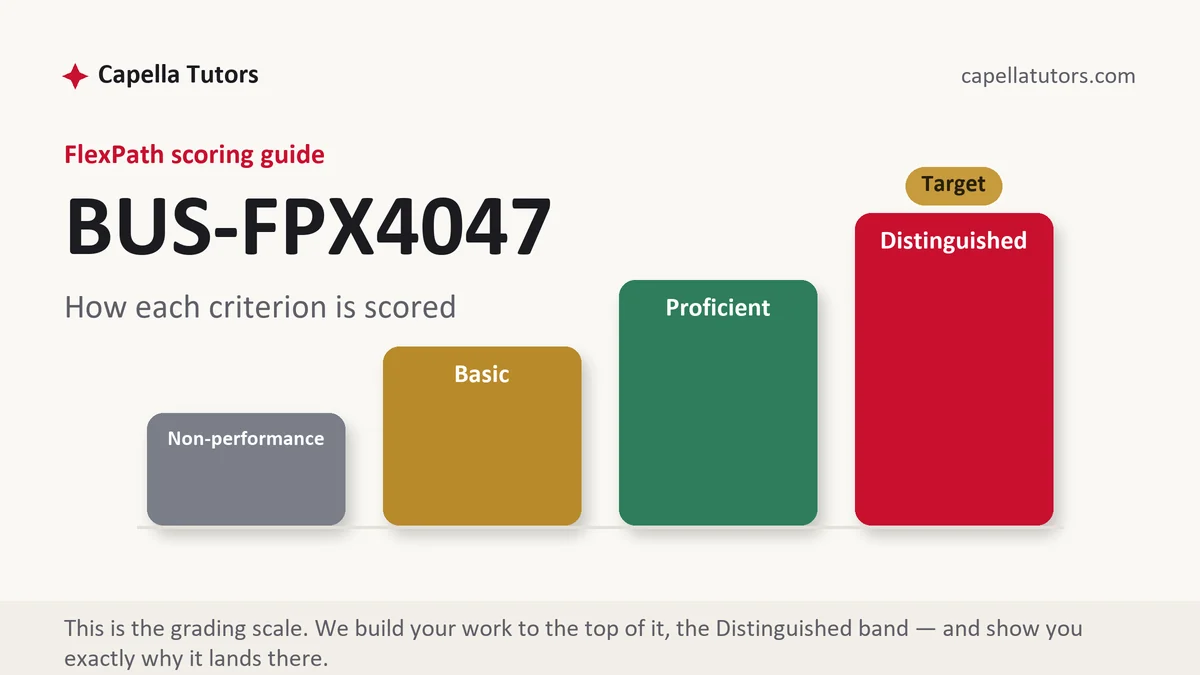
What BUS FPX 4047 actually grades
The first thing this course tests is whether you can tell a training problem from a problem that merely looks like one. Most requests that arrive at a learning function are not training problems at all. If people know how to do the work and are not doing it, the cause is usually an incentive pointing elsewhere, a tool that does not work, a process that makes the right behaviour slower, or a supervisor who tolerates the wrong one, and running a workshop about it wastes money and leaves the cause intact. The assessments reward the student who runs the diagnostic first and is willing to conclude that training is not the answer.
Needs assessment has three levels and the criteria expect all three. The organizational level asks whether the proposed training supports what the business is trying to achieve and whether the environment will let the new behaviour survive contact with the job. The task level breaks the work down into what somebody actually has to do and to the standard required. The person level asks who specifically has the gap, since training everybody when the deficit sits in one shift is expensive and mildly insulting to the rest. Evidence for each level is obtainable: performance data, error logs, customer complaints, observation, supervisor interviews and a short survey will between them establish the gap or show that there is not one.
Design is graded on objectives before anything else. A learning objective states what the participant will be able to do, under what conditions, and to what standard, and it uses a verb somebody can observe. Understand, know and be aware of are not observable and cannot be assessed, while calculate, demonstrate, troubleshoot and complete can. Get the objectives right and the rest of the design follows almost mechanically, because the objective tells you what practice is needed, what the assessment must measure and how long the session has to be. Get them wrong and you produce content with no way of knowing whether it worked.
Then transfer, which is the part that separates a training paper from a training programme. Learning that happens in a room and never appears on the job is the normal outcome rather than the exception, and the causes are known: no opportunity to practise soon after, a supervisor who never mentions it, tools or procedures that do not match what was taught, and no consequence either way. The design has to address that directly through spaced practice, job aids, a supervisor briefing, a follow-up point and something in the work that requires the new behaviour. Evaluation follows the same logic. Reaction data collected at the end of a session tells you whether people enjoyed it, and enjoyment correlates weakly with learning, so a paper whose evaluation plan stops at a feedback form has stopped one level too early.
How we help in this course
Training deliverables we write start from the gap rather than from the content. Tell us the performance problem, whatever data exists on it, who is affected and what the organization can realistically run, and the sample will contain a three-level needs assessment, objectives written as observable behaviour, a design matched to those objectives and an evaluation plan that reaches beyond reaction. Where the assessment asks for materials, we produce the facilitator outline, the practice activities and the assessment items rather than a description of what they would contain.
Our terms are the same as for every course in the catalogue. A premium original deliverable inside 24 to 48 hours, eight people between the brief and delivery, a reviewer dedicated to matching the file against the scoring guide, and free revision until the criteria are satisfied. Anything the evaluator sends back re-enters the cycle at no charge. Faculty have two business days to assess a submitted attempt, so we schedule the drafts to leave room for a resubmission inside the same 12-week billing session.
The assessments, one by one
Assessment 1: Conducting a Training Needs Analysis
Assessment 1 in BUS FPX 4047, Employee Training and Development, usually asks you to establish whether a performance problem is a training problem at all, and then to locate the gap at the organisational, task and person level with evidence for each. Read the full Assessment 1 manual.
Assessment 2: Creating Training Objectives and Course Design
Assessment 2 in BUS FPX 4047, Employee Training and Development, usually asks you to design: objectives written as observable behaviour, a sequence built backwards from them, practice proportionate to what has to be learned, and transfer support that reaches the job. Read the full Assessment 2 manual.
Assessment 3: Developing a Training Program
Assessment 3 in BUS FPX 4047, Employee Training and Development, usually asks for the accounting: how you will know whether the programme worked, at which levels you can actually measure, what it cost, and what the honest caution is about attributing any improvement to it. Read the full Assessment 3 manual.
How to actually write BUS FPX 4047: where to begin
Convert the scoring guide into headings, then write one sentence naming the performance gap in observable terms before you design anything. Not staff need better customer service, but call handlers resolve 62 percent of issues on first contact against a target of 80, and the shortfall concentrates in the two newest teams. In current courserooms the assessments include "Conducting a Training Needs Analysis", "Creating Training Objectives and Course Design" and "Developing a Training Program" among others, and your scoring guide decides the exact format of each.
Run the analysis before you accept the request. Ask whether the people concerned could do the task if their job depended on it today, because that single question separates a skill deficit from everything else. If they could, training is the wrong intervention and the paper should say so and propose the right one. If they could not, establish where the gap sits by comparing what the work requires against what people can currently do, using observation, performance data or a short assessment. Document the method, since a criterion about needs assessment is asking how you know rather than what you concluded.
Write objectives that can be tested and build backwards from them. An objective such as given a customer account record and the current pricing table, the representative will calculate a corrected invoice with no arithmetic errors within five minutes tells you exactly what the session must contain: worked examples, several practice items with feedback, and a timed assessment using real records. Sequence matters too. Adults learn a procedure faster when they see it demonstrated, try it with support, then try it alone, and a design that spends fifty minutes presenting and five minutes practising has the ratio backwards. Spacing beats massing, so two shorter sessions a week apart usually produce more retention than one long one, and saying that in the design with a reason attached earns the row.
Plan the evaluation before the programme runs, and plan for the levels you can actually measure. Reaction is easy and nearly worthless on its own. Learning is straightforward with a pre and post assessment on the objectives. Behaviour requires somebody to look at the job three months later, which means agreeing now who will look and at what. Results means the business measure you named in the gap statement, and the honest caution is that other things will have changed in the meantime, so say what else could explain a movement. If the criteria ask for a return calculation, put the costs on one side, including participant time at their loaded hourly rate which is usually the largest single item, and the estimated benefit on the other with the basis of the estimate declared.
| Section | What goes in it | What Distinguished looks like |
|---|---|---|
| Performance gap | The problem stated in observable terms, with current performance, target performance and who is affected. | A gap quantified from real data rather than described from a manager's impression. |
| Needs assessment | Organizational, task and person analysis, the methods used, and the evidence each produced. | All three levels addressed, including a stated check that training is the right intervention at all. |
| Objectives | What participants will be able to do, under what conditions, to what standard. | Observable verbs with conditions and criteria attached, each one directly traceable to the gap. |
| Design and delivery | Content sequence, methods, practice, feedback, timing, delivery mode and who facilitates. | Practice time proportionate to the objectives, with the sequencing and spacing justified. |
| Transfer support | Job aids, supervisor involvement, follow-up, and what in the work will require the new behaviour. | Specific mechanisms with owners, rather than a statement that management support is needed. |
| Evaluation and references | Measures at each level attempted, instruments, timing, who collects, costs, and APA both ways. | Evaluation designed before delivery, with the alternative explanations for any improvement acknowledged. |
Developing the analysis
Training research contains a gap between what is known and what is practised that is wide enough to build a paper around. Decades of transfer research have identified the same conditions repeatedly, opportunity to perform, supervisor support, similarity between the training environment and the job, and yet the standard organizational response to a performance problem remains a one-off session with no follow-up. Saying this in your analysis, with citation, is a stronger opening than any description of a design model. Be careful with the evaluation frameworks, though. The four-level model is universally taught and has been criticised for implying a causal chain between the levels that the evidence does not support, since positive reaction does not reliably lead to learning and learning does not reliably lead to behaviour change without the conditions above being present. Treat the levels as separate questions rather than as a ladder, and say so. The return on investment literature deserves similar scepticism. Published training returns are frequently enormous and frequently rest on benefit estimates supplied by the people who ran the programme, with no control for anything else happening in the business at the time, so if your assessment requires a return figure, produce it with the assumptions visible and describe it as an estimate under stated conditions. The strongest evaluation design available to most organizations is not an experiment but a comparison across groups trained at different times, which costs nothing extra and is far more persuasive than a before and after in a single group.
Citations that survive faculty review
Peer-reviewed research in applied psychology, human resource development and training journals through Business Source Complete and ABI/INFORM is the evidence base here, and the transfer of training literature in particular has meta-analytic sources worth citing directly rather than through a textbook. Instructional design models and the evaluation levels each belong to identifiable originators, so cite the author rather than the summary, and where a model has been revised, cite the version you are using. The Association for Talent Development publishes benchmarking data on training spend, hours per employee and delivery mix, which is what you use when you need to say whether an organization's investment is unusual. The Bureau of Labor Statistics supplies the wage figures behind any calculation involving participant time, and using a loaded hourly rate rather than base pay makes a cost estimate defensible. Where the training is compliance-driven, the requirement itself is a source: the Occupational Safety and Health Administration sets required safety training, and other agencies set their own, so cite the regulation rather than asserting that training is mandatory. Society for Human Resource Management material is appropriate for practice context. Learning platform vendor white papers and infographics about attention spans should stay out of the reference list entirely, since several of the numbers circulating in that material have no traceable source. Finish with a current APA check running text to list and list back to text.
The mistakes that land Basic instead of Distinguished
- Training proposed without checking it is the problem. A skill gap and a motivation gap look identical from a distance and have entirely different fixes.
- Objectives written with unobservable verbs. If nobody can see understanding happen, nobody can assess it, and the whole design loses its anchor.
- Content-heavy design with almost no practice. A session that presents for an hour and practises for five minutes has taught recognition rather than capability.
- Evaluation that stops at the feedback form. Reaction data measures enjoyment, and the criteria are asking whether behaviour on the job changed.
- Transfer left to good intentions. Without a follow-up point, a job aid and a supervisor who mentions it, the new behaviour disappears within weeks.
BUS FPX 4047 questions students actually ask
How long should the programme I design actually be?
As long as the objectives require and no longer, and the way to defend the number is to build it from the parts. Count the demonstration time, the practice repetitions each objective needs, the feedback between them and the assessment at the end, then add the overhead of getting started and wrapping up. Four objectives needing three practice cycles each will not fit into ninety minutes, and saying so with the arithmetic visible is better than proposing a session length because it sounds reasonable. Consider splitting it. Two sessions a week apart with a task to complete in between usually produces better retention than one continuous block and is easier for an operation to release people for. Whatever you choose, state the reasoning in a sentence, because a criterion about design is assessing your decisions rather than your schedule.
Do I need to build the actual materials?
Read the criteria closely, since prompts in this course differ sharply on this point and the difference is worth a lot of marks. Where the guide asks for a design, a detailed outline with objectives, sequence, timings, methods and assessment items is what is wanted, and producing a full slide deck instead can leave the design criteria unanswered. Where it asks for materials, build them, and build the unglamorous ones: the job aid somebody keeps at their desk, the practice scenarios, the observation checklist a supervisor uses afterwards, the assessment questions with the correct answers marked. Those demonstrate design capability far better than presentation slides do. If you are unsure, cover the design fully and attach one worked sample of each material type, which satisfies both readings of the prompt.
What if I cannot get any performance data?
Build the case from what is observable and say how you built it. Sit with three people doing the work and record where they hesitate, where they ask somebody, where they redo something and how long each step takes. Interview two supervisors about what new starters get wrong in their first month. Look at whatever the organization already counts, since complaints, rework, error corrections and escalations all exist somewhere even in a small business. Twenty observations and four interviews is a legitimate needs assessment for a course deliverable provided you describe the method, the sample and the period. State the limitation in one sentence and move on. What fails is a needs assessment consisting of an assertion that employees require training, since that is the claim the whole section exists to test.
Training design or needs assessment due?
Send the prompt, the criteria and the performance problem. We run the three-level analysis, write the objectives and plan the evaluation. First premium sample free.