Give us the assessment prompt together with its criteria and a premium original sample is with you in 24 to 48 hours, aimed at the Distinguished column and verified by a second reader who rebuilds the arithmetic before anything ships. The course is listed as BUS FPX 2062, Finance Fundamentals, worth 1.5 program points, a core requirement across the six FlexPath specializations of the BS in Business, taught in FlexPath in a degree that totals at least 90 program points, no fewer than 27 of them at the 3000 level or above. In Capella's catalog the course code is written BUS-FPX2062.
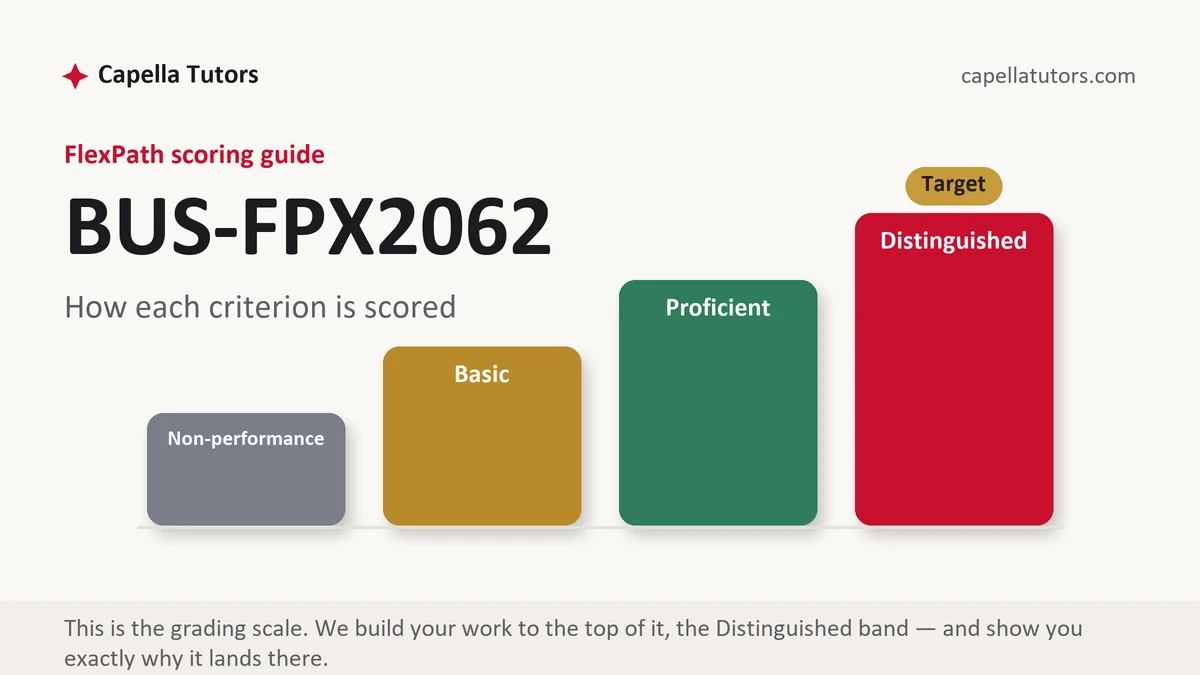
What BUS FPX 2062 actually grades
Finance at this level is graded on whether money arriving later is treated differently from money arriving now, and on whether you can say what your own calculation licenses. The assessments in this course usually present a firm with a decision to make, an equipment purchase, a loan, a savings target, a set of statements to read, and ask for the numbers plus a verdict. Two gates operate in sequence. A wrong model caps the grade regardless of how well the memo reads, and a correct model still lands in Basic when the write-up reports outputs and never says what the firm should do about them.
Time value of money is the organizing idea and it runs underneath everything else the criteria mention. Present value, future value, the difference between an ordinary annuity and one paid at the start of each period, compounding frequency, and the gap between a stated annual rate and the effective rate it produces once compounding is counted are all fair game, and small confusions there propagate through an entire assessment. Around it sit the applications: net present value, payback, internal rate of return, the cost of borrowing against the cost of equity, working capital and the cash conversion cycle, and the ratio families that describe liquidity, leverage, activity, and profitability.
Risk is the third strand and the one undergraduate drafts treat most casually. A finance criterion asking about risk is not asking for a paragraph saying markets are uncertain, it is asking which input could move, in which direction, by how much, and at what point the recommendation reverses. Diversification, the relationship between expected return and risk taken, and the reason a small private firm cannot borrow at the rate a large public one pays all belong in this strand, and naming the threshold where your answer flips is the single move that most reliably lifts the criterion.
How we help in this course
Our 2062 samples arrive with the model built before the prose. Cash flows are laid out year by year, the discount rate is justified rather than asserted, formulas appear once so a reader can reproduce the result, and every ratio is set beside a prior period or an industry figure so it means something. Send the case exhibits, the rate if your prompt supplies one, and the criteria, and the walkthrough explains each step in plain language so you can defend the reasoning in your own words if faculty ask.
The pipeline behind that runs eight deep: the scoring guide gets decoded first, a subject writer drafts, a criterion reviewer scores the draft against the columns, an APA and originality pass runs, and an editor closes it out. One of those readers does nothing except rebuild the calculation independently and check that the same answer appears, because a finance paper standing on a broken spreadsheet cannot be rescued by good sentences. Turnaround holds at 24 to 48 hours, revisions run free until the criteria are met, and faculty feedback returns through the same sequence without a charge.
The assessments, one by one
Assessment 1: Midpoint Exam
A set of finance problems and short answers on interest rates and risk premiums, the role of the CFO, financial markets, time value of money and related concepts. Read the full Assessment 1 manual.
Assessment 2
Assessment 2 in BUS FPX 2062, Finance Fundamentals, usually moves from single calculations to the way cash behaves across a year. Read the full Assessment 2 manual.
Assessment 3
Assessment 3 in BUS FPX 2062, Finance Fundamentals, is usually the deliverable where the arithmetic has to end in a decision somebody will act on. Read the full Assessment 3 manual.
How to actually write BUS FPX 2062: where to begin
Take the scoring guide apart before you open the exhibits. Each criterion becomes a heading, the Distinguished wording sits underneath it, and only then do the numbers come out, because financial exhibits are an invitation to start computing and computation with no criterion attached is the most efficient way to produce work that cannot be graded. Note which criterion wants a calculation, which wants an interpretation, and which wants a recommendation, since those are usually three separate rows and answering all three in one paragraph costs you two.
Then work the decision the way a finance department would. A print shop is asked to approve a $9,000 finishing machine that saves $2,600 a year in outsourced work for five years, and the firm discounts at 8 percent. Undiscounted payback is $9,000 divided by $2,600, about 3.5 years, and that is where weak papers stop, because it treats a dollar arriving in year five as identical to a dollar arriving today and says nothing at all about years four and five. The five-year annuity factor at 8 percent is 3.9927, so those savings are worth $10,381 in today's money and net present value is $1,381, which is the amount the purchase adds to the firm right now. Discount each year separately and the same story arrives more slowly: $2,407, $2,229, $2,064, $1,911, and $1,770, so cumulative discounted savings only pass $9,000 partway through year five, a discounted payback near 4.2 years. The internal rate of return, meaning the discount rate at which the machine exactly breaks even, is roughly 13.7 percent. The recommendation writes itself from there. Approve the purchase if the firm can raise money for less than 13.7 percent, decline it if not, and state which of those you are assuming and why.
Write the verdict first and let the rest of the document support it. An executive reader wants the answer in the opening paragraph with the one number that drives it, then the assumptions, then the calculation, then the condition that would change the call. Give the assumptions their own short section listing the rate and its source, the horizon, the growth applied to any flow, and the tax treatment, because that list is what distinguishes finance writing from arithmetic homework and it is quick to produce once the model exists.
| Section | What goes in it | What Distinguished looks like |
|---|---|---|
| Decision and recommendation | The financial question, the alternatives available, and the answer you are giving. | The verdict in the first paragraph with the single figure that drives it. |
| Inputs and assumptions | Cash flows, horizon, discount rate, growth, and tax treatment, each with its origin. | Every input justified in a sentence and the one most likely to be wrong flagged as such. |
| The calculations | Time value work, ratios, and whichever capital budgeting measures the criteria name. | Arithmetic a reader can reproduce from the figures shown, with each formula stated once. |
| Interpretation | What the outputs mean for the firm's cash, its debt capacity, and its room to act. | Results read against a benchmark or a prior period instead of reported in isolation. |
| Risk and sensitivity | What can move the answer and how far it can move before the answer changes. | A stated break-even on the input that matters, given as a rate or a threshold. |
| Sources and format | Market data, filings, and texts presented in current APA. | Rates and industry figures dated, with the retrieval source named for each. |
Developing the analysis
Finance teaches its tools as though they were settled and then spends the upper-division courses explaining why they are not, and an undergraduate paper that shows a little of that awareness reads well. The oldest argument is whether prices already reflect everything knowable, which would make consistent outperformance a matter of luck, against the behavioral account in which predictable human errors leave patterns behind. The practical version of that argument sits inside the cost of equity, since the standard model relating expected return to market risk remains the classroom default while its empirical record has been contested for decades. A third gap touches your own assessment directly. Theory prefers net present value, yet surveys of what finance officers actually use find payback and internal rate of return still in heavy circulation, partly because a payback period is easy to explain to somebody who controls the budget. Say which measure you are trusting, why the others gave a different signal, and what a reader who preferred one of them would write. That is enough at this level, and more than most submissions attempt.
Citations that survive faculty review
Finance sources have to be dated to be worth anything, which makes source selection half the work. The Federal Reserve's H.15 release carries Treasury yields and is the standard place to find a risk-free rate, cited with the date you retrieved it. FRED, the Federal Reserve Bank of St. Louis data service, holds the macro series when a prompt wants inflation or a benchmark rate over time. Company figures come from SEC EDGAR, where the annual filing gives you debt, interest expense, and the notes explaining the terms, none of which a stock quote page provides. Industry cost of capital and beta tables compiled annually by finance faculty work as a benchmark provided you name the compiler and the year. Peer-reviewed finance journals through the Capella library carry the evidence when a criterion asks for research rather than for a market number. Three conventions matter more here than elsewhere. Date every rate you use. Say whether a rate is stated annually or effective after compounding, since the two differ and the difference changes your answer. Keep basis points and percentage points distinct in the prose. Then reconcile the reference list with the text in current APA, both directions.
The mistakes that land Basic instead of Distinguished
- Payback offered as the whole analysis. It ignores everything happening after the recovery date and ignores what waiting costs.
- A discount rate that appears from nowhere. Ten percent is a habit rather than a justification, and the criterion is asking where the rate came from.
- Ratios reported with nothing to compare them to. A current ratio of 1.4 is neither strong nor weak until it sits beside last year or beside the industry.
- Mixing nominal flows with a real rate. Growing cash flows for inflation and then discounting at a rate that already excludes it double counts, silently.
- No sensitivity anywhere in the paper. A single-point answer conceals how close the decision sits to reversing itself.
BUS FPX 2062 questions students actually ask
What discount rate do I use when the prompt does not give me one?
Pick a defensible rate, say where it came from, and then show what happens if you are wrong. A small firm's borrowing rate, a published industry cost of capital for the sector with the compiler named, or a Treasury yield plus a stated risk premium are all acceptable starting points at this level provided the source and the date appear. Then run the sensitivity, which is the part that earns the criterion. On the print shop machine above, moving the rate to 12 percent brings the annuity factor to 3.6048 and net present value down to about $372, and moving it to 15 percent gives 3.3522 and a loss of about $284. Two lines of arithmetic have now told your reader that the decision turns somewhere in the low fourteens, which is a far more useful finding than a single number computed at a rate nobody defended.
My spreadsheet keeps producing a net present value that looks wrong.
It is almost always the same cause. The built-in NPV function discounts the first cell in the range by one full period, so an initial outlay placed inside the range gets discounted when it should not be, and the answer comes out low by a predictable amount. Put the year zero cost outside the function and add it: discount the operating years with the function, then add the negative outlay to the result. Two more checks are worth making a habit. Confirm the rate and the periods use the same unit, since a monthly cash flow discounted at an annual rate is wrong by a wide margin, and use the dated version of the function when the flows do not arrive at even yearly intervals. Then reproduce one year by hand and see whether the spreadsheet agrees with you.
How many ratios does the assessment want, and which ones?
Exactly the ones the criterion names, computed for at least two periods, each with something to be compared against. A paper carrying fifteen ratios and no comparisons scores below one carrying four ratios that are trended against last year and set beside an industry figure, because the criterion is measuring interpretation rather than volume. Choose one from each family the guide mentions, typically a liquidity measure, a leverage measure, an activity measure, and a profitability measure, then write a sentence per ratio saying what moved and what caused it. Where a ratio contradicts another, say so and resolve it, since rising profitability alongside falling cash is a real finding and the sort of thing the top column is describing.
Capital budgeting deliverable due?
Send the exhibits, the rate if you were given one, and the criteria. The model comes back rebuilt, the assumptions listed, the call made. First premium sample free.