Send the prompt, the criteria and the organization you have chosen, and a premium original sample returns inside 24 to 48 hours, written to the Distinguished descriptors, read again by somebody checking nothing except criterion coverage, and revised free until the score lands. This is the final course on the transcript for most students: BUS FPX 4993, Business Capstone Project, worth 3 program points, the capstone of the FlexPath BS in Business. The degree requires at least 90 program points in total, with a minimum of 27 of them earned at the 3000 level or above, and this course sits at the top of that requirement. In Capella's catalog the course code is written BUS-FPX4993.
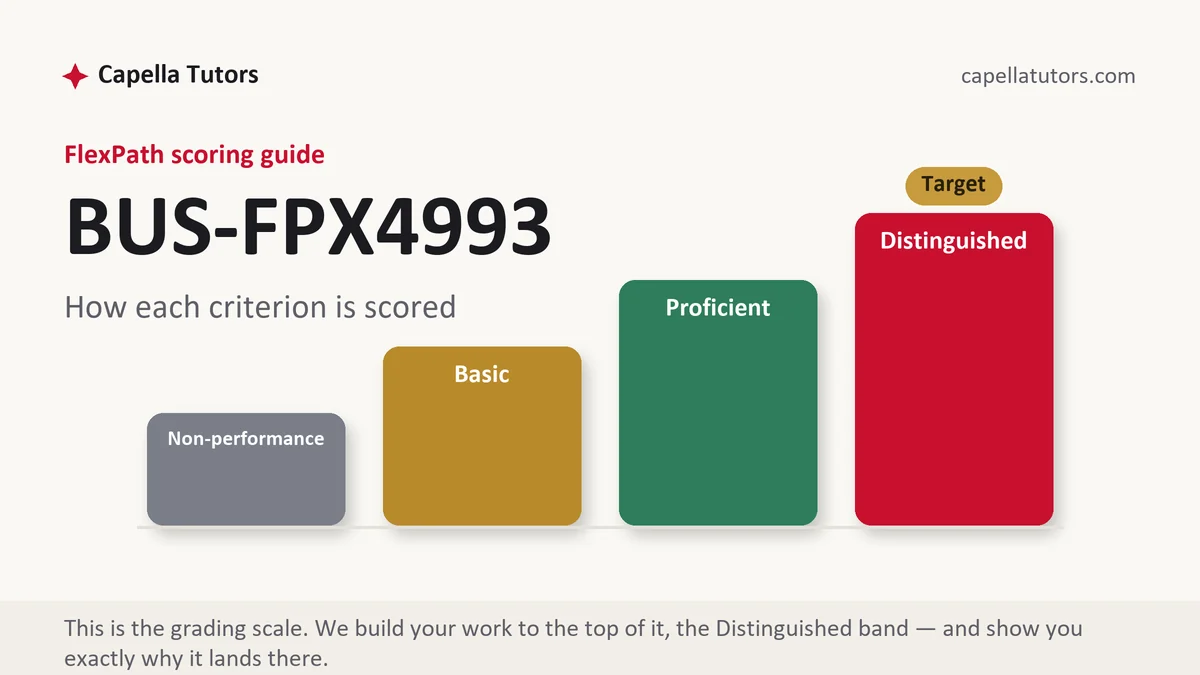
What BUS FPX 4993 actually grades
Every earlier course in the degree asked one discipline's question. Marketing asked about the customer, finance asked about the money, operations asked about the process and human resources asked about the people. The capstone asks all of them at once about a single organization, and the criteria are built to find out whether you can hold them together. That is the whole difference, and it is a larger difference than it sounds, because the answers pull against each other. The operations improvement costs money the finance analysis says is tight. The staffing plan that fixes the service problem breaks the margin. A capstone deliverable that answers each question separately and never resolves the conflicts has produced a set of course assignments bound in one file.
The second difference is the reader. Earlier assessments were written for a faculty evaluator holding a scoring guide, and the successful strategy was to answer each criterion visibly in order. This one is written for somebody who runs a business, has twenty minutes, and will decide whether to act. That reader wants the recommendation first, the reasoning available underneath it, the numbers in a form they can check, and no paragraph explaining what a framework is. The scoring guide is still what awards the marks, and the criteria in a capstone are typically written to reward exactly the document an executive would want, which means the two audiences point the same way for once.
The third difference is that nobody supplies the material. Earlier courses handed you a case, a data set or a defined scenario. Here you choose the organization, find the evidence, decide what is relevant and defend those choices. That freedom is where most capstones go wrong, usually by choosing a company too large to say anything specific about or too obscure to research at all. Expect the criteria to assess the quality of your evidence base as much as the quality of your conclusions, since an executive recommendation built on assertion is worth nothing regardless of how well it is argued.
The fourth is integration itself, which is assessed and cannot be faked by adding a section. Integration means a marketing conclusion changing a financial projection, an operations constraint limiting a growth recommendation, and a human resource cost appearing in the same table as the revenue it enables. The test to apply to your own draft is whether any section could be deleted without the rest of the document changing. If it could, that section was decoration. A capstone where the pieces genuinely depend on each other reads differently from one where they merely sit adjacent, and evaluators who have marked a hundred of these can tell within two pages.
How we help in this course
Capstone work is the largest thing we take on and it runs differently from a single assessment. We start by reading what the criteria actually weight, then agree the organization, the scope and the evidence base with you before drafting, because a capstone built on the wrong subject cannot be rescued later. The sample arrives with the analysis integrated rather than compartmented, financial support built in a spreadsheet so the figures reconcile, and an executive summary written last so that it states the recommendation rather than previewing the structure.
Terms hold even at this size. A premium original deliverable inside 24 to 48 hours, an eight-person pipeline behind it, a reviewer working the scoring guide row by row, and free revision until the criteria are met. Where the course breaks the work into staged submissions, we can take them one at a time and keep the through-line consistent between them, which matters more here than anywhere else in the degree. Evaluator feedback re-enters the cycle at no charge, and with two business days allowed for each assessed attempt we plan the sequence so that a revision still fits inside your 12-week billing session.
The assessments, one by one
Assessment 1: Mission Statement
Write a mission statement for the capstone organization, explain it, and identify its core competencies and competitive advantages. Read the full Assessment 1 manual.
Assessment 2: SWOT Analysis
Analyze the capstone organization's strengths, weaknesses, opportunities and threats, propose strategies for development, and respond to peer feedback. Read the full Assessment 2 manual.
Assessment 3: Environmental Scan
Analyze the internal and external factors that affect the capstone organization and their implications for strategy. Read the full Assessment 3 manual.
Assessment 4: Long-Term and Short-Term Plans
Set a long-term goal for the capstone organization and the short-term goals that lead to it, with measures and timelines. Read the full Assessment 4 manual.
How to actually write BUS FPX 4993: where to begin
Read the scoring guide first and read it as a weighting rather than as a list, because the criteria will tell you where the marks concentrate and capstone guides are rarely balanced. Then choose the organization, and choose it for evidence rather than for interest. A public company with filed financial statements gives you audited figures, a stated strategy, a candid risk disclosure and segment results, all free. Your own employer gives you access, operational detail and a genuine problem, at the cost of verifiable numbers. A small local business gives you both access and simplicity if the owner will talk to you. In current courserooms the assessments include "Mission Statement", "SWOT Analysis", "Environmental Scan" and "Long-Term and Short-Term Plans" among others, and your scoring guide decides the exact format of each.
Then do the thing that distinguishes a capstone from a long report, which is to go back through your own coursework and take inventory. You have already learned how to map a process and find its constraint, how to build a pay structure, how to test whether a resource is a genuine advantage, how to compute a contribution margin and a break-even, how to read a variance, how to assess a market entry, and how to run an ethical framework against a decision. Write a list of those capabilities against the organization you have chosen and mark which ones bear on its situation. Three or four applied properly will produce a stronger document than nine mentioned in passing, and the list itself tells you where your evidence gaps are before you start writing.
Build the financial spine early, because it is what holds the disciplines together and it is the part most often bolted on at the end. Whatever your recommendation turns out to be, it has a cost, a timing and an expected return, and every other section connects to that table. If the operations analysis says the constraint is a packing station running at 42 units an hour, the fix costs something and produces something, and those figures belong in the same schedule as the marketing projection that assumes the extra volume can be sold. Do this in a spreadsheet with the assumptions on their own sheet, so that when the volume assumption changes in week three the whole document does not have to be retyped.
Write the executive summary last and write it as a decision document. One page: what the organization faces, what you recommend, what it costs, what it returns, and the main risk. No previews of the structure, no sentence saying this paper will examine, no framework names. Then check the through-line by reading only your section conclusions in order, since if they do not tell a single coherent story the body will not either. Finish with the implementation and the measures, because a capstone that ends at the recommendation has stopped at the point where an executive starts asking questions, and the criteria in this course almost always reward the answer to those questions.
| Section | What goes in it | What Distinguished looks like |
|---|---|---|
| Executive summary | The situation, the recommendation, the cost, the return and the principal risk, on one page. | A summary that could be read alone and acted on, with the recommendation in the first two sentences. |
| Organization and evidence base | The business, its scale, its results, and where every figure in the document came from. | Evidence traced to filings, published data or a named internal source, with estimates labelled as such. |
| Integrated analysis | The disciplines applied together: strategy, operations, finance, people, marketing and ethics as relevant. | Findings in one area visibly changing the analysis in another rather than sitting in adjacent sections. |
| Options and choice | The realistic courses of action, compared on consistent criteria, with trade-offs stated. | A rejected option explained in enough detail that the reader can see why it lost. |
| Financial support | The cost of the recommendation, the projected effect, the timing, and a sensitivity test. | A model whose assumptions are visible and whose conclusion survives a plausible adverse movement. |
| Implementation, measures and references | Phases, owners, dependencies, leading indicators, risks and current APA in both directions. | Indicators that report within a quarter, with a named owner and a stated point of reconsideration. |
Developing the analysis
The intellectual demand in a capstone is synthesis under conflict, and it is worth naming that explicitly in your own document rather than hoping it shows. Each discipline you have studied optimises for something different, and applied to the same firm they will recommend different things. The operations answer to a service failure is usually more capacity, the finance answer is usually a tighter cost base, the human resource answer is usually better selection and retention, and the marketing answer is frequently a different customer segment altogether. A weak capstone picks whichever one the writer found most interesting. A strong one states the conflict, applies a criterion for resolving it, and says what is being given up. That criterion should come from the organization's own position rather than from your preference, which means a firm short of cash resolves toward the option that pays back fastest even if a slower option is better in theory, and a firm with a reputational exposure resolves toward the option that closes it even if the arithmetic is finer. The other honest point concerns the limits of an outside analysis. Working from public information means you can see results and not causes, you can see what was said and not what was decided, and you cannot know what constraints the management team is operating under. Say so once, specifically, naming the two or three facts you would need in order to be confident. An executive reading a recommendation from somebody who knows what they do not know finds it more credible rather than less, and the criteria in a capstone are usually written by people who have sat on the receiving end of exactly that document.
Citations that survive faculty review
A capstone is judged partly on the quality of its evidence base, so build the reference list deliberately rather than accumulating it. For a public company, the annual report and quarterly filings on SEC EDGAR are the primary sources and carry segment results, the risk factors written under legal exposure, and the management discussion explaining performance in the firm's own words. Industry context comes from the research databases in the Capella library alongside Census Bureau industry statistics for size and concentration, Bureau of Labor Statistics data for wages, employment and occupational trends, and Bureau of Economic Analysis series for the wider economic picture. Peer-reviewed research through Business Source Complete and ABI/INFORM supports any claim that a management practice produces an effect, and it is where the frameworks you are applying should be cited to their originators rather than to a course textbook. Where regulation shapes the recommendation, cite the agency directly. Established business press can establish that an event occurred and is not evidence that a strategy worked. Company marketing material, investor relations pages and sustainability reports document what the organization claims about itself and should be presented that way. Interviews you conduct yourself are legitimate primary evidence if the assessment permits them, and should be described by role and date rather than by name. Keep consultancy trend reports and vendor white papers out of the evidence base, then run current APA in both directions and confirm that every figure in the financial model has a visible origin.
The mistakes that land Basic instead of Distinguished
- Sections that read like separate assignments. A capstone assembled by topic rather than integrated by argument is the failure mode the criteria were written to detect.
- An organization too large to analyze. A global conglomerate produces a survey, and specificity is what the whole deliverable is being graded on.
- An executive summary that previews the structure. A reader who wanted a table of contents already has one, and the summary exists to carry the recommendation.
- Financial projections with invisible assumptions. A model nobody can inspect is a set of numbers, and an executive will discount the entire document once they notice.
- A recommendation with no implementation. Naming the right course of action and stopping leaves every question an executive would actually ask unanswered.
BUS FPX 4993 questions students actually ask
How is this different from the strategy paper I already wrote?
Scope, ownership and audience. A strategy assessment gave you a defined question inside one discipline, supplied or narrowly framed the material, and was written to be marked against criteria about strategic analysis. The capstone gives you an organization and expects you to decide which questions matter, which means part of what is being assessed is your judgment about scope before any analysis begins. It also expects the disciplines to interact, so the financial section constrains the strategic one rather than following it. And it is written for somebody who would have to fund the recommendation, which changes the register throughout: shorter sentences, the conclusion in front, the reasoning available rather than displayed, and no passage explaining a model. If you find yourself defining a framework before using it, you have slipped back into the earlier register.
Can I reuse work from my previous courses?
Reuse the capability, not the text. Submitting or recycling prose you previously turned in raises an academic integrity question in most institutions, and it is worth checking your own policy before you do anything with an earlier file. What you should absolutely carry forward is the method. If you built a break-even analysis in your managerial accounting course, you know how to build one here and it will be faster and better the second time. If you ran a process map, run another. Take your earlier assessments out and read them for technique rather than for content, then apply the technique to the new organization with new data. That is what the word integrative in a capstone description actually means, and it is a legitimate and expected use of what you already produced.
How long should the finished document be?
Whatever the scoring guide says, and the length is rarely the difficulty. Capstone deliverables run longer than earlier assessments because they cover more ground, and the common error is padding rather than brevity, since a document that repeats its analysis in the summary and again in the conclusion reads as though it is filling space. Budget the words by criterion weight instead. If integration and recommendation carry the most marks, they get the most pages, and the organizational background that feels comfortable to write gets two paragraphs rather than four. Put supporting schedules in appendices where an executive can find them without wading through them. Then check the length of your paragraphs, because a capstone written in dense unbroken blocks will be skimmed by exactly the reader it was written for, and the criteria on professional communication are usually worth more here than students expect.
Capstone due?
Send the criteria and the organization you are working with. We agree the scope first, then build one integrated document with the numbers underneath it. First premium sample free.