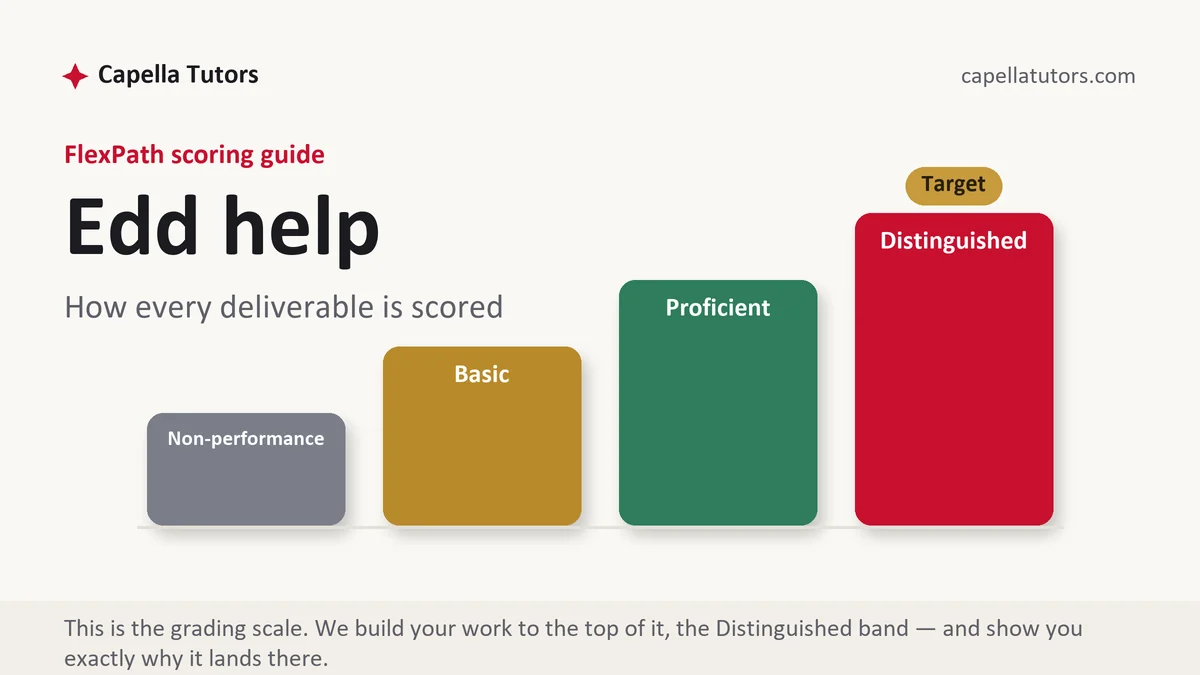
Capella's EdD is a practitioner doctorate, built to change something inside an organization rather than add a chapter to a literature. The FlexPath version with the Educational Leadership specialization runs 32 program points across sixteen required courses: five doctoral core courses worth 10 points, five specialization courses worth another 10, and a six-course doctoral project holding the last 12, taken once the coursework behind it is complete. Every course is passed by written work scored against a guide, at doctoral register. We draft to the Distinguished column inside 24 to 48 hours and revise free until the criteria clear.
What the Capella EdD actually demands
People searching for Capella EdD help arrive with one assessment and one suspicion, that the work is judged against a standard nobody spelled out. It has a name. The EdD trains a scholarly practitioner, someone whose evidence is research and whose object is their own institution, and every criterion is written from that stance. A master's assessment asks whether you understand a framework. A doctoral assessment asks what the framework licenses you to claim about one organization, on what evidence, and with what left honestly uncertain.
The stance catches two kinds of student from opposite directions. Career educators arrive fluent in the setting and lose criteria on warrant, because twenty years of watching a problem is experience rather than evidence. Strong academic writers arrive fluent in warrant and lose criteria on use, because an argument no principal could act on misses the point of a practitioner doctorate. Aim between them: a claim a researcher would accept, carrying a recommendation a superintendent could sign.
The 32-point shape, and where the points sit
The program is exactly sized, and the size drives every planning decision you make. Sixteen required courses, 32 program points, three blocks doing different jobs. Specializations differ and Capella revises requirements between catalog years, so check your totals against the year you enrolled under.
| Block | Courses | Points | What it does |
|---|---|---|---|
| Doctoral core, the 80xx band | 5 | 10 | Doctoral studies, organizational improvement, problems of practice, research design, data literacy |
| Educational Leadership specialization, the 85xx band | 5 | 10 | Leadership design, learning culture, the future of the field, change leadership, assessment and evaluation |
| Doctoral project, the 995x band | 6 | 12 | The practice-focused project, taken upon completion of the coursework behind it |
| EDD FPX 9980 continuation | 1 | Not shown | Outside the 32 required points, for a project still running when the sequence ends |
The last row surprises people. EDD FPX 9980, Doctoral Project Development, sits outside the required 32 and the catalog prints no point value beside it. Nobody plans to take it, and the cause is almost always a project scoped around data a site could not produce. If you are weighing the doctorate against the master's, the two do not run on the same clock: Capella's MS in Education page lists that degree in the GuidedPath format, fixed weekly deadlines and letter grades instead of criterion levels, and the education degree hub maps it.
EdD or PhD, and how to settle it for your school
The question arrives early and deserves a general answer followed by a specific check. Across universities the distinction is usually purpose rather than difficulty. A PhD in education prepares somebody to produce research, judged on contribution to knowledge. An EdD prepares somebody to lead using research, judged on whether a defensible method reached a problem inside a real organization. That is a tendency and not a rule, since programs define the labels differently, so confirm it at the school you are applying to rather than in any general account, this one included.
| Question | Practitioner doctorate, the usual pattern | Research doctorate, the usual pattern |
|---|---|---|
| Who it is built for | A leader who will stay in practice | Someone heading toward research or a faculty line |
| What the final work is judged on | Whether a defensible method addressed a real problem | Whether the study contributes something new to the field |
| Where the data comes from | One organization, usually the one that employs you | A sample selected to support a generalizable claim |
| Who the intended reader is | A principal, a cabinet, a board committee | A scholarly audience and a committee representing it |
| How it ends | A recommendation delivered to people who can act | A dissertation defended, then published |
| How to verify | Read the program description at the specific school, and ask what the culminating work is called and who receives it | |
For a Capella EdD the consequence is simple: your site is your instrument, and feasibility is a design constraint from the first course.
Send the EdD course you are in
The code and the scoring guide are enough to start. First premium original sample free, back inside 24 to 48 hours.
Every EdD course we cover
Sixteen required courses plus the continuation, seventeen pages. Each covers what its criteria grade, how to write to its guide, and the mistakes that cost a level.
Doctoral core, the five 80xx courses
EDD FPX 8010, EDD FPX 8020, EDD FPX 8030, EDD FPX 8040, EDD FPX 8050
Educational Leadership specialization, the five 85xx courses
EDD FPX 8520, EDD FPX 8522, EDD FPX 8524, EDD FPX 8526, EDD FPX 8528
The doctoral project, six courses
EDD FPX 9951, EDD FPX 9952, EDD FPX 9953, EDD FPX 9954, EDD FPX 9955, EDD FPX 9956
Continuation, outside the 32 points
Browse the full course catalog
The dissertation in practice, six courses long
The project block is where the degree gets finished or abandoned. Six courses, 12 points, taken once the coursework behind it is complete. Capella gives these courses numbers and titles and no chapter list, so read what follows as work the sequence absorbs somewhere, and let your project handbook place it.
The arc is stable across practitioner doctorates. A problem of practice is named and measured in the site's own figures. A design is chosen that the site can support. Permissions clear, which is a queue rather than a conversation and includes any human-subjects review your project requires. Data is gathered and analyzed. Findings become recommendations somebody could act on. Two of those steps are not writing at all, and those two eat the calendar.
The decision shaping the sequence is which organization you study, and it is a real tradeoff. Your own district gives access nobody else gets, and permission travels through people who already answer your email. It also hands you a supervisor with a stake in the finding, colleagues who cannot comfortably decline, and records you may read in your job but not analyze without separate approval. An outside organization inverts all of it: cleaner position, harder access, a permission process that can outlast the course it is due in. Most study their employer, which works if positionality is written in the first project course.
The time problem nobody warns district employees about
The hardest constraint in an EdD is not the writing. Almost everyone in the program holds a job whose calendar somebody else designed. FlexPath bills in flat 12-week sessions and allows up to two courses at a time, which sounds like freedom and behaves like a meter, and the meter does not pause for the opening of school, the testing window or budget season. A session opening the week staff return costs you most of its first three weeks, so a 12-week session with three weeks gone is a nine-week session you paid twelve for. Two of those a year is six weeks of flat billing spent on work you were never going to do. Put your heaviest course inside the quiet stretch your own system has.
The pairing rule follows from the same math. Ten taught courses fit into five slots at the ceiling of two at a time, and the project six run in the order the sequence sets, with any overlap a question for your project handbook. The pair that works puts one reading-and-argument course beside one whose labor is building something, so the two business days faculty have to evaluate an attempt are filled rather than waited out. The two-course rotation playbook covers the mechanics and the expedite page carries the pacing math.
Where EdD students stall
Rarely in the core. The stall lands at the seam between the last specialization course and the first project course, because only one of the two warns you in advance. An assistant principal finishes the specialization block at Distinguished, opens EDD FPX 9951, and is asked for a problem with a magnitude. She has a topic, chronic absenteeism, and no published figure for it at her own site. Three weeks go into requesting data through a channel that did not exist until she needed it, and the session bills across all three.
- A topic where a problem belongs. Teacher morale is a subject; a measured turnover rate in four named buildings is a problem.
- Permission assumed rather than held. Access to a system in your job is not approval to analyze it in a study.
- A site that cannot produce the data. If nobody records it, no design later recovers it for you.
- Positionality postponed. Written late it reads as a disclosure; written first it reads as design control.
- The project treated as one long paper. It is six graded courses, each with its own guide and its own bill.
How the courses sequence
FlexPath lets you set the order inside the blocks, which is not the same as every order being sensible. Start with EDD FPX 8010, since it installs the doctoral sourcing and APA apparatus later criteria assume rather than teach. Take EDD FPX 8030 before you are attached to a topic, because that course is where a topic becomes a problem of practice, and running the conversion late means rewriting work you paid for. Keep EDD FPX 8040 and EDD FPX 8050 close: design and data literacy answer each other's questions, and a design chosen without knowing what your site measures gets rebuilt.
The specialization five can sit around the core in almost any order, and reading them as one set pays off later, since the framework your project leans on usually comes from this block. The project six go last by design. What your enrollment agreement permits is a question for your enrollment counselor, and the standard underneath all sixteen courses is the one the scoring guide guide and the FlexPath writing manual take apart.
EdD questions students actually ask
Is an EdD the same as a PhD in education?
Not usually, and the difference is purpose rather than prestige. As a general pattern, a PhD trains a producer of research and is judged on contribution to knowledge, while an EdD trains a leader who applies research and is judged on whether a defensible method reached a real problem in a real organization. Programs define the labels differently, so confirm the distinction at the school you are applying to and ask who reads the culminating work.
Can I use the district I work in as my EdD project site?
Usually yes, and most EdD students do, but access and permission are separate things. Employment gets you inside the building. It does not give you the right to analyze records you may read in your job. Get permission in writing from whoever owns the data, expect any human-subjects review to run on its own queue, and put positionality in the first project course: your role, what it grants, what it risks, and a safeguard beside each risk.
What is EDD FPX 9980 and will I have to take it?
EDD FPX 9980, Doctoral Project Development, is a continuation course outside the 32 required program points, and the catalog prints no point value beside it. It exists for learners whose project is still running after the six-course sequence, usually because the project was scoped around data the site could not deliver. Ask your enrollment counselor what enrolling in it does to your session billing before you need the answer.