Send your approved design, your raw material and the criteria you are graded on, and the analysis and the findings section come back inside 24 to 48 hours, coded or computed against the plan you filed, written toward the Distinguished column, and reworked free until the guide is satisfied. This course is EDD FPX 9954, EdD Doctoral Project 4, worth 2 program points, the fourth of the six numbered project courses that carry 12 of the 32 program points in the FlexPath Doctor of Education, Educational Leadership specialization. In Capella's catalog the course code is written EDD-FPX9954.
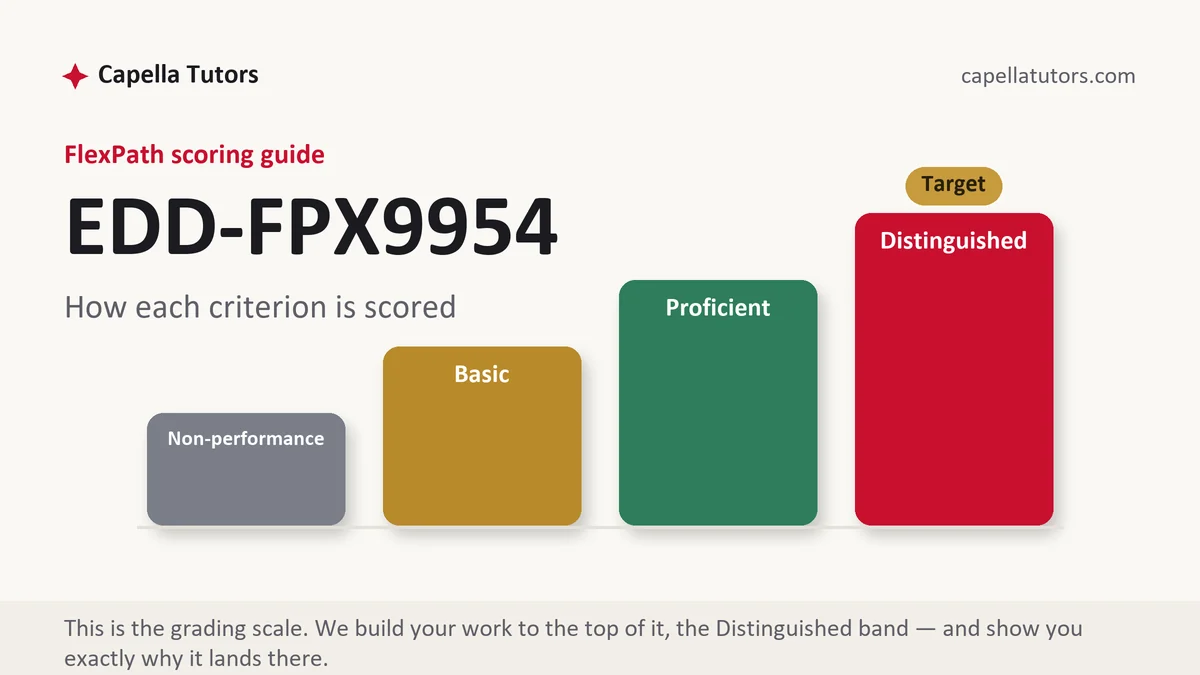
What EDD FPX 9954 actually grades
The catalog attaches a number and a title to this course and stops there, so no milestone name appears on this page. At this depth the grading turns concrete in a way earlier courses are not, because there is now a body of material that either does or does not match what you said you would gather, and an analysis that either does or does not follow the plan you filed. The assessments in this course usually ask you to account for what was collected against what was promised, to show the analytic procedure rather than assert it, and to report findings organized by research question with the interpretation held back for later.
Fidelity is the criterion nobody warns you about. Almost every practitioner project deviates, because schools move: a principal leaves, a testing window shifts, two participants withdraw, a survey closes at 38 responses out of 62 invited rather than the 50 you assumed. None of that is failure. Silence about it is. Write a short deviation record with the date, the change, the reason and the consequence for the analysis, and the section reads as a competent researcher managing a real site. A 61 percent response rate reported with a sentence on who did not answer and what their absence plausibly does to the finding is stronger than a 61 percent response rate reported as though everybody had.
The analysis itself is graded on procedure. Qualitative work has to show the ladder: a first cycle staying close to the language of the transcript, a codebook recording each code with a definition and an example, a second cycle grouping codes into categories for a stated reason, and themes that are arguments rather than folder labels. Quantitative work has to show the checks: missing data handled by a named method, assumptions tested rather than assumed, effect sizes with intervals beside the p values. A gain of 3.1 points on a 40-point measure with a standard deviation of 9.4 across 38 respondents is a standardized effect near 0.33 with an interval running from roughly 0.02 to 0.64, and reporting that honestly says the direction is probably real and the size is not yet pinned down. That sentence is the doctoral one.
How we help in this course
Our work in 9954 begins with your own protocol rather than with your draft. We read what you filed, then build the codebook or the analysis to match it, so that the procedure described in the chapter is the procedure that was actually run. Transcripts come back coded with definitions and exemplar quotations attached, category decisions carry their rationale, and quantitative output arrives with the assumption checks visible rather than buried in an appendix. Where the data will not support a claim you were hoping to make, you hear it before the section gets written rather than after.
Terms are unchanged and the second read is the part that matters here. Every deliverable is an original premium sample returned inside 24 to 48 hours, passed through a criterion-by-criterion scoring-guide review and an independent APA and originality check, with rewrites free until the guide is met. The additional pass in this course is arithmetic. Somebody recomputes every percentage, every mean and every count in the document and confirms the number in the narrative equals the number in the table, because a single disagreement between the two puts a reader on guard for everything else they cannot verify.
The assessments, one by one
Assessment 1
Assessment 1 usually opens the collection stage, so what is graded is correspondence rather than interest: whether the material you now hold is the material your approved design promised. Read the full Assessment 1 manual.
Assessment 2
Assessment 2 usually moves from what you hold to what you did with it, so the graded object is procedure rather than result. Read the full Assessment 2 manual.
Assessment 3
Assessment 3 usually turns the analysis into a chapter, so the graded question is discipline: whether you can report what the data says and stop there. Read the full Assessment 3 manual.
How to actually write EDD FPX 9954: where to begin
Open the scoring guide beside your own protocol and read them together, because the criteria at this stage are usually written as promises about the protocol. Where a criterion asks you to demonstrate rigor, the demonstration is an artifact: a codebook excerpt, an audit trail entry, an agreement figure, a table of assumption tests. Decide which artifact answers which criterion, produce the artifacts, then let the prose explain them. A findings section written first and evidenced afterward reads as a story with numbers dropped into it, and evaluators recognize the order it was written in.
Then hold the line between finding and meaning, since this is the course where the two get mixed and the criterion punishing it is usually a separate one. A finding is what the data says: seven of fourteen participants described the coaching cycle as a compliance exercise, or attendance in the two focus buildings moved from 31.8 to 27.6 percent across the window. Meaning is why that happened and what somebody should do about it, and it belongs in the stage after this. Writing the interpretation early feels efficient and costs twice, once because the findings criterion comes out thin and once because the discussion arrives with nothing left to say.
Then make only the trustworthiness claims you can support. If you claim intercoder agreement, produce it: two coders on 20 percent of the corpus with a kappa of 0.79 and a written record of how disagreements were settled. If you claim member checking, say who received what, how long they had it, and what changed as a result, because member checking with no changes recorded usually means it did not happen. If you claim an audit trail, keep one and date the entries. Negative case analysis is the cheapest credibility available: find the participant whose account contradicts your emerging theme, quote them, and explain what you did with them. Lincoln and Guba get cited by nearly every practitioner project and satisfied by considerably fewer, and evaluators know which they are reading.
| Section | What goes in it | What Distinguished looks like |
|---|---|---|
| Data account | What was collected, when, from whom, and how it compares with what the protocol specified. | A deviation record with dates, reasons and analytic consequences, written without apology. |
| Participants as realized | Actual counts, response or completion rates, and who is missing from the final set. | Non-response addressed with a plausible account of how it shifts the finding. |
| Analytic procedure | The coding cycles or statistical steps in order, with definitions, software and decisions recorded. | A procedure another analyst could repeat on the same material and land close to the same place. |
| Trustworthiness or validity | Agreement figures, member checking, audit trail, assumption tests, reliability statistics. | Claims evidenced with artifacts rather than named, including what happened to the disconfirming cases. |
| Findings by question | Results organized under each research question, with quotations or statistics carrying the weight. | Findings stated plainly, with effect sizes and intervals, or with quotations that earn their length. |
| Presentation | Tables and figures numbered, labeled and readable alone, with APA formatting throughout. | Every table interpretable without the surrounding prose, and every number agreeing with every other. |
Developing the synthesis
The synthesis at this stage happens inside the data rather than across a literature, and it has a specific shape. Codes become categories only once you can say what the category asserts, and categories become themes only once the theme survives a search for the cases contradicting it. Work the material twice with different intentions, once for what is common and once for what is anomalous, because the anomaly usually shows you where the boundary of your theme sits. In a mixed design the integration is the graded part rather than the two strands, so write the joint display that puts the quantitative result and the qualitative account of the same question side by side, then say whether they converge, diverge or explain one another. A chapter with a survey section followed by an interview section and no meeting point has done the work and skipped the criterion.
Citations that survive faculty review
This chapter cites less and cites more precisely. Methodological sources carry the analytic claims: whoever published the coding approach, whoever defined the agreement statistic you report, whoever wrote the trustworthiness criteria you are meeting. Cite them for the specific step you took rather than as a general endorsement, and where you departed from their procedure say so in the same sentence that cites them. Where you report a statistic, the convention faculty check is the full report rather than the verdict, meaning the test, the degrees of freedom, the statistic, the exact p, the effect size and its interval, in that order. For qualitative reporting the equivalent convention is attribution discipline, so every quotation carries a participant identifier, a role, and enough context that a reader knows what was being asked. Keep substantive literature out of the findings unless a criterion calls for it, run the reference list both ways in current APA, and verify that any adapted instrument is credited here as well as in the methodology chapter.
The mistakes that land Basic instead of Distinguished
- Interpretation smuggled into the findings. A results paragraph explaining why is spending the next chapter's material early and getting no credit for it.
- Deviations left unmentioned. Reviewers find the gap between the protocol and the data, and an unexplained one reads as concealment.
- Themes that are only topics. Barriers to implementation is a folder label rather than a finding about what participants said.
- p values with no effect size. Significance answers whether, and a district decision needs to know how much.
- Quotations used as decoration. Three long extracts making the same point signal that the coding never reached a category.
EDD FPX 9954 questions students actually ask
My response rate is low. Is the project salvageable?
Almost always, provided you stop treating the shortfall as an embarrassment and start treating it as data. Report the invited count, the completed count and the rate, then describe the people who did not respond in whatever legitimate terms you have, by building, by role, by grade band, and say which direction their absence probably pushes your result. If the teachers most frustrated with a program were also the least likely to answer a survey about it, your finding is conservative and you should say so in the chapter. Where the number is too small for the analysis you planned, change the analysis rather than the claim, since descriptive reporting with intervals or a shift of weight onto the qualitative strand both beat a significance test that was never going to reach anything.
What if my results contradict the framework I spent a whole course building?
Then you have a finding, and usually a better one than confirmation would have been. Report it in the same plain register you would use for a supportive result, without hedging language written to protect the framework, and save the explanation for the interpretation stage. What you must not do is quietly rewrite the framework so the data fits, because the earlier chapter is already filed and anybody reading the document in order will see the seam. Doctoral evaluation is looking for whether you can be wrong in public and reason about it, and a project that disconfirms its own premise and says so cleanly tends to score above one that confirms everything it expected.
Collection ran past the end of my billing session. What happens?
Practically, the work continues and the calendar becomes an accounting problem rather than an academic one. FlexPath runs on flat 12-week sessions with up to two courses open at once, so a project course that outlasts a session carries into the next one and the cost of the delay is measured in sessions rather than in credits. What you control is throughput inside the weeks you already have. Submit each attempt the moment it is finished rather than saving them up, allow the two business days faculty have to evaluate a submission, and keep a second lighter course open so the session is not spent watching a transcription queue. Confirm the specifics of your own enrollment with your advisor before assuming anything about billing.
The handoff here is a findings section another person could interpret, which is a stricter standard than a findings section you understand yourself. EDD FPX 9954 delivers the realized data account, the analytic procedure with its evidence attached, and results organized under each question, and EDD FPX 9955, EdD Doctoral Project 5, takes those results and argues about what they mean for practice. Anything left implicit now becomes an argument you cannot support later, because interpretation can only work with findings that are actually on the page. Write the reflexive memos while the material is fresh as well, since the reflective account expected at the close of the sequence is far easier to evidence from notes made during analysis than reconstructed from memory nine months afterward.
Findings section due?
Send the guide, your filed protocol, and your transcripts or your dataset. We will build the codebook or the analysis and report only what the data supports. First premium sample free.