Send the prompt, the scoring guide, and whatever you have drafted, and a premium original sample returns inside 24 to 48 hours with each claim warranted, each framework traced to the person who built it, and free revisions until the guide is satisfied. The transcript line reads EDD FPX 8010, Foundations of Doctoral Studies in Education, worth 2 program points, part of the five-course doctoral core in the Capella EdD with the Educational Leadership specialization, taken in FlexPath inside a required sequence of 32 points. In Capella's catalog the course code is written EDD-FPX8010.
What EDD FPX 8010 actually grades
This course grades a stance before it grades a technique. Faculty are reading for evidence that you have stopped writing as an experienced educator with strong opinions and started writing as someone who owes a reader a defended claim. The professional practice doctorate has a stated purpose, and the Carnegie Project on the Education Doctorate puts it directly: the graduate is a scholarly practitioner and the culminating study is a dissertation in practice aimed at a problem inside a real organization. Shulman, Golde, Bueschel and Garabedian set that agenda in Educational Researcher in 2006, arguing that education had allowed its research doctorate and its practice doctorate to collapse into one another. Early deliverables are partly a test of whether you know which degree you enrolled in.
Doctoral prose is the second graded strand, and it is structural rather than lexical. Undergraduate and much graduate writing explains; doctoral writing argues. Stephen Toulmin's account in The Uses of Argument, published in 1958, remains the most useful diagnostic because it names the parts a weak paragraph is missing: a claim, the grounds offered for it, the warrant licensing the move from one to the other, a qualifier limiting how far the claim reaches, and a rebuttal stating the conditions under which it would fail. Most submitted drafts contain grounds and a claim with nothing between them, which is what a Proficient descriptor tends to describe. Calibration is scored in both directions, since a claim asserted harder than its evidence allows reads as inexperience, and a claim buried under four qualifiers reads as an author unwilling to commit.
The third strand is research integrity, defined far more broadly here than in anything you have taken before. Verbatim copying is the least of it. What draws doctoral scrutiny is patchwriting, where sentences are reordered and synonyms swapped while the source's architecture survives intact; citing an abstract as though the study had been read end to end; and crediting a framework to whoever mentioned it most recently rather than to the person who published it. Attribute the revised taxonomy of educational objectives to Anderson and Krathwohl in 2001, attribute the original to Bloom's 1956 committee, and say which of the two you actually used. Information literacy is graded next to it, because a claim is only as strong as the search that found its evidence. ERIC and Education Source through the Capella library are the primary databases here, and the ERIC thesaurus lets you search on the descriptors indexers assigned rather than the phrase your district happens to use.
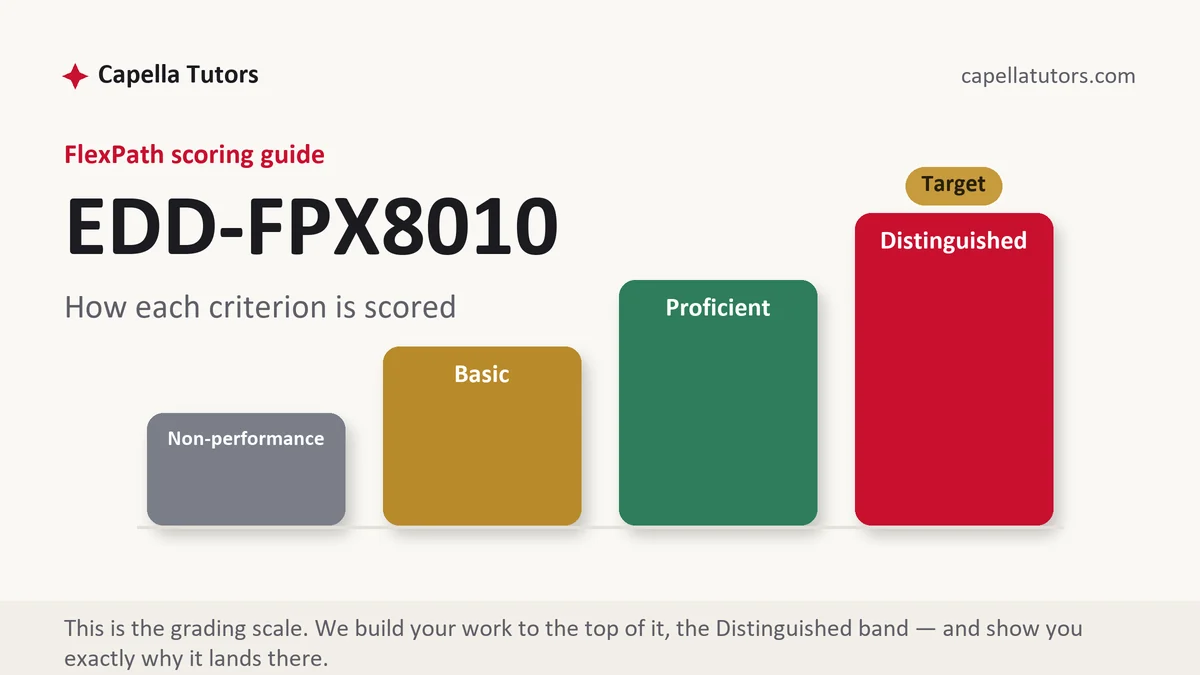
Pacing habits set in this course tend to repeat for the length of the program. FlexPath bills in flat 12-week sessions, permits two courses at a time, grades only what you submit, and gives faculty up to two business days to evaluate an attempt against the four criterion levels of Non-performance, Basic, Proficient and Distinguished. A learner who submits a genuine first attempt in week two and reads the feedback carefully has spent nothing and gained a map. A learner who polishes privately until week ten has purchased no extra information and left no room to use any.
How we help in this course
Drafts for 8010 are built the way the criteria are written. Every claim in the document arrives with grounds attached, every model is cited to its originating publication, and the paragraph describing your professional setting also states what the available evidence entitles you to say about it. When a deliverable asks you to position yourself as a scholarly practitioner, the sample does that with specifics from your role rather than a paragraph of stated intention, so tell us your title, your setting, and the problem that pushed you into a doctorate in the first place.
Terms match the rest of the studio. One premium original sample inside 24 to 48 hours, aimed at the top descriptor in your own guide, moved through an eight-person pipeline in which one reader does nothing but check the reference list against the in-text citations in both directions, and revised at no charge until the criteria are met. Faculty comments re-enter the same cycle free of charge.
The assessments, one by one
Assessment 1
Assessment 1 of EDD FPX 8010, Foundations of Doctoral Studies in Education, is where you stop writing as an experienced educator with strong opinions and start writing as someone who owes a committee a defended claim. Read the full Assessment 1 manual.
Assessment 2
Assessment 2 of EDD FPX 8010 moves from stance to evidence. Read the full Assessment 2 manual.
Assessment 3
Assessment 3 of EDD FPX 8010 is the synthesis, and it usually asks you to turn everything the course has drilled into one warranted position on a decision your organization faces, then say where the doctoral sequence takes it next. Read the full Assessment 3 manual.
How to actually write EDD FPX 8010: where to begin
Open the scoring guide and build the document out of it before drafting a sentence of prose. Each criterion becomes a heading, the Distinguished descriptor is pasted underneath it in a working copy, and every paragraph you write is assigned to one of those headings or cut. Doctoral guides usually carry one row that graduate guides do not, a criterion scoring scholarly communication and the quality of your evidence separately from the correctness of your answer, which means a right answer written casually still loses a level. The assessments in this course usually ask you to account for the doctoral path you are entering, to show that you can locate and judge scholarship, and to write about your own practice with a distance a reader can verify. Your scoring guide decides which of those a given attempt wants and in what proportion.
Then take one sentence you would say in a staff meeting and rebuild it as a doctoral claim, because that exercise is what the writing criteria are measuring. Begin with what an assistant principal actually says: our new teachers need more support. There is no claim there, only a preference. The doctoral version leads with grounds. In the district in question, 14 of the 41 teachers hired across the last three years left within two years, and the exit conversations from that group name isolation and unclear expectations more often than salary. Now the claim can be narrow and strong: early departure in this district tracks with the absence of structured induction rather than with pay. The warrant is where the literature does its work, and Ingersoll and Strong supplied it in their 2011 review in Review of Educational Research, which found that most studies of induction and mentoring reported improved retention while cautioning that the designs behind those findings varied widely in quality. The qualifier concedes that 41 hires in one system cannot separate induction from building leadership. The rebuttal names what would defeat the claim, which here is a comparable district with the same induction gap and no attrition problem. Five moves, and a paragraph containing all five reads at a different level than one containing two.
Then learn to read a study in the order that makes it usable, since the reading volume in a doctoral program is only survivable if each article is stripped for four things. Take the design first, because it sets the ceiling on every conclusion the article can offer. Take the sample second, with its size and who was excluded, because that governs whether anything transfers to your organization. Take the measure third, and ask what was actually counted, since an article about achievement may mean a state summative test, a vendor benchmark, or course grades, and those three are not interchangeable. Take the authors' own limitations section last, because it records what they declined to claim, and citing a study for something its authors refused to assert is the fastest way to lose a criterion on use of evidence.
| Section | What goes in it | What Distinguished looks like |
|---|---|---|
| The doctoral stance | Your role, your setting, and the practice problem that brought you here. | The line between improving a practice and contributing to a theory drawn explicitly, with its source cited. |
| Argument and voice | Claims with grounds, warrants that name the literature, qualifiers sized to the evidence, a stated rebuttal condition. | Every substantive paragraph carries a claim a reader could dispute, with its limits declared by the author first. |
| Evidence and its quality | The sources located, the reason each was selected, and the authority each one carries. | Peer-reviewed empirical work kept separate from professional commentary, with the search route described. |
| Use of sources | Paraphrase that rebuilds rather than reworded sentences, and primary attribution for every model. | Frameworks traced to the publication that introduced them, with secondary reading acknowledged as secondary. |
| Practice context | The organization described concretely enough for a reader to judge whether your claims fit it. | Baseline figures reported with their period and their denominator, so a later study has something to move. |
| Plan forward and references | The route from this course toward the culminating study, and current APA throughout. | A plan tied to the required sequence rather than a hopeful date, with citations and references matching exactly. |
Developing the synthesis
Synthesis is the move that separates doctoral reading from graduate reading, and it is easier to demonstrate than to define. A summary paragraph reports three studies in three sentences, each beginning with an author's surname. A synthesis paragraph opens with the state of the evidence and uses those authors as support for a position you have taken about them. Try it on the induction literature above. The summary version says Ingersoll and Strong found induction helpful, that a later evaluation found smaller effects, and that a third study found none. The synthesis version says induction lowers early departure where mentoring is bundled with released time and sustained administrative attention, that the studies reporting nothing tend to describe programs in which a mentor was assigned and no other resource moved, and that the disagreement is therefore about program intensity rather than about induction as an idea. Same three sources, one of them now doing analytic work.
Citations that survive faculty review
Four kinds of source carry weight in education at this level and they are not interchangeable. Peer-reviewed empirical articles in journals such as Educational Researcher, the American Educational Research Journal and Review of Educational Research support any statement about what happens when something is tried. Foundational works cited to their originating publication carry the frameworks, which means Toulmin for argument structure, Anderson and Krathwohl for the revised taxonomy, Boyer's 1990 Scholarship Reconsidered for the argument that scholarship includes application and integration, and the Carnegie Project on the Education Doctorate for the scholarly practitioner itself. Federal and state statistical sources, chiefly the National Center for Education Statistics and your own state education agency, establish scale and let you show that a local problem is not merely local. Standards bodies supply obligations rather than evidence, and the Professional Standards for Educational Leaders issued by the National Policy Board for Educational Administration in 2015 is the one most EdD deliverables eventually reference. Format in the seventh edition of the Publication Manual of the American Psychological Association, then reconcile the list against the text in both directions, because a reference with no citation and a citation with no reference are both scored.
The mistakes that land Basic instead of Distinguished
- Summary wearing the label of synthesis. Three consecutive sentences that each begin with a different author's name have organized your reading, not your argument.
- A framework credited to its most recent mention. Citing a 2021 article for the revised taxonomy tells a reader you met the idea secondhand and never went to the source.
- Preference dressed in doctoral vocabulary. Long words wrapped around an unsupported opinion score lower than a plain sentence with a citation behind it.
- A local problem asserted without a number. Claiming your school struggles with something, with no count, no period and no denominator, leaves the rest of the paper resting on nothing.
- Writing the EdD as though it were a PhD. Proposing to test a theory instead of improving a practice misreads the degree, and the criteria are written to catch it.
EDD FPX 8010 questions students actually ask
What actually changes between master's writing and doctoral writing?
The unit of work changes. A strong graduate paper answers the prompt completely and cites appropriately. A doctoral paper takes a position and defends it against the strongest objection available, which reshapes every paragraph in the document. Three habits carry most of that difference. Claims arrive with a warrant, so a reader can see why the evidence licenses the conclusion rather than merely accompanying it. The literature is characterized as a body with agreements and disputes instead of being reported study by study. And the author names the limits of the claim before an evaluator has to. Length and vocabulary are not the difference, and inflating either is the most common failed attempt at doctoral tone.
How many sources does a doctoral assessment need?
Your scoring guide sets a floor, and the floor is rarely the right answer. Count by the job each source does instead. Every distinct claim about what works needs at least one empirical study behind it, every framework you lean on needs the publication that introduced it, and every figure you report about your own organization needs either a document you can name or an assumption you declare. That accounting usually lands above the stated minimum and well below a padded list, and it survives the question faculty actually ask, which is why this source and not a better one. Twenty references where six appear once in a throwaway sentence reads worse than twelve that each carry weight.
Can I write about my own district, and can I use first person?
Yes to both, with conditions. A practice doctorate expects you to study the setting you work in, and the seventh edition of the APA manual prefers a plain I to the third-person constructions writers use when they want to sound impersonal. The conditions concern disclosure rather than grammar. State your role and the authority attached to it, because a reader needs to know whether the people in your account report to you. State how you obtained anything you present as fact about the organization. And keep the site identifiable only to the degree your program permits, since a paper that names a school and catalogues its failures is a different document from one that does not.
First doctoral deliverable due?
Send the prompt and the guide. The first premium sample is free, and every claim inside it is warranted rather than announced.