Give us your findings, your framework and your scoring guide, and the interpretation, the recommendations and the implications come back inside 24 to 48 hours at doctoral register, argued against the Distinguished descriptors and revised free until they meet them. The course is EDD FPX 9955, EdD Doctoral Project 5, worth 2 program points, fifth of the six numbered project courses, a group accounting for 12 of the 32 program points the FlexPath EdD requires under its Educational Leadership specialization. In Capella's catalog the course code is written EDD-FPX9955.
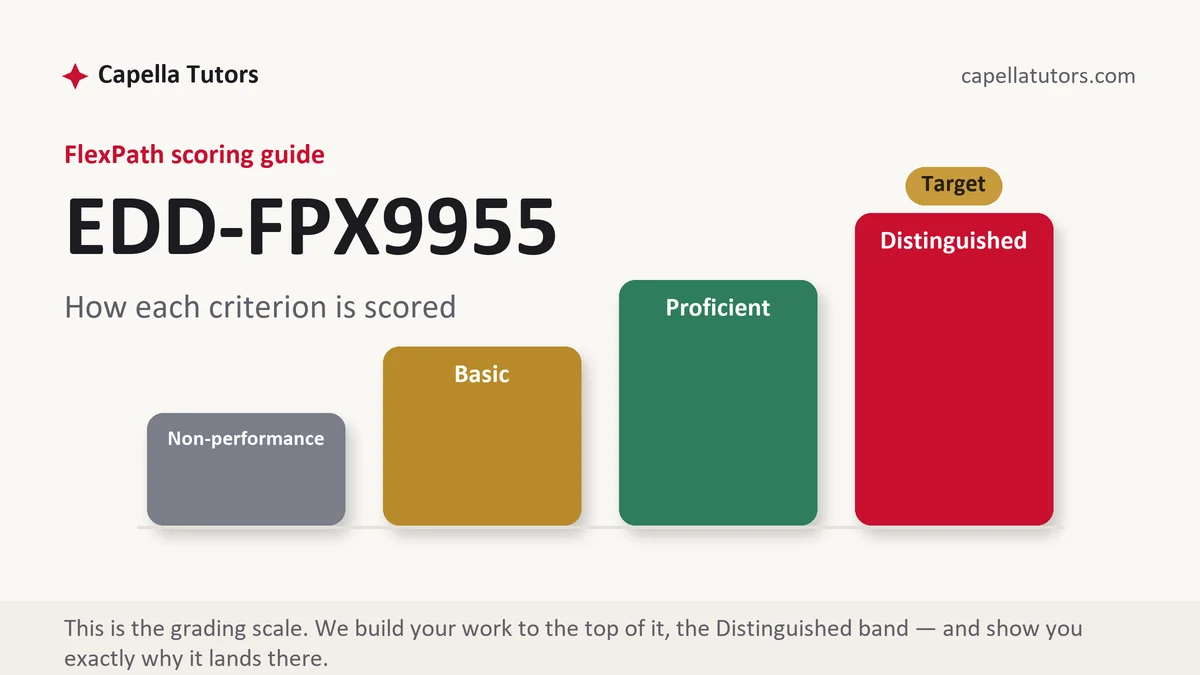
What EDD FPX 9955 actually grades
No public chapter list attaches to this course number, so nothing here names a milestone your program has not. What is being graded at this depth is judgment. The data is fixed, the analysis is finished, and the only remaining variable is what you make of it, which is why this stage separates learners more sharply than any earlier one. The assessments in this course usually ask you to interpret findings against the framework you built, to state what the project can and cannot support, to convert the result into recommendations somebody could act on, and to say what it means for practice beyond the site that hosted you.
Interpretation is graded as an argument with a shape. Each finding gets connected to the framework that predicted it or failed to, then to the literature that agrees or disagrees, then to the practical consequence. Where your result matches the field, say so briefly and move on, because agreement is cheap. Where it does not, that is the paragraph the criterion came looking for, and the answer is almost never that the field is wrong. It is usually that your site differs in a way you can name: a smaller dose, a shorter window, a different baseline, a population the original studies never included. An interpretation that explains a discrepancy through a named difference is doing the thing a practitioner doctorate exists to do.
Recommendations carry their own criterion and are usually the weakest section in a submitted draft, because they get written as wishes. A recommendation a doctoral reader will accept has an actor, an action, a resource, a timeline and an indicator. Increase collaboration is a wish. Moving one attendance support position from the two lowest-rate buildings to the two highest, effective at the start of the second quarter, tracked by the monthly chronic-absence rate in both pairs, is a recommendation, and it is one a board could vote on. Cost it where you can. Forty-six half-days of release time at four hundred dollars a day is 18,400 dollars, and a recommendation naming its own price is read as serious even by the people who decline it.
How we help in this course
Our 9955 drafts are structured around a claim ladder rather than a chapter outline. Each finding is written as a claim, the evidence for it is named, the framework relationship is stated, the competing explanation is dealt with, and only then does a recommendation appear. That order keeps interpretation from drifting into advocacy, which is the failure faculty flag most often at this stage. Recommendations arrive with actors, resources and indicators attached, and the limitations section is written as a set of design consequences rather than as a list of regrets.
Standard terms apply, with one addition specific to the work here. An original premium sample per deliverable inside 24 to 48 hours, a scoring-guide review criterion by criterion, an independent APA and originality pass, an editor before delivery, and revision at no cost until the guide is met. The extra pass in this course is a consistency read against your earlier chapters. Somebody checks that the questions you interpret are worded the way they were asked, that the framework constructs are the ones you defined, and that no finding appears in the discussion which never appeared in the results.
The assessments, one by one
Assessment 1
Assessment 1 usually opens the interpretation stage, so the data is fixed and the only remaining variable is your judgment about it. Read the full Assessment 1 manual.
Assessment 2
Assessment 2 usually turns judgment into advice, so what is graded is whether somebody could act on what you wrote. Read the full Assessment 2 manual.
Assessment 3
Assessment 3 usually pushes the work outward, so the graded question is whether the project reaches anybody. Read the full Assessment 3 manual.
How to actually write EDD FPX 9955: where to begin
Begin by writing one sentence per finding, in plain language, with no explanation attached to it. Line those sentences up under the research questions and you have the skeleton of the interpretation, and you will usually discover that two findings are the same finding and one is an observation you never actually tested. Then expand each sentence in a fixed order: what it says, what the framework predicted, what the literature reports, what differs, what follows. Writing to that order is what stops the section from becoming a second results chapter, which is the most common structural failure at this stage.
Then write limitations as consequences of the design you chose, because that is what they are, and follow each one with what a reader may still conclude. A single-site study of eleven schools cannot support a claim about districts in general, and it can support a claim about districts of this size with this staffing pattern. Self-reported practice data cannot establish what teachers did, and it can establish what they believe they did, which was your question. A twelve-week window cannot show whether a change persisted. Written that way, limitations demonstrate control over the design. Written as apologies, they invite a reader to discount the findings you just spent a chapter defending.
Then make the dissemination plan concrete, because at this stage it stops being an intention. Name the audience, the artifact and the date: a two-page brief to the assistant superintendent for teaching and learning in the first week of August, a twenty-minute item on a board work session agenda in September, a session proposal to a state principals association before its December deadline. Match the artifact to the reader, since a school board will not read a chapter and a practitioner journal will not print a dissertation. Drafting the brief now, while the argument is still live, is also the cheapest way to find out which of your recommendations cannot survive being said in one page.
| Section | What goes in it | What Distinguished looks like |
|---|---|---|
| Interpretation by question | Each finding restated, connected to the framework, and set against the relevant literature. | Discrepancies explained through a named difference in setting, dose, population or window. |
| Framework revisited | What the model predicted, what it got right, and where it needs adjusting for this context. | An honest verdict on the framework, including the constructs the data declined to support. |
| Limitations | The design consequences that bound the claim, each followed by what a reader may still conclude. | Limitations that constrain the claim precisely rather than disclaiming it in general. |
| Recommendations | Actor, action, resource, timeline and indicator, pitched at the level of the person who can act. | Recommendations costed or scheduled, with a monitoring measure named for each one. |
| Implications for practice | What the finding means for similar sites, and what it means for leadership practice more widely. | Transfer argued through described context rather than asserted through generalization. |
| Dissemination plan | The audience, the artifact, the channel and the date for each act of sharing. | Named recipients and real deadlines rather than a promise to share findings with stakeholders. |
Developing the synthesis
The synthesis here runs in the opposite direction from the literature chapter. There you assembled other people's findings into an expectation, and here you put your own result back into that conversation and watch what moves. Do it explicitly. Take the two or three studies your project stands closest to, state what each reported, state what you found, and say whether your work extends them, bounds them or complicates them. Extending means your result holds in a setting they never tested. Bounding means it holds only under a condition you can name. Complicating means the mechanism they proposed does not appear to be the one operating at your site. Choosing among those three words, and defending the choice in a paragraph, is the highest-value writing in the chapter, and it is what lets the closing section say what the field still needs to know without sounding like a list of leftovers.
Citations that survive faculty review
Citation work in the interpretation chapter is mostly reuse under pressure, and the pressure exposes weak spots. Every source you invoke here should already have appeared in the literature chapter, and any newcomer needs a reason for arriving late, usually that your finding pointed somewhere you had not anticipated. Go back to the primary studies rather than to your own earlier summary of them, because a paraphrase of a paraphrase drifts, and a reviewer who checks one will check three. When you compare effect sizes, compare like with like, since a standardized difference from a randomized trial and a correlation from a survey are not on the same scale and saying so protects the comparison. Standards documents earn a place in the recommendations, because a recommendation aligned to the Professional Standards for Educational Leaders speaks in language a hiring district already uses. Run the reference list against the text in both directions in current APA, then confirm nothing cited in the discussion is missing from the chapter where it should have been introduced.
The mistakes that land Basic instead of Distinguished
- Findings repeated instead of interpreted. Restating results with fresh adjectives satisfies neither the findings criterion nor the discussion one.
- Recommendations with no owner. Where nobody is named, nobody is responsible, and the section reads as commentary.
- Limitations written as apologies. A list of regrets invites a reader to discount the chapter you just built.
- Overreach past the sample. Eleven schools cannot speak for a state, and the sentence that tries costs a criterion.
- A dissemination plan with no date. Sharing findings remains an intention until an audience and a deadline are attached to it.
EDD FPX 9955 questions students actually ask
How do I stop the discussion from repeating the results?
Change the grammatical subject. In the results the subject is the data: seven participants said, the rate moved, the difference was. In the discussion the subject should be the idea, so the coaching cycle appears to function as documentation rather than as development, which is what the framework predicted for schools where the observer also evaluates. If a paragraph in your discussion still has a number as its subject, it belongs upstairs. A practical check is to write the discussion with the results chapter closed, because anything you cannot say from memory of the argument, as opposed to memory of the table, is probably repetition.
My findings are null. Is that a failed project?
No, and doctoral evaluation is not built to punish it, though weak writing about it will be punished. A null result in a practitioner project usually has one of three explanations and your job is to argue for the most likely: the intervention was not delivered as designed, the study could not detect a change of the size that occurred, or the intervention does not work in this context. All three are findings a district can use, and the second and third carry different consequences for practice. Show the implementation data if you have it, show the effect your design was capable of catching, and recommend accordingly. Programs that get quietly continued because nobody measured them are a large part of why this degree exists.
Who should my recommendations be addressed to?
Whoever can act, which is often not the person you most want to persuade. Sort the recommendations by the altitude of the decision. Classroom-level changes go to instructional leaders and cost time. Building-level changes go to principals and cost schedule. Resource reallocation and policy go to the cabinet or the board and cost money and political capital. Writing all three to a general audience produces recommendations nobody owns. Where a change needs two levels to move together, say so explicitly, because a recommendation quietly depending on somebody outside the room is the kind that gets agreed to and never happens.
What this course hands over is a complete argument, and the one after it tests whether the document around that argument agrees with itself. EDD FPX 9955 produces the interpretation, the limitations, the recommendations and the dissemination plan, and EDD FPX 9956, EdD Doctoral Project 6, is where the whole manuscript gets reconciled, presented and released to the audience you named. The reflective expectation starts to bite here too, since a reflection written at the end is only as good as the notes kept while your thinking changed. Record the moment your interpretation shifted, the finding you did not want, and the recommendation you dropped, and the closing course becomes assembly rather than invention. FlexPath sessions stay twelve weeks flat, submit-on-grade holds, and the two business days faculty take to evaluate an attempt are the right window for drafting the practice brief.
Discussion chapter due?
Send the guide, your findings, and the framework you built. We will write the interpretation, cost the recommendations, and put dates on the dissemination plan. First premium sample free.