Give us the prompt, the criteria and the situation you are trying to write about, and a premium original sample comes back in 24 to 48 hours with the problem stated as a measured gap in a named setting, the causes traced rather than guessed, and free revision until the guide is met. The catalog line is EDD FPX 8030, Investigating Problems of Practice, worth 2 program points, one of the five doctoral core courses in the Capella EdD with the Educational Leadership specialization, taken in FlexPath within a required 32-point sequence. In Capella's catalog the course code is written EDD-FPX8030.
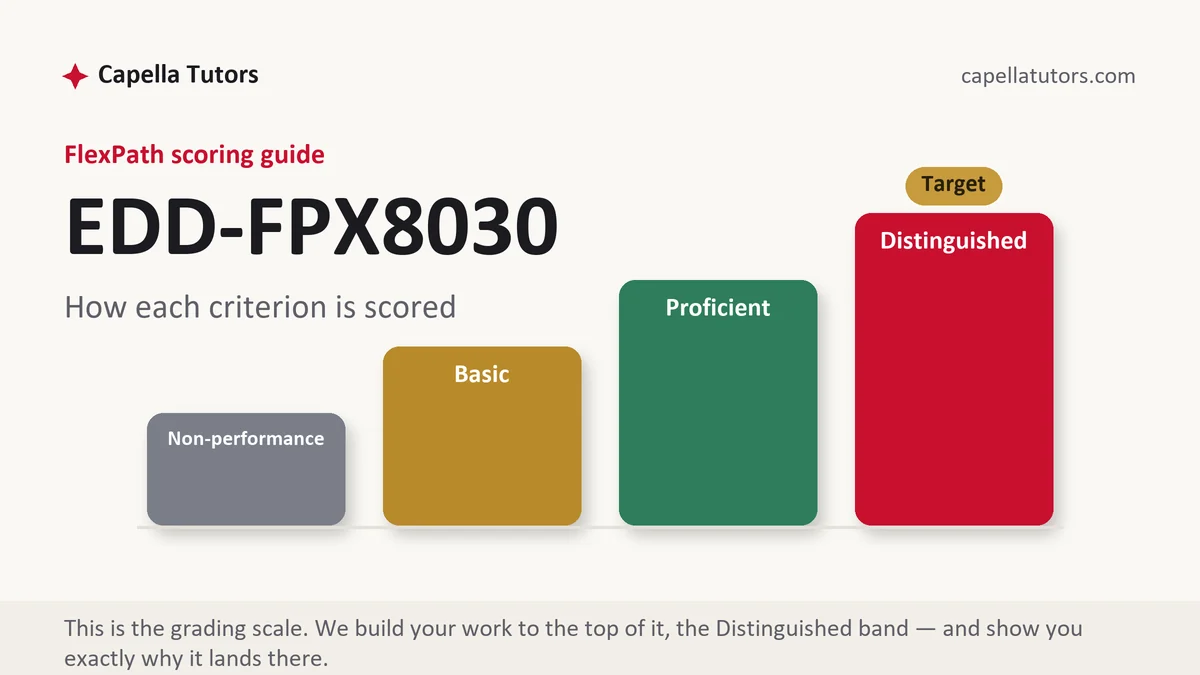
What EDD FPX 8030 actually grades
Almost everything scored in this course turns on one distinction, and it is the distinction most learners arrive without. A topic is a subject you find interesting. A complaint is a subject that annoys you. A problem of practice is something else entirely: it lives in a named organization, it shows up as a gap between what is happening and what should be happening, that gap can be evidenced rather than asserted, and someone in your position could act on it. The Carnegie Project on the Education Doctorate built the dissertation in practice around exactly this object, which is why the criteria refuse to accept a well-written essay about a national issue. Student engagement is a topic. The fact that 81 of this building's 214 ninth graders failed at least one core course last semester is the beginning of a problem of practice.
Evidencing the gap locally is the second graded strand, and it is where careless numbers do the most damage. Every figure you offer needs three things visible before a reader will accept it: what was counted, out of what, and over what period. Thirty-eight percent means nothing until it reads as 81 of 214 ninth graders enrolled on the last day of the first semester. Then the number needs company, because a single figure has no direction. Give the same measure for the two prior years, give the district or state figure for comparison, and disaggregate it, since a building-level average almost always conceals the actual problem. Skrla, Scheurich, Garcia and Nolly made the case for that discipline in Educational Administration Quarterly in 2004, arguing that an equity audit should examine teacher quality, program placement and outcomes together rather than reporting a single achievement gap and stopping.
Causal reasoning is the third strand. The criteria distinguish a symptom from a cause, and they distinguish both from a cause you can actually reach. A cause and effect diagram in the tradition Kaoru Ishikawa established forces you to sort candidate causes into families instead of listing them, and repeated why questions of the kind Taiichi Ohno described inside the Toyota production system push past the first plausible answer. The honest warning about that technique is that it stops wherever the person asking loses nerve, and in schools it tends to stop at student motivation, which is a restatement of the problem wearing the clothes of an explanation. Push one round further and you usually arrive at a routine nobody owns.
The fourth strand is you. Practice doctorates expect insider inquiry, and the criteria therefore expect a positionality statement that does real work. H. Richard Milner argued in Educational Researcher in 2007 that researchers must attend to the seen, unseen and unforeseen dangers of their own position, working through the self, the self in relation to others, and the shift from self to the system. Kathryn Herr and Gary Anderson describe insider standing as a continuum rather than a category in The Action Research Dissertation, which is the more useful framing when you supervise some of the people you plan to study. Access you hold because of your job is not the same as access a participant granted you, and saying so is graded.
How we help in this course
Samples for 8030 are built backward from the problem statement, because everything downstream inherits its precision. We write the gap with its numerator, denominator and window in place, put the local figure beside a comparison figure, disaggregate wherever your data allows it, then trace causes until the last one is something a person in your role could change. Tell us your setting, the group affected, and whatever figures you can share or point us to publicly, and the draft argues about your organization instead of about the sector.
The arrangement is the same one every course here runs on. A premium original sample inside 24 to 48 hours, drafted against the top descriptor of the guide you were issued, reviewed by eight people with one of them checking only that no claim about your setting outruns the evidence supplied for it, and revised free until the criteria are satisfied. Faculty feedback is worked through at no additional charge.
The assessments, one by one
Assessment 1
Assessment 1 of EDD FPX 8030, Investigating Problems of Practice, turns a subject into an object a doctoral study can act on. Read the full Assessment 1 manual.
Assessment 2
Assessment 2 of EDD FPX 8030 asks what is producing the gap you established. Read the full Assessment 2 manual.
Assessment 3
Assessment 3 of EDD FPX 8030 puts you inside the study. Read the full Assessment 3 manual.
How to actually write EDD FPX 8030: where to begin
Take the criteria apart first, then write the problem statement, and let the literature arrive third. Reversing those last two produces the commonest failure in this course, a competent review of published research followed by a problem that the review never actually established. Each criterion becomes a heading, the top descriptor sits underneath it while you draft, and any paragraph that does not serve a heading goes. The assessments in this course usually ask you to identify a problem inside a setting you can reach, to show with evidence that it exists there, to explain what is producing it, and to say what makes the problem worth a doctoral study, and your scoring guide decides the emphasis and the form.
Then write the gap in one paragraph and refuse to leave it vague. Here is the shape. Of the 214 students enrolled in ninth grade on the last instructional day of the first semester, 81 failed at least one core course, which is 38 percent, against 31 percent two years earlier and 24 percent across the district in the same period. Disaggregated, the rate reaches 52 percent among students with individualized education programs and 47 percent among multilingual learners, while it sits at 29 percent for everyone else. That paragraph does four things a vague one cannot: it fixes the population, it establishes a direction of travel, it rules out the explanation that this is normal everywhere, and it tells you which students the study is actually about. Gloria Ladson-Billings, in her 2006 presidential address to the American Educational Research Association, argued that gaps like the one in that final sentence are better understood as an accumulated education debt than as a deficit in the students, and citing that reframing changes the tone of everything you write afterward.
Then run the causes down until you hit something you can move. Ninth graders are failing, so ask why: most of the failures come from missing coursework rather than from failed tests. Why is work missing? It stops being turned in after an absence of several days. Why does it stop? There is no route back in, because recovery is negotiated teacher by teacher. Why is it negotiated individually? No building-level make-up procedure exists and no one is accountable for creating one. That chain ends somewhere a dean of students can act, which is the point of the exercise, and it never once passes through a sentence about motivation. Then name the causes you cannot move, such as housing instability behind the absences, say plainly that your study is not addressing them, and explain why the reachable cause is still worth acting on. Faculty read that admission as judgment rather than as retreat.
| Section | What goes in it | What Distinguished looks like |
|---|---|---|
| The problem of practice | The gap between current and intended, located in a named setting and open to your influence. | A statement a reader could disagree with, because it commits to a place, a group and a number. |
| Local evidence | The measure, its numerator and denominator, its window, a trend, a comparison, and disaggregation. | Figures sourced to documents you name, with the group the problem actually concentrates in identified. |
| Stakeholders | Who is affected, who decides, who would have to act, and what each of them stands to lose. | The stake of the group with the least power described as concretely as the stake of the decision maker. |
| Causal analysis | Candidate causes sorted into families, tested against evidence, and pursued past the first answer. | A chain that terminates in something actionable, with unreachable causes named and set aside openly. |
| Equity analysis | Access, placement, staffing and outcomes examined together rather than one gap reported alone. | Disparities framed as produced by arrangements, with the framing attributed to its source. |
| Positionality and references | Your role, your authority over participants, your stake in the answer, and current APA throughout. | Specific safeguards named for each risk your position creates, rather than a general promise of care. |
Developing the synthesis
The literature in this course has a job beyond decoration: it supplies the conceptual framework that explains why you expect these causes to matter. Sharon Ravitch and Matthew Riggan describe that framework in Reason and Rigor as the argument connecting what you already believe, what the literature reports, and what you intend to do, and Joseph Maxwell's interactive model of design makes the same point by refusing to let goals, framework, questions, methods and validity be settled in isolation. In practice this means your review should be organized by cause rather than by author. Group everything published on course recovery and credit retrieval under one heading and state what that body of work agrees on. Group the work on transition into secondary school under another and say where it conflicts with the first. Then state which of your candidate causes the literature makes plausible, which it makes unlikely, and which it simply has not examined, because that third category is where a genuine contribution to practice tends to sit.
Citations that survive faculty review
Three registers of source do distinct work in a problem of practice investigation. Empirical education research locates your problem in what is already known, and the searches worth running go through ERIC and Education Source with the descriptors an indexer would use rather than the wording your district favours. Public data and organizational documents supply the local evidence, which means state report cards, federal collections through the National Center for Education Statistics, your own school profile, board minutes, improvement plans and handbooks, each cited so a reader could retrieve it. Methodological and framing texts carry the moves you are making, which means Milner in 2007 for positionality, Herr and Anderson for insider standing, Skrla and colleagues in 2004 for the equity audit, Ladson-Billings in 2006 for the education debt, and Ravitch and Riggan for the conceptual framework. Do not attribute a technique to a course reading that merely describes it, format the whole set in the seventh edition of the APA manual, and confirm that every number in your problem statement traces to a citation, a named document, or a stated assumption.
The mistakes that land Basic instead of Distinguished
- A national problem with a local sentence bolted on. If the paper would read identically about any district in the country, no criterion about a situated problem can be met.
- Percentages without denominators. A rate quoted with no population and no window cannot be checked, and an unverifiable figure supports nothing built on top of it.
- Causal analysis that stops at motivation. Saying students are disengaged renames the problem, and the criteria are written to notice the substitution.
- A solution chosen before the causes were traced. Reasoning backward from a favoured program is visible in a paragraph, particularly when the diagram has one branch.
- Positionality written as reassurance. Declaring yourself objective is not a safeguard, and the absence of a named safeguard is what loses the level.
EDD FPX 8030 questions students actually ask
What separates a problem of practice from a research topic?
Four tests, and a topic fails at least three of them. A problem of practice is situated, meaning it belongs to a named organization rather than to education generally. It is evidenced, meaning somebody can see the gap in a number, a document, or a body of testimony you can point to. It is actionable from where you sit, meaning a person in your role could influence it inside a realistic timeframe. And it matters to identifiable people whose stake you can describe. Teacher retention is a topic. The fact that this building lost nine of its fourteen newest teachers in three years while the two schools next door lost two between them is a problem of practice, because it is local, countable, and open to influence by whoever runs induction.
What if I do not have access to the data I need?
Work outward from what is already public before you request anything. State report cards, federal collections and your own school profile carry enrollment, attendance, discipline and outcome figures disaggregated further than most people expect, and they are usually enough to establish that a gap exists. Board minutes, improvement plans, handbooks and job postings are public documents that evidence how the organization has already framed the issue. Where you still need internal data, ask through the route your district actually uses, put the request in writing, and say in the paper what you asked for and what you were given. A problem evidenced from public sources and named gaps reads far better than one evidenced by a figure you cannot source.
Do I have to disclose that I lead the program I am investigating?
Yes, and the disclosure should be specific rather than confessional. Say what your role is, who reports to you, which decisions you control, and what you stand to gain if the investigation reaches a particular conclusion. Then say what you did about each of those. Handing data collection to someone outside your supervisory line, declining to include your own direct reports, keeping an audit trail of decisions you can show a reader, and inviting a colleague to argue with your interpretation are all concrete answers. Insider position is an advantage in a practice doctorate because you can see what a visitor cannot. It becomes a defect only when it goes unnamed.
Problem statement not landing?
Send the prompt, the guide, and the figures you have. The first premium sample is free, and the gap inside it is measured rather than described.