Send whatever state the project is actually in, along with the guide you are working against, and a dated plan plus the next deliverable come back inside 24 to 48 hours, aimed at the Distinguished descriptors and reworked at no cost until the criteria are met. This course is EDD FPX 9980, Doctoral Project Development, in the EdD with the Educational Leadership specialization, delivered under FlexPath. Two honest notes about it: the catalog does not show a point value for this course, and it is not part of the 32 program points the degree requires, so treat anything you have heard about how it counts as something to confirm with your advisor in writing. In Capella's catalog the course code is written EDD-FPX9980.
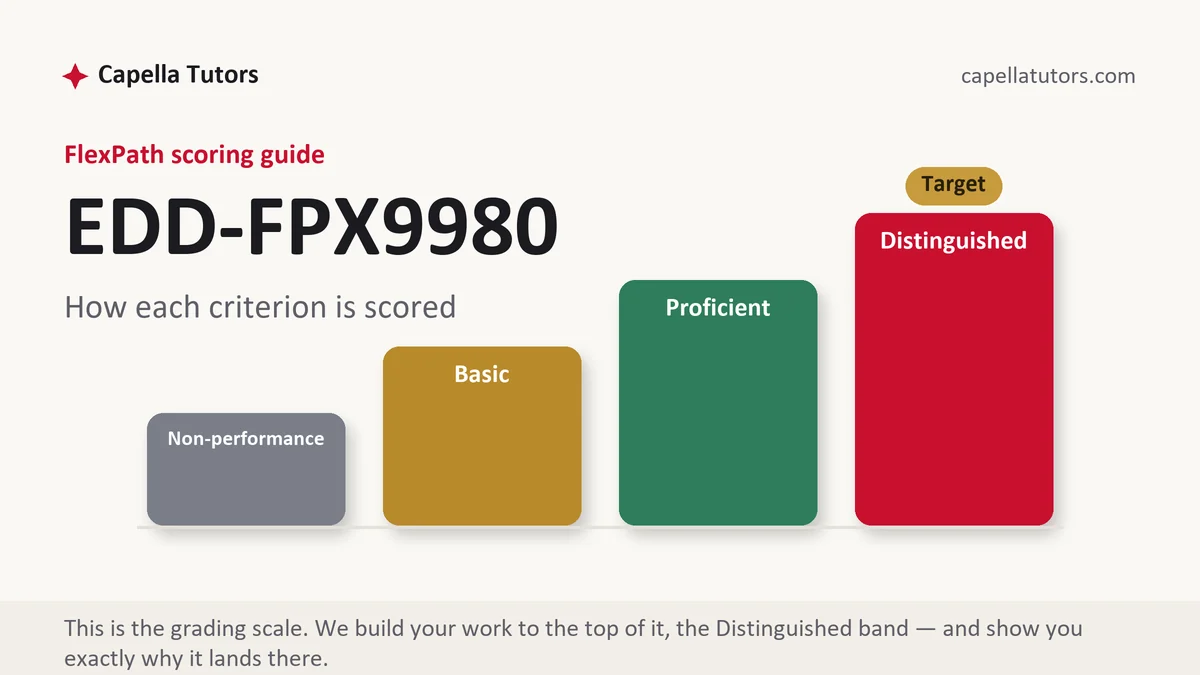
What EDD FPX 9980 actually grades
A continuation course is not a lighter version of a project course. It exists because doctoral work runs on real calendars inside real school districts, and the six numbered project courses assume a pace that a superintendent turnover, a delayed approval or a lost testing window can break. Because no public description attaches to this course number, what your faculty expect inside it is set by your handbook and your chair rather than by any outside account, including this one. What is safe to say is what a term like this has to produce, which is measurable movement on the specific thing that stopped.
So diagnose the stall before you write anything, because the three common causes want opposite responses. A site that changed underneath you, a principal who left or a program that was discontinued, needs a scope decision and possibly a second site, and it needs one quickly rather than after another term of hoping. An approval that came back for redesign needs the design rewritten to the reviewer's actual objection, which usually means reading their comments as instructions rather than as opinions. A writing debt, the most common cause by a distance, needs nothing intellectual at all: it needs words on days. Learners routinely treat the third as though it were the first, redesigning a project that was merely unwritten, and that is how one continuation term becomes three.
The other thing this term really tests is your relationship to a calendar. FlexPath bills in flat 12-week sessions and allows two courses at a time, which means a continuation term is a fixed quantity of weeks that will pass whether or not you produce anything inside them. Do the arithmetic on the first day. Fourteen thousand words of manuscript remaining across six two-week blocks is 2,340 words a block, which is about 170 words a day, which is twenty minutes for most people. Written down, that is a plan. Left as a feeling about how much is left, it is the same volume of work carrying an unlimited quantity of dread.
How we help in this course
Our work here starts with triage rather than with a draft. We read what exists, compare it against your scoring guide and your chair's most recent comments, and tell you plainly which of the three stalls you have and what the shortest defensible route to a finished project looks like from where you are standing. Then you get a block plan with a named deliverable every two weeks, ordered so each one unlocks the next rather than by chapter number, and we write to that plan alongside you.
Everything else runs on the studio's normal terms, which is much of the point of using them at this stage. Each piece comes back as an original premium sample within 24 to 48 hours, reviewed criterion by criterion against your own guide, checked independently for APA and originality, and rewritten at no cost until it meets the target. What changes in a continuation term is cadence rather than quality: shorter pieces delivered more often, because momentum is the thing you are actually buying back.
The assessments, one by one
Assessment 1
Assessment 1 in a continuation term usually asks you to say plainly where the project stands, so the graded object is diagnosis rather than progress. Read the full Assessment 1 manual.
Assessment 2
Assessment 2 in a continuation term usually asks for movement you can show, so the graded object is a schedule with deliverables in it and a document answering whatever came back. Read the full Assessment 2 manual.
Assessment 3
Assessment 3 in a continuation term usually asks you to put the pieces back into one argument, so the graded object is coherence rather than volume. Read the full Assessment 3 manual.
How to actually write EDD FPX 9980: where to begin
Reread your own approved design before you reread your draft. Learners returning to a stalled project almost always open the manuscript, which is the document their doubts are attached to, when the useful document is the protocol, which says what they promised and what still counts as done. Mark every element of that protocol as delivered, partly delivered or not started. The map that produces is usually smaller than the anxiety around it, and it identifies the one item everything else has been waiting on, which is where the term should begin.
Then write the smallest complete unit rather than the next chapter. A findings section for one research question is a complete unit. A codebook is a complete unit. A two-page methodology revision answering a reviewer's three objections is a complete unit. Chapters are too large to finish inside a two-week block, and a block ending with nothing finished teaches you that the plan does not work, which is the belief that ended the last term. Submit each unit for feedback as it is done, allow the two business days faculty have to evaluate a submission, and start the following unit inside that window rather than waiting on it.
Then resist the redesign. Every stalled project develops a story about how it would move faster if the question changed, and the story is almost always false, because changing the question invalidates the literature that justified it, the instrument built from it, the approval granted on it and any data collected under it. A change of question in a continuation term does not save six weeks, it spends two courses. The exceptions are real and narrow: your site withdrew, your approval was refused rather than returned, or the data you needed turns out not to exist. Where one of those applies, decide fast and in writing with your chair. Where none does, the fastest route to a finished doctorate is the project you already have, written down.
Then protect the reflective and dissemination material, which is the part learners quietly abandon under time pressure and then have to rebuild from nothing. Keep a short log through the term of what you decided and why, because the reflective writing waiting at the end of the sequence is graded on instances, and instances do not survive in memory. Keep the practice brief alive too, even at one page, since the audience at your site has been waiting longer than you have and that brief is the deliverable making the whole project count for them. Neither costs more than an hour a fortnight, and both are far more expensive to write from scratch afterward.
| Section | What goes in it | What Distinguished looks like |
|---|---|---|
| Stall diagnosis | Which of the three causes applies: a site that changed, an approval returned, or work unwritten. | The cause named in one sentence with evidence, and the response matched to it rather than to habit. |
| Protocol audit | Every element of the approved design marked delivered, partly delivered or not started. | An audit against the filed protocol rather than against the draft, with the blocking item identified. |
| Block plan | The term divided into two-week blocks, each carrying one deliverable that can actually be finished. | Blocks ordered by dependency, with the daily word or task count written down where you can see it. |
| Chair and reviewer comments | Every outstanding comment listed, with the change it requires and the date it was addressed. | Comments treated as instructions, answered individually, with a response note attached to the resubmission. |
| Reflective log | A running record of decisions, reversals and surprises across the term, each entry dated. | Entries specific enough to become evidence in the closing reflection without being rewritten. |
| Site and audience contact | What the host site has been told, what it is owed, and when it next hears from you. | A site kept warm with a short update, so that access and goodwill survive the delay. |
Developing the synthesis
The synthesis a continuation term needs is a synthesis of your own unfinished material, and it is worth an afternoon. Lay out every fragment written across the numbered project courses, the literature chapter, the design, the partial findings, the abandoned appendix, and read them in order as one document. You will find three things every time: passages better than you remember that can be used as they stand, passages arguing for a position you no longer hold that have to go, and a gap smaller than the fear attached to it. Then write a one-page account of what the project now claims, in plain sentences, with no citations in it. That page becomes the spine you write against for the rest of the term, and it is also the fastest way to show a chair that your hands are back on the argument.
Citations that survive faculty review
Returning to a reference list after months away has its own failure modes and all of them are fixable in one session. Check whether the empirical sources carrying your justification have aged past what your program expects of current evidence, and add the two or three studies published since you stopped, because a reviewer notices a literature that ends abruptly two years ago. Confirm that every framework and every method is still attributed to its primary source rather than to a summary grabbed in a hurry. Re-resolve every doi and every public data link, since report cards and district dashboards move and dead links accumulate while a project sits. Square the list with the text in both directions under current APA, then delete the sources you collected and never used, because a list padded with unread work is a specific and recognizable tell. Then stop citing and start writing, since reading more is the most respectable available way to avoid finishing.
The mistakes that land Basic instead of Distinguished
- Redesigning instead of writing. A new question does not save a term, it spends the two courses that justified the old one.
- Planning in chapters. A unit too large to finish inside two weeks produces another block that ends with nothing done.
- Reading instead of drafting. More sources feels like progress and is the commonest form of avoidance at this stage.
- Losing the site. A district that has not heard from you in eight months may not still be available when you come back.
- Assuming how the course counts. The catalog shows no point value here, and guessing is an expensive way to find the answer.
EDD FPX 9980 questions students actually ask
Does this course count toward the 32 points my degree requires?
The catalog does not show a point value for it, and it is not part of the 32-point required sequence, which is as far as any outside source should take you. What that leaves open is how enrolling in it interacts with your billing, your financial aid and your expected completion date, and those follow your enrollment agreement rather than a course description. Ask your advisor in writing, keep the answer, and ask specifically what happens if you need more than one term of it. A written answer from the person who administers your record is worth more than any general account, this one included.
How many continuation terms will I need?
Nobody can tell you generically, but you can estimate it in ten minutes and the estimate is usually close. Count what is left in units you can measure: words of manuscript, transcripts to code, sections to revise against comments. Divide by what you have actually produced in a comparable week, using the last two months as evidence rather than what you intend to produce. Then add a third for the approval and feedback queues you do not control. Most learners who do that arithmetic honestly discover they need one term and have been behaving as though they needed four, which is itself part of the problem. If the honest answer is two, plan two and stop renegotiating it every fortnight.
Should I change my chair or my topic to move faster?
Changing the topic is almost never faster, for reasons any doctoral learner discovers about six weeks after doing it. Changing a chair is a different question and occasionally the right one, but it is a relationship problem rather than a scheduling one, and the test is whether feedback arrives in a usable form rather than whether it arrives in the form you wanted. Before requesting anything, try answering the last set of comments literally, item by item, with a note saying what you changed for each. A surprising number of stalls are a learner and a chair talking past one another, and that repair costs an evening rather than a quarter.
The handoff out of a continuation term is back into the sequence you left, and it should be a clean one. Finish the term with the blocking item resolved, the protocol audit updated, every outstanding comment answered in writing, and the next numbered project course entered with a deliverable already drafted rather than with a fresh intention. Keep the shape of what you are rejoining in view: EDD FPX 9951 through EDD FPX 9956, six courses worth 12 of the 32 required program points, with the reflective account and the dissemination obligation landing at the end of them. A continuation term does not remove either expectation, it only moves them, and the learners who keep a running log through the delay are the ones who finish the closing course in weeks rather than in months.
Project stalled?
Send what exists, your chair's last set of comments, and your guide. We will name the stall and put a finishable two-week deliverable in your hands. First premium sample free.