Hand us the deliverable and the guide it will be scored against, and a premium original sample comes back within 24 to 48 hours, aimed at the Distinguished column and revised free until it lands there. The transcript entry is EDD FPX 8522, Leading a Culture of Learning, carrying 2 program points inside the five-course Educational Leadership specialization, which supplies 10 of the 32 points in the FlexPath EdD at Capella. In Capella's catalog the course code is written EDD-FPX8522.
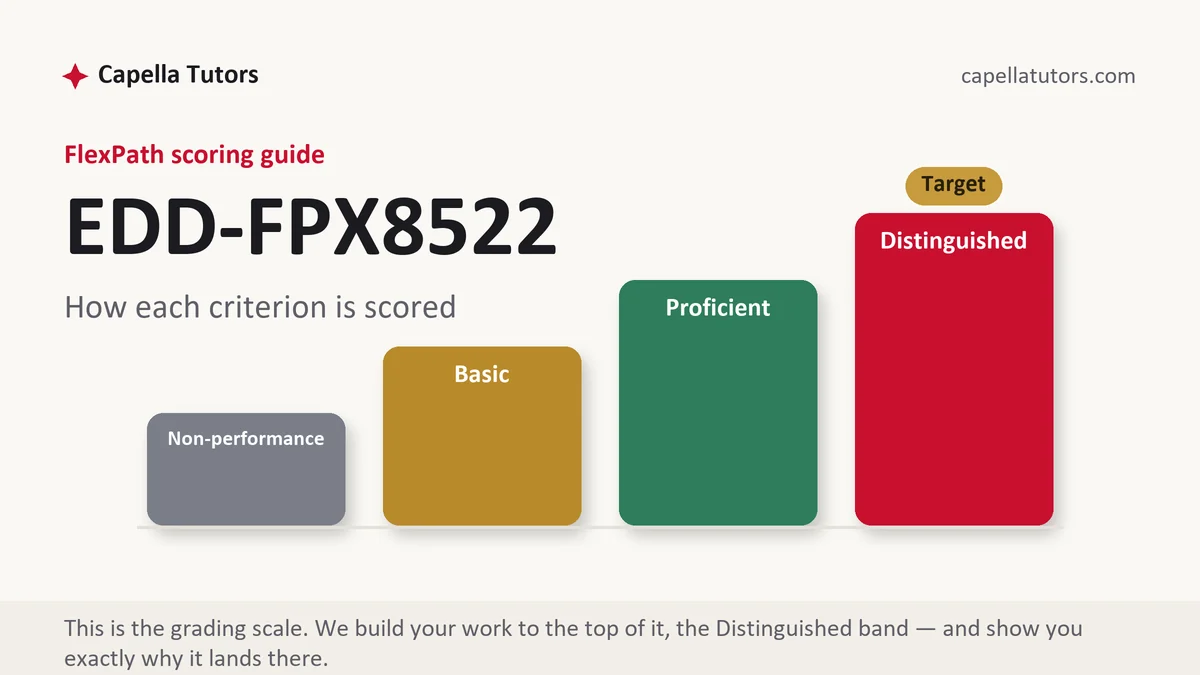
What EDD FPX 8522 actually grades
This course is about the adults. Students appear in it, but the object of study is the working life of the staff: what they believe about what is possible, what they are willing to show each other, how they spend the hours the schedule gives them, and whether anything they learn in July survives October. Criteria at this level want that treated as an object with properties rather than as a mood. The move a doctoral reader is watching for is the shift from claims about atmosphere to claims about conditions, because conditions can be described, measured and altered, and atmosphere can only be asserted.
The first technical demand is keeping culture and climate apart. Climate is what people currently perceive, it moves within a year, and it is what an ordinary staff survey captures. Culture is the layer underneath, the assumptions so settled that nobody argues about them, and Schein's account of artifacts, espoused values and underlying assumptions is the standard route into it, cited to Schein rather than to a slide deck. The reason it matters for scoring is that a great deal of student writing measures climate, calls it culture, and then proposes to change culture in a semester. Say which layer your evidence reaches, and say which layer your intervention can plausibly touch.
The second demand is the adult learning strand. Professional learning is graded on design, not on hours logged, which means the criteria want to see who is learning what, in what format, on whose time, with what follow-through into practice. Sessions delivered once and never revisited change little, and the alternative your assessment usually asks you to build involves cycles, protocols and shared examination of real student work. Relational trust is the third demand, and the evidence base for it is strong: the Chicago work by Bryk and Schneider is the customary anchor, and it is more useful than a general appeal to positive relationships because it decomposes trust into respect, competence, personal regard and integrity, each of which is something a leader can actually be seen doing or failing to do.
How we help in this course
Drafts for 8522 stay on the evidence side of the line. Where the deliverable makes a claim about the staff, the sample names the instrument, the number of respondents and the response rate, or it labels the evidence as indirect and says so in the sentence. Professional learning proposals arrive with a format, a facilitator, a place in the calendar and a protocol attached, since a plan for teacher collaboration with no protocol is a request for teachers to be nicer to each other. Send us what you have, including a climate report, a staffing pattern or a set of meeting agendas, and the analysis is written from your building's actual conditions.
The service terms are the same as everywhere else on the site. A premium original sample per deliverable inside 24 to 48 hours, written and checked by eight people, with one pass devoted to matching every criterion in the guide to a section in the document. Revisions cost nothing and there is no limit on them. FlexPath lets you submit as soon as the work is ready and returns four levels per criterion within two business days, so the target is a first attempt that clears every row rather than a fast attempt that generates rework.
The assessments, one by one
Assessment 1
Assessment 1 usually asks for a defensible account of the conditions the adults in your building actually work under. Read the full Assessment 1 manual.
Assessment 2
Assessment 2 usually asks you to design the adult learning rather than describe it. Read the full Assessment 2 manual.
Assessment 3
Assessment 3 usually asks for the leader's own moves and the leader's own account of them: what you will do publicly and repeatedly to build trust, what you will stop doing, and where your own past practice contradicts what you now propose. Read the full Assessment 3 manual.
How to actually write EDD FPX 8522: where to begin
Start by turning the scoring guide into the outline and marking, next to each criterion, what kind of proof it will accept. Some rows want a description of current conditions, which needs data. Some want an interpretation through a named framework, which needs primary citation. Some want a plan, which needs cadence and ownership. Some want a reflection on your own practice, which needs candor rather than sources. The assessments in this course usually combine several of those, and your scoring guide decides the format, the audience and how much of the argument must be cited. Getting the proof type right in advance is what stops the common failure here, which is a beautifully written document that answers a criterion in the wrong currency.
Then handle the survey numbers properly, because culture work lives or dies on them. Suppose a staff climate survey returns 34 responses in a building of 61 certificated staff, a response rate of 56 percent, and the item on feeling safe to admit a mistake averages 3.1 on a five-point scale. The Basic reading reports the average and calls the culture weak. The doctoral reading reports the denominator first, notes that 27 people did not answer and that non-response in staff surveys is rarely random, then breaks the item apart, because an average of 3.1 built from a cluster at 4 and a cluster at 2 describes two schools sharing a car park rather than one middling school. Split by grade band, by years in the building and by department if the numbers allow, suppress any cell too small to protect anonymity, and report the spread rather than only the mean.
Then design the learning intervention as a routine with a protocol. Naming a professional learning community earns nothing, since the phrase has been applied to everything from lesson study to a shared lunch. Specify instead: which six teachers, meeting for how long, on which day, on time released how, examining what artifact, using which discussion protocol, producing which decision by which date, and reporting to whom. Then add the follow-through step that most plans omit, which is what happens between meetings, because the learning is in the change of practice rather than in the conversation. Attach a measure that reads within a term, such as the share of meetings that ended with a documented instructional decision, and put a date on the first review.
Then write your own position honestly. Doctoral criteria in this course tend to include a reflective row, and the writing that scores there is not confessional and not self-congratulatory. Name a specific occasion when a norm you now propose to change was one you personally enforced, say what you did, and say what you would trade to undo it. Then keep the whole document in the language of conditions rather than of character, because that is both the ethical choice and the effective one when the staff you describe may eventually read what you wrote.
| Section | What goes in it | What Distinguished looks like |
|---|---|---|
| The setting and the adults in it | Size, staffing pattern, turnover, schedule structure, and the collaboration time that exists on paper. | The building described in numbers a reader could verify, with turnover and stability stated. |
| Evidence of current conditions | Survey instrument, respondents, response rate, item-level results, plus indirect traces such as agendas. | Denominators given, spread reported alongside means, non-response treated as information. |
| Interpretation through a framework | Culture or trust theory named and attributed, applied to the specific pattern you found. | The framework explaining one local detail, with the layer it addresses stated plainly. |
| The professional learning design | Participants, format, protocol, release time, artifact examined, decision produced, cadence. | A routine another leader could convene next month without further instruction. |
| Trust and communication moves | What the leader will do publicly and repeatedly, and what they will stop doing. | Observable behavior on a schedule, including the thing given up to make room. |
| Measurement plan and references | Baseline, re-measure date, indicators readable within a term, current APA in text and list. | Indicators that would move if the design worked and stay flat if it did not. |
Developing the synthesis
The synthesis worth building here is about direction of causation, and it is the argument that separates a doctoral paper from a workshop handout. Nearly everything known about school culture comes from cross-sectional data: a survey administered once, correlated with an achievement measure from the same year. Trust, collaboration, collective efficacy and teacher satisfaction all show associations with outcomes in that literature, and all of them are also plausible consequences of a school that has recently started to succeed. Teachers in an improving building trust each other more because things are working, not only the reverse. Longitudinal and quasi-experimental work is thinner but more informative, and it generally supports a modest mutual reinforcement rather than a single arrow. The position a criterion rewards is the one that admits this and designs around it: propose the concrete early win that gives the staff an experience of success, then predict the belief shift and measure it afterward, and treat any culture claim built on one administration of one instrument as a snapshot instead of a trend.
Citations that survive faculty review
An education leadership evaluator will accept four families of source in this course. Empirical studies of school organization, teacher collaboration and trust, retrieved through ERIC, PsycINFO and the Capella library, carry the claims about what conditions do, and each should enter with the design and the setting so a reader can judge transfer. Instrument documentation is the family students skip, and it matters most here: if you use a climate or efficacy scale, cite its developer, report its subscales, and say something about its reliability rather than treating the score as self-evident. Conceptual sources belong to their authors, so organizational culture is cited to the theorist who built the model and adult learning claims to the scholar who proposed them, never to a secondhand summary that has smoothed away the qualifications. Local artifacts complete the set: your survey report, your schedule, your agendas, your retention figures, named in text and dated. Association wording deserves a last pass, since linked to and associated with are defensible where caused and drove almost never are in this evidence base.
The mistakes that land Basic instead of Distinguished
- Climate data called culture. A survey taken in March measures perception now, and the deeper layer needs different evidence and a longer horizon.
- A mean with no spread and no denominator. One average hides the split that is usually the real finding, and it hides how many people never replied.
- Collaboration proposed without a protocol. Time in a room is not professional learning, and the criteria are grading the structure that fills it.
- Staff described as personalities. Resistance written as a trait gives a leader nothing to change, and it will not survive the ethics row.
- Correlation reported as cause. Almost the entire culture literature is cross-sectional, so verbs promising causation get scored down.
EDD FPX 8522 questions students actually ask
My school has no culture survey. What evidence can I use?
Use the traces the building already produces, and label them as traces. Meeting agendas show what adult time is spent on, and counting the minutes given to student work against the minutes given to logistics is a culture measure nobody has to answer a questionnaire for. Sign-in sheets for optional learning show voluntary participation. Master schedules show whether common planning time exists or is a slogan. Exit interviews and transfer requests show who leaves and from which grade level. Staff meeting talk can be tallied by who speaks and for how long. Any of these can be read across a year rather than at a moment, which is more than most single surveys give you. Say plainly that these are indirect indicators, triangulate at least three of them, and a doctoral reader will take them seriously.
Is collective teacher efficacy really the strongest lever there is?
It is a real construct with a real association, and the ranking you have seen quoted is doing more work than the evidence supports. Collective efficacy is measured by asking teachers what their faculty can accomplish with the students it has, and schools where achievement is already rising tend to answer that question more confidently, so a large share of the correlation runs in the direction opposite to the one people cite. There is also a ceiling problem: a scale where most schools cluster near the top cannot separate them well. Write it as a belief that plausibly sustains effort and follows early success, propose the success experience first, then measure the belief. That framing keeps the construct and drops the overclaim, and doctoral criteria notice which of the two you chose.
How do I write about culture without insulting the staff I work with?
Describe conditions rather than character. A sentence saying teachers here resist change is an accusation with no mechanism, and it is also unusable, since you cannot design against a personality. A sentence saying the last three initiatives were announced in August and abandoned by February describes a condition, explains the response, and points at something a leader can change. Keep individuals unidentifiable, use roles and grade bands, remove the school name where the assignment allows, and quote nobody who spoke to you in confidence unless the criterion requires it and you have permission. The rule that keeps the writing both ethical and effective is simple: every negative statement about adults in the building should be followed by the structural cause you intend to address.
Culture assessment on the calendar?
Send the prompt, the guide, and any survey report or schedule you can share. First premium sample free, with the denominators reported.