Send your problem of practice and the guide you are scored against, and the search, the synthesis and the framework section return inside 24 to 48 hours at the register a doctoral reader expects, appraised study by study, aimed at the Distinguished descriptors, and rewritten free until the criteria are satisfied. The course is EDD FPX 9952, EdD Doctoral Project 2, worth 2 program points, second of the six numbered project courses, a group supplying 12 of the 32 program points required by the FlexPath Doctor of Education with the Educational Leadership specialization. In Capella's catalog the course code is written EDD-FPX9952.
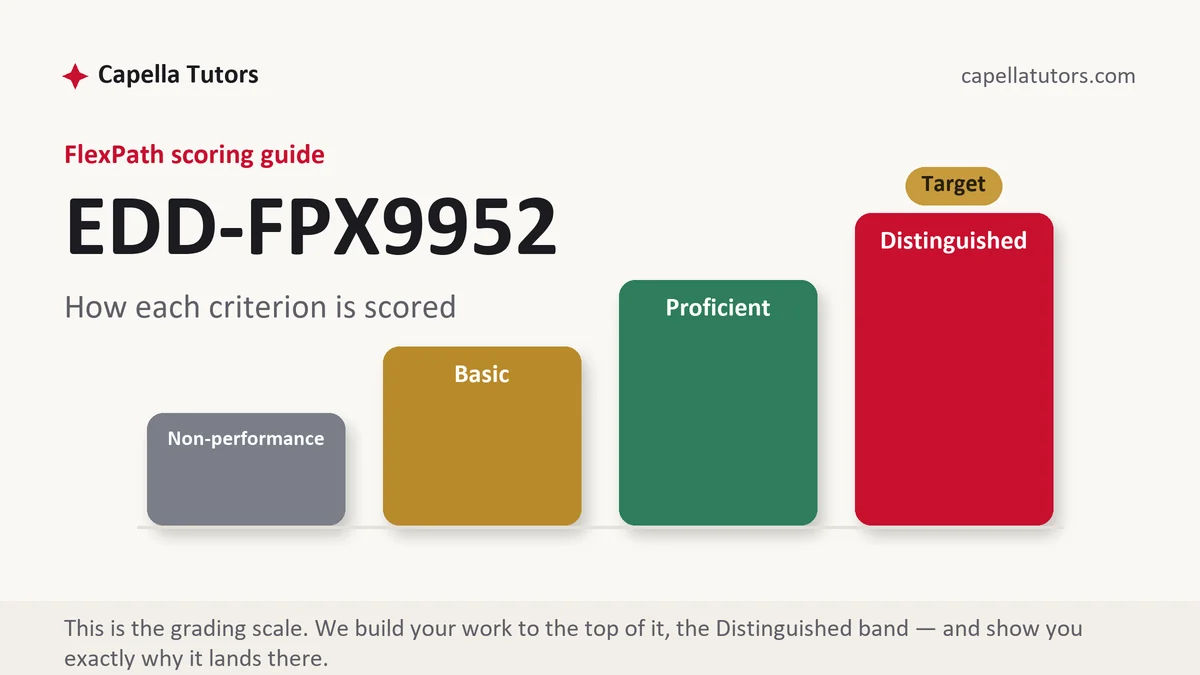
What EDD FPX 9952 actually grades
The catalog publishes a number and a title for this course and no outline of its contents, so nothing below invents a milestone name for it. What is described here is work a six-course project group has to hold somewhere, and your handbook decides where. At this depth the graded question shifts from whether the problem is real to whether anybody has already answered it. The assessments in this course usually ask for a documented literature search another person could repeat, an appraisal ranking evidence by design rather than by publication year, a synthesis that reports the collisions between studies as carefully as the agreements, and a framework explaining why your problem behaves the way it does.
Reproducibility is the criterion that quietly divides the columns. Reporting that you looked in ERIC and Education Source is not a method. Databases named, a date range with a reason attached, peer-review and language limits, the descriptors and keyword strings written out with their Boolean operators, and a count at every stage is a method. Say 1,146 records retrieved, 998 removed on title and abstract against stated criteria, 148 read in full and 27 retained with the 121 rejections grouped by reason, and a reader knows exactly how much evidence exists on your problem and how you moved from all of it to your list. Print the strings in an appendix exactly as they were typed into the database, because a reviewer unable to repeat the search cannot certify what you concluded from it.
The framework half is graded on use rather than on naming. A conceptual framework in an education project is the set of constructs you claim are operating plus the relationships you claim hold between them, drawn from theory and from the studies you have just appraised, and drawn as a figure only where the figure carries something the prose cannot. The test faculty apply is whether the framework generates anything. If your constructs never become the questions you ask and later the items on your instrument, the framework is decoration and gets scored as decoration. Attribution matters here too: leaning on Bronfenbrenner, on Bandura, on Wenger or on an improvement-science tradition means citing the people who published the idea rather than the handbook chapter that summarized it for you.
How we help in this course
Our 9952 drafts hand you a finished evidence table rather than a promise of one. Each study you kept occupies a row carrying its design, its setting, its grade band, its sample size, the dose delivered, the outcome measured, the effect reported and the strength we assigned, so a synthesis paragraph can cite a row instead of waving at a body of work. The search is written as a method, strings and stage counts intact, and the framework section is drafted so that every construct is defined once, cited to its origin, and then visibly reused further down the document.
Delivery terms are the studio's usual ones applied at doctoral weight. One original premium sample per deliverable inside 24 to 48 hours, eight people across the pipeline including a criterion-by-criterion scoring-guide review and a separate APA and originality check, and rewrites at no cost until your guide is met. The pass specific to this course is a quotation audit. Somebody opens the sources and confirms that every effect size, sample size and finding you attribute to a study is what that study actually reports, because a misquoted number here reappears in three later chapters and gets caught by the person least willing to forgive it.
The assessments, one by one
Assessment 1
Assessment 1 of EDD FPX 9952, EdD Doctoral Project 2, is the search made reproducible: databases named, limits justified, strings printed as they were typed, and a count at every stage between everything retrieved and everything kept. Read the full Assessment 1 manual.
Assessment 2
Assessment 2 of EDD FPX 9952, EdD Doctoral Project 2, is the synthesis: the studies you kept, arguing with each other on your page, organized by mechanism and never by author. Read the full Assessment 2 manual.
Assessment 3
Assessment 3 of EDD FPX 9952, EdD Doctoral Project 2, is the framework and the gap: the constructs you claim are operating on your problem, the relationships you claim hold between them, each traced to whoever published it, and then the two gaps your project sits between. Read the full Assessment 3 manual.
How to actually write EDD FPX 9952: where to begin
Work backward from the verbs in the scoring guide. Appraise, synthesize, situate and justify are four different operations, and a paragraph that summarizes where the criterion asked for synthesis scores in the middle regardless of its prose. Copy the Distinguished wording into an outline as headings, then settle which artifact answers each one: a strings appendix, an evidence table, a themed synthesis, a construct map, a stated gap. Build the artifacts first and write the connective prose afterward, since the opposite order produces paragraphs about work no reader can inspect.
Then get honest about effect sizes, because education research reports them and most drafts step around them. Suppose your retained set runs from 0.09 to 0.62 in standardized units and the largest effect comes from a single study of 91 students in one suburban high school, while the two biggest studies, at 4,800 and 11,300 students across multiple districts, report 0.11 and 0.14. The synthesis that scores well says the plain thing: the program probably works, at a size near a tenth of a standard deviation once it is delivered at scale, and the 0.62 is a promise no district has kept. Then convert that into something a practitioner can weigh, because a tenth of a standard deviation on a scaled assessment is a few points, which is worth having and is not a turnaround. Saying it that way is the practitioner-scholar move the degree is grading.
Then write the gap in two registers. The gap in the literature is what nobody has studied: the program has not been tested in K-8 buildings of your size, or has only been tested where a coach was funded full time. The gap in practice is what your site is not doing: the program sits in the improvement plan and has never been scheduled. Those are different gaps, they are rarely both present in one sentence, and the project belongs in the overlap. Name both explicitly at the close of the section, because the following stage designs against the gap you named, and a vague one produces a design nobody can defend.
| Section | What goes in it | What Distinguished looks like |
|---|---|---|
| Documented search | The databases used, the limits applied and the reason for them, the descriptor and keyword strings, a count at every screening stage. | A search another person could repeat and finish holding your retained set, strings printed in an appendix. |
| Appraisal | Every study you kept, entered by design, setting, sample, dose, outcome and the strength you gave it. | A named appraisal standard behind each rating, with weaker designs marked and retained rather than quietly dropped. |
| Synthesis | Themes or mechanisms across studies, with agreements and contradictions both handled openly. | A stated position on each conflict, and the reason one body of evidence outweighs another. |
| Conceptual framework | The constructs claimed to be operating, the relationships between them, and the source of each. | Constructs that reappear as questions and instrument items rather than stopping at the diagram. |
| The gap | What the literature has not settled and what the site is not doing, stated separately. | A gap narrow enough that one practitioner project could close a piece of it. |
| References | Education research, standards documents and public data, current APA in both directions. | A primary source behind every framework, and a live retrieval path for every public dataset. |
Developing the synthesis
Synthesis in an education project means the studies argue with each other on your page. Organize by mechanism, never by author, and open each theme with a sentence stating what the collected evidence supports before a single citation enters it. The test is deletion: any paragraph you can remove without weakening the argument was a summary. Read the design and the sample before you read the conclusion, since a conclusion is only a claim and the design is the thing that permits it, and observational school data rarely permits a causal one. When two studies of the same program disagree, look at what differs between them, dosage, duration, grade band, baseline performance, coach ratio, and name it, since the difference is usually the finding. Close by saying what the assembled evidence still cannot tell a leader, because that sentence is where your project earns its place in the sequence.
Citations that survive faculty review
Four source types carry an education literature chapter and each has one job. Peer-reviewed studies gathered from ERIC, Education Source and ProQuest through the Capella library support every claim about how a condition or a program behaves. The What Works Clearinghouse tells you which of those claims survived a standards review, which matters as much for what it declines to endorse as for what it does. Public datasets, from the National Center for Education Statistics down to your own state report card and district dashboard, establish magnitude and hand a reader something they can open themselves. Standards documents, including the Professional Standards for Educational Leaders, supply the language practitioners will judge your recommendations in. Beyond source type, watch the conventions faculty check: design and sample reported before the finding, effect sizes given rather than only p values, the unit of analysis stated, and theory cited to whoever built it. Then walk the reference list and the in-text citations against each other in current APA and confirm every doi still resolves.
The mistakes that land Basic instead of Distinguished
- A synthesis heading sitting on top of an annotated bibliography. One study to a paragraph, in sequence, with no theme sentence anywhere above them.
- A framework named once and abandoned. Where the constructs never become questions, a reader sees it from the table of contents.
- Effect sizes left out. Reporting that a program improved outcomes without saying by how much is the middle column by default.
- A search reported as a sentence. Two database names and no stage counts is not a method anybody can check.
- Secondary attribution for a primary idea. Citing a textbook for somebody else's theory tells a faculty reader you have not read the theory.
EDD FPX 9952 questions students actually ask
How old can my sources be?
Two rules run at once and they do not conflict. Empirical claims about what works should rest on roughly the last five years, because funding, policy and assessment regimes shift underneath education findings faster than they do in most fields. Foundational theory has no expiry, and citing the original is required rather than tolerated: if your framework rests on situated learning, the source from 1991 is the source. What faculty penalize is neither age nor recency in itself, it is a recent citation standing where a seminal one belongs, or a thirty-year-old program evaluation offered as current evidence of effect. Where you rely on older empirical work because nothing newer exists, say so in one sentence and the choice becomes a finding about the literature rather than a gap in your reading.
Is a conceptual framework the same thing as a theoretical framework?
They overlap, and your handbook may use one term for both, so follow it. The working distinction most faculty apply is that a theoretical framework adopts an existing theory whole and views the problem through it, while a conceptual framework assembles constructs from several sources, including your own site knowledge, into a model of how the problem operates here. A practitioner project usually needs the second built on the first. Either way the grading is identical. Define each construct once in your own words with a citation, state the relationship you claim between constructs, and then use them. A framework that does not shape the questions is a paragraph, whatever it is called.
Can I cite my district's own reports?
Yes, and they often do a job peer-reviewed work cannot, which is establishing that the condition exists here at this size. Treat them as evidence of magnitude and context rather than of effect, cite them as you would any organizational document, and check whether your program wants the district named or masked before the chapter is filed. An internal report you were shown but that is not public sits differently: get permission in writing, or paraphrase the figure in a form the district has already released itself. Never let a district evaluation carry an effectiveness claim alone, because it was written by people with a stake in the answer and a reviewer will point that out before you do.
The handoff out of this course is a chapter and a commitment. EDD FPX 9952 delivers a reproducible search, an appraised evidence table, a synthesis that resolves its own conflicts and a framework whose constructs are defined and sourced, and EDD FPX 9953, EdD Doctoral Project 3, converts those constructs into a design, a sample and an instrument. The connection is mechanical rather than thematic: an interview protocol is graded on whether its questions came from somewhere, and the somewhere is this chapter. Learners who leave the framework loose here spend the following course inventing questions and then discovering they cannot justify one of them. FlexPath bills in flat 12-week sessions and allows two courses open at a time, so a sensible pattern is to run a project course beside a lighter one, submit each attempt as it is finished, and use the two business days faculty have to evaluate it to push the next section forward.
Literature chapter due?
Send the guide, your problem of practice, and any sources you already trust. We will build the search, the evidence table, and a framework that still does work three courses from now. First premium sample free.