Send the deliverable and the guide that scores it, and a premium original sample lands with you in 24 to 48 hours, written at the Distinguished descriptors with the arithmetic verified by a second reader and revisions free until the criteria are met. The course is EDD FPX 8528, Assessment and Evaluation in the Learning Organization, 2 program points, one of the five Educational Leadership specialization courses whose 10 points sit inside the 32-point sequence of Capella's FlexPath EdD. In Capella's catalog the course code is written EDD-FPX8528.
What EDD FPX 8528 actually grades
Two different objects sit inside one course title, and separating them early saves whole criteria. One is the measurement of student learning, meaning instruments, purposes, cut scores and what a score can carry. The other is the evaluation of a program, an initiative or a professional learning effort, meaning design, comparison, inference and use. Doctoral criteria treat both as questions about defensible reasoning rather than as questions about statistics, so the graded chain runs from a decision somebody has to make, back to the inference that would justify it, back to the evidence that could support the inference, and only then to the instrument or the design. Papers that start at the instrument almost always end up measuring what was convenient.
The measurement strand is graded on one principle above all: validity is a property of an interpretation and a use, not a property of a test. The professional testing standards published jointly by the educational research, psychological and measurement associations make that explicit, and it settles most of the arguments students get into. A reading inventory can be a valid basis for grouping students for instruction next week and an indefensible basis for deciding a teacher's evaluation rating, with no change in the instrument. Formative, interim and summative are likewise categories of purpose and consequence rather than product labels, so a test sold as formative that produces a score used in a placement decision is functioning summatively, and your paper should say so.
The evaluation strand is graded on design and honesty about the counterfactual. A logic model connecting inputs, activities, outputs and outcomes is the usual scaffold, and evaluation questions come before methods, since the question decides whether you need a comparison group, an implementation measure or a description. Federal evidence expectations under the Every Student Succeeds Act push districts to say what tier of evidence supports a program, from studies with strong designs down to a documented rationale, and knowing that hierarchy lets you place your own evaluation in it accurately. The fourth graded element is use, which is where measurement becomes leadership: who sees the results, what decision each audience is permitted to make, what stakes attach, and what the measure will distort once people know it is being watched.
How we help in this course
Work for 8528 is checked as reasoning, not decorated with numbers. Every rate in the draft carries its numerator, its denominator and its window, every instrument is described with the purpose it was built for before it is used for anything, and every finding names the design that produced it along with the explanations that design cannot exclude. Where the deliverable asks for an evaluation plan, the sample carries the questions, the comparison, the implementation measure and the reporting structure by audience. Send your state assessment reports, an interim data extract or a program description, and the analysis is built on your figures with the limits of those figures stated in the text.
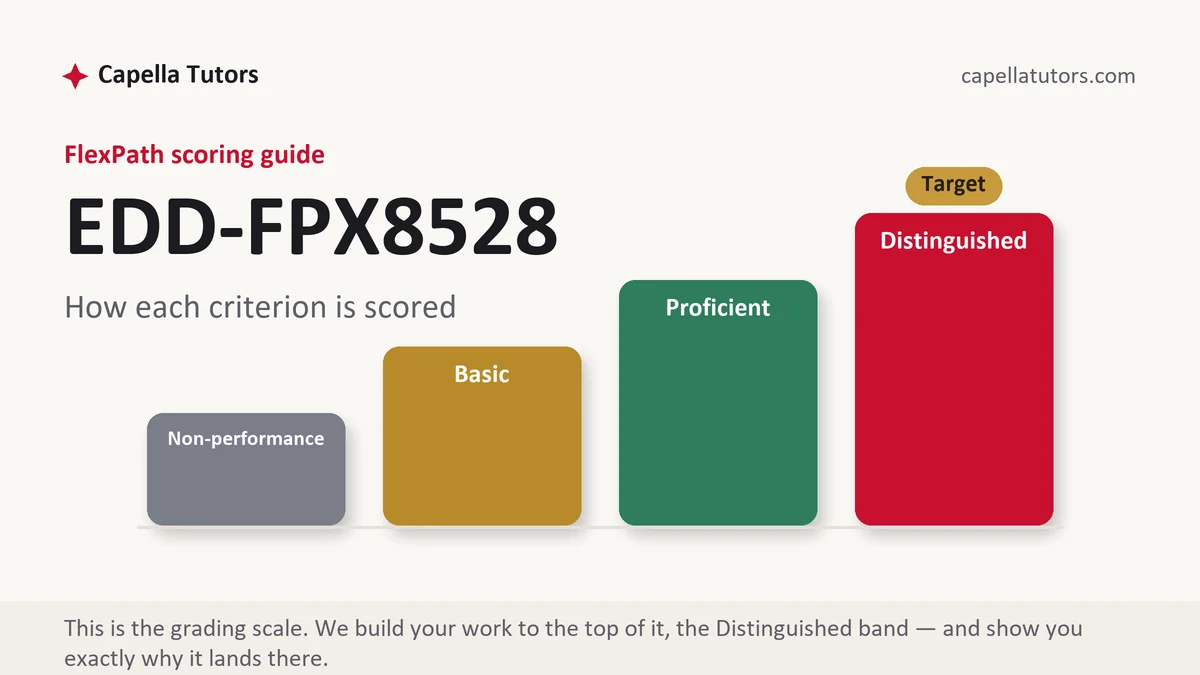
Delivery is standard across the studio. One premium original piece inside 24 to 48 hours, eight people from the source pull to the last proofread, and one pass reserved entirely for recalculating every figure in the document and confirming the totals in the narrative match the tables. Revisions cost nothing until the guide is satisfied. FlexPath returns four levels per criterion within two business days of the attempt you choose to submit, so we write for a first submission that closes the course rather than one that starts a revision cycle.
The assessments, one by one
Assessment 1
Assessment 1 usually asks you to appraise a measure rather than admire it. Read the full Assessment 1 manual.
Assessment 2
Assessment 2 usually asks for an evaluation design you could defend to somebody who wants a different answer. Read the full Assessment 2 manual.
Assessment 3
Assessment 3 usually moves from measurement to leadership, so the question is no longer what the numbers say but who receives them and what they are permitted to do. Read the full Assessment 3 manual.
How to actually write EDD FPX 8528: where to begin
Turn the guide into headings, then write the decision at the top of the page before you write anything else. Every criterion in this course is easier once the document knows what it is for: a placement decision, a program continuation decision, a resource allocation, a report to a board, a recommendation about an instrument. Then label each criterion by what it demands, since some want an appraisal of an existing measure, some want a plan, some want an analysis of data you supply, and some want an argument about ethical use. The assessments in this course usually combine an analytic section with a plan or recommendation, and your scoring guide decides the deliverable, the audience and how much of the reasoning must be documented rather than summarized.
Then get the arithmetic right, because this is the course where a reader checks it. Say a school reports third grade reading proficiency at 48 percent last year and 54 percent this year and the improvement plan claims the new intervention worked. Three questions dismantle that claim. First, the denominator: 54 percent of 58 tested students is 31 children, while 48 percent of 62 is 30, so the entire six-point movement is one additional student. Second, the cohort: these are different children, and a proficiency rate compares groups rather than tracking growth, so the change may be composition. Third, the distribution: rates move fastest when students near the cut score cross it, which tells you nothing about the students furthest behind. Write those three checks explicitly, then report what would settle the question, which is the same students measured twice, a comparison group, and several prior years of the same indicator so ordinary fluctuation is visible.
Then choose an evaluation design you can actually defend and say what it cannot show. Most school evaluations have no randomization and no clean comparison, and that is workable if you are honest about it. An interrupted series with five points before the program and four after supports a claim about a change in level or trend. A matched comparison supports a weaker claim if you state the matching variables. A description of implementation supports the most important claim of all in a first year, which is whether the program happened. Write the alternative explanations you cannot rule out, name the sample size and the response or participation rate, and use language proportional to the design, since consistent with and associated with are defensible where caused is not.
Then write the use and consequence section, which is where doctoral criteria separate this course from a statistics exercise. Say who receives each result and what they are authorized to do with it, because the same table sent to a teacher, a principal and a board serves three different decisions and needs three different framings. Say what stakes attach, and then say what the measure will distort, since attendance rates, discipline referrals and pass rates all have documented histories of definitional drift once they are watched. Add the equity checks, including disaggregation with small cells suppressed to protect identities, and the question of whether every group had comparable opportunity to learn what the instrument measures.
| Section | What goes in it | What Distinguished looks like |
|---|---|---|
| Decision and evaluation questions | The decision at stake, who makes it, when, and the questions that would inform it. | Questions answerable with obtainable evidence, ordered by what the decision needs first. |
| Instruments and their claims | Each measure, the purpose it was built for, its scoring, and the interpretation you intend. | Validity argued for the specific use, with an inappropriate use named and ruled out. |
| Data quality | Population, numerators and denominators, missing cases, testing conditions, comparability across years. | Denominators shown throughout and missing data reported rather than quietly dropped. |
| Design and analysis | Comparison or series structure, implementation measure, the analysis performed and why it fits. | A design named accurately, with the alternative explanations it leaves open listed. |
| Findings and limits | Results with effect described in practical terms, subgroup breakdowns, suppression rules applied. | Practical significance discussed separately from statistical, with cell sizes respected. |
| Use, ethics and references | Audience-specific reporting, decision rights, stakes, distortion risks, current APA both ways. | Each audience given what it can act on, with the predictable gaming of the measure anticipated. |
Developing the synthesis
Everything in this course eventually meets one tension, which is measuring what matters against managing what gets measured. Everything schools genuinely care about is reached indirectly: a standardized test samples a domain in ninety minutes, a discipline referral records an adult's decision as much as a student's behavior, an attendance figure depends on a coding rule, and a teacher evaluation rating summarizes a handful of visits. Attaching consequences to any of those improves the number faster than it improves the thing, a pattern documented across accountability regimes as score gains that fail to appear on other measures of the same skill, as narrowing toward tested content, and as effort concentrated on students nearest a cut score. Growth measures were introduced to fix the fairness problem in status measures, and they carry their own instability, moving substantially year to year for the same teacher or school where the group is small. The defensible doctoral position is neither refusal to measure nor faith in one index: use indicators that would not distort in the same direction, keep the highest stakes off the noisiest measures, report uncertainty with every figure, and monitor for the distortion you expect.
Citations that survive faculty review
Five source families carry this course. The professional testing standards issued jointly by the American Educational Research Association, the American Psychological Association and the National Council on Measurement in Education are the authority for anything about validity, reliability or fair use, and citing them directly rather than through a textbook paraphrase is the mark of a doctoral writer. Technical documentation for the instrument you are using supplies its intended purpose, its norming population, its reliability estimates and its standard error, and no serious claim about a score can be made without it. Peer-reviewed measurement and program evaluation research, retrieved through ERIC and the Capella library, supports design choices and the appraisal of prior findings. Official accountability documents, meaning your state assessment technical report, the state plan, and the federal clearinghouse standards a district uses to judge program evidence, establish the rules you work inside. Local data artifacts complete the picture: the data dictionary, the extract with its date, the suppression policy. Vendor efficacy studies are usable only when labeled as such, with the funding relationship stated in your sentence rather than buried in the reference list.
The mistakes that land Basic instead of Distinguished
- A percentage with no denominator. Six points in a grade of sixty is four children, and a rate reported without its base cannot be interpreted at all.
- Cohorts compared as though they were the same students. Year to year proficiency tracks two different groups, so growth claims need the same children measured twice.
- Validity treated as a property of the test. The question is always whether this interpretation supports this use, and the answer changes with the decision.
- A design left unnamed. Findings presented with no comparison and no series invite the reader to supply the missing counterfactual themselves.
- No account of distortion. Every indicator with consequences attached changes behavior toward the indicator, and a plan that ignores this will be corrected in the comments.
EDD FPX 8528 questions students actually ask
Our proficiency rate rose six points. Can I say the program worked?
Not from that sentence alone, and the reasons are worth writing into the paper. A proficiency rate compares two different groups of children when the grade turns over, so last year's fourth graders and this year's fourth graders are separate samples, and the rate can move because the incoming cohort differed. The rate also hides where the movement happened, since students just below the cut score crossing it produce the same headline as broad growth across the distribution. In a grade of about sixty, six percentage points is roughly four students, which is inside the noise a small group produces year to year. What you can defend is a matched analysis of the students who received the program, reported with its number, alongside the same measure for comparable students who did not, plus several years of prior points so a reader can see whether this change stands out from ordinary fluctuation.
I have no control group. What evaluation design can I actually defend?
Several, provided you name the counterfactual and stop short of causal language. The strongest option usually available to a school is an interrupted series: at least four or five measurement points before the program and several after, using an indicator collected routinely, so a shift in level or slope can be distinguished from drift. Next is a matched comparison, meaning students, classrooms or schools that resemble yours on prior performance and composition and did not receive the program, with the matching variables stated. Weaker but still usable is a within-program dose comparison, where students who received more of it are compared with those who received less, with the caution that dose is rarely random. In every case, write the alternative explanations you cannot rule out, and describe results as consistent with rather than caused by. Naming your design honestly earns more credit than overclaiming a stronger one.
How do I evaluate professional learning rather than just student scores?
Evaluate it in layers and stop treating satisfaction as evidence. The layered approach is familiar from Kirkpatrick in training contexts and from Guskey in education, and the practical point both make is that reaction, learning, use in practice and student outcome are separate questions requiring separate measures. Reaction is the cheapest and least informative. Learning can be checked with a task rather than a survey, for instance asking participants to score three samples of student work and comparing their scores with a calibrated set. Use in practice is the layer that decides everything downstream, and it needs observation of the practice with a stated definition, or artifacts collected on a schedule. Only then does a student outcome question make sense, because a program that was never implemented cannot be shown to have failed. Report the implementation figure first, always.
Evaluation plan or data analysis due?
Send the prompt, the guide, and whichever reports you can share. First premium sample free, with every rate shown against its denominator.