Upload the prompt and the scoring guide and you get a premium original sample within 24 to 48 hours, written to the Distinguished descriptors and revised free until every criterion is satisfied. What appears on your record is EDD FPX 8526, Change Leadership in a Learning Organization, 2 program points, sitting in the Educational Leadership specialization that supplies 10 of the 32 points in the FlexPath Doctor of Education at Capella. In Capella's catalog the course code is written EDD-FPX8526.
What EDD FPX 8526 actually grades
Two phrases in the title do separate work, and drafts that miss the distinction lose criteria. Change leadership is the act of getting a specific practice to happen differently in a specific place. A learning organization is a school that can notice the results of its own actions and revise, which is a property of the routines, not a mood in the building. The graded question is usually whether your change is designed so the organization can learn from it, meaning it produces information at intervals a leader can act on rather than a verdict eighteen months later when the principal has moved on.
The theory strand is graded on attribution and on fit. The five disciplines belong to Senge, the distinction between correcting an error and questioning the assumption that generated it belongs to Argyris and Schon, the eight-step sequence belongs to Kotter and came from consulting practice rather than from research, the stages of concern work belongs to Hall and Hord and is genuinely empirical about individual adoption, and adoption categories belong to Rogers. A criterion that asks you to apply a change framework is asking for the framework to explain something local, so the useful move is to take one element, for instance the difference between a school fixing a scheduling error and a school asking why its schedule keeps producing that error, and show it operating in your own case.
The improvement strand is where doctoral education work has moved, and it changes what a criterion counts as rigor. The vocabulary of improvement science, meaning a problem of practice stated precisely, a system analysis that explains why current results occur, a theory of improvement with drivers, and small tests run in cycles before anything is launched, gives you a way to be specific about causality without pretending to run a trial. The two other technical demands are fidelity against adaptation, since a practice imported unchanged often fails and a practice changed beyond recognition proves nothing, and sustainment, which is the question of what remains once attention moves. Coburn's dimensions of scale, including depth, spread, sustainability and the shift of ownership to the people doing the work, are the customary way to argue that last point.
How we help in this course
Drafts for 8526 are written as tests rather than as announcements. Each proposed change arrives with a baseline, an aim carrying a number and a date, a first cycle small enough to run without permission from a board, process measures that read weekly, and a decision rule that says what result triggers expansion, revision or abandonment. Frameworks are attributed to the people who built them and used on one local detail apiece. Tell us the practice you want changed, the number of adults it involves, and what has already been tried and failed in that building, because a plan that ignores the last failed attempt is the plan staff will assume this one repeats.
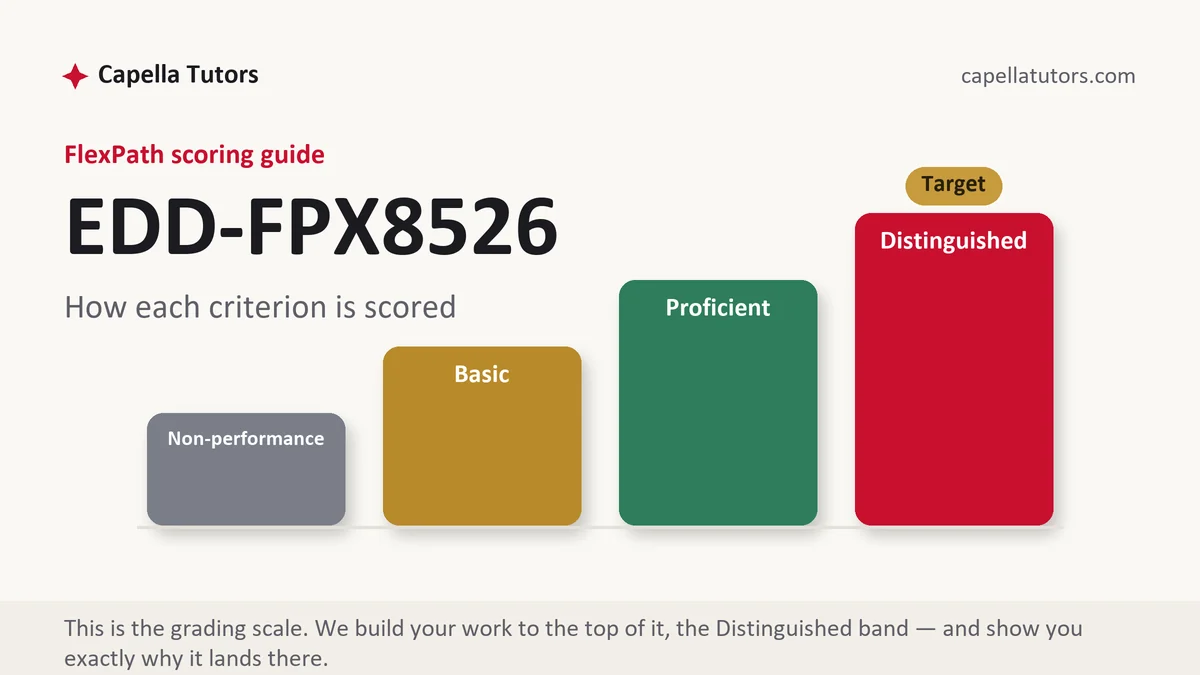
What we charge and how fast we work stay the same whatever the course code. A premium original deliverable turned around in 24 to 48 hours, eight people involved from the literature search to the final read, and revisions included until the guide is met, with faculty comments folded back in at no charge. FlexPath scores each criterion at one of four levels within two business days of an attempt, and since you submit when the work is ready rather than on a calendar, we write for a first submission that needs no second pass.
The assessments, one by one
Assessment 1
Assessment 1 usually asks for the front half of an improvement argument: a problem of practice narrow enough to test, and an analysis of the system that keeps producing it. Read the full Assessment 1 manual.
Assessment 2
Assessment 2 usually asks for the theory and the test: an if and then chain naming the mechanism you believe operates, and a first cycle small enough to run without anybody's permission. Read the full Assessment 2 manual.
Assessment 3
Assessment 3 usually asks the question a change plan is weakest on: what survives. Read the full Assessment 3 manual.
How to actually write EDD FPX 8526: where to begin
Convert the scoring guide into headings, then write the problem statement three times until it is narrow enough to test. A problem of practice is not a topic, and the difference is measurable: student writing is a topic, while ninth grade students in this building produce fewer than half a page of extended writing per week in any subject other than English is a problem, because it names a population, a behavior, a frequency and a boundary. The assessments in this course usually ask for some combination of analysis, plan and evaluation, and your scoring guide decides the format and how much of the local evidence has to be documented. Do the narrowing before anything else, since every later section inherits the precision of that sentence.
Then analyze the system that produces the current result, which is the section most drafts replace with a list of causes. Work backward from the behavior through the conditions that make it rational. If teachers are not assigning extended writing, the reasons are usually structural: a course load of 150 students makes weekly feedback arithmetically impossible at ten minutes a paper, the district assessment calendar occupies four weeks of the term, no shared rubric exists so grading is unbounded, and nobody has ever agreed what counts as extended writing. Each of those is a driver, and each one suggests a different change. Then state your theory of improvement as an if and then chain with the mechanism named, and mark the link you are least sure about, because that is the link your first test should attack.
Then design the test small, which is the single most common gap between a Basic plan and a Distinguished one. The instinct is to propose a building-wide initiative starting in August. The doctoral move is to propose two teachers, one course, three weeks, one rubric, twelve pieces of student work, with a prediction written down before the cycle starts and the result compared against it afterward. Then say what the second cycle does depending on what happened. Attach process measures that read inside a fortnight, such as the number of assignments given and the proportion returned with feedback inside a week, and keep the outcome measure separate. Show the review meeting on a calendar, name who attends, and say what decision that meeting has authority to make.
Then write sustainment and removal, and write them as arithmetic. Say what routine carries the change once the pilot ends, who owns it when you leave the role, and where it appears in the school improvement plan and the master schedule. Then name what stops. A staff with ninety minutes of shared time a week cannot absorb a seventh priority, so a change proposal without a removal proposal is a request for unpaid hours, and reviewers at this level treat it as one. Close with the failure case: write the two most likely reasons your change dies, and the specific counter you have planned for each.
| Section | What goes in it | What Distinguished looks like |
|---|---|---|
| Problem of practice | The population, the behavior, the frequency, the boundary, and the baseline evidence. | A sentence narrow enough to test, with a number attached to the current state. |
| System analysis | Why the present result is a rational product of current conditions, drivers listed and traced. | Structural causes named, including the ones the writer helped create. |
| Theory of improvement | The if and then chain, the mechanism, and the link the writer trusts least. | A chain a reader could falsify, with the weakest link chosen for the first test. |
| Change framework applied | One named model, attributed to its author, doing work on a specific local difficulty. | The model explaining a detail rather than supplying a headings list. |
| Tests, measures and cadence | Scale of the first cycle, prediction, process and outcome measures, review dates, decision rules. | A first cycle small enough to run next month, with rules written before results arrive. |
| Sustainment, removal, references | Who owns it afterward, what it replaces, the failure cases, current APA in text and list. | An explicit removal with the hours it frees, plus a planned response to the likeliest failure. |
Developing the synthesis
What earns the synthesis criterion here is the quarrel between prescriptive change models and empirical implementation research, and the reason it matters is practical. Stage models are attractive because they are memorable and orderly, and they are largely retrospective, assembled from cases that succeeded, which means they cannot tell you which step failed in a case that did not. Implementation and improvement research asks a narrower and more answerable question: under what conditions did this practice get used as intended, by how many people, for how long, and with what result. That literature keeps returning the same findings, which are that adoption is uneven across a staff, that early enthusiasts are not representative, that fidelity and local adaptation trade off against each other, and that most changes decay when the person who championed them leaves. The defensible position is layered: use a stage model for sequencing and communication, use improvement methods for evidence, and treat sustainment as the real test, since a result held for one year under one principal shows capability rather than change.
Citations that survive faculty review
Four families of source carry a change paper at doctoral level. Empirical school improvement and implementation studies, found through ERIC and the Capella library, support claims about what happens when a practice is introduced, and each should arrive with its scale, its duration and its setting, because a two-year study in eleven schools with district funding is not evidence about one building in one term. Framework literature belongs to its authors, and the correct citation is the book or paper where the idea was proposed rather than the training deck that reduced it to a diagram, particularly for models that circulate mostly as images. Improvement methodology sources supply the machinery, meaning how a driver diagram is built, how a short cycle is documented, how a run of data is read for signal rather than noise. Local documents anchor the whole thing: your improvement plan, the schedule, the minutes of the meeting where the last initiative was dropped, each named and dated. One habit is worth building deliberately, which is citing the failed attempt honestly, since a paper documenting what did not work in this building is more credible than one writing history as though nothing had been tried before.
The mistakes that land Basic instead of Distinguished
- A topic offered where a problem of practice was required. Without a population, a frequency and a baseline, nothing later in the paper can be measured.
- A stage model used as an outline. Eight headings borrowed from a framework is formatting, and the criterion asked for the framework to explain something.
- A launch instead of a test. Building-wide rollouts with no small cycle first give a reader no way to judge whether the theory holds.
- Causes listed rather than a system explained. Bullet lists of reasons skip the step where you show why the current behavior is rational.
- No removal and no owner. A plan that adds work without freeing time, or that depends on the writer staying in post, fails the sustainment row.
EDD FPX 8526 questions students actually ask
Which change model should I use, and does it matter that some of them are not research?
Pick one, attribute it accurately, and say what it is. The eight-step sequence belongs to Kotter and came out of consulting practice rather than out of a controlled study. The unfreeze and refreeze phrasing is credited to Lewin, though scholars have shown the three-stage packaging was assembled by later writers rather than written that way by him. The stages of concern work by Hall and Hord is empirical and about individuals adopting a practice. Diffusion categories come from Rogers and describe adoption spread, not school improvement. None of them is a warrant for your plan, all of them are useful scaffolding, and a doctoral paper says which it is using and why that structure fits this problem. Then it adds the thing no stage model contains, which is a testable theory of why your specific change would produce your specific outcome.
The assessment asks for a change plan I cannot actually implement. How should I write it?
Write it as a proposal that could be authorized on Monday, and be explicit that it is a proposal. Everything that makes a plan evaluable can be written before anything happens: the baseline you would collect and where it lives, the aim with a number and a date, the first test and how small it is, the process measures, the review cadence, the decision rules for expanding, adapting or stopping. Then add the parts a reviewer will look for precisely because you have not run it, which are the resource cost, the approvals required, the risks and the plan for the most likely failure. Say what evidence would tell you the theory was wrong. A prospective plan with decision rules reads as doctoral work. A retrospective story about a change that already happened, written with no baseline, does not.
Our school already has six initiatives running. How do I address that in the paper?
Count them, cost them, and propose what stops. List every current initiative with the adult time it consumes each month, and the total is usually the finding: a staff with two hours of collaborative time per week cannot carry six priorities, so in practice it is carrying two and performing four. Then write the removal explicitly. Say which initiative ends, which meeting is shortened, which report is retired, and who has the authority to make that call. Naming a replacement is easy and naming a removal is what a superintendent actually needs to see. Add the transition detail, because ending a program has its own communication and data obligations, including what happens to the students currently receiving it and how you will know their outcomes did not deteriorate after it stopped.
Change plan due for review?
Send the prompt, the guide, and what the building has already tried. First premium sample free, with the aim numbered and the first cycle sized.