Send the prompt with the scoring guide attached and a premium original sample returns inside 24 to 48 hours, drafted against the Distinguished wording of that guide, with revisions free until the criteria are satisfied. The course is EDD FPX 8520, Educational Leadership by Design, worth 2 program points, one of the five Educational Leadership specialization courses that contribute 10 of the 32 points in Capella's FlexPath Doctor of Education. In Capella's catalog the course code is written EDD-FPX8520.
What EDD FPX 8520 actually grades
The title is the assignment. This course scores whether you can specify a leadership practice, not whether you can describe one you admire. A design has parts: a purpose stated as a problem worth solving, the standards you accepted as design criteria, the roles that carry the work, the routines those roles perform on a stated cadence, the artifacts the routines run on, and the evidence that would tell you it is working. Doctoral criteria are looking for that specification. A paper reporting which leadership style the writer identifies with has answered a question from an earlier degree.
Instructional leadership is the center of gravity, and the graded distinction is between leading instruction and administering a building. The research gives you the reason it matters: what a school leader does reaches students through teachers, through the conditions teachers work in, and through what gets taught and assessed, so every claim in your design travels through an intermediate step. Write the step down. If the design is a weekly classroom visit, say what the visit changes in a teacher's planning by Thursday and how that change reaches the task a student is handed. Omitting the middle move is why so many design paragraphs read as aspiration.
Standards are graded as design criteria rather than as citation. The Professional Standards for Educational Leaders, issued in 2015 by the National Policy Board for Educational Administration in place of the older ISLLC set, are the usual frame, and the preparation standards known as NELP sit behind program accreditation. Used well, a domain becomes a constraint: if the standard obliges attention to equity of access, your routine has to say which students it reaches first and how you would notice it never reached the rest. Used badly, the standards become an appendix where every domain gets one sentence and none of them touches the design.
How we help in this course
Samples for 8520 are built as specifications. Each routine in the draft carries a cadence, an owner, an artifact and a time cost, each claim about effect names the intermediate step it passes through, and each standard invoked appears as a test the design has to pass. Tell us your role, the size and level of the school or system you are writing about, and the constraints you cannot move, whether that is contract language, an existing observation cycle or a board priority, and the design arrives shaped to your setting rather than to a generic district.
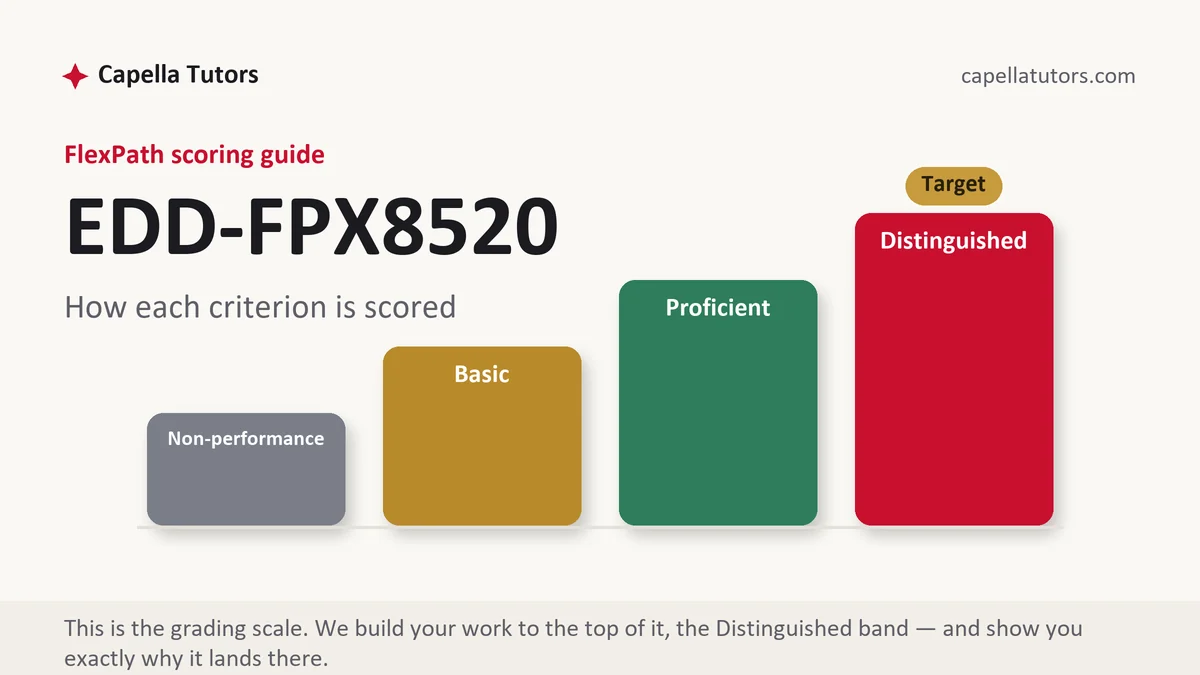
Delivery follows the studio standard. One premium original deliverable inside 24 to 48 hours, eight people from the standards and literature pull through scoring-guide review to the final proofread, and revisions at no charge until the work meets the guide. FlexPath scores every criterion at Non-performance, Basic, Proficient or Distinguished and lets you submit the moment a piece is ready, with faculty holding two business days to evaluate an attempt, so the working objective on a first submission is a scoring sheet carrying no Basic rows.
The assessments, one by one
Assessment 1
Assessment 1 in a design course is the diagnostic front end. Read the full Assessment 1 manual.
Assessment 2
Assessment 2 is where the design has to exist on the page. Read the full Assessment 2 manual.
Assessment 3
Assessment 3 usually closes the design work by asking how the practice would be put in place and how you would know whether it worked. Read the full Assessment 3 manual.
How to actually write EDD FPX 8520: where to begin
Open the scoring guide before you open a document. Copy each criterion in as a heading, paste the Distinguished wording underneath it, then sort the criteria into four kinds: those asking you to analyze a context, those asking you to justify a design decision, those asking you to align to standards or literature, and those asking you to plan implementation or evaluation. The assessments in this course usually ask for some mixture of all four, and your scoring guide decides the deliverable, its length and whether the audience is a faculty reader or a named district body. Verbs matter more than nouns in that sorting, since evaluate, justify and recommend are three separate obligations.
Then write the design at a level of detail that would let somebody else run it on Monday. Say the problem is that feedback after a classroom observation arrives too late to change anything. The Basic version proposes more frequent feedback and better communication. The doctoral version specifies a fifteen-minute visit to every teacher inside a six-week cycle, one look-for per cycle drawn from the instructional priority, notes entered on a single-page form before the observer leaves the room, a conversation within two school days, and a calibration session where three observers score the same recorded lesson and reconcile before the cycle opens. Then count the cost. Forty teachers at fifteen minutes is ten hours of observation per cycle, and forty conversations at ten minutes adds nearly seven more, against an administrator week that already holds a duty schedule. Say who absorbs those hours, or say which existing routine you are stopping to release them.
Then attach evidence in two layers, because a doctoral reader looks for both. The first layer measures whether the design ran at all: cycles completed against cycles planned, median hours from visit to conversation, the share of feedback notes that name the look-for. Those figures arrive within weeks and tell you whether you are evaluating a design or evaluating its absence. The second layer measures whether it worked, which needs a baseline taken before the first cycle, a stated window, and an outcome defensibly connected to the mechanism, such as the proportion of observed lessons where students do the reasoning. Name the subgroup breakdowns in advance, and say what result would make you withdraw the design.
Then write the two parts most drafts skip, which are authority and objection. State what you can decide alone, what needs a supervisor, and what needs a bargaining conversation or a board vote, since a proposal built on authority the writer does not hold reads as naive to any faculty member who has run a building. Treat resistance as design input: if teachers suspect a short visit will be used evaluatively, the design needs a written firewall between the cycle and the summative evaluation, or the mechanism dies in week two.
| Section | What goes in it | What Distinguished looks like |
|---|---|---|
| Problem of practice and setting | The gap in current leadership practice, the school or system around it, and who is affected. | A problem sized with local evidence, scoped to ground the writer can act on. |
| Design criteria and standards | The standards, values and constraints the design must satisfy, each cited to its issuing body. | Standards used as tests, with at least one visibly changing a decision. |
| The design itself | Roles, routines, cadence, artifacts, and the hours each one consumes. | Detail sufficient for another leader to run it without asking the author a question. |
| Mechanism and evidence | The steps between a leader's action and a student's work, with literature behind each link. | Every link named and sourced, with the weakest one identified rather than hidden. |
| Implementation and authority | Sequence, decision rights, policy or bargaining limits, and the objections expected. | Decision rights stated accurately, and objections answered inside the design. |
| Evaluation plan and references | Baseline, process and outcome measures, review cadence, current APA in text and list. | Measures with denominators and a window, plus a stated condition for abandonment. |
Developing the synthesis
The synthesis this course rewards is the argument over how much leadership can be shown to do. You will meet the claim that leadership ranks second only to classroom teaching among school-level influences on learning, and it always arrives with a companion claim, that nearly all of the influence is indirect. Both rest largely on correlational work: teacher perception surveys matched to achievement, principal turnover studies that treat a change of leader as the shock, and case studies of unusually improving schools. Each design answers one objection and opens another. Perception surveys measure reputation as much as practice. Turnover studies can price a principal without telling you which practice produced the price. Case studies chosen for success select on the outcome, which is why lists of what effective leaders do keep including things ineffective leaders also do. The defensible position is neither dismissal nor enthusiasm: call the effect real, mediated and imprecisely measured, pick the mediating path your design depends on, cite the evidence for that path rather than the headline, and close by stating what your own evaluation could never establish.
Citations that survive faculty review
Four kinds of source carry weight with an education leadership evaluator. Peer-reviewed empirical work in educational administration journals, reached through ERIC and the Capella library, supports any claim that a leadership practice changes teaching or learning, and each citation should arrive with its design, its setting and its sample, since a result from forty urban elementary schools is not a result about a rural high school. Standards and policy documents belong to their issuers, so leadership standards are cited to the National Policy Board for Educational Administration with a year and accreditation standards to their own body. Research syntheses are legitimate and are the right place to establish a pattern before you narrow to one study. Local documents are the fourth kind and the one doctoral writers underuse: a district improvement plan, a bargaining agreement, board minutes, a school report card, each named in text so a reader can see the constraint is real. What fails review is the consultant layer, meaning vendor white papers, leadership blogs, and framework summaries lifted from a textbook when the framework has a named author and an original paper behind it.
The mistakes that land Basic instead of Distinguished
- A style described instead of a practice specified. Naming a leadership style is one sentence, and the criteria are grading a system with roles, routines and a cadence.
- An effect claimed with no route to a student. Leadership reaches learning through teaching, so a design that skips the middle step leaves nothing to evaluate.
- Standards parked in a table. A domain that changes no decision in the document has been cited rather than used.
- A routine with no time cost. Every cycle you propose consumes hours somebody already spends, and an unbudgeted routine collapses first.
- Authority assumed. Proposing what a contract, a policy or a board reserves to somebody else shows the design was never tested against your own setting.
EDD FPX 8520 questions students actually ask
I am not a principal yet. Can I still write a leadership design?
Yes, and the course does not assume a principalship. It assumes a real sphere of practice, which for a teacher leader might be one department, for an instructional coach the four teachers on a cycle, for a district analyst a reporting routine eight schools depend on. Write that sphere accurately, edges included, and the design gets stronger rather than smaller, because you can name what you actually control. Where the work needs authority you do not hold, say who holds it and what you would bring them: a pilot with an end date, the data you would collect, the decision you would ask them to make afterward. Faculty read that as leadership. A design written as though the author runs a district they do not run reads as a paper assembled from a textbook.
How much leadership philosophy belongs in this?
As much as the guide asks for, converted into decision rules. A values paragraph earns little on its own, since every writer in the course values children and collaboration. What earns is a value expressed as something you would do when it costs you. If you claim to lead for equity, write the rule that decides which students get the added minutes when there are not enough minutes for everyone, and name what that rule takes away from somebody else. Two or three rules of that kind carry more of the criterion than a page of belief statements. Where the guide explicitly asks for a leadership platform, keep it, then close it with the rules it produces so a reader can watch the values do work later in the document.
Which standards should I align to, and do I have to quote them?
Align to whatever your guide names, and if it names nothing, use the national leadership standards and say why you chose them. Quoting is rarely the right move, because a criterion asks for alignment and a quotation only proves you located the document. Paraphrase the obligation, cite the issuing body with its year, then show the design satisfying it. Where your state publishes its own leadership standards or an administrator evaluation rubric, add it, since your practice is judged against that instrument rather than against the national set, and naming both is the local precision doctoral criteria reward. If two frameworks disagree on a point, say which one governed your decision and why, which reads far better than pretending they agree.
Leadership design due this week?
Send the prompt, the guide, and the constraints you cannot move. First premium sample free, specified down to the cadence.