Bring the framework you built and the guide you are graded against, and the design, the sampling logic, the instruments and the ethics narrative come back inside 24 to 48 hours, written toward the Distinguished descriptors and revised at no charge until they land there. The course is EDD FPX 9953, EdD Doctoral Project 3, carrying 2 program points, the third numbered course of the six that together account for 12 of the 32 program points in the FlexPath EdD with the Educational Leadership specialization. In Capella's catalog the course code is written EDD-FPX9953.
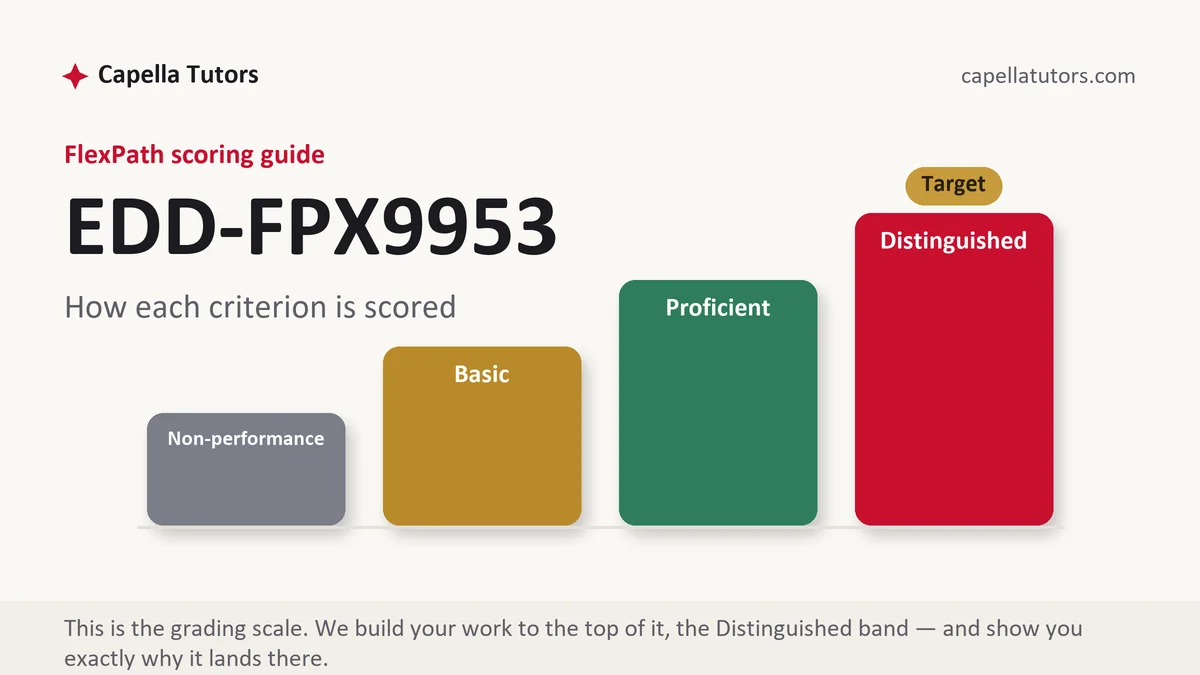
What EDD FPX 9953 actually grades
No published chapter list attaches to this course number, so the stages named here are the work a project has to complete rather than labels your program uses. What is graded at this depth is alignment, and alignment is unforgiving because a reader can check it in one pass. Your questions get laid beside your data sources beside your analysis plan, and the reader looks for a question with no source, a source with no analysis, or an analysis that cannot produce an answer in the shape the question asked for. The assessments in this course usually ask for the design and its justification, the participants and how they were selected, the instruments and where their items came from, the procedure in enough detail to be repeated, and an ethical account of doing all of it inside a school.
Sampling is where practitioner projects lose criteria, in both traditions and for opposite reasons. Qualitative designs get marked down for treating a number as a plan: fourteen interviews is not a sample, while fourteen interviews chosen to cover every grade band, both buildings and three tenure brackets is. Quantitative designs get marked down for claiming a power they do not have. Run the arithmetic and print it. Detecting a standardized difference of 0.30 at conventional power needs something on the order of 175 participants per group, and a study of three schools with 41 teachers between them will not get there, which is an argument for a descriptive or mixed design rather than a reason to hide the calculation. Evaluators reward the learner who states the limit and then designs inside it.
Then there is the ethics account, which in a school setting is far more specific than a paragraph about confidentiality. Minors need parental consent and their own assent, and the reading level of both documents is part of what gets reviewed. Student records are protected, so what you may see in your job and what you may analyze in your project are two different sets and the second one is smaller. Colleagues you supervise cannot decline you comfortably, so recruitment usually has to move to somebody who does not evaluate them. A district of a few thousand students is a small place, which means an unmasked school name plus a job title plus a subject area can identify a person long after their name is gone. Write each of those as a risk with a control beside it and the section becomes evidence of judgment rather than boilerplate.
How we help in this course
Our 9953 drafts are built around an alignment table before any prose is written. Each research question gets a row, and the row carries the data source, the specific instrument items or documents that answer it, the analysis that will be run, and the framework construct it traces back to. Everything else in the chapter is written to make that table true. Instruments arrive with a provenance note on every item, protocols arrive with probes rather than a bare question list, and the procedure is written in order with owners and durations attached to each step.
Delivery holds at the studio standard. Each deliverable inside 24 to 48 hours as an original premium sample, a scoring-guide review against your own criteria before it reaches you, a separate APA and originality pass, and unlimited revision until the guide is met, with faculty feedback folded back in free. The extra check in this course is a stress read. One reviewer tries to answer each of your questions using only the sources your design provides, and anything unanswerable gets flagged before you submit rather than after a reviewer returns the chapter.
The assessments, one by one
Assessment 1
Assessment 1 of EDD FPX 9953, EdD Doctoral Project 3, is the design and the sample: the tradition you are working in, the specific design inside it, and a selection logic that answers your questions rather than a number chosen for convenience. Read the full Assessment 1 manual.
Assessment 2
Assessment 2 of EDD FPX 9953, EdD Doctoral Project 3, is the instrument and the procedure: every item traced to the construct or question it serves, and a sequence a stranger could execute without calling you. Read the full Assessment 2 manual.
Assessment 3
Assessment 3 of EDD FPX 9953, EdD Doctoral Project 3, is the ethics account and the analysis plan: consent and assent, protected records, dual-role safeguards, de-identification, the review pathways under way, and the coding steps or tests chosen before any data exists. Read the full Assessment 3 manual.
How to actually write EDD FPX 9953: where to begin
Start by writing the alignment table and refuse to write prose until it holds. Put the questions in the left column in their final wording, then fill each row rightward. If a question needs data from a system you have not confirmed access to, the row is not finished. If two questions draw on the same single interview item, one of them is redundant. If a row ends in an analysis you cannot perform, either the analysis or the question changes now, which costs a paragraph, rather than in the fifth course, which costs a chapter. Faculty who grade dozens of these read the table first and the prose second.
Then write the procedure the way a stranger would have to follow it. Recruitment happens on a date, through a named channel, by a named person who does not supervise the participants. Consent is collected in a stated form and stored somewhere specific. Interviews run 45 to 60 minutes, are recorded with permission, are transcribed inside a stated window, and go back to participants for correction if you intend to claim member checking. Documents come from a defined set, three years of school improvement plans and two years of attendance committee minutes or whatever it actually is, with a rule for what is in and what is out. Vagueness here is not a style problem, it is the difference between a design and an intention.
Then submit for review early and write as though the answer might change your design rather than merely bless it. Your university's process and your district's own approval are separate queues with separate forms, and neither moves quickly. A reviewer who asks you to drop a question about a named administrator, or to raise the reading level of an assent form, has just changed your instrument, and every document downstream has to move with it. Build the calendar backward from the last date collection could start and still leave the following course room to analyze anything at all.
| Section | What goes in it | What Distinguished looks like |
|---|---|---|
| Design and rationale | The tradition, the specific design inside it, and why your questions require that design. | A design defended in one paragraph against the alternative you rejected, with the reason given. |
| Participants and sampling | Who, how many, how selected, and the logic that makes the selection answer the questions. | Selection criteria set in advance, with the limits of the resulting sample named rather than softened. |
| Instruments | Every item, its source, and the framework construct or question it serves. | Items traceable to the framework, piloted or expert-reviewed, with the pilot actually reported. |
| Procedure | Recruitment, consent, collection, storage and timing, in order, with owners named. | A sequence a stranger could execute without contacting you for clarification. |
| Analysis plan | The coding approach or the statistical tests, chosen before data exists, with software named. | An analysis matched to the data type and the question, with trustworthiness or assumption checks specified. |
| Ethics and permissions | Consent and assent, records protection, dual-role safeguards, de-identification and approval status. | Each risk paired with a control, and the separate approval pathways described accurately. |
Developing the synthesis
The synthesis this stage needs is methodological rather than substantive, and it is short. You are showing that the design you chose is the one the field uses for questions like yours, which means citing methodologists rather than education studies for a page or two. Say which tradition your questions sit in and why, name the design, and attribute it to a primary methodological source rather than to a research methods textbook's summary of that source. Where you borrow an analytic procedure, cite the people who published the procedure and follow their steps rather than a paraphrase of them. Then do the thing most drafts skip. Name the design you did not choose and say in one sentence why it would have answered a different question. That single comparison does more for the criterion than three pages of definitions, and it is the reason EDD FPX 8040, Research Design for Practitioners, sits earlier in the program.
Citations that survive faculty review
Methodology chapters need a different reference profile from literature chapters, and faculty notice when they get the same one twice. Primary methodological sources carry the design: whoever defined the tradition, whoever published the coding approach you are using, whoever wrote the trustworthiness criteria you claim to meet. Instrument sources carry the items, so if you adapt a published survey, cite it, state what you changed, and say whether permission was required and obtained. Regulatory and policy sources carry the ethics: the federal protections covering student records, your state's rules on research in schools, and your district's own research request policy where one is published. Keep the education literature in this chapter to the minimum needed to justify a measure. Then reconcile the reference list against the citations both ways in current APA, confirm every adapted instrument is credited in the text and not only in an appendix, and remove any source whose first page you have not read.
The mistakes that land Basic instead of Distinguished
- A sample size with no logic behind it. A number chosen for convenience and defended afterward is visible on the first reading.
- Instrument items from nowhere. Questions invented on the spot cannot be traced to the framework, and the trace is the criterion.
- An analysis named but not specified. Thematic analysis is a family rather than a method until you say whose steps you are following.
- Consent treated as a formality. In a school, who does the asking and who cannot easily refuse matters more than the wording of the form.
- A calendar with no slack in it. Approval queues run on their own clock, and a design assuming otherwise stalls the course after this one.
EDD FPX 9953 questions students actually ask
How many participants does a qualitative EdD project need?
Your handbook or your chair may state a floor, and if so that number governs. Absent one, the honest answer is enough to cover the perspectives your questions require, which for a single-site practitioner study usually lands between ten and twenty interviews, with the range depending far more on how varied the roles are than on how many people work there. Justify it by coverage rather than by count: every grade band represented, both buildings, veterans and newcomers, and at least one person likely to disagree with your premise. Then say how you will know whether it was enough, which means describing what you will do if new participants keep producing new ideas rather than asserting in advance that saturation will occur on schedule.
Do I need approval from my district as well as from the university?
Usually yes, and the two are independent of each other. Universities review to protect participants and to check that the design justifies the risk. Districts review to protect instructional time, student data and their own exposure, and many run a formal research request process with its own committee, its own deadlines and its own habit of meeting monthly. Neither approval substitutes for the other, and a verbal yes from a friendly principal is not the district's approval. Ask early which pathway applies, get the requirement in writing from your faculty, and build both queues into the schedule as though each will take longer than you were told it would.
Can I use data my district already collected?
Often, and it is the fastest route through this stage when it works, but two questions decide it. First, are the records identifiable, because de-identified aggregates and student-level records sit under different rules and different permissions. Second, who holds authority to release them, which is rarely the same person who has access to them. Extant data also constrains your questions rather than serving them, since an attendance system records what it was built to record and a question about why a student stopped coming will not be answered by a field that only stores whether they did. Where existing data covers part of your question, say which part and pair it with something you collect yourself.
What leaves this course is a document somebody else could execute, and that is the whole test of it. EDD FPX 9953 produces an aligned design, a justified sample, sourced instruments, a dated procedure and an ethics account with its approvals under way, and EDD FPX 9954, EdD Doctoral Project 4, spends its weeks doing exactly what that document says. The relationship between the two is stricter than it looks, because every departure you make later has to be written against this text, so the more precise it is now the less explaining the next course requires. Learners on a flat 12-week FlexPath session sometimes hold this course open while an approval moves, which is reasonable, and the productive use of that wait is drafting the analysis procedures and the codebook you will need the moment data arrives.
Methodology chapter due?
Send the guide, your framework, and what your site will actually release. We will build the alignment table, the instruments, and an ethics account with a control beside every risk. First premium sample free.