Send the full manuscript and the criteria you are graded against, and the reconciliation pass, the presentation and the dissemination materials come back inside 24 to 48 hours, checked chapter against chapter, written to the Distinguished descriptors, with revisions included until the guide is met. The course is EDD FPX 9956, EdD Doctoral Project 6, carrying 2 program points, the last of the six numbered project courses, which between them hold 12 of the 32 program points the FlexPath Doctor of Education asks for in its Educational Leadership specialization. In Capella's catalog the course code is written EDD-FPX9956.
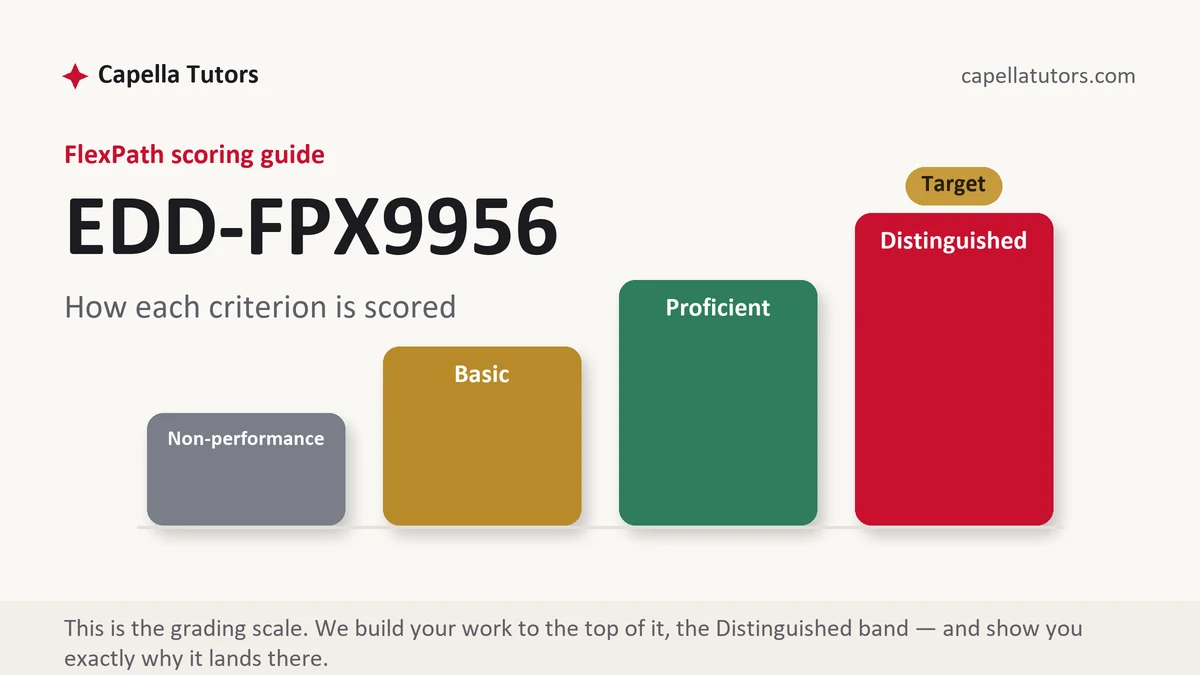
What EDD FPX 9956 actually grades
This course has a number and a title in the catalog and no published checklist, so whatever review your program runs is described by your handbook rather than by this page. What gets graded at the close of a doctoral project is different in kind from everything before it. Almost nothing new is produced except a presentation and a reflection, and almost everything is verified. The assessments in this course usually ask for the manuscript in final form, evidence that it has been read as one document rather than as six, an oral or recorded presentation of the argument, a plan or an artifact for releasing the findings into practice, and a reflective account of what the work did to you as a leader.
The reconciliation pass is where most of the marks sit, and it is unglamorous. A project written across five previous courses accumulates drift. A research question appears in four slightly different wordings across five chapters. A framework construct is called self-efficacy in one place and confidence in another. A participant count reads 14 in the methodology and 13 in the findings because somebody withdrew and one sentence never got updated. A reference list of 74 entries carries three sources appearing nowhere in the text and omits two that do. None of that is an intellectual failure and all of it is visible to a reader in a single sitting, which is exactly why an evaluator treats it as evidence about the care taken with everything they cannot check.
The presentation is graded as an argument rather than as a tour. A doctoral audience does not need your literature chapter recited, they need the problem, the question, what you did, what you found and what should change, in that order, with the evidence held ready in case somebody asks. Eight slides is usually plenty for twenty minutes and twenty slides is a warning sign. Anticipate the three questions any reader of your document will ask, which are almost always about the limits of your sample, the alternative explanation you did not test, and how you know the intervention was actually delivered. Have an answer that concedes what should be conceded, because a defended weakness reads better at this level than a denied one.
How we help in this course
Our 9956 work is a reconciliation before it is a draft. The manuscript gets read end to end against itself: every research question compared across chapters for identical wording, every construct traced from framework to instrument to finding, every number in the narrative checked against its table, every citation matched to the reference list in both directions, and every heading levelled to the template your program supplies. You receive the corrected document plus a change log, so you know what moved and why, and nothing is altered silently.
Beyond that pass, the deliverables people actually need at the end are the ones nobody teaches. We build the presentation as an argument in eight to ten slides with speaker notes, the practice brief as two pages written for a reader who will never open the manuscript, and the reflective statement drafted from your own notes rather than from a template. Terms match everything else in the studio: 24 to 48 hours per deliverable, criterion-level review before delivery, independent APA and originality checking, and revision at no charge until the guide is satisfied.
The assessments, one by one
Assessment 1
Assessment 1 usually opens the closing stage, so almost nothing new is written and almost everything is verified. Read the full Assessment 1 manual.
Assessment 2
Assessment 2 usually asks you to say the whole project out loud, so what is graded is an argument rather than a tour. Read the full Assessment 2 manual.
Assessment 3
Assessment 3 usually closes the sequence, so the graded object is what the work changed rather than what it found. Read the full Assessment 3 manual.
How to actually write EDD FPX 9956: where to begin
Run the reconciliation as a mechanical pass with a checklist, and do not trust your own reading of a document you wrote. Search the file for your research questions, paste every occurrence into one place, and make them identical. Do the same for framework construct names, participant counts, site descriptors and date ranges. Export the reference list and the in-text citations separately and compare them in both directions rather than by eye. Check that every table and figure is numbered in order, called out in the text before it appears, and readable if the prose around it vanished. That work takes a day and recovers criteria no amount of good writing will.
Then build the presentation from the abstract rather than from the chapters. If you cannot state the problem in one sentence, the finding in one sentence and the recommendation in one sentence, no deck will rescue the talk and neither will the manuscript. Give the design one slide instead of four and give the findings the most time. Put the effect size, the sample and the window on the same slide as the result, so the first question you get is about meaning rather than about arithmetic. Rehearse aloud against a timer, because a presentation that runs long gets cut at the recommendations, which is the only part a practice audience came for.
Then write the reflection with evidence in it, since this is the section most learners fill with gratitude and lose marks on. A doctoral reflection is an argument about change in your own practice, and arguments need instances. Name the decision you made differently because of this work: the meeting where you asked for the denominator before agreeing to an initiative, the improvement plan you sent back because it carried no indicator, the colleague whose disconfirming interview changed a recommendation you had already written. Revisit the positionality you declared at the start and say what it actually did rather than what you feared it might. Say what you would design differently now. Reflection at doctoral level is scored on specificity exactly like everything else.
Then release the work, because a practitioner project that ends in a repository has done half its job. Decide what each audience gets: a two-page brief with the recommendation on page one for a cabinet, a short agenda item with three slides for a board committee, a faculty meeting session for the site that hosted you, a practitioner journal or a state association conference for the wider field. Give the host site its version first and before anybody else receives it, since they carried the cost of the study in time and access. Then send the participants a paragraph telling them what came of their hour, which almost nobody does and which is the reason the next doctoral learner at that school gets a yes.
| Section | What goes in it | What Distinguished looks like |
|---|---|---|
| Manuscript reconciliation | Questions, constructs, counts, dates and site descriptors made identical across every chapter. | A document reading as one argument written once rather than as six courses stitched together. |
| Formatting and template | Heading levels, table and figure numbering, front matter and pagination against your program's template. | Formatting invisible to the reader because nothing in it interrupts them. |
| Reference integrity | Every citation matched to an entry and every entry matched to a citation, with links verified. | No orphans in either direction, and a primary source standing behind every framework. |
| Presentation | Problem, question, method, findings and recommendations as a timed argument, evidence held in reserve. | Eight to ten slides, findings given the most time, and conceded weaknesses answered rather than deflected. |
| Dissemination | The audience list, the artifact for each, the channel and the date, beginning with the host site. | Materials written at the reader's altitude, with the host site and the participants served first. |
| Reflection | What changed in your practice, with instances, and what the positionality you declared actually did. | Specific decisions named and dated, including the one your findings forced you to reverse. |
Developing the synthesis
The synthesis expected at the close is a synthesis of the project with itself. Read the document in one sitting and ask whether the problem named in the opening chapter is the problem the recommendations address, because five courses of drift routinely produce a project answering a slightly different question from the one it set out with. Then ask whether the framework survived the whole way through, appearing in the questions, the instrument, the analysis and the interpretation, rather than being introduced early and quietly dropped after the literature chapter. Then ask the question a practitioner will ask, which is what one thing this project would have a leader do on Monday. If the answer takes a paragraph, the argument has not converged yet, and the repair is upstream in the recommendations rather than in the closing section you are trying to write.
Citations that survive faculty review
Citation work at this stage is verification rather than sourcing, and it deserves real hours in the plan. Confirm that every framework and every method is attributed to a primary source rather than to a summary, because that is the check an experienced reader performs first and the one most likely to turn something up. Confirm that every direct quotation carries a locator and matches the original word for word. Confirm that any adapted instrument is credited in the text, in the appendix and in the reference list. Confirm that public data still has a retrieval path that resolves, because state report cards move and a dead link in a document that will sit in a repository for a decade is a permanent flaw. Match entries to citations and citations to entries under current APA, then read the reference list on its own for internal consistency of format, since a list that is right about content and wrong about punctuation still costs a criterion.
The mistakes that land Basic instead of Distinguished
- Chapters that disagree with each other. A participant count changing between methodology and findings undermines everything a reader cannot verify.
- A presentation that recites the manuscript. Walking an audience through the literature chapter spends the minutes the findings needed.
- Reflection written as thanks. Appreciation is not evidence of professional change, and the criterion is asking for change.
- Dissemination promised in the future tense. A plan with no audience, no artifact and no date is not yet a plan.
- Formatting left to the final night. Template compliance is the cheapest criterion on the rubric and the easiest one to drop.
EDD FPX 9956 questions students actually ask
What does the final review actually check?
Your program's handbook holds the checklist and it governs, so ask for it in writing and work against the real one rather than a description of it. What stays consistent across doctoral programs is the character of the check. Reviewers are testing whether the document is internally coherent, whether the claims are proportionate to the evidence, whether the ethics account matches what was approved, and whether the formatting meets the template. They are not, at this point, relitigating your topic. Which means the way to fail a final review is almost never intellectual and almost always clerical, and that is good news, because clerical problems are the only kind you can eliminate completely in a week of disciplined work.
How is presenting to a school board different from presenting to faculty?
The order of the argument inverts. A faculty audience wants the reasoning that licenses the conclusion, so you build from question to method to finding to recommendation. A board wants the decision first, so you open with what you are asking them to do, then the finding that justifies it, then one slide on how you know, with the method available if somebody asks and never volunteered. Keep the whole thing inside what an agenda slot allows, which is often ten minutes rather than twenty. Drop the theoretical vocabulary entirely, name the money, and close on the indicator you would report back on, because a board that knows how it will hear about the outcome is considerably more likely to approve the thing.
How long should the reflection be, and can I write it in first person?
First person is expected in a reflective section, and hedging it into the third person makes the writing worse without making it more scholarly. Length follows your guide, and where no length is given, two to four pages of specific material beats eight pages of general material every time. Structure it around change: what you believed about the problem before, what the evidence did to that belief, what you did differently as a result, and what you still do not know. Tie at least one instance to the leadership standards your program works from, since that connection is frequently a criterion of its own, and end on the practice question you are carrying forward rather than on a summary of the project.
This is the end of the sequence, so the handoff runs outward rather than into another course. EDD FPX 9956 releases a reconciled manuscript, a presented argument, a set of materials written for people who will never read the document, and a reflection that evidences what the work changed. The obligation outliving the degree is the one to the site, because a district that opened its data and its staff to you is owed the finding in a form its leaders can use, ahead of anybody else. If the project is not finished when the session ends, that is ordinary rather than alarming, and EDD FPX 9980, Doctoral Project Development, exists for exactly that situation. FlexPath keeps its flat 12-week sessions and its two-course ceiling right to the end, so plan the final weeks around submit-on-grade and the two business days faculty have to evaluate what you send them.
Final review or presentation coming?
Send the full manuscript and your program's template. We will reconcile it chapter against chapter, build the deck, and write the brief your district will actually read. First premium sample free.