Send the guide you are being scored against along with whatever you already know about your site, and a draft pitched at doctoral level returns inside 24 to 48 hours, written to the Distinguished descriptors and revised at no charge until the criteria are satisfied. On your transcript this course reads EDD FPX 9951, EdD Doctoral Project 1, carrying 2 program points, the opening course of the six-course project group that holds 12 of the 32 program points in the FlexPath Doctor of Education with the Educational Leadership specialization. In Capella's catalog the course code is written EDD-FPX9951.
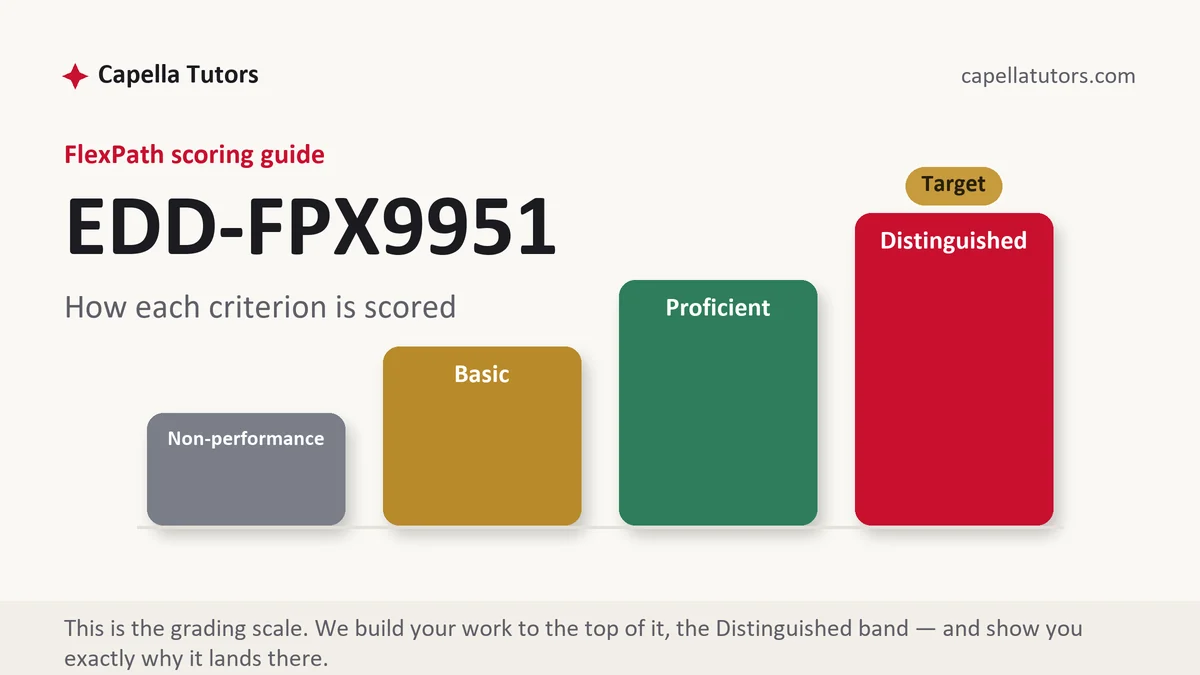
What EDD FPX 9951 actually grades
Capella gives this course a number and a title in its catalog and no chapter list, so nothing on this page assigns it a milestone name. Treat the stages described here as work the six-course project group has to absorb somewhere, and let your project handbook decide where. At this depth the graded object is narrower than most learners expect. Not a study. A problem. The assessments in this course usually ask you to name a condition inside a real organization, show with that organization's own figures that the condition exists at the size you claim, and state what you intend to find out about it, with your scoring guide deciding how many criteria that gets divided across.
The distinction that settles your score is the one between a topic and a problem of practice. Student engagement is a topic, and so are teacher retention and instructional coaching. A problem of practice has a location, a magnitude and an owner. Take a K-8 district of 4,300 students across eleven schools reporting chronic absenteeism at 23.4 percent, which is a figure the board has already seen. Two of those eleven buildings sit at 31.8 percent while attendance support is staffed at one position per school regardless of rate. That sentence carries a site, a measured gap, a decision behind it and somebody with the authority to change it, and every course after this one leans on it. EDD FPX 8030, Investigating Problems of Practice, is where the habit gets taught; this is where it has to produce one you can live beside for five more courses.
The other half is alignment, graded harder here than anywhere later because nothing downstream repairs it cheaply. Problem statement, purpose and questions have to describe the same object at three levels of resolution. If the problem is unequal allocation of attendance support, the purpose cannot be to explore teacher perceptions of engagement, and no question may ask about something the district does not record. Access is graded too, usually quietly. Permission is a written thing rather than a friendly conversation, and a project designed around data a district will not release is a project that restarts in the fourth course with the clock already running.
How we help in this course
Our 9951 drafts start from your site's published numbers rather than from a literature. Send the state report card, the school improvement plan, the enrollment and staffing counts, or whatever your district puts on its own website, and the problem statement gets built on figures a reader can verify, with the gap expressed as the difference between two numbers instead of as a concern. The purpose sentence and the questions are written as a set, so that each question can be answered with data your site either already holds or can reasonably be asked for.
The pipeline is the same eight people used on every deliverable here: a research pull, a subject draft, a scoring-guide review taken criterion by criterion, an independent APA and originality pass, and an editor before anything reaches you. One original premium sample per deliverable inside 24 to 48 hours, rewrites at no cost until your guide is met, and faculty comments folded back into the same cycle free. What this course adds is a feasibility read. Before you commit five more courses to a question, somebody checks whether a site of your size can answer it at all.
The assessments, one by one
Assessment 1
Assessment 1 of EDD FPX 9951, EdD Doctoral Project 1, is where a concern you carried into the doctorate becomes a problem of practice: one condition, inside one named organization, sized with that organization's own published figures. Read the full Assessment 1 manual.
Assessment 2
Assessment 2 of EDD FPX 9951, EdD Doctoral Project 1, is the alignment deliverable: a purpose sentence and a small set of questions describing the same object as your problem at three levels of resolution. Read the full Assessment 2 manual.
Assessment 3
Assessment 3 of EDD FPX 9951, EdD Doctoral Project 1, is the account of where the work will happen and who you are inside it: the organization in figures, your role and the access it grants, the risks that role creates, and the permission you hold in writing. Read the full Assessment 3 manual.
How to actually write EDD FPX 9951: where to begin
Print the scoring guide and read its verbs before its nouns. Identify, justify, situate and align are four separate demands, and a paragraph that describes where the criterion said justify lands Basic however clean the prose is. Turn each Distinguished descriptor into a heading, then decide what evidence sits beneath it: a table of site figures, a named source beside each figure, a one-sentence purpose, a numbered list of questions. Writing that happens before that skeleton exists tends to be writing about your interest in the topic.
Then do the arithmetic that tells you whether the problem is worth six courses. Continue the eleven-school example. If the two high-absence buildings enroll 690 students between them and 31.8 percent are chronically absent, that is 219 students against 787 across the district. Bringing those two schools down to the district rate would remove 58 students from the chronic count, roughly seven percent of the district total, which is a real result and also a modest one, and knowing that now is what lets you scope honestly. Write the problem as district-wide instead and your intervention has to reach 4,300 students on a doctoral timeline, which no single practitioner delivers. Scope gets decided by numbers, not by modesty.
Write positionality in this course rather than three courses later. You are almost certainly studying an organization that employs you, which is the ordinary condition of an EdD and also a specific set of problems: colleagues who cannot comfortably decline you, records you may read in your job but not analyze in your study, and a conclusion your supervisor has a stake in. Name your role, name what it grants you, and put a safeguard beside each risk. Faculty read that as control over the design. Its absence reads as a learner who has not yet noticed the position they are standing in.
Name the audience now as well. A practitioner doctorate ends by being used rather than by being filed, so decide in the first course who receives the finding: a principal, a cabinet, a board committee, a program faculty. Writing toward a named reader keeps the questions practical and keeps the framework from drifting into abstraction. It also turns the dissemination expectation waiting at the end of the sequence into a matter of formatting rather than invention, which is worth several weeks by the time you get there.
| Section | What goes in it | What Distinguished looks like |
|---|---|---|
| Problem of practice | The condition, its location, its magnitude in the site's own figures, and who owns the decision behind it. | A gap stated as the difference between two verifiable numbers, with the decision it implicates named. |
| Purpose | One sentence saying what the project will find out or change, at the scale the site can support. | A purpose that would break if it were moved onto a different problem. |
| Questions | Two to four questions, each answerable with a data source you can name today. | Questions whose answers would change what somebody does, with the source listed beside each one. |
| Site and context | The organization in figures: enrollment, staffing, performance, demographics, and prior attempts at this problem. | Context that explains why the problem persists here rather than describing the district generically. |
| Positionality and access | Your role, the access it grants, the risks it creates, and the permission you hold in writing. | Every risk paired with a named safeguard, and the approval pathways described as the separate queues they are. |
| Sources and format | Education research and public data behind every claim, current APA in both directions. | Every figure traceable to a document a reader could open, with a retrieval path for anything live. |
Developing the synthesis
The literature you cite in the opening course does one job: it establishes that your problem is a known kind of problem and that nobody has settled it at your kind of site. That is not a full review, and inflating it to look like one is the standard overreach here. Group the handful of sources you use by mechanism rather than by author. Put the studies that explain the condition in one cluster, the studies that tried to move it in a second, the studies reporting why attempts failed in a third, then write one sentence saying what the three clusters together license you to expect. Read design and sample before you read any conclusion, because a result from a single suburban high school of 1,900 students is not evidence about eleven elementary buildings, and saying so out loud is what separates the columns. Close by naming the gap twice, once in the literature and once in your site's practice, since they are rarely the same gap and the project has to sit where they overlap.
Citations that survive faculty review
Four kinds of source carry an education project and each does one job, so mixing up the jobs costs credibility fast. Peer-reviewed education research, pulled through the Capella library from ERIC and Education Source, supports every claim that a condition or a program behaves a certain way. Government figures, whether from the National Center for Education Statistics, your state report card or your district's own published dashboard, fix the magnitude of the problem and give a reader something they can open themselves. The What Works Clearinghouse tells you which intervention claims have survived a standards review, which is useful precisely because it also tells you which have not. Standards documents, the Professional Standards for Educational Leaders among them, supply the vocabulary practitioners will eventually judge your recommendations in. Attribute frameworks to whoever built them: cite Bronfenbrenner rather than the textbook chapter summarizing him, and cite an improvement tradition to the authors who published it. Then check citations against entries and entries against citations in current APA, and put a year beside every borrowed figure.
The mistakes that land Basic instead of Distinguished
- A topic standing in for a problem. Teacher morale is a subject; a 41 percent three-year turnover rate in four buildings is a problem.
- Magnitude asserted without a source. Significant absenteeism means nothing until a rate, a denominator and a school year appear beside it.
- Questions the site cannot answer. If nobody records it, no design in the next five courses will recover it for you.
- Positionality postponed. Studying the organization that employs you without saying so reads as an oversight rather than a choice.
- A purpose sentence that fits any project. If the sentence survives having the topic swapped out of it, it is not yet a purpose.
EDD FPX 9951 questions students actually ask
Can my doctoral project sit in the district that employs me?
Yes, and that is the ordinary case for an EdD, provided you handle what your position does to the work. Write down your role, your reporting line and your influence over anyone you plan to recruit. Where you evaluate potential participants, recruitment usually has to run through somebody who does not, consent has to say plainly that declining costs nothing, and identifying details need stripping harder than usual because a district of eleven schools is a small place. Records you may see as an employee are not automatically records you may analyze as a researcher, and that distinction is worth asking about in writing before a design rests on it. State the arrangement in this course and keep it visible, because a design quietly leaning on your authority is the kind of thing a reviewer catches late.
What is the difference between a problem of practice and a research problem?
A research problem is a hole in what is known. A problem of practice is a condition somebody is living with and would like changed, and this degree grades the second while requiring you to connect it to the first. The working test is whether a named person at your site would recognize your sentence as describing their week. If a principal reads the problem statement and says that is exactly what October looks like, you have one. If they read it and ask what you mean, you have a topic. The connection to the literature arrives next, when you show that the condition is a known kind and that the answers already published do not fit a setting like yours.
How much site data do I need before I write the problem statement?
Less than you think, and it has to be public or permitted. Two or three verifiable figures usually carry it: the rate you are worried about, the comparison that turns it into a gap, and the size of the population affected. Report cards, board minutes, improvement plans and enrollment counts are already public in most states and are enough to establish magnitude. What you should not do is build the statement on internal numbers you have not been cleared to use, because the remedy later is a rewritten opening section rather than a swapped citation. Where a figure is your own estimate, label it as an estimate and show the two numbers you divided.
What this course hands forward is worth stating exactly, because five more courses get built on the same three sentences. EDD FPX 9951 delivers a problem of practice with its magnitude sourced, a purpose, a set of answerable questions, a described site and a written access position. EDD FPX 9952, EdD Doctoral Project 2, takes those and builds the argument that the problem is a known kind and that a nameable framework explains how it operates. Nothing later in the sequence renegotiates the problem cheaply: by the third course a change of problem invalidates a synthesis, by the fourth it invalidates an approval, and by the fifth it invalidates data you have already collected. FlexPath pays for this in flat 12-week billing sessions with up to two courses open at once, which sounds generous until a project course sits idle waiting on a permission you could have requested in week one. Submit on grade, allow the two business days faculty have to evaluate an attempt, and spend the wait drafting the next section.
Problem statement due?
Send the guide, your state report card, and anything your district publishes. We will build a problem of practice with verifiable numbers behind it. First premium sample free.