Hand us the prompt and the criteria for whatever this course is asking you to produce and a premium original sample returns inside 24 to 48 hours, built against the Distinguished descriptors and checked by a second reader before delivery. The course is listed as BHA FPX 2003, Current Trends and Future Directions in Healthcare Management, carrying 1.5 program points as a lower-division core requirement of the BS in Health Care Administration, offered in FlexPath, one of the courses inside a 90-point degree that also sets a floor of 27 points at the 3000 level or above. In Capella's catalog the course code is written BHA-FPX2003.
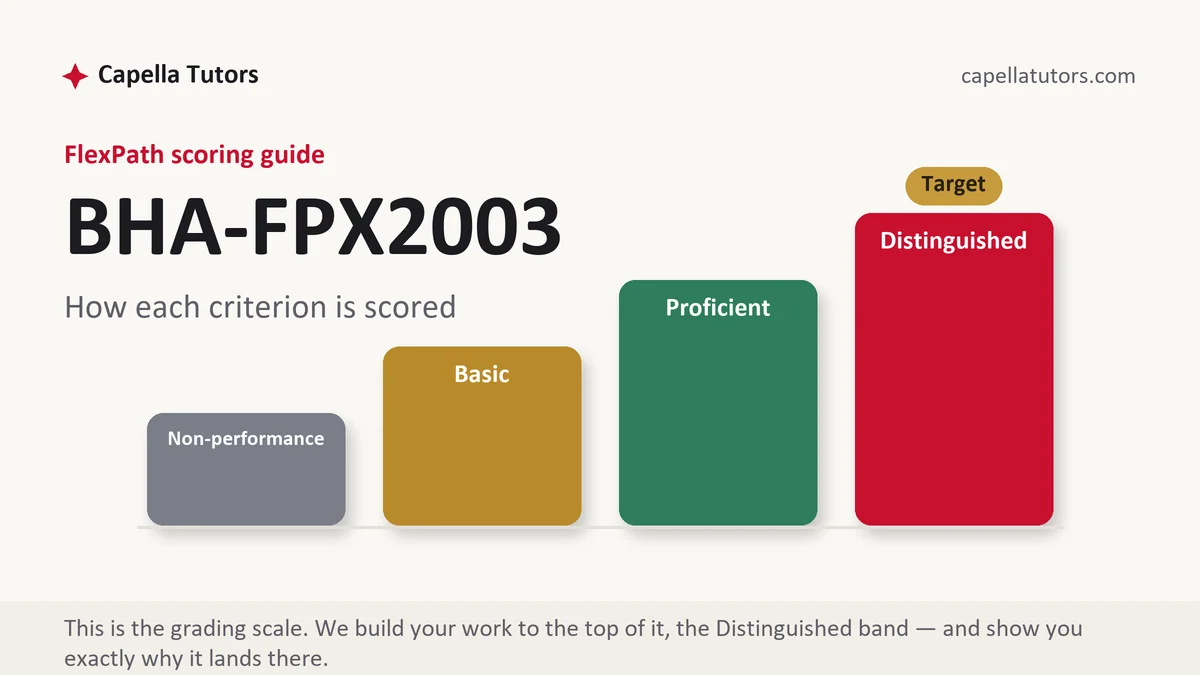
What BHA FPX 2003 actually grades
A trends course rewards discipline rather than enthusiasm, and that is the first thing to understand about the grading. The assessments in this course usually ask you to take a development affecting health care organizations and say what a manager should do about it, so the criteria are reading for whether the trend is described with evidence instead of assertion, whether you separate a driver from a symptom, and whether the recommendation belongs to somebody who could actually carry it out. A paper that reports what everyone already knows about telehealth or staffing shortages sits in the Basic column no matter how current the examples are.
Precision about the trend itself is the first divider. Remote visits are not a single phenomenon, and the useful question is not whether they grew but which service lines they held in once in-person capacity returned, what the payment rules now allow, and which patients gained access as a result. Workforce pressure is not a mood, it is a vacancy rate, a time to fill, a turnover percentage, and a replacement cost per departing employee, and those four numbers turn a complaint into a management problem. The same conversion applies to the shift of procedures into ambulatory surgery centers, to consolidation among systems and the employment of physicians, to price transparency requirements, to the spread of payment arrangements that put providers at risk for total cost, and to the arrival of machine learning in documentation and imaging. Name the trend, then quantify it and say who is affected.
The management half is what the course is actually named for. Every trend in your paper needs a decision attached: which department owns the response, which budget line moves, what the first step costs, who has to agree, and how anyone would know in six months whether it worked. Environmental scanning tools belong here as tools rather than decoration, so a strengths and weaknesses grid that lists twelve items and concludes nothing scores worse than three items with a decision hanging off them. If your assessment asks for a future direction, give it a horizon, a stated assumption, and the signal you would watch to find out whether the assumption is holding.
How we help in this course
Our 2003 samples treat every trend claim as a number that has to be found rather than a sentence that can be written. Figures arrive with a year and a publishing body attached, the difference between a national pattern and a local one is stated rather than assumed, and each recommendation names an owner, a cost order of magnitude, and a measure. Tell us your organization type, whether you are writing about a hospital, a clinic group, a long-term care provider, or a payer, and the sample will scan that setting instead of describing health care in general.
Delivery follows the pattern that every course on this site runs on. Each deliverable lands inside 24 to 48 hours, targeted at the top column and moved through eight hands on the way to you: sources and the scoring guide pulled first by a research analyst, a subject writer drafting, a scoring-guide reviewer grading the draft criterion by criterion as a Capella evaluator would, an APA and originality reviewer checking citation symmetry, and an editor closing it out. Revisions cost nothing until the work satisfies the guide, and anything faculty send back re-enters the same cycle free.
The assessments, one by one
Assessment 1
Assessment 1 of BHA FPX 2003, Current Trends and Future Directions in Healthcare Management, is the measurement stage of the course. Read the full Assessment 1 manual.
Assessment 2
Assessment 2 of BHA FPX 2003, Current Trends and Future Directions in Healthcare Management, is where a trend has to turn into a decision. Read the full Assessment 2 manual.
Assessment 3
Assessment 3 of BHA FPX 2003, Current Trends and Future Directions in Healthcare Management, is the forecasting stage. Read the full Assessment 3 manual.
How to actually write BHA FPX 2003: where to begin
Start from the scoring guide and build the document out of its criteria, one heading each, with the top-level wording sitting under the heading while you draft. Trends writing drifts more than any other kind, because there is always another interesting development to mention, and the heading structure is what keeps a second example from eating the analysis your criterion actually wants.
The move that separates the columns is the split between a headline and a driver. Take staffing as the worked case. The headline is that a hospital cannot fill night shifts. The drivers underneath it are separable and each one implies a different response: an aging workforce reaching retirement, a local pipeline that graduates a fixed number of clinicians a year, a wage position that has fallen behind two competitors within driving distance, a scheduling practice that makes the job worse than it needs to be, and a labor market outside health care that now pays comparably for less demanding work. A Basic paper recommends better recruiting for all five. A paper in the top column says which driver dominates in this organization, gives the reason it thinks so, and directs the money there, then adds the sentence a manager needs, which is what it would cost to be wrong.
Give any forward-looking claim a horizon and an assumption. Saying that a technology will change practice is unfalsifiable and reads as filler. Saying that a specific adoption is likely inside three years if reimbursement continues on its current footing, and stalls if it does not, is a forecast, and the criterion rewarding future direction is looking for exactly that shape. Where the evidence does not support a prediction, say what you would need to see before making one, since a stated information gap is judgment and an invented certainty is a lost criterion.
| Section | What goes in it | What Distinguished looks like |
|---|---|---|
| The trend, stated | One sentence naming the development, the setting it affects, and the period it covers. | A claim narrow enough to be wrong, rather than a topic heading. |
| Evidence | Two or three quantities with years and publishers, plus the population each number describes. | Figures compared like with like, and any pandemic-period spike identified as one. |
| Drivers | The forces producing the trend, separated from the effects the trend produces. | The dominant driver named and defended, with the others acknowledged and set aside. |
| Who it hits | Implications for patients, staff, the finance office, and the governing body, kept distinct. | Consequences that differ by stakeholder rather than one effect restated four ways. |
| The recommendation | The action, its owner, a first step, a rough cost, and the decision it commits the organization to. | An action a named role could start on Monday, with the risk of doing nothing stated. |
| Measurement and sources | The indicator that would show progress, its review cadence, and references in current APA. | A measure the organization already collects, on a cycle somebody already runs. |
Developing the analysis
The published work on health care trends contradicts itself often enough that pretending otherwise is a tell. Consolidation is the standard example: proponents argue that scale funds capital, information systems, and service line depth that a stand-alone facility cannot afford, while a substantial body of health economics research finds higher negotiated prices after mergers without matching gains in quality. Payment arrangements that put providers at risk show the same pattern, with modest average savings that depend heavily on how the comparison benchmark is constructed and that vary widely between participating organizations. Take one of these arguments and settle it for your setting rather than in general. Say which finding applies to an organization of your size in your market, name the condition under which the other side would be right, and commit. Weighing the evidence and then taking a position anyway is what the top descriptor is describing, and it is rare in submitted work because it feels riskier than balance.
Citations that survive faculty review
Four source types earn their place here, and one does not. Federal data and program documents give you the denominators and the rules, principally the Centers for Medicare and Medicaid Services for payment policy, the Health Resources and Services Administration for workforce supply, and the Bureau of Labor Statistics for employment and wage projections. Peer-reviewed health services and health policy research, pulled through the Capella library, tells you whether an effect has been measured rather than announced. Established survey and analysis organizations, including the American Hospital Association annual survey and the major health policy foundations, provide sector-level figures that faculty accept when the year is stated. Professional association material carries practice norms. What does not count as evidence is a vendor white paper offered as proof that the vendor's product works, and citing one in a trends assessment is a reliable way to lose a criterion. Give every statistic its year, since a figure from a peak period describes that period only, and check the reference list against the text in both directions.
The mistakes that land Basic instead of Distinguished
- A prediction with no horizon. Eventually is not a forecast, and a criterion asking for future direction cannot be met by an adverb.
- Percentages with no denominator. Growth of forty percent means nothing until the reader knows forty percent of what, measured over which months.
- A recommendation nobody owns. If the sentence begins with the organization should, name the role that will do it.
- Treating an unusual period as the new normal. A spike driven by an emergency waiver is a spike until the rule that produced it is made permanent.
- Scanning frameworks used as decoration. A four-box grid earns nothing unless a decision comes out of it.
BHA FPX 2003 questions students actually ask
How recent does a source have to be in a trends assessment?
Recent enough that the situation it describes still exists, which is a different test from a fixed number of years. Utilization and workforce figures go stale quickly, so the most current release from the agency that publishes them is what you want, and citing a three-year-old survey when a newer one exists is a visible weakness. Payment rules change annually, so use the current year. Conceptual and methodological sources are different, and a framework paper from fifteen years ago is perfectly citable when you are naming the framework rather than reporting a condition. The rule that actually matters is that the year appears in your sentence, because a reader who can see the vintage can judge the claim, and one who cannot will assume the worst.
How do I write about artificial intelligence in health care without guessing?
Write about the deployment rather than the technology. Ambient documentation tools, imaging triage, and coding assistance are in use in identifiable organizations, and there is published evaluation of some of them, so an assessment can rest on what has been measured rather than on what vendors expect. Then write the governance paragraph that most students skip: who validated the tool on a population resembling yours, who monitors it after go-live, what happens when it is wrong, how the organization documents that a human made the decision, and which existing committee owns it. A trends paper that treats a new tool as an operational change with owners and controls reads as management writing. One that predicts transformation reads as a press release.
The trend I chose is national and my organization is small. How do I connect them?
Bring the national figure down to a unit you can defend, then reason from the unit. If national data show a category of procedure shifting into ambulatory settings, ask how many of those cases your organization performs in a year, what share could plausibly move, what each one contributes, and what the transfer would do to operating room utilization and to the staff assigned there. The connection is arithmetic rather than analogy. Where you cannot obtain an internal figure, state a range and say how you derived it, because a labeled estimate is acceptable in this course and an unlabeled one is not, and a scenario resting on two or three declared assumptions is exactly the shape a manager is used to reading.
Trends paper on the clock?
Send us the prompt and the setting you are writing about. We will find the figures, name the drivers, and attach a decision to each one. First premium sample free.