Put the prompt and the scoring guide in front of us and an original sample at premium standard reaches you within 24 to 48 hours, its cost model built line by line so a reader can check the arithmetic, with free revisions until the criteria are covered. The catalog lists this course as HIM FPX 2670, Strategic Management of Health Information Systems, worth 3 program points, taken in FlexPath as part of the Health Information Management specialization, and it belongs to the Capella BS in Health Care Administration, a degree built on 90 or more program points with 27 of them required at the 3000 level or higher. In Capella's catalog the course code is written HIM-FPX2670.
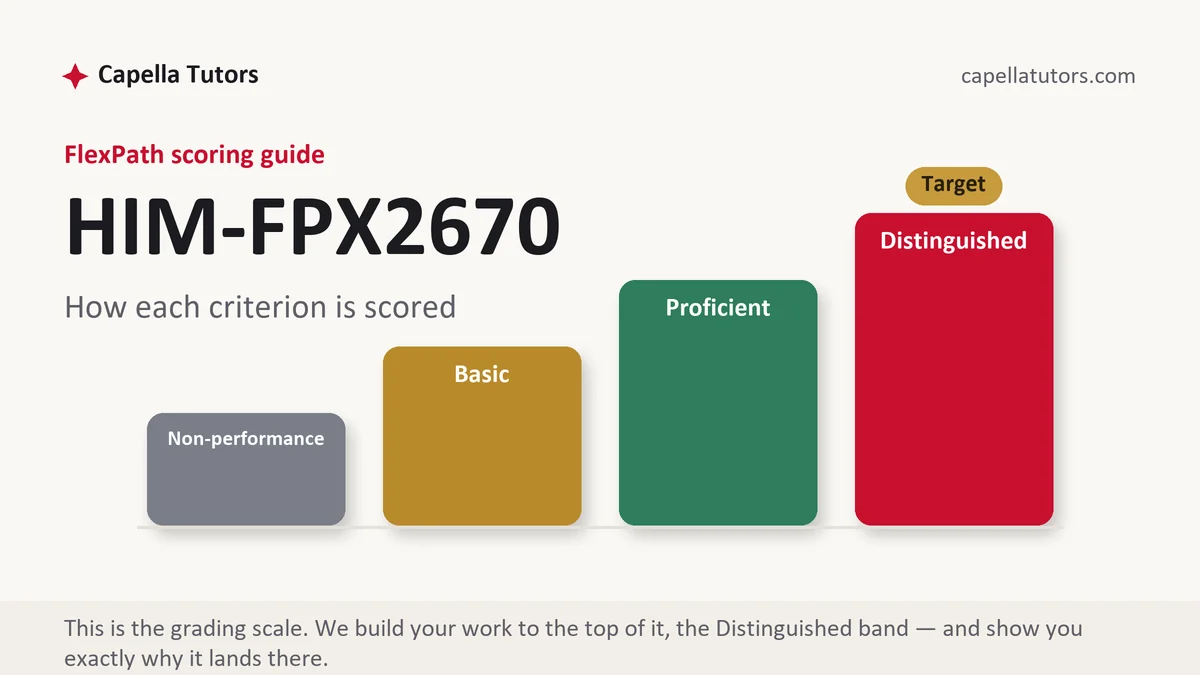
What HIM FPX 2670 actually grades
The word strategic in the title is doing real work, because this course is not about operating a system, it is about the decisions wrapped around one. Choosing it, paying for it over years, putting it in without breaking the clinic, connecting it to everything else, and eventually turning it off. The criteria are checking whether an undergraduate can treat software as a multi-year commitment with staffing and workflow consequences rather than as a product that gets picked after a good demonstration.
The first thing graded is whether you can write requirements before looking at options. That means describing the current state in enough operational detail to be recognizable, stating the problem as something observable rather than as a complaint, and then turning each need into a statement somebody could test during a demonstration. Must-have and nice-to-have have to be separated in advance, because everything looks essential once a salesperson is in the room. The reliable technique is a scripted demonstration: you write three or four scenarios from your own organization, a walk-in patient with no record, a records request from an attorney, a referral arriving from outside, and you make each vendor perform them rather than showing you the tour they prepared.
The second strand is money over the life of the thing, and it is where most undergraduate drafts stop far too early. A quoted price per user per month is one line of a cost model that also includes implementation services, every interface priced separately, data conversion, hosting or hardware, training hours and the backfill to cover the people sitting in training, annual support and maintenance, and the productivity dip that follows a go-live and always costs something even when nobody books it anywhere. Criteria that mention total cost of ownership are asking for that whole set, arranged over at least five years, with the assumptions declared.
The third strand is implementation, where the grading rewards realism. Big bang, phased rollout and pilot are three different risk profiles, not three names for the same plan, and each carries a consequence you should state: a single cutover concentrates the pain and gets it over with, a phased approach lengthens the period during which two systems have to be reconciled, a pilot buys evidence at the cost of momentum. Alongside that sit the parts nobody enjoys writing. How much history converts into the new system, what stays behind in a read-only archive and for how long, what the department does during downtime when the paper process is the only process, and whether training completion is a gate that anybody is willing to enforce.
The fourth strand is connection. An interface engine, message standards such as HL7 version two for transactions and consolidated clinical documents for summaries, application programming interfaces built on the FHIR standard for newer exchange, and the master patient index that decides whether two records belong to one person all appear in these assessments. A duplicate record rate is the most useful number an undergraduate can bring to this discussion, because it converts an abstract identity problem into a percentage somebody has to own. Governance holds the rest together: a steering committee with a charter, an executive sponsor whose name appears on the decision, and a prioritization method, since an initiative with no owner is an initiative that quietly stops.
Last comes measurement. Criteria that mention benefits realization want a number defined before the system goes live, a baseline captured while the old process is still running, and a date on which somebody checks. Chart completion time, release of information turnaround, help-desk ticket volume by category and duplicate creation rate are all measurable without special tooling, and a paper that claims efficiency without one of them has claimed nothing.
How we help in this course
A 2670 draft from us arrives with its numbers exposed. The cost model is laid out year by year with each assumption stated next to the figure it produced, evaluation matrices publish their weights before their scores, and any claim that a system improves something is written with the measure and the baseline attached. Tell us the organization type and size you have been given, the current systems if the prompt names any, and which criterion is the one you cannot get traction on, and we will build the analysis around that rather than around a generic clinic.
The commercial side does not change between courses. Every deliverable is written once, originally, to premium standard and returned in a 24 to 48 hour turnaround, eight people handle it from the opening research to the file that lands in your inbox, one of them scoring the draft against your guide before it reaches you, and rewriting continues at no charge until the criteria are satisfied. Faculty comments are handled inside the same arrangement free. An evaluator has two business days to return a graded attempt, so the agreed delivery date is set from the date you want that clock to start.
The assessments, one by one
Assessment 1
Assessment 1 of HIM FPX 2670, Strategic Management of Health Information Systems, is the one that has to be written before anybody looks at a product. Read the full Assessment 1 manual.
Assessment 2
Assessment 2 of HIM FPX 2670, Strategic Management of Health Information Systems, is where a decision has to be defended with arithmetic. Read the full Assessment 2 manual.
Assessment 3
Assessment 3 of HIM FPX 2670, Strategic Management of Health Information Systems, is the one that has to survive contact with a working department. Read the full Assessment 3 manual.
How to actually write HIM FPX 2670: where to begin
Pull the criteria out of the scoring guide and make each one a heading in your outline before anything else, because a systems paper drifts toward description faster than almost any other assessment type, and description earns the middle column. The criteria here usually gather around six things: the current state and the problem, the requirements, the options and how they were evaluated, the cost across the life of the decision, the implementation and its risks, and the measurement plan. The assessments in this course usually ask you to evaluate or plan a system for a described organization, and your scoring guide decides whether that comes out as a recommendation memo, a comparison matrix, a project plan or a presentation with speaker notes.
Then build the evaluation so it can be audited. A weighted matrix is the standard instrument and it is trivially easy to fake, so do it in the honest order: list the criteria, assign the weights and write one sentence justifying each weight, and only then score the options. If clinical documentation efficiency carries a weight of twenty five and vendor viability carries ten, a reader can disagree with you productively. If the weights appear after the scores, the matrix is a decision dressed as an analysis, and an experienced evaluator can spot that from the pattern of the numbers.
Then price the decision properly, because this is the single move that separates the top column from the rest. Take an ambulatory practice with 38 licensed users. Subscription licensing at $520 per user per year is $19,760 annually. Implementation services are quoted at $46,000, two interfaces to the reference laboratory and the billing clearinghouse cost $7,500 each for $15,000, conversion of three years of demographics and problem lists is $12,000, and training 38 people for six hours each is 228 hours backfilled at $34 an hour, which is $7,752. Year one therefore lands at $100,512. Years two through five carry the license plus annual support at eighteen percent of the first-year license, $3,557, so $23,317 a year, or $93,268 across four years. The five-year total is $193,780. The lesson is in the shape of that number rather than its size: the per-user price that dominated the sales conversation accounts for barely half the commitment, and the lines that decide the answer are implementation, interfaces and the hours your own staff will lose.
Then write the implementation section as a sequence with dependencies rather than as a wish. Say what has to be finished before the next thing starts, name who owns each stage, and give the downtime procedure a paragraph of its own, because a records department without a downtime plan is one power event away from having no process at all. Finish with measurement. Name two or three indicators, state the baseline value and how you obtained it, set the date of the first review, and say what result would count as the project having failed. A recommendation that cannot fail is a recommendation nobody has to keep.
| Section | What goes in it | What Distinguished looks like |
|---|---|---|
| Current state and problem | The organization, its size, its existing systems, and the problem stated as something observable. | A problem with a measure attached, described from the workflow rather than from the software. |
| Requirements | Functional, technical, security and reporting needs, split into must-have and desirable. | Requirements written so a demonstration could pass or fail them, each traced to the problem. |
| Options and evaluation | The alternatives considered, including doing nothing, and the weighted criteria used to compare them. | Weights published and justified before scores, with the runner-up taken seriously. |
| Cost of ownership | License, implementation, interfaces, conversion, training and backfill, support, across at least five years. | A model that adds up, with every assumption visible and the largest cost driver named. |
| Implementation and risk | Approach, sequence, owners, data conversion decisions, downtime procedure, and the top risks with responses. | Risks with likelihood, consequence and a named mitigation, including what triggers a rollback. |
| Measurement and references | Indicators, baselines, review dates, and current APA in text and in the list. | Baselines captured before go-live and a stated threshold that would count as failure. |
Developing the analysis
The evidence problem in health information technology is that the most available material is the least independent, and the criteria reward a writer who notices. Vendor documentation tells you what a product is designed to do and is written to sell it. Practitioner rating services report what customers say, which is real information about satisfaction and not evidence that a system improves care. Peer-reviewed evaluations are the only sources that can support a causal claim, and even those need reading with the design in view, because a great many published implementations are single-site before-and-after reports with no comparison group, so an improvement that appears after go-live may be a trend that was already running or a staffing change nobody controlled for. The literature also refuses to be uniformly cheerful, which is useful to you. Computerized order entry and decision support are associated with fewer of some errors while introducing new ones, alert fatigue is a documented consequence of firing too many warnings at the same clinician, and workarounds appear reliably wherever a system makes the correct path slower than the wrong one. Use that honestly: recommend the system and name the failure mode you expect, then attach the monitoring that would catch it. When you reach for a model, cite the person who built it, so diffusion of innovations belongs to Rogers, the unfreezing sequence to Lewin, and the information systems success model to DeLone and McLean in their original 1992 form or their 2003 revision, rather than to the textbook chapter that summarized any of them.
Citations that survive faculty review
Four families of source belong in a systems paper. Peer-reviewed informatics research, from journals such as the Journal of the American Medical Informatics Association, Applied Clinical Informatics and the International Journal of Medical Informatics and reached through the Capella library, carries every claim about whether something works, and each study should arrive in your text with its setting and design visible. Federal material sets the rules of the market: the national coordinator's certification program defines what certified health information technology has to do, and its published rules govern how information is shared between organizations. Standards organizations supply the technical vocabulary, so cite HL7 for the messaging and document standards and for the FHIR specification, and cite the profile itself rather than an article describing it, with the version and the release date, since a standard without a version is not a citation. Professional and industry bodies, principally HIMSS and AHIMA, give you implementation practice and workforce guidance. Vendor and consultancy publications are usable when they are labeled for what they are and quoted as claims rather than findings. Then run current APA both ways, checking that every source in the list appears in the text, and give web-published standards and government documents their retrieval details.
The mistakes that land Basic instead of Distinguished
- Costing the license and calling it the cost. Implementation, interfaces and lost staff hours usually outweigh subscription fees, and leaving them out understates the decision by half.
- Requirements copied from a feature list. Build the criteria from a vendor's brochure and that vendor wins the evaluation before it starts.
- A demonstration scored on impressions. Without scripted scenarios from your own organization, every product looks capable.
- No downtime procedure. A plan that assumes continuous availability has not been written by anybody who has worked through an outage.
- Benefits with no baseline. Claiming improved efficiency without a before figure gives the reader nothing to verify and the organization nothing to manage.
HIM FPX 2670 questions students actually ask
How do I compare systems when nobody will give me real prices?
Build the cost model anyway and label every figure as an estimate with its basis attached. Published rate cards, government procurement postings, association surveys and academic case reports give defensible ranges for per user licensing, implementation services and interface work, and where nothing public exists you can state a planning assumption in the open, for example that annual support runs at a fifth of the license and that each staff member loses six hours to training. What earns the criterion is not accuracy you cannot have, it is a model whose arithmetic works and whose assumptions are visible, so a reader can change one number and watch the total move. Then test the comparison by asking which assumption would have to be wrong to change your recommendation, and say what that assumption is.
Do I have to name real vendors in the paper?
Your scoring guide decides, and both approaches can reach the top column if the evidence discipline is right. Named products let you cite real capability documentation and real certification listings, which is a genuine advantage, but everything a vendor publishes about itself is marketing and has to be framed that way in the sentence that uses it, with the claim attributed rather than adopted. Anonymized options, labeled as Vendor A and Vendor B with stated capability profiles, are perfectly acceptable and often produce a cleaner analysis, because the reader watches your criteria rather than their own opinion of a brand. Whichever route you take, the weighted criteria have to be published before the scores, otherwise the matrix is a justification written after the decision.
What is the difference between an interface and interoperability?
An interface is a specific pipe between two named systems, built once, paid for once and maintained forever, and it moves an agreed message from one place to another. Interoperability is the property of being able to exchange information with systems you have not met yet and have the receiver understand it the same way you meant it. The distinction matters commercially, because ten interfaces is ten line items on a quote and ten things that break during an upgrade, while conformance to a shared standard reduces the number of one-off pipes you have to fund. It matters clinically too, since data that arrives as a document a human must read has moved but has not become usable, whereas data that arrives as structured, coded elements can populate a problem list or fire a decision support rule. Say which of the two your recommendation is actually buying.
System evaluation due and the numbers will not behave?
Send the prompt, the organization profile and the guide. The cost model, the weighted matrix and the rollout plan come back as one worked document. First premium sample free.