Send whatever this course has asked you to write, together with its criteria, and a premium original sample comes back in 24 to 48 hours, pitched at the Distinguished descriptors and reviewed by a second person before you see it. The course is recorded as BHA FPX 3001, Essentials of the Healthcare System, worth 3 program points, an upper-division core requirement in the BS in Health Care Administration taught in FlexPath, and one of the courses that counts toward the minimum of 27 points at the 3000 level or above inside the 90-point degree. In Capella's catalog the course code is written BHA-FPX3001.
What BHA FPX 3001 actually grades
Four questions run underneath everything this course asks: who pays, who delivers the care, who is covered, and who is left out. The assessments in this course usually require you to describe some part of that arrangement and explain how it functions, and the criteria separate a student who has memorized a diagram from one who understands how money and patients move through it. Reciting that there are public payers and private payers is a Basic answer. Explaining that a single hospital admission may be paid under a federal program with a fixed amount per stay, that the same hospital's clinic visit next week is paid by a commercial plan at a negotiated rate, and that the patient owes a different amount in each case, is the upper-division version of the same content.
The payer map is where the specifics live. The federal program for older adults and some people with disabilities is built in parts, with hospital coverage, outpatient and physician coverage, a private plan alternative that receives a capitated payment, and a drug benefit delivered through plans rather than by the program directly. The low-income program is a partnership in which the federal government matches state spending at a rate that varies by state, and states make consequential choices about eligibility and covered services, which is why any sentence describing it as a single national benefit is wrong. Commercial coverage arrives mostly through employers, with individual marketplace plans and subsidies alongside. Separate systems serve military families, veterans, and tribal communities. The uninsured are a category with a size, a composition, and consequences, and leaving them out of a system description is a lost criterion in almost every version of this assignment.
Delivery is the second half. Care happens in acute care hospitals, in small rural facilities operating under a designation that changes how they are paid, in ambulatory surgery centers, in federally qualified health centers, in physician practices increasingly owned by systems and payers, in skilled nursing and home health and hospice, in urgent care and retail settings, and in behavioral health organizations that sit partly outside the rest. The workforce staffing all of it is regulated state by state, so who may prescribe, order, and practice without supervision depends on where the building is. Public health belongs in your answer as a distinct system with its own funding, governance, and measures, since a health department answers to a different authority and is judged on population indicators rather than on admissions.
How we help in this course
Our 3001 samples are built around movement rather than categories. Where a prompt asks for a description of the system, the draft follows money from a payer to a provider and a patient from a symptom to a setting, because that structure makes the components explain themselves and it keeps the paper out of list form. Every rate or share we use carries a year and the population it describes. Tell us which part of the system your assessment targets, and whether your instructor wants a national view or a state one, and the sample is scoped accordingly.
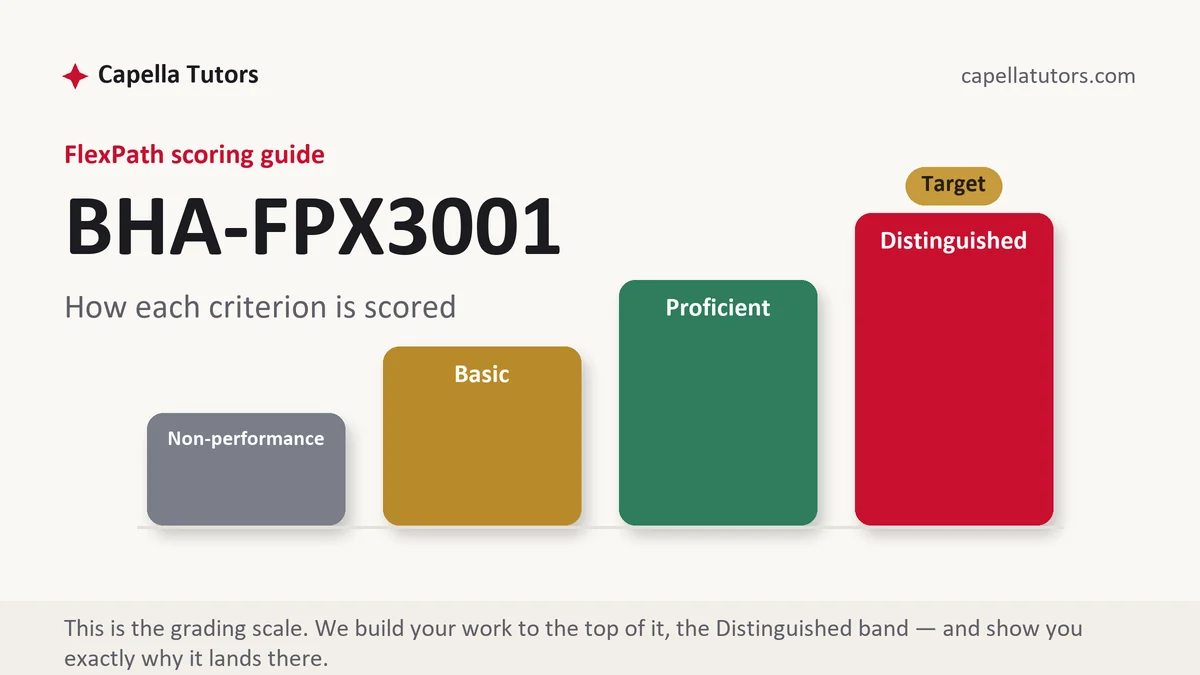
Terms are the same across every course this studio supports. Work returns inside 24 to 48 hours aimed at the top column, having gone through eight sets of hands: research and scoring guide first, then a subject writer, then a scoring-guide reviewer who grades the draft criterion by criterion in the manner of a Capella evaluator, then an APA and originality check on citation symmetry, then an editor. Revisions are unlimited and free until the work meets the guide, and faculty comments come back through the same process without a charge.
The assessments, one by one
Assessment 1
Assessment 1 of BHA FPX 3001, Essentials of the Healthcare System, is where four questions start running underneath everything: who pays, who delivers the care, who is covered, and who is left out. Read the full Assessment 1 manual.
Assessment 2
Assessment 2 of BHA FPX 3001, Essentials of the Healthcare System, turns from the payer map to the buildings. Read the full Assessment 2 manual.
Assessment 3
Assessment 3 of BHA FPX 3001, Essentials of the Healthcare System, brings in the part of the arrangement that answers to a different authority. Read the full Assessment 3 manual.
How to actually write BHA FPX 3001: where to begin
Build the document from the scoring guide, one heading per criterion, before you decide what to say. This course produces more list-shaped papers than any other requirement in the degree, and a heading structure is the cheapest defense against it, because a criterion asking you to analyze access will not accept an inventory of insurance types no matter how complete the inventory is.
Then use a single patient to carry the analysis, which is the technique that reliably moves this assignment up a column. Follow one person with poorly controlled diabetes through a year. The insurance is a plan with a high deductible, so the first thousand dollars of testing supplies and clinic visits are paid out of pocket, which means the visits get skipped in the first quarter of the plan year and resume once the deductible is met. The nearest endocrinologist takes new patients in eleven weeks, so the primary care clinic manages the condition longer than it should. A hypoglycemic episode produces an emergency visit and a two-day admission paid at a fixed amount for that diagnosis, which is many times the cost of the visits that were skipped. Every abstract point in the course is visible in that story: coverage is not access, cost sharing shapes utilization, network adequacy is a real constraint, payment method changes provider behavior, and prevention loses to acute care in a system that pays for the second more reliably than the first.
Keep three words apart and the criteria get easier. Coverage means someone has a plan. Access means care is obtainable in practice, which depends on cost sharing, network, appointment supply, distance, hours, transportation, and language. Utilization is what actually happened. A population can be fully covered and poorly served, and the sentence that says so is often the sentence that earns the analysis criterion.
| Section | What goes in it | What Distinguished looks like |
|---|---|---|
| The payer map | Public programs, commercial coverage, the separate federal systems, and the uninsured. | State variation acknowledged and the uninsured given a size and a composition. |
| Delivery settings | Where care is given, who owns the setting, and what each one is designed to handle. | Settings tied to the payment that sustains them rather than listed as facility types. |
| Coverage and access | The distinction between holding a plan and obtaining care, with the barriers named. | An access barrier traced through to a measurable consequence for a real population. |
| Workforce and scope | Who delivers care, how supply is distributed, and how state rules govern practice. | Scope treated as a state-by-state variable that changes what a setting can offer. |
| Public health | Prevention, surveillance, and the agencies that carry them, with their funding path. | Population work connected to the delivery system rather than described in parallel. |
| Figures and format | Every rate with its year, its source, and the population in its denominator, in current APA. | Numbers a reader could reproduce from the cited release without guessing the vintage. |
Developing the synthesis
The literature on system performance disagrees in ways an upper-division paper can handle. National health spending is a large share of the economy and grows faster than most other categories, but analysts differ on whether the driver is the price paid per service or the volume of services delivered, and that disagreement matters because the two diagnoses recommend opposite remedies. Comparisons with other wealthy countries are common in this course and are easy to mishandle, since coverage schemes, the boundary of what counts as health spending, and the way outcomes are measured are not identical across systems. There is also a live argument about how much of the difference in outcomes belongs to medical care at all, given the weight of income, housing, education, and environment. Handle this by naming the interpretation you are adopting and the strongest objection to it, then continuing. A paper that presents contested figures as settled facts reads as compiled, and a paper that names the dispute in two sentences reads as informed.
Citations that survive faculty review
Four families of source cover almost every claim this course requires. Federal statistical and program sources carry the structural numbers, with national expenditure estimates from the actuarial office at the Centers for Medicare and Medicaid Services, coverage estimates from the Census Bureau and federal household surveys, workforce supply and shortage designations from the Health Resources and Services Administration, and quality and utilization data from the Agency for Healthcare Research and Quality. Peer-reviewed health services journals, retrieved through the Capella library, supply measured effects and the arguments about them. Established policy analysis organizations produce state-level comparisons that are appropriate to cite when you name the year and the organization. Professional bodies supply definitions and practice norms. One journal habit lifts accuracy immediately in this course: read the sample description before the headline number, because a figure drawn from adults under 65 and a figure covering the whole population are different facts wearing the same percentage sign. Every statistic gets a year, and the reference list gets checked against the text in both directions.
The mistakes that land Basic instead of Distinguished
- Using coverage and access as synonyms. They come apart constantly in practice, and the criterion is usually written to see whether you know it.
- Describing the low-income program as uniform. Eligibility and benefits are state decisions, and a national description of them is inaccurate.
- Statistics without a year. A rate detached from its release date cannot be checked and will be treated as unsupported.
- Omitting people without coverage. A system description that stops at insured populations has left out the group the analysis criterion cares about most.
- Cross-country comparison with no caveat. Different boundaries and different measurement make raw comparisons misleading unless you say what was adjusted.
BHA FPX 3001 questions students actually ask
How do I keep this assessment from turning into a list?
Give the paper a spine that has to move. Follow money from a payer to a provider, or follow a patient from a symptom to a setting, and the components introduce themselves in the order they actually appear. A list has no internal logic to tell a reader why one item follows another, which is why list-shaped papers score well on knowledge criteria and poorly on everything else. If your prompt genuinely asks for a description of components, describe each one by the job it does and the pressure it is under rather than by what it is called, and end each part by naming what breaks when that component fails.
Which statistics are safe to use in a paper about the system?
Ones you can attribute to a named federal release with a year attached. Coverage figures come from federal household surveys and the census, spending totals come from the national expenditure accounts maintained by the actuarial office at the federal payment agency, workforce supply and shortage designations come from the health resources agency, and utilization and quality figures come from the federal healthcare research agency. Any of those is defensible when you name the release and the year. What is not safe is a percentage lifted from an advocacy page, a figure quoted in a news story without its origin, or a number passed through three secondary sources until it lost the population it described. When in doubt, find the release the secondary source used and cite that instead.
My assessment asks me to compare the United States with another country. How much detail is enough?
Two or three dimensions handled properly beats a survey of everything. Choose how the system is financed, how coverage is organized, and one access or outcome measure, compare those three, and say what the comparison does and does not establish. Note the boundary problem in a sentence, because countries count long-term care, social supports, and administrative activity differently, and a spending comparison that ignores this overstates the gap. Use a source that harmonizes the figures rather than setting two national releases side by side yourself. Then answer the question the criterion actually wants, which is what an administrator could reasonably borrow from the comparison and what would not transfer.
System analysis to write?
Send the prompt and tell us whether your instructor wants a national or a state view. Every figure arrives with its year. Your first premium sample is free.