Hand over the case, the prompt and the scoring guide, and one original premium sample comes back inside 24 to 48 hours with every rule in it traced to the regulation it came from, revised free until the criteria are satisfied. The registrar lists this one as HIM FPX 2660, Ethics and Compliance in Healthcare Data Management, carrying 3 program points, sitting inside the Health Information Management specialization of Capella's FlexPath BS in Health Care Administration, a degree that runs to 90 program points or more, of which 27 at minimum come from courses numbered 3000 and up. In Capella's catalog the course code is written HIM-FPX2660.
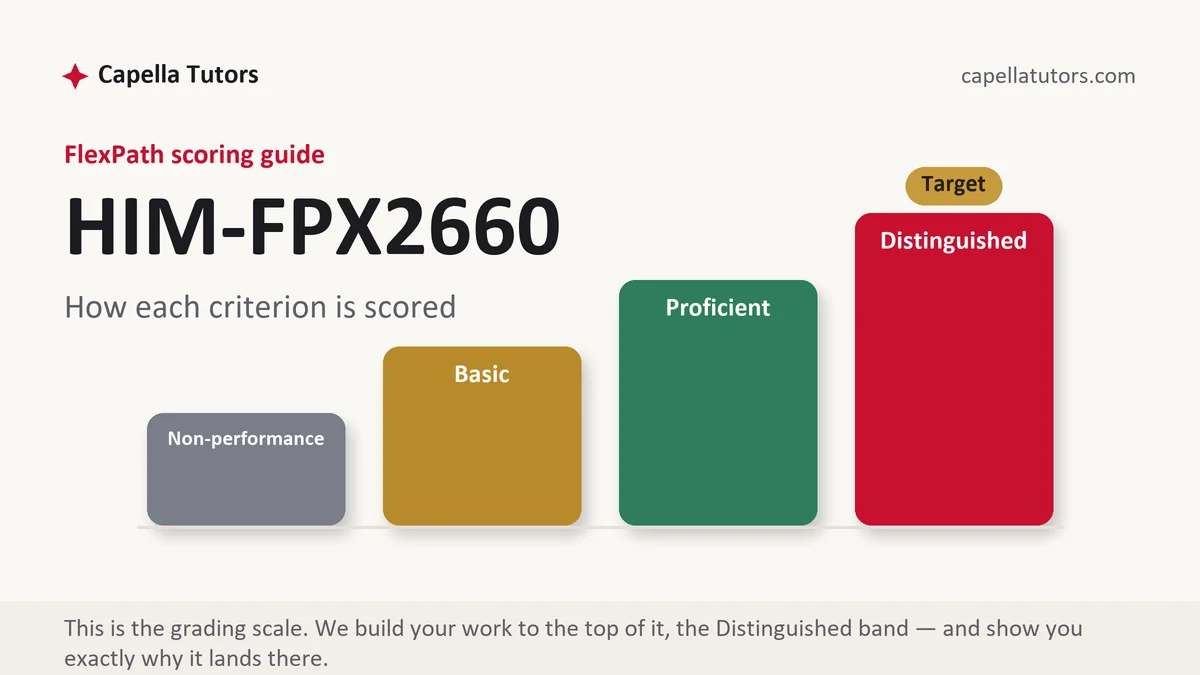
What HIM FPX 2660 actually grades
The course pulls apart two questions most learners arrive believing are one: whether an action is permitted, and whether it is defensible. Federal privacy law answers the first and is silent on the second, which is why an ethics criterion sits next to a compliance criterion in almost every guide in this course. A records clerk who opens a neighbor's chart out of concern has an entirely legitimate role and an entirely illegitimate purpose, and describing that case correctly means saying both things in the same paragraph rather than choosing one.
The regulatory half is built from three connected rules, and the criteria test whether you can tell them apart. The privacy rule governs what may be used and disclosed, permitting treatment, payment and health care operations without patient authorization and requiring authorization for most other purposes, with the minimum necessary standard limiting how much information moves in almost every situation except a few listed ones, treatment among them. The security rule sits underneath the electronic version of the same information and asks for administrative, physical and technical safeguards, anchored to a risk analysis that the organization is expected to keep current. The breach notification rule takes over when something goes wrong. A distinction students routinely miss inside the security rule is worth learning early, since implementation specifications marked addressable are not optional: an organization either implements the specification, or documents why it is not reasonable in its environment and puts an equivalent measure in its place.
The third strand is the breach analysis itself, and it is graded as a procedure rather than as an opinion. An impermissible use or disclosure of unsecured protected health information is presumed to be a breach unless the organization can show, through a documented assessment, that there is a low probability the information was compromised. The assessment weighs at least four things: what information was involved and how identifiable it is, who used or received it, whether it was actually acquired or viewed rather than merely exposed, and how far the risk was mitigated afterward. When notice is required, individuals are told without unreasonable delay and no later than 60 days after discovery, an incident touching 500 or more residents of a state adds prominent media notice and immediate reporting to the Secretary, and smaller incidents go on a log submitted within 60 days after the calendar year ends. Papers that skip the assessment and jump to notification lose the criterion even when the final answer is right.
The ethical half is graded on judgment rather than recall, and the AHIMA Code of Ethics is the reference point an evaluator expects to see used rather than merely named. Recurring situations include a workforce member browsing records of people they know, a supervisor requesting an audit trail for a purpose that has nothing to do with privacy, pressure to adjust documentation so a claim will pay, and a family member who assumes that being family grants access. Some of the material is stricter than the general privacy rule and you are expected to notice when it applies, particularly the separate federal protection for substance use disorder treatment records and the separate authorization that psychotherapy notes require.
Finally, the criteria look for the machinery an organization uses to keep itself honest. A compliance program is a named set of parts, familiar from federal guidance for health care organizations: written standards and procedures, a compliance officer with real oversight, training that reaches the people who touch the data, open lines of communication including a way to report anonymously, auditing and monitoring that actually samples records, published and consistently applied discipline, and prompt corrective action when something is found. Non-retaliation belongs in that list too, because a reporting channel nobody trusts produces no reports and an organization with no reports usually concludes it has no problems.
How we help in this course
Compliance drafts from this studio carry their authority on the surface. Every rule statement in a 2660 sample points to the part of the regulation or the guidance document it came from, every scenario conclusion follows a written analysis rather than an assertion, and the ethics section names the professional obligation it relies on instead of gesturing at fairness. Send us the case and tell us which criterion is giving you trouble, and if the deliverable is a policy or a training piece rather than an essay, tell us who is supposed to read it, because a workforce sanction policy and a new-hire orientation slide handle the same rule in very different registers.
The commitments behind that work do not vary. One original sample at premium standard per deliverable, produced in a 24 to 48 hour window by a team of eight running from the opening research to the last read, with a dedicated reviewer scoring the draft against your criteria before it leaves us. Corrections are free for as long as the criteria demand them, and anything your faculty send back is handled inside the same arrangement at no charge. An attempt can occupy an evaluation window of two business days, so the delivery date is fixed from the point at which you intend to submit.
The assessments, one by one
Assessment 1
Assessment 1 of HIM FPX 2660, Ethics and Compliance in Healthcare Data Management, is where two questions get pulled apart for the first time: whether an action was permitted, and whether it was defensible. Read the full Assessment 1 manual.
Assessment 2
Assessment 2 of HIM FPX 2660, Ethics and Compliance in Healthcare Data Management, turns the analysis outward: instead of judging one incident, you write the thing an organization would follow the next time. Read the full Assessment 2 manual.
Assessment 3
Assessment 3 of HIM FPX 2660, Ethics and Compliance in Healthcare Data Management, is the one that asks what an organization does with what its own monitoring found. Read the full Assessment 3 manual.
How to actually write HIM FPX 2660: where to begin
Before you form any opinion about the case, break the scoring guide into headings, one per criterion, because a compliance analysis written as a single continuous argument usually leaves at least one row unanswered. The criteria in this course tend to cluster around five moves: establish the facts, identify the governing rule, apply that rule to these specific facts, judge the ethics separately, and prescribe what the organization does next. The assessments in this course usually give you a scenario and ask what happened and what should happen now, and your scoring guide decides whether the answer takes the form of a case analysis, a policy document, a training piece or a presentation.
Write the facts before the law. List who acted, what information was involved and how identifiable it was, who received it, what system it moved through, and when the organization found out, because half of the wrong conclusions in student work come from a fact that was assumed rather than read. Then name the rule with enough precision that a reader could go and check it, and resist the urge to write the word HIPAA as though it were a single provision. Application is the criterion that separates the columns: take each element of the rule and say, in its own sentence, whether these facts satisfy it.
Work an example through so the shape is clear. A scheduling clerk emails herself a spreadsheet of 340 patients, with names, dates of birth, phone numbers and appointment reasons, so she can finish confirmation calls from home. Run the assessment rather than reacting. The information is directly identifying and includes reasons for visit, so the first factor points toward compromise. The recipient is a workforce member, which is mitigating, but the mailbox sits outside the organization's control, which is not. The file was opened, so it was acquired rather than merely exposed. Mitigation is weak, because nobody can verify deletion from a personal email account. A low probability of compromise cannot be demonstrated on those facts, so notification follows: the 340 individuals within 60 days of discovery, no media notice since the number falls below 500, and the incident added to the log filed within 60 days after year end. Then the ethics question, which the facts have been quietly setting up all along. The clerk was trying to keep her clinic on schedule, so a sanction with no workflow fix produces the same incident with a different employee next quarter.
Close on the response, which is where most drafts thin out. A remedy that consists only of retraining tells an evaluator that you stopped thinking at the first available answer. The version that earns the top column has four parts: a sanction applied consistently with the organization's written policy rather than invented for this case, a specific correction to the workflow that made the shortcut attractive, a technical control such as blocking or encrypting outbound attachments to personal domains, and a monitoring step with a named owner and a date, so somebody has to come back in ninety days and show that the fix held.
| Section | What goes in it | What Distinguished looks like |
|---|---|---|
| The facts | Who acted, what data moved, through what system, to whom, and when it was discovered. | Facts separated from inferences, with anything assumed labeled as an assumption. |
| The governing rule | The specific requirement at issue, cited to the regulation or the guidance rather than to a summary. | The right rule chosen among several that look relevant, with the wrong candidates ruled out. |
| Application | Each element of the rule tested against these facts, one element per sentence. | A documented risk assessment where one is required, reaching a stated conclusion. |
| The ethical question | What a professional obligation asks for once the legal question is answered. | The obligation named from the code of ethics, with the cost of the right choice acknowledged. |
| Organizational response | Sanction, workflow correction, technical control, training, and notification where required. | Measures matched to the cause, each with an owner and a date, not a list of good intentions. |
| Monitoring and references | How the fix gets verified, and current APA in text and in the reference list. | An audit that samples real records on a stated cycle, and regulations cited correctly. |
Developing the synthesis
The argument worth building in this course is that privacy and access are both public goods and they pull against each other. Federal policy now pushes strongly toward patients getting their information immediately and toward penalizing practices that interfere with the flow of electronic health information, while clinicians raise the reasonable objection that a patient can read a pathology result on a phone before anyone has called to explain it. Neither side of that is a villain, and a paper that treats one as obviously correct has skipped the analysis. De-identification carries a similar tension. The safe harbor method removes eighteen categories of identifier and is administratively simple, the expert determination method is more flexible and requires somebody qualified to certify that the risk is very small, and published re-identification work has shown repeatedly that combinations of ordinary details can single a person out of a supposedly anonymous file. What that research supports is a claim about risk under particular conditions, not a claim that de-identification never works, and stating the limit precisely is what an evaluator means by analysis. Take one of these tensions, set out both positions with sources attached, then say which one your recommendation follows and what you accept as the cost. Choosing well matters less than showing that you understood there was a choice.
Citations that survive faculty review
Compliance writing draws on four tiers of authority, and substituting one for another is what costs the criterion. The regulations themselves are primary, so cite the parts of the Code of Federal Regulations that carry the privacy, security and breach rules, reached through the electronic code rather than through somebody's summary of it. Federal agency material interprets those rules and is the next tier: guidance and enforcement information from the Office for Civil Rights, including the public listing of reported breaches, compliance program guidance published for health care organizations by the Office of Inspector General, the federal agency material governing substance use disorder records, and the national coordinator's rules on information sharing. Professional bodies supply the ethical standard and the practice detail, chiefly the AHIMA Code of Ethics and its practice briefs. Peer-reviewed work, from journals such as Perspectives in Health Information Management or the informatics literature, is what you use for any empirical claim, meaning anything about how often incidents occur, what causes them or whether a control works. Law firm bulletins and vendor security blogs are readable and frequently accurate, and they still do not belong in the place where the rule itself should be cited. Finish with a current APA pass in both directions, and give regulations their proper legal reference format rather than treating them as web pages.
The mistakes that land Basic instead of Distinguished
- Announcing a breach without running the assessment. The conclusion may be right, but the criterion is asking for the documented four-factor reasoning that produced it.
- Treating the law as one undifferentiated rule. Privacy, security and breach notification impose different duties, and a paper that blurs them cannot apply any of them.
- Retraining as the whole remedy. A control that depends entirely on people remembering is the fix that fails first.
- Ethics written as adjectives. Calling conduct unprofessional without naming the obligation it breached is decoration, not analysis.
- Real identifiers in the submission. Pasting a genuine chart entry or audit extract into an assessment about privacy is the one error no evaluator can overlook.
HIM FPX 2660 questions students actually ask
Is every impermissible disclosure automatically a breach?
No, and the distinction is one of the few places in this course where a precise answer is available. An impermissible use or disclosure of unsecured protected health information is presumed to be a breach, and the presumption stands unless the organization can demonstrate a low probability that the information was compromised, using a documented risk assessment that weighs at least the nature and extent of the information involved, who received it, whether it was actually acquired or viewed, and how far the risk was reduced afterward. Two exclusions also exist for good-faith internal mistakes and for information that could not reasonably have been retained. The practical lesson for a case analysis is that the assessment has to be written down, because an organization that reaches the right conclusion without recording how it got there has still failed the requirement.
What do I write when the lawful answer and the right answer disagree?
Write both, in that order, and let the difference be the point. Say what the regulation permits, cite the provision that permits it, and then ask the separate question the ethics criterion is really about: whether the patient would recognize this use of their information as something they agreed to. A release that is technically permitted for operations, a marketing list drawn from diagnosis codes, or a manager who is entitled to see an audit log and wants it for a grudge are all situations where permission and propriety part company. The strongest papers recommend the narrower action, name the professional obligation behind it, usually from the AHIMA Code of Ethics, and acknowledge what the organization gives up by choosing it. Refusing to admit a cost is what makes an ethics section read as decoration.
Can I use a real incident from my own workplace?
You can use the shape of one, and you should strip everything that could identify anybody before it reaches the page. Change the setting to a generic organization type and size, remove names, dates, unit names and job titles specific enough to point at a person, and describe roles rather than individuals. Never paste a screenshot, an audit log extract or a chart entry into an assessment. If the incident is the kind of thing your employer investigated formally, treat the investigation itself as confidential and write from the general pattern instead of the file. A constructed scenario with declared assumptions is fully acceptable in this course, and it is graded on how well the rules are applied rather than on whether the events happened.
Compliance case sitting unopened?
Send the scenario and the guide. You will get the rule analysis, the ethics section and the corrective action plan built as one document. First premium sample free.