Send the prompt together with the scoring guide and one premium original sample returns inside 24 to 48 hours, argued to the Distinguished descriptors your evaluator is reading, with unlimited free revision until the criteria are satisfied. The transcript entry is BHA FPX 3112, Introduction to Healthcare Economics, worth 3 program points, a Leadership specialization course at the 3000 level inside Capella's FlexPath BS in Health Care Administration, a degree of at least 90 program points of which no fewer than 27 must sit at the 3000 level or higher. In Capella's catalog the course code is written BHA-FPX3112.
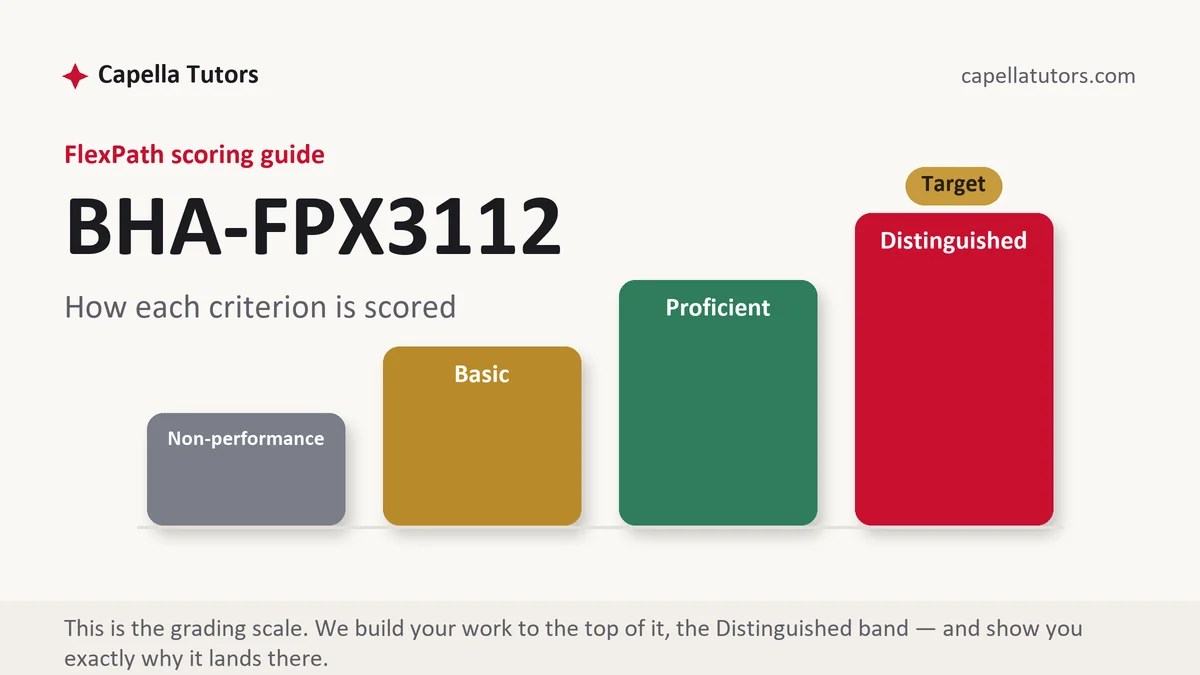
What BHA FPX 3112 actually grades
Health economics is graded on vocabulary discipline before anything else, because this industry uses four words for what students assume is one number. Cost is what the organization spends to produce the service. Charge is the list price in the chargemaster, which almost nobody pays. Payment is what the payer actually sends after the contract is applied. Out of pocket is the portion the patient owes under the benefit design. A paper that slides between those four has not made a small stylistic error, it has lost the ability to say anything true, and the criteria treat it that way. Put a worked line in early and the problem disappears: a procedure charged at 4,800 dollars, contracted with a commercial plan at 1,910 dollars, costing the department 1,640 dollars to deliver, contributes 270 dollars, and the 4,800 dollar figure matters only to a patient with no coverage and no negotiated rate behind them.
The second thing graded is whether you can trace an incentive to a behavior. Every payment method rewards something, and the criteria want the chain drawn rather than asserted. Fee for service pays per unit delivered and therefore rewards volume, which is why utilization management exists as a counterweight. Capitation pays a fixed amount per member per period and therefore rewards keeping people well and, in its unmanaged form, rewards doing less than is needed, which is why quality measurement is bolted to it. Bundled payment fixes a price for an episode and pushes the coordination problem inside the bundle, rewarding whoever can shorten a stay or prevent a complication and penalizing whoever cannot. Say what each design rewards, then say what it makes tempting, because the criterion is testing whether you can see both directions.
The third strand is why the ordinary competitive model does not describe this market, and precision earns points here. Insurance separates the person choosing the care from the person paying for it, which changes demand in documented ways. Moral hazard is the increase in use that follows from facing a lower price at the point of service, and it is not an accusation of bad faith. Adverse selection is what happens when the people most likely to need coverage are the most likely to buy it, which drives premiums up and pushes out the healthy. Information asymmetry runs deeper still, because the supplier is usually the one telling the buyer what to purchase, and Arrow's 1963 paper on uncertainty in medical care is where that argument is made properly. Add supply constraints created by licensure, certificate of need laws and long training pipelines, and you have the reasons a market for care behaves unlike a market for anything else.
The fourth strand is the arithmetic, kept at introductory level and expected to be correct. Marginal thinking is the whole discipline in one habit: the question is never whether a service is valuable but whether one more unit of it is worth what the next unit costs. Opportunity cost is what the same dollars would have bought elsewhere, and in a fixed budget it is the only honest way to describe a choice. Fixed cost and variable cost drive break even and explain why filling an under used imaging suite is so profitable and building a second one is not. None of this needs calculus, and all of it needs to be stated with units, because a number without a unit is where most of the lost points in this course are hiding.
How we help in this course
Economics deliverables come back with the numbers worked rather than described. If the prompt calls for an elasticity, the draft shows the percentage change in quantity, the percentage change in price, the resulting coefficient and its interpretation in a sentence a manager could use. If it calls for a payment model comparison, each model gets its incentive, its risk holder and its failure mode. If it calls for a policy position, the paper names who gains, who pays and over what period. Send the prompt with any figures your instructor supplied and those are the figures we use.
The service terms do not change for this course. Each deliverable is one premium original sample inside 24 to 48 hours, eight people work it from brief to final file, and one of those passes exists only to recompute every calculation independently and confirm the interpretation attached to it is the right way round. Revision remains free until the scoring guide is met, faculty feedback re-enters the process without charge, and since an evaluator can take two business days over a submitted attempt we plan the schedule against your target grade date rather than the date you first message us.
The assessments, one by one
Assessment 1
The assessment usually asks you to look at a health care market or a pricing question and reason about it economically, which starts with keeping four words apart: cost is what the organization spends to produce the service, charge is the list price, payment is what the payer sends after the. Read the full Assessment 1 manual.
Assessment 2
The assessment usually asks you to compute something and then say what it means: an elasticity from a price change and the demand response that followed, or a patient's share of a bill under a stated benefit design. Read the full Assessment 2 manual.
Assessment 3
The assessment usually asks for a recommendation with the economics under it, and the distinction that decides most of the criteria is between a saving and a shift. Read the full Assessment 3 manual.
How to actually write BHA FPX 3112: where to begin
Break the scoring guide into headings first and keep the economic vocabulary consistent underneath each one. Undergraduate economics criteria are usually phrased as explain, apply and analyze, and those three verbs want different amounts of work: explain wants the concept defined correctly, apply wants it used on the scenario in front of you, and analyze wants a comparison with a conclusion attached. The clusters in 3112 usually cover market behavior, payment and insurance mechanics, cost concepts applied to a decision, and a policy or organizational implication. The assessments in this course usually ask you to take one health care decision and reason about it economically, and your scoring guide decides the deliverable and the sections it expects.
Then do the elasticity properly, because it is the calculation most often attempted and most often misread. Take a constructed clinic that raises the visit copay from 20 dollars to 30 dollars, a 50 percent increase, after which monthly visits fall from 1,240 to 1,140, a decrease of 8.1 percent. The elasticity is negative 8.1 divided by 50, which is about negative 0.16, and the number is the easy part. The interpretation is the criterion. Demand this inelastic means the copay increase raises revenue rather than reducing utilization, so if the goal was to slow unnecessary visits the tool has failed at that job while succeeding at collecting more money. It also means roughly 100 visits stopped happening, and the evidence on cost sharing has consistently found that patients cut back on necessary and unnecessary care at similar rates rather than pruning wisely. Write that consequence out. A coefficient with no consequence attached is half a criterion.
Then handle insurance as risk pooling rather than as a discount arrangement, since almost every confused paragraph in this course comes from getting that wrong. An insurer collects predictable premiums from many people to cover unpredictable losses for a few, which is why a plan with a large pool can price more accurately than a plan with a small one, and why any design that lets healthy people leave raises the price for those who stay. Work a benefit design out loud with numbers: a plan carrying a 2,000 dollar deductible, 20 percent coinsurance after it, and a 6,000 dollar out of pocket maximum leaves a patient with a 9,000 dollar hospital bill paying the first 2,000, then 20 percent of the remaining 7,000, which is 1,400, for a total of 3,400 dollars, well under the cap. Showing that sequence once demonstrates you understand cost sharing in a way three paragraphs of definitions cannot.
Then close by saying who bears the cost of whatever you recommend, because that sentence is the difference between an economics paper and an opinion piece. Savings in health care are rarely destroyed, they are moved, so a shorter length of stay saves the hospital money under a bundled payment and moves work to a family at home, a formulary restriction saves the plan money and moves effort to a prescriber, and a prevention program spends now to avoid a cost that may land on a different payer years later. Name the party, name the timeframe, and say whether the parties gaining and paying are the same. Add a sensitivity line if the recommendation rests on one assumption, since stating that the case still holds if volume comes in ten percent below forecast is cheap to write and reliably impressive.
| Section | What goes in it | What Distinguished looks like |
|---|---|---|
| The decision or question | The scenario stated as an economic problem, with the units and period defined. | A question framed at the margin rather than as a general judgment about value. |
| Cost, charge and payment | The four figures kept apart, each with its source, for the service at issue. | A worked line showing charge, contracted payment, cost and what is left over. |
| Market analysis | Demand and supply conditions, the payer's role, and the constraints on entry. | Moral hazard, selection or asymmetry named accurately and applied to this market. |
| Calculations | The arithmetic set out with formulas visible, units labeled and signs correct. | Every result interpreted in one plain sentence a manager could repeat. |
| Incentives | What the payment arrangement rewards and what behavior follows from it. | Both directions given, including what the design makes tempting to do badly. |
| Recommendation and references | The position taken, who bears the cost, over what period, in current APA. | A named payer, a stated timeframe, and a sensitivity check on the key assumption. |
Developing the analysis
The distinction that decides several criteria in this course is between a cost saving and a cost shift, and undergraduate papers blur it constantly because the vocabulary encourages them to. A genuine saving means fewer real resources were consumed: fewer hours of labor, fewer supplies, fewer imaging minutes, a bed occupied for less time and then used by somebody else. A shift means the same resources were consumed and a different party paid, which is a legitimate goal for one organization and no gain at all from the perspective of the system. Discharging patients earlier can be either, and the paper has to say which. If the shorter stay reflects better coordination and the readmission rate holds, the resource use fell. If it reflects sending people home to unpaid family care and the readmission rate rises, the cost moved and then grew. Get in the habit of asking whose ledger your claim lives on, because a criterion asking you to analyze financial implications is asking exactly that. The same test applies to prevention arguments, which are frequently overstated in student work: prevention improves health reliably and saves money only sometimes, because screening a large population to find a small number of cases has a cost of its own, and saying so plainly is treated as sophistication rather than as pessimism.
Citations that survive faculty review
Four source families support economic argument at this level. Peer-reviewed health economics and health services research, reached through the Capella library, Business Source Complete and PubMed, carries any claim that a price, a benefit design or a payment change altered behavior, and the classic results should be credited to their origin rather than to a summary, which means Arrow's 1963 paper for uncertainty and asymmetry and the RAND health insurance experiment for the effects of cost sharing. Federal statistical series supply the magnitudes and must be quoted with the series and the year, principally the National Health Expenditure Accounts from CMS for spending, the Medical Expenditure Panel Survey from AHRQ for utilization and household spending, and Bureau of Labor Statistics series where wages or medical price indexes are involved. Policy analysis organizations are the fourth family and belong in their own sentence with their character stated, so a KFF employer benefits survey is cited as a survey with its year and its sample, and Congressional Budget Office scoring is cited as a projection with its assumptions acknowledged. Trade press and vendor material may describe what organizations are doing and may not stand as evidence that a strategy works. Then check current APA in both directions, and check that every number in the text still matches the source you took it from.
The mistakes that land Basic instead of Distinguished
- Charge used as though it were cost. The chargemaster price is a negotiating artifact, and building an argument on it invalidates the argument.
- An elasticity with no sign and no meaning. The coefficient is arithmetic, and the criterion is asking what the organization should do about it.
- Insurance treated as a discount card. Risk pooling is the mechanism, and every selection argument in the course depends on it.
- A claim that a program saves money, with no payer named. Savings land on somebody's ledger, and the criterion wants to know whose.
- Numbers without units or periods. A figure that could be per visit, per month or per year is a figure the evaluator cannot check.
BHA FPX 3112 questions students actually ask
Do I need statistics or calculus for this course?
No. The mathematics is arithmetic and ratios, and the difficulty is interpretation rather than computation. You will calculate percentage changes, a price elasticity or two, a break even point, a cost per unit of service, and the patient share of a bill under a benefit design, all of which a calculator handles. What the criteria actually test is whether the result means what you say it means: whether a negative elasticity near zero implies utilization will barely move, whether a break even volume above your realistic capacity means the proposal fails, whether a per member per month figure is comparable to the annual number sitting beside it. Show the formula, show the substitution, show the answer, then write the sentence explaining it.
What is the real difference between cost, charge and reimbursement?
They answer three different questions and are almost never equal. Cost answers what the organization spent to deliver the service, and it is internal, calculated rather than observed, and dependent on how overhead was allocated. Charge answers what the organization lists as its price, and it is set high for historical and negotiating reasons, appears on the chargemaster, and is paid in full by almost no one. Reimbursement, better called payment, answers what a payer actually transmitted after the contract, the fee schedule or the prospective payment method was applied, and it is the number that determines whether the service was worth providing. When a criterion asks about financial viability it is asking about payment against cost, and any sentence built on charges is answering a question nobody asked.
Can I write about my own state or my own employer?
Yes, and it usually makes for a stronger paper as long as the figures are public. State level material is abundant and citable: your state health department publishes utilization and expenditure reports, several states run all payer claims databases with public summaries, and Medicaid program documentation describes eligibility, managed care arrangements and payment policy in detail. For an employer, keep to what has already been published, meaning audited financial statements for a nonprofit system, the community health needs assessment, public rate transparency files or press material. Do not reproduce internal figures you were given access to as an employee, and where you need an internal style number for the argument, construct it, label it as constructed, and show how you derived it.
Economics assessment due this session?
Send the prompt, the guide and any figures your instructor provided. The first premium sample is free and every calculation arrives with its interpretation written out.