Give us the assessment prompt and the scoring guide that came with it, and an original premium sample lands within 24 to 48 hours, checked term by term against a current reference and revised at no charge until the criteria are satisfied. The course appears on your transcript as HIM FPX 1610, Introduction to Medical Terminology, worth 3 program points, and it belongs to the Health Information Management specialization within the FlexPath BS in Health Care Administration at Capella, where the degree totals at least 90 program points and 27 or more of those have to be earned in courses numbered 3000 and above. In Capella's catalog the course code is written HIM-FPX1610.
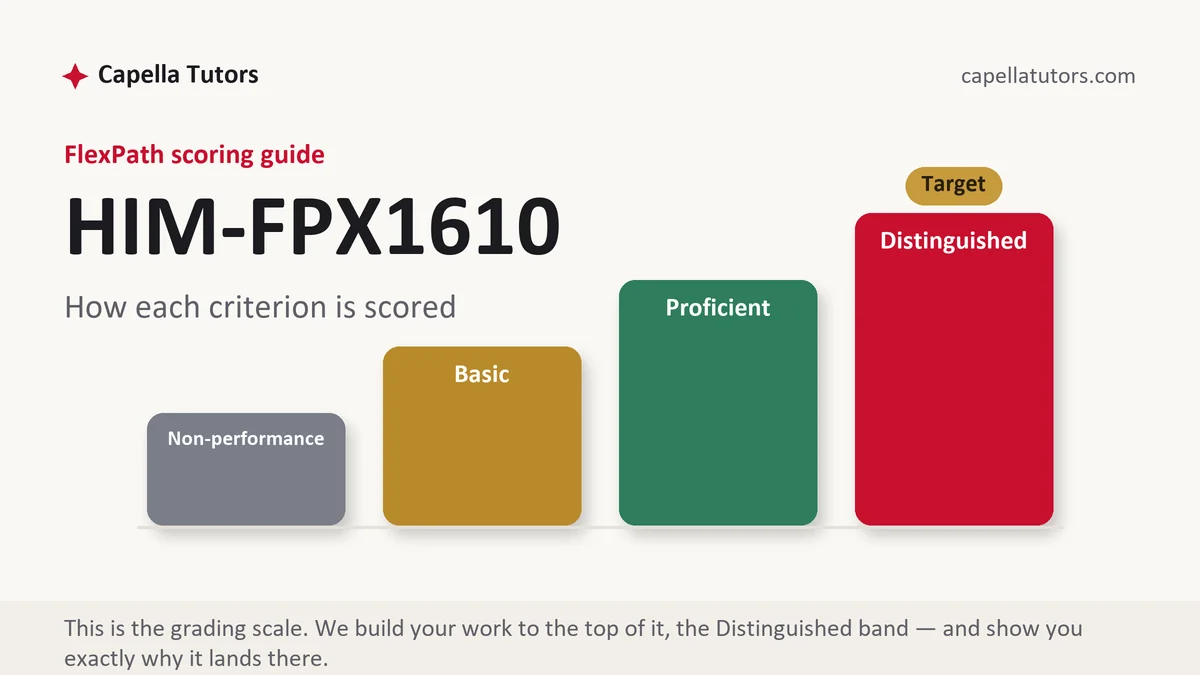
What HIM FPX 1610 actually grades
Medical terminology is taught as vocabulary and graded as construction. The criteria are not asking whether you have seen a word before, they are asking whether you can take an unfamiliar one apart, say what each piece contributes, and reassemble the meaning in a sentence somebody outside the chart could follow. Every term in this course is built from the same small inventory: a prefix that positions or quantifies, a root that names a body part or substance, a combining vowel that lets the pieces sit next to each other, and a suffix that says what is happening to the thing the root named. Pericarditis is peri, meaning around, plus cardi, the heart, plus itis, inflammation. Once that pattern is visible, the word stops being memorized and starts being read.
The mechanical rule underneath the pattern is where most first attempts slip. A combining vowel, almost always an o, stays in place when the next word part begins with a consonant and disappears when it begins with a vowel. That is why gastroenteritis keeps the o in front of enter and why gastritis has none in front of itis. Graders notice, because the same rule governs how a term is indexed and looked up later, and a learner who writes gastroitis has not made a typing error, they have shown that the rule is not yet in place.
The second strand is the suffix family that decides what was done to a patient, where being wrong by two letters changes the operation. An ectomy removes something. An ostomy creates an opening that stays open. An otomy is a cut that gets closed again. A pexy fixes a structure back in position, a plasty repairs or reshapes it, and a rrhaphy stitches it. A cholecystectomy takes the gallbladder out. A cholecystostomy drains it through a tube and leaves the organ where it was. Those are different consent forms, different lengths of stay and different entries in the record, and a paper that swaps them has misreported an episode of care rather than misspelled a word.
The third strand is the vocabulary that surrounds the clinical terms and gets less respect than it earns. Position words carry the same weight as diagnoses: proximal and distal describe distance from the point of attachment rather than from the floor, supine and prone are not interchangeable in a fall narrative, and ipsilateral and contralateral decide which side of a body a note is about. Sound-alikes are the other trap, because a spelling checker approves all of them. The ilium is a pelvic bone and the ileum is the last stretch of small intestine. Dysphagia is difficulty swallowing and dysphasia is difficulty with language. Mucus is the substance, mucous is the membrane producing it. Plurals arrive from Latin and Greek rather than English, so a record contains diagnoses, bronchi, vertebrae, ova and apices, and a writer who produces diagnosises has told the reader how carefully the rest of the document was assembled.
The last thing graded is judgment about abbreviations and audience. The Joint Commission publishes an official Do Not Use list, and the entries on it exist because copied and hurried orders caused harm: a handwritten U for unit reads as a zero, IU reads as IV or as the number ten, Q.D. and Q.O.D. are mistaken for one another, a trailing zero after a decimal point turns one milligram into ten, a missing leading zero turns half a milligram into five, and MS sits unreadably between morphine sulfate and magnesium sulfate. Assessments at this level commonly ask you to write for somebody outside the record, a patient, a relative, a newly hired clerk, and the evaluator is watching whether the clinical meaning survives translation instead of being deleted and replaced with something vague.
How we help in this course
Work in 1610 gets checked against a dictionary rather than against an opinion. Every term in a draft we send you is broken to its parts in our working notes before it appears in a finished sentence, the plain-language rendering is written to be read aloud and tested that way, and abbreviations get their own pass against what your prompt and the safety lists allow. Send the clinical narrative or the assigned term set along with a note about who the finished piece is meant for, because a paragraph aimed at a discharged patient and a paragraph aimed at a new records clerk are two documents built from the same word parts.
What you are buying does not change from course to course. Every deliverable arrives as a single original sample at premium standard, turned around in a 24 to 48 hour window, with eight sets of hands on it between the first look at your prompt and the finished document, one of those passes reserved entirely for marking the draft against your own guide row by row. Rewrites cost nothing and continue until the criteria are met, and faculty feedback is folded back in on the same basis. A graded attempt can occupy an evaluator for two business days, so we set delivery against the submission date you picked rather than the day the writing happens to finish.
The assessments, one by one
Assessment 1
Assessment 1 of HIM FPX 1610, Introduction to Medical Terminology, is where the course stops asking whether you recognize a word and starts asking whether you can take one apart. Read the full Assessment 1 manual.
Assessment 2
Assessment 2 of HIM FPX 1610, Introduction to Medical Terminology, moves from taking terms apart to writing for somebody who will never see the original document. Read the full Assessment 2 manual.
Assessment 3
Assessment 3 of HIM FPX 1610, Introduction to Medical Terminology, is the one that asks you to judge language rather than only read it. Read the full Assessment 3 manual.
How to actually write HIM FPX 1610: where to begin
Start with the scoring guide rather than the word list. Number the criteria, give each one a heading in a working document, and accept that an undergraduate assessment is marked row by row, so a paragraph attached to no row earns nothing however well written it is. The assessments in this course usually ask you to work from a short clinical scenario, a discharge summary or a set of assigned terms and to produce something a reader outside the chart can use, and your scoring guide decides whether that arrives as a table, a memo, a patient letter or an essay. Read the verb in each criterion before writing anything, since define, apply, analyze and communicate are four different jobs and only the first one is satisfied by a glossary.
Then build your own term table, even when the deliverable is continuous prose. Four columns do it: the term exactly as it appears in the source, the word parts separated with slashes, the literal meaning assembled from those parts, and the sentence you would actually say out loud to the intended reader. Working in that order prevents the commonest failure in this course, which is looking a term up, pasting the dictionary definition, and never noticing that the definition contains three more words the reader also does not know.
Take percutaneous transluminal coronary angioplasty, long enough to look impossible and regular enough to come apart in about a minute. Per is through, cutane is skin, and ous makes it descriptive, so the first word means through the skin. Trans is across, lumin is the channel inside a vessel, so the second word means along the inside of that channel. Coron names the vessels that circle the heart like a crown, and angi is vessel while plasty is surgical repair. Assembled, the term describes repairing a heart vessel by working along the inside of it after entering through the skin. For a patient that becomes a procedure that opens a narrowed artery in the heart using a thin tube passed in through a puncture in the wrist or the groin. Nothing was invented in that sentence and nothing clinical was dropped, which is the entire exercise.
Then decide how far the translation should go. Federal plain-language guidance for health materials points writers toward short sentences, everyday words and a reading level well below the one a college essay is written at, and the technique that satisfies a grader and a patient at the same time is to keep the clinical term and attach the explanation to it rather than to delete it. Write hypertension, high blood pressure, once, then use either. Write bilateral, meaning both sides, and the reader has gained a word instead of being protected from one. Where a term genuinely has no everyday equivalent, describe what it does rather than what it is, and say plainly which part of the record you took it from.
| Section | What goes in it | What Distinguished looks like |
|---|---|---|
| The source material | The scenario, report or term set you were given, quoted or summarized so a reader knows what you worked from. | The document type named, with the section each term was pulled from identified. |
| Word part analysis | Each term separated into prefix, root, combining vowel and suffix, with the contribution of each named. | Combining vowel rules applied correctly and the analysis carried through unfamiliar terms, not only easy ones. |
| Meaning in context | What the term means in this patient's situation rather than in the abstract. | Meanings that fit the scenario, with anatomy and body system stated where it disambiguates. |
| Plain-language version | The sentence written for the intended reader, at their reading level, with the clinical term retained and defined. | Wording a non-clinical reader can act on, with no meaning quietly lost in the simplification. |
| Abbreviations and safety | Short forms expanded at first use and any prohibited abbreviation flagged with the reason. | The safety rationale explained rather than the entry simply avoided. |
| References and accuracy | The dictionary, government or professional sources used, in current APA both in text and in the list. | Reference works cited with edition and year, and every term traceable to one of them. |
Developing the synthesis
The judgment this course quietly rewards is noticing that standardized language and recorded language are not the same thing. A dictionary gives one clean definition per term. A real chart gives you a physician who wrote CHF exacerbation in the assessment line, a nurse who charted shortness of breath at rest, and a discharge summary that says acute decompensated heart failure, all describing one patient across one admission. Nothing in that is wrong, but the three phrasings do not carry identical weight when the record is later abstracted, and the gap between what a clinician typed and what a classification system will accept is exactly why coders send queries back to the physician instead of guessing. Abbreviation practice varies the same way, since organizations keep their own approved lists on top of the nationally prohibited ones, so an abbreviation that is normal on one unit is unacceptable in a document leaving the building. At this level you are not expected to resolve any of that. You are expected to notice it, name it when your source material shows it, and write your own sentences so that a later reader has fewer of those decisions to make. That habit is what makes the rest of the specialization possible, because every downstream job in health information, from coding to release of information to data quality review, is somebody deciding what the words in a record actually claim.
Citations that survive faculty review
Three families of source carry the weight in a terminology paper. A current medical dictionary, meaning a named edition of a reference such as Dorland's, Stedman's or Taber's, is what you cite for a word part or a definition, and citing it properly with edition and year is part of what is being marked. Government sources supply the consumer-facing language and the code sets: the National Library of Medicine publishes plain-language health definitions through MedlinePlus, and CMS documentation is where the classification systems your terms eventually feed are described. Professional and accreditation bodies supply the practice rules, principally the Joint Commission for the prohibited abbreviation list and AHIMA for how health information departments handle documentation language. Where an assessment asks you to claim that patients understand one wording better than another, that is a research claim and needs peer-reviewed health literacy work behind it rather than an assertion. Two habits keep the reference list clean. Do not cite flashcard sites, term-of-the-day pages or anonymous study aids, because they carry no author and no review, and a grader who finds one discounts everything near it. Then run current APA in both directions and confirm that every citation in the text appears in the list and every entry in the list is used somewhere in the text.
The mistakes that land Basic instead of Distinguished
- Combining vowels applied by ear. Keeping the o in front of a suffix that starts with a vowel signals that the building rule was never learned.
- Definitions copied whole from a dictionary. A definition made of three more clinical terms has translated nothing for the reader it was written for.
- Sound-alike substitutions. Ileum for ilium, or dysphasia for dysphagia, moves the patient's problem to a different body system.
- Anglicized plurals. Diagnosises and bronchuses tell an evaluator that the Latin and Greek endings were skipped rather than learned.
- Prohibited abbreviations used without comment. A bare U or a trailing zero in a paper about medical language is the one error the criteria are guaranteed to catch.
HIM FPX 1610 questions students actually ask
Do I have to memorize every term on the list?
Memorizing the list is the slow route and it stops working the moment an unfamiliar word appears. Learn the inventory instead, which is roughly forty prefixes, sixty roots and thirty suffixes doing almost all of the work, and drill the pairs that change the meaning of a chart entry rather than the ones that merely sound impressive. Once hyper and hypo, ectomy and ostomy, itis and osis, and emia and uria are automatic, an unseen term becomes a puzzle with a known method rather than a gap. Keep a reference open while you draft, because nobody in a health information department works from memory either, and the graded skill is accurate assembly rather than recall under pressure.
Can I use abbreviations in the assessment itself?
Spell the term out the first time, put the abbreviation in parentheses after it, and use the short form from then on, which is the convention in current APA and the one an evaluator expects in an undergraduate paper. Two limits sit on top of that. Anything on the Joint Commission Do Not Use list stays out of your writing entirely, including a bare U for unit and a trailing zero after a decimal point, because the assessment is partly about whether you know why those entries were banned. And if the deliverable is written for a patient or a family member, an abbreviation you have defined once is still an obstacle on page two, so use the full words. Your scoring guide has the final say on format.
I have never worked in a clinic. Will that hurt me here?
No, and the course is positioned early in the specialization for exactly that reason. Health information work is done on the document rather than at the bedside, so what you need is the ability to read a record accurately, not the ability to have written one. Everything the assessments draw on is publicly reachable: the National Library of Medicine publishes plain-language definitions for consumers, a current medical dictionary supplies the word parts, and sample discharge summaries and operative reports circulate in teaching material. Where clinical experience does help is in judging what a reader already knows, and you can substitute for it by testing a sentence on somebody outside health care and watching where they stop.
Terminology deliverable due this week?
Send the scenario, the term list and the guide. The word part breakdown and the patient-ready wording arrive in the same file. First premium sample free.