Send the prompt and the scoring guide and a premium original sample comes back inside 24 to 48 hours, written against the Distinguished descriptors your evaluator is holding, revised at no cost until the criteria are met. The course records as BHA FPX 2102, Leadership and Communication in Healthcare Management, worth 3 program points, a specialization course that both the Leadership track and the Health Information Management track of Capella's FlexPath BS in Health Care Administration draw on, inside a degree that runs to at least 90 program points. In Capella's catalog the course code is written BHA-FPX2102.
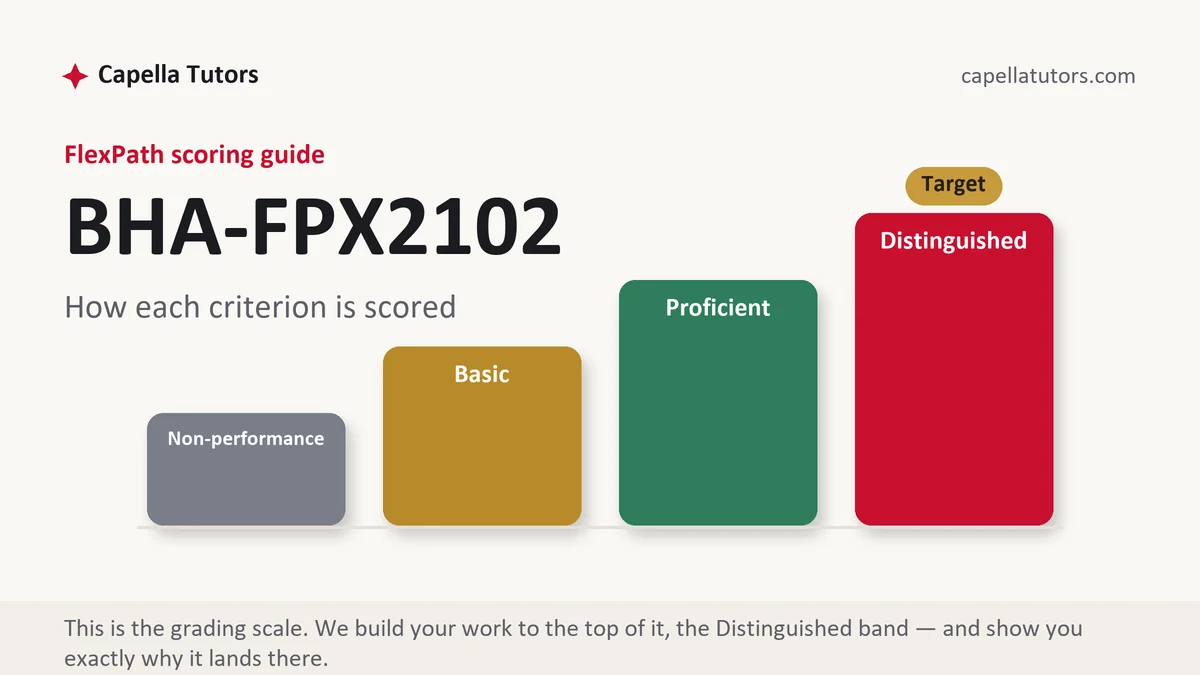
What BHA FPX 2102 actually grades
BHA FPX 2102 is where a health care administration student stops reading about managers and starts writing as one. The criteria are indifferent to how many leadership theories you can name. They test whether you can take one named model, apply it to a department that has a size, a staffing pattern and a problem, and produce something a director could act on before lunch. Most submissions lose ground in the same place: four styles get summarized in four tidy paragraphs, a preference is announced in the fifth, and nothing in the scenario is ever touched by the theory.
The models are worth knowing precisely, because accurate use scores and enthusiasm does not. Transformational leadership, traced to Burns in 1978 and developed by Bass, is about raising what a group is willing to attempt, and it costs manager time you have to account for. Transactional leadership runs on clear exchange, and it is the correct answer more often than students expect, particularly where the work is protocolized and the measure is compliance. Servant leadership, from Greenleaf's 1977 essay, defines the leader's job as clearing whatever stops the staff working. Situational approaches, associated with Hersey and Blanchard, argue that the readiness of the person in front of you picks the style rather than your temperament. Work in the top column names the model, credits where the idea came from, then shows the model doing something: which meeting changes, who hears what and in what order, and what the manager stops doing.
The communication half is graded harder than the leadership half because it is easier to check. Every deliverable here has an audience, and the criteria notice when you did not write for one. A note to a chief nursing officer is short, leads with the ask, and puts the reasoning underneath it. A briefing for registration clerks names the change, the date it starts, the person to ask, and nothing else. A message that has to travel up a clinical hierarchy carries different weight from one traveling across it, and structured handoff formats exist because unstructured handoffs fail, which is why the situation, background, assessment and recommendation pattern keeps appearing in these prompts. Watch the register as well, since health care writing borrowed from a motivational poster reads as junior no matter how clean the grammar is.
The third strand is conflict, and the scenarios are usually built so a reasonable person stands on the other side. A coder and a physician disagreeing about documentation, a charge nurse and a scheduler disagreeing about float coverage, a department head who will not release staff for training: none of those is a villain problem, they are competing legitimate priorities with one resource in the middle. The criteria want the interest behind each position identified, the escalation route named, and a resolution that says who decides when agreement does not arrive. A paper that settles the disagreement by promising open communication has described a wish and skipped the criterion.
How we help in this course
Tell us the department. Bed count or panel size, how many staff, which shifts they cover, who the manager reports to, and the friction you actually see, and the draft comes back with the theory fastened to those details instead of floating above them. If you have no site to write about, we build one that behaves plausibly and label every constructed figure as constructed, which is what faculty expect in any case. Where the deliverable is a memo, a staff briefing or a slide narrative, we write it in that form rather than writing an essay and putting a memo header on it, because format compliance is its own criterion in this course more often than students notice.
Terms are the studio's. One premium original sample per deliverable inside 24 to 48 hours, eight people between the first outline and the file that reaches you, with one pass reserved for reading the draft against the scoring guide criterion by criterion and another spent only on citations. Revision stays free until the work meets the guide, and faculty feedback re-enters the same cycle at no charge. Since an evaluator has two business days with a submitted attempt, we count backward from the date you want the grade rather than forward from the day you write to us.
The assessments, one by one
Assessment 1
Assessment 1 of BHA FPX 2102, Leadership and Communication in Healthcare Management, is where you stop reading about managers and start writing as one. Read the full Assessment 1 manual.
Assessment 2
Assessment 2 of BHA FPX 2102, Leadership and Communication in Healthcare Management, is graded harder than the leadership work because it is easier to check. Read the full Assessment 2 manual.
Assessment 3
Assessment 3 of BHA FPX 2102, Leadership and Communication in Healthcare Management, puts a disagreement in front of you and asks you to manage it. Read the full Assessment 3 manual.
How to actually write BHA FPX 2102: where to begin
Open the scoring guide first and turn it into your outline. Each criterion becomes a heading, the Distinguished wording sits underneath it while you draft and comes out before you submit, and every paragraph you write has to belong to one of those headings. In 2102 the criteria usually gather around four things: describe the situation accurately, apply a leadership approach to it, plan the communication, and deal with the disagreement the scenario contains. The assessments in this course usually ask you to write to a named audience about a department you can describe, and your scoring guide decides the format, the length and the sections it wants. A paragraph attached to no criterion is a paragraph the evaluator has no box to score.
Then write the situation section with facts in it. A weak version says the department has low morale and high turnover. A version that gives the rest of the paper something to hold reads like this: an outpatient imaging department running two shifts, 19 technologists and 4 schedulers, open 11 hours a day six days a week, where 7 of the 19 technologists have been in post under a year and the daily huddle stopped in March when the supervisor's role went vacant. Every later claim now has somewhere to land, because a reader can see why handoff quality slipped and why an inspirational appeal to a team that is 37 percent new hires needs a transactional floor built under it first.
Then build the communication plan as a set of decisions rather than a paragraph of intentions. Each message needs an audience, a channel, a sender, a time and one thing the reader is supposed to do. Undergraduate criteria reward that specificity because it can be checked: the evaluator can see whether the night shift was included, whether the physician group heard it from a peer or from a group email, and whether anyone told the schedulers before the change reached them. Add the route by which people answer back, since a plan that only pushes information outward is half a plan, and name the thing you will look at in four weeks to know the message landed.
Then close by saying what you would do differently as the leader in the scenario, in specific terms. Criteria asking for reflection are not asking for modesty. They are asking whether you can name a behavior, say what it costs, and describe its replacement. Saying you tend to solve problems yourself rather than delegate is a start. Saying that in the last three schedule conflicts you rewrote the roster yourself instead of coaching the charge nurse who owns it, and that the next one goes to her with a fifteen minute debrief afterward, is the version that scores.
| Section | What goes in it | What Distinguished looks like |
|---|---|---|
| Situation and department | The unit described by size, staffing, hours and the problem as it presents. | Figures that explain the problem, with anything invented labeled as constructed. |
| Leadership approach | The named model, credited to its originator, and why this situation suits it. | The model applied to particular decisions rather than summarized and set aside. |
| Communication plan | Audience, channel, sender, timing and the action each message asks for. | Every group reached, including the shift nobody remembers, with a route back. |
| Conflict and resistance | The disagreement, the interest behind each position, and the escalation path. | A named decider, a deadline, and what happens if the parties never agree. |
| Measures and follow-up | What you will look at, when you will look, and who owns the check. | Measures the department already collects, on a review date that exists. |
| References | Peer-reviewed leadership sources and professional standards, current APA. | Frameworks cited to the original work rather than to a textbook chapter. |
Developing the synthesis
The judgment this course is really testing is whether you can tell a people problem from a system problem, because the two need different leadership and undergraduate papers routinely misdiagnose. A department missing its turnaround target because two technologists are careless has one answer. The same department missing it because the schedule leaves one technologist alone through the busiest ninety minutes of the day has another, and no amount of coaching repairs the second. The evidence cuts the same way. Studies linking leadership style to staff retention and to patient outcomes are numerous, mostly cross-sectional, and rarely able to exclude the possibility that better-run organizations attract better leaders rather than the reverse. Use that honestly. Say the association is well documented, say what kind of study produced it, then argue from the mechanism you can actually see in the scenario in front of you. An undergraduate paper that concedes what a survey cannot prove and then explains what it does support is doing precisely what the top column describes, and it is rarer than you would think.
Citations that survive faculty review
Three kinds of source carry three different loads in this course. Peer-reviewed leadership and health services research from roughly the last five years, pulled through the Capella library, CINAHL and Business Source Complete, supports any claim that a style or a practice changes an outcome. Professional and accrediting bodies supply the standards you are being measured against, which here usually means the American College of Healthcare Executives competencies, the American Organization for Nursing Leadership where nursing staff are in scope, and Joint Commission requirements covering communication during transitions of care. Federal agency material, principally the AHRQ team training resources, gives you tools that have been tested rather than tools you invented. The habit that separates the columns is attribution: transformational leadership goes to Burns and to Bass, servant leadership goes to Greenleaf, group development stages go to Tuckman's 1965 paper, and none of them goes to the survey text that condensed all four onto two pages. Then run current APA in both directions so every citation in the text appears in the reference list and every entry in the list appears in the text.
The mistakes that land Basic instead of Distinguished
- Four theories summarized, none applied. The criterion says apply, and a comparison table is not an application.
- No audience. A document written to nobody in particular gets read as an essay and scored as one.
- Conflict resolved by goodwill. Naming the interests and the decider is the criterion, hoping for openness is not.
- Frameworks credited to the textbook. Your evaluator knows where these ideas came from and can tell whether you looked.
- A scenario with no numbers in it. Staffing, hours and volume are what turn a leadership choice into a defensible one.
BHA FPX 2102 questions students actually ask
Do I need to be a manager already to write these assessments?
No, and the criteria are not written on that assumption. What they need is a setting you can describe accurately, which can be the department you work in now at any level, one you worked in previously, a volunteer placement, or an organization you construct from public information about a real facility. If you have never held a management title, use what you can observe: how the schedule gets built, who covers a call-out, where information gets stuck, which decisions have to travel upward. Frontline detail is usually better raw material than a title, because it is specific and a title is not. Label anything you invented as constructed, give the basis for it, and the criterion is satisfied.
Which leadership theory should I choose?
Choose the one the scenario argues for, then defend it against the obvious alternative, because the defense is where the points sit. A team of experienced staff who know the work and have lost interest in it is a transformational case. A newly assembled team learning a protocol against a compliance deadline is a transactional case with situational coaching layered over it. A department where staff know exactly what is wrong and cannot get anyone to fix it is a servant leadership case, and saying so is more convincing than picking whichever model flatters you most. Explaining why the runner-up would fail here takes one paragraph and moves a criterion.
How formal should a memo or briefing be?
Formal in structure, plain in language. A memo a health care executive will actually read opens with the recommendation or the request, gives the reason in three or four sentences, states what it costs and who is affected, and ends with the decision you want and the date you need it. Headings are allowed and usually help. Contractions are fine. What is not fine is burying the ask in paragraph five, spending three hundred words on background before the point, or using the passive voice to avoid naming who does the work. If the prompt specifies a format, follow it exactly, since format compliance is frequently scored on its own line.
Leadership memo due this week?
Send the prompt, the scoring guide and a description of the department. The first premium sample is free and it arrives in the format the prompt asked for.