Send us the prompt and the scoring guide and one premium original sample returns inside 24 to 48 hours, aimed at the Distinguished descriptors your faculty are grading from, with free revision until every criterion is satisfied. The course appears on your transcript as BHA FPX 2106, Health Information Management in Healthcare Organizations, carrying 3 program points, a specialization course used by the Leadership track and by the Health Information Management track of the FlexPath BS in Health Care Administration at Capella, a degree of at least 90 program points. In Capella's catalog the course code is written BHA-FPX2106.
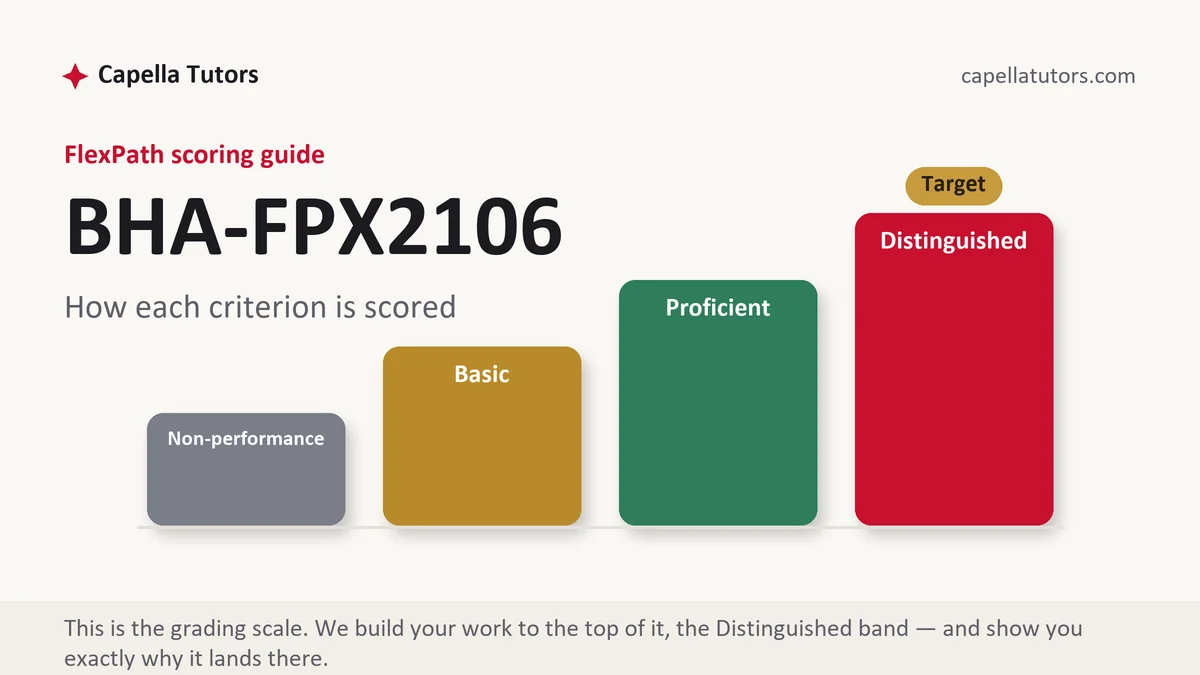
What BHA FPX 2106 actually grades
BHA FPX 2106 grades one shift in how you see a chart. To a clinician the record is a working document. To an administrator it is three things at once: a legal instrument that will be read aloud in a deposition, the sole evidence supporting every dollar the organization bills, and the raw material of every quality figure the facility reports. Criteria in this course keep circling back to that triple duty, and submissions that treat health information as a filing and software problem lose ground on the first criterion and never recover it.
Privacy is where the most points move, and precision matters more than sentiment. The Privacy Rule and the Security Rule are different regulations doing different jobs, the first governing uses and disclosures of protected health information and the second governing the administrative, physical and technical safeguards around it in electronic form. Treatment, payment and health care operations are the permitted purposes that need no authorization, and everything outside them usually does. The minimum necessary standard limits what may be shared even when the disclosure is permitted, and it has a specific exception for treatment. Consent and authorization are not synonyms, an authorization has required elements and an expiration, and a paper that uses the two words interchangeably has told the evaluator it read a summary rather than the rule. Breach notification obligations, the patient right of access, and the distinction between the designated record set and the legal health record all sit in this same territory.
Data quality is the second strand, and it is where administration and information management meet. A record is only useful if it is complete, accurate, timely, consistent and unambiguous, and each of those has a failure mode with a cost attached. The master patient index is the standard teaching case, because a duplicate record is simultaneously a patient safety event, a billing rework event and a reporting error. Consider a constructed example you can carry through a paper: a facility logging 42,000 registrations a quarter with a duplicate rate of 4.1 percent creates roughly 1,720 duplicate records in three months, and if reconciling one takes 22 minutes of a health information technician's time the cleanup alone is about 631 hours a quarter. That arithmetic is what turns a data quality complaint into a management argument.
The third strand is the systems layer, taught at survey level and graded on whether you understand what each piece is for. Classification and terminology are not the same thing, so ICD-10-CM and ICD-10-PCS classify diagnoses and inpatient procedures for reporting and payment, CPT codes physician and outpatient services, and SNOMED CT and LOINC exist to make clinical meaning and laboratory results computable rather than to bill anything. Interoperability standards, chiefly the HL7 family and the FHIR specification built on it, describe how systems exchange that content. Retention schedules, release of information workflows and audit logging round it out. The criterion is rarely asking you to configure anything. It is asking whether you can explain to a department head why a request routes the way it does.
How we help in this course
Work on 2106 starts with the regulation rather than the opinion. When a deliverable turns on privacy, we write from the rule text and cite it as regulation, so the paper says which part of 45 CFR governs the situation instead of gesturing at HIPAA as though it were a single sentence. When it turns on data quality, we build the scenario numerically, so the duplicate rate, the rework hours and the denial exposure appear as figures a reader can check rather than as adjectives. Tell us your facility type, your record system if you are comfortable naming it, and the workflow the prompt describes, and the draft is written around that setting.
Delivery works the same way it does across the studio, with one addition for this course. Every deliverable comes back as a premium original sample inside 24 to 48 hours, eight people handle it between the outline and the file, and one of those passes exists purely to verify that each regulatory statement in the draft matches the source it cites. Revisions are unlimited and free until the scoring guide is met, faculty comments come back into the cycle at no cost, and because an evaluator holds a submitted attempt for up to two business days we schedule from your intended submission date rather than from today.
The assessments, one by one
Assessment 1
Assessment 1 of BHA FPX 2106, Health Information Management in Healthcare Organizations, is usually the privacy deliverable, and it is the one where half-answers are most common. Read the full Assessment 1 manual.
Assessment 2
Assessment 2 of BHA FPX 2106, Health Information Management in Healthcare Organizations, moves from the rule to the record itself. Read the full Assessment 2 manual.
Assessment 3
Assessment 3 of BHA FPX 2106, Health Information Management in Healthcare Organizations, is the stage where a rule and a workflow have to be explained to someone who does not work in health information. Read the full Assessment 3 manual.
How to actually write BHA FPX 2106: where to begin
Start by converting the scoring guide into a skeleton, since undergraduate criteria in this course are unusually literal and reward the student who answers them in order. Give every criterion its own heading, paste the Distinguished language beneath it while you draft, and delete that language before submission. The clusters in 2106 usually run along these lines: describe the function or the regulation accurately, apply it to the situation you were given, identify what goes wrong when it is handled badly, and recommend a workflow or a control with an owner attached. The assessments in this course usually ask you to explain something regulatory to a non-specialist audience, and your scoring guide decides the format and the sections it expects.
Then get the privacy analysis right, because it is the criterion most often half-answered. Work through a disclosure in four steps rather than one. Ask who is requesting the information and in what capacity, ask whether the purpose falls inside treatment, payment or operations or outside it, ask what the minimum necessary amount would be for that purpose, and ask what documentation the disclosure itself requires. A worked example beats an abstraction: a request from an employer for an employee's visit notes is not a treatment disclosure, it does not fall under payment or operations, it therefore requires a valid authorization signed by the patient, and even with that authorization the release should be limited to what the authorization names rather than the whole chart. Write the reasoning in that order and the criterion has nowhere to go.
Then handle data quality as a measurable problem instead of a complaint. Name the dimension you are addressing, state how it is measured, give the baseline and the denominator, then propose a control that operates at the point the error is created rather than at the point it is discovered. Registration is usually where the error is created. A duplicate caught by a coder three days later has already cost a clinician a partial history and a biller a rejected claim, so the control belongs at the search step during registration, in the form of a minimum search protocol, a required second identifier and a hard stop on partial matches. Then say who owns the control, what report shows whether it is working, and how often somebody looks at that report.
Then finish with the recommendation written for the person who has to fund it. Health information proposals fail on paper for a predictable reason: they name a technology and stop. A committee needs the operational shape as well, meaning who runs the new step, how long it adds to a transaction, what training it takes, what the audit trail will show, and what the organization is exposed to if nothing changes. Exposure in this domain is concrete and worth stating plainly, since it includes claim denials, corrective action after a records request, regulatory enforcement and the reputational cost of a breach notification. Give the reader a number where a number exists and say clearly where one does not.
| Section | What goes in it | What Distinguished looks like |
|---|---|---|
| The setting and the function | The facility, the department and the information workflow as it currently runs. | A workflow described step by step, with the handoffs and the systems named. |
| The rule that applies | The regulation or standard governing the situation, cited to the rule itself. | The correct rule, the correct part, and the exception that changes the answer. |
| Analysis of the situation | What is permitted, what is required, and what the organization must document. | Reasoning that runs request, purpose, minimum necessary, documentation, in order. |
| Data quality and risk | The dimension at issue, its measure, the baseline and what failure costs. | A rate with a denominator and a window, and a cost tied to the rate. |
| Control or recommendation | The change, the point in the workflow it sits at, and its owner. | A control at the point of error creation, with an audit report behind it. |
| References | Regulatory sources, professional practice guidance and peer-reviewed work, current APA. | Regulations cited to the Code of Federal Regulations rather than to a summary. |
Developing the analysis
The reasoning skill this course is quietly building is the ability to separate what the law requires from what the organization has chosen to do, because students conflate the two constantly and the criteria are written to catch it. A great deal of what a health information department does is policy rather than statute. Requiring a written request for every release, refusing to fax results, holding a sensitive note back from a portal for a set interval: those may be defensible institutional decisions, and none of them is HIPAA. Getting this right in a paper takes one habit. When you assert an obligation, name its source, and when you describe a practice, say whose practice it is. State enforcement adds a second layer, since a state law that is more protective of the patient than the federal floor is the one that governs, which is why a paper that answers a privacy question purely from federal rules and never mentions the state is answering only part of it. Write that limitation into the paper explicitly. Saying that the federal analysis produces one answer and that the applicable state statute must be checked before the policy is finalized shows exactly the judgment the top column is describing.
Citations that survive faculty review
Four families of source do the work here and they are not interchangeable. Regulations come first and are cited as regulations, meaning the HIPAA Privacy and Security Rules at 45 CFR Parts 160 and 164, the Conditions of Participation where record content is at issue, and the state statute that applies to your facility, all quoted from the rule text rather than from a law firm's blog post about it. Federal guidance interprets those rules and belongs in a different sentence, chiefly material from the Office for Civil Rights at Health and Human Services and from the Office of the National Coordinator for Health Information Technology on certification and on information blocking. Professional practice sources, principally the American Health Information Management Association practice briefs, supply the operational standard the field holds itself to, and they are evidence of accepted practice rather than evidence of law. Peer-reviewed informatics research, reached through the Capella library, PubMed and journals such as JAMIA and Perspectives in Health Information Management, is what supports any claim that an intervention improved accuracy or safety. Then run current APA both ways and confirm that the reference list and the text agree.
The mistakes that land Basic instead of Distinguished
- HIPAA treated as one undivided rule. Naming the Privacy Rule or the Security Rule, and the part, is what the criterion is watching for.
- Consent and authorization used as synonyms. They have different triggers and different required elements, and the difference is scorable.
- A summary site cited instead of the regulation. Secondary explanations of the rule are not the rule, and evaluators check.
- Data quality asserted with no measure. Poor documentation is an opinion until it carries a rate, a denominator and a period.
- A software purchase offered as a workflow fix. A system with nobody assigned to run the new step recreates the old error faster.
BHA FPX 2106 questions students actually ask
Do I need coding experience to pass this course?
No. The criteria are written for future administrators rather than for future coders, and they ask you to explain what each code set is for and how documentation quality drives it, not to assign a code to a case. What does get graded is precision about the categories. Knowing that ICD-10-CM captures diagnoses while ICD-10-PCS captures inpatient procedures, that CPT covers physician and outpatient services, and that SNOMED CT and LOINC are clinical terminologies rather than billing systems, is enough to answer most prompts correctly. If a deliverable does put a coding scenario in front of you, argue it from the documentation upward, because the administrator's question is always whether the note supports the code that was billed.
Can I use records or screenshots from where I work?
Not in their original form, and the safest answer is to build a scenario instead. Anything you submit for a course leaves the covered entity, so a real record needs de-identification before it goes anywhere, and de-identification under the safe harbor method means removing all eighteen categories of identifier, which includes far more than a name and a date of birth. Employer policy usually forbids the export regardless of what the rule permits. Construct a patient, construct the encounter, keep the workflow accurate because the workflow is what you are being graded on, and state in the paper that the case is illustrative. Faculty accept that without hesitation, and it removes the risk entirely.
How do I cite a federal regulation in APA?
Treat it as a legal source rather than as a journal article, and it stops being confusing. A regulation is cited to its title and section in the Code of Federal Regulations with the year, so a privacy provision is cited to 45 CFR followed by the specific section, and the reference entry gives the title, the CFR location and the year rather than an author and a publisher. Guidance documents from Health and Human Services are a different object and are cited as agency publications with the department as the author. The practical rule for this course is simple: if you are stating what the law requires, the citation should point at the law, and if you are stating how the law is usually interpreted, the citation should point at the agency or the professional body doing the interpreting.
Privacy or data quality assessment due?
Send the prompt, the guide and the workflow you were given. The first premium sample is free and every regulatory claim in it comes back with the rule cited.