Give us the prompt and the criteria and a premium original sample returns inside 24 to 48 hours, written to the Distinguished descriptors with every rate and every calculation verified by a second reader before delivery. The course sits on a transcript as BHA FPX 3004, Ensuring Patient Safety and Quality Improvement in Healthcare, carrying 3 program points as an upper-division core requirement of the BS in Health Care Administration, offered in FlexPath, and counting toward the 27 points at the 3000 level or above that the 90-point degree requires. In Capella's catalog the course code is written BHA-FPX3004.
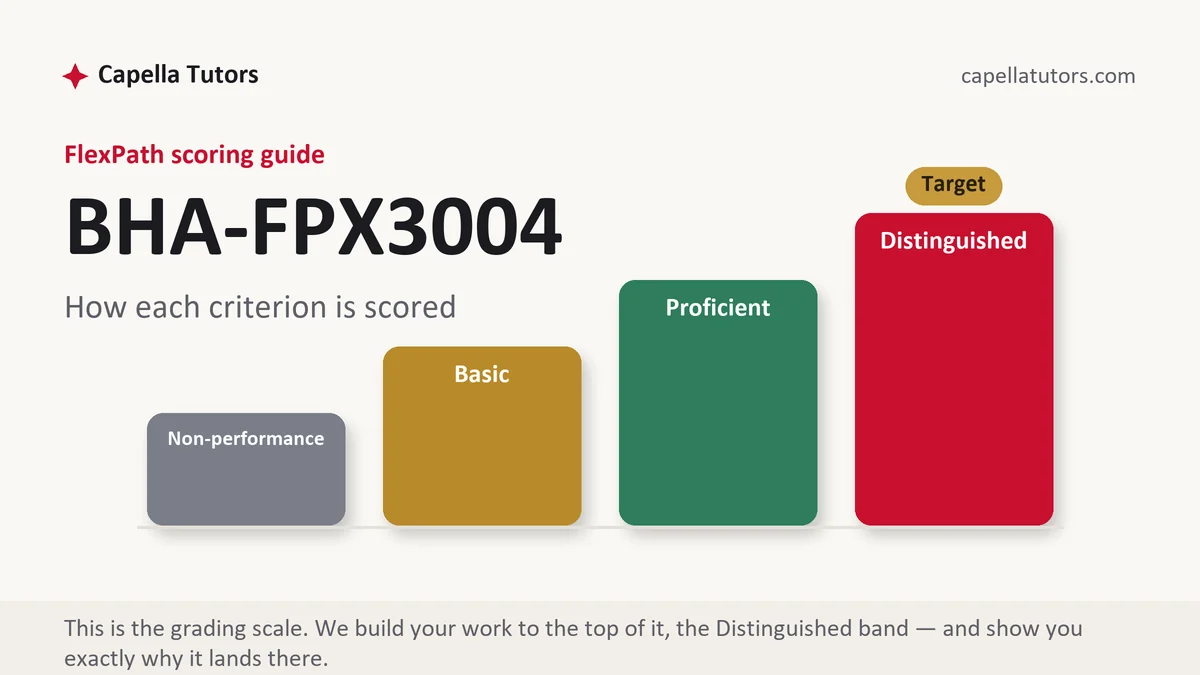
What BHA FPX 3004 actually grades
Two skills are graded in this course and they are unrelated to each other, which is why students who are strong at one still lose criteria. The first is causal reasoning about harm. The second is measurement. The assessments in this course usually hand you an adverse event or a performance problem and ask both for an explanation and for a plan, and the criteria reward an answer that treats the event as the product of a system rather than the fault of the last person to touch the patient. Layers of defense with holes in them is the standard image for a reason: the nurse who administered the wrong concentration is the final gap, and the ones behind her are look-alike packaging, a stocking decision, an alert nobody reads any more, a staffing ratio that removed the second check, and a policy written for a unit that no longer exists.
Measurement is where the marks are quietly lost. A count is not a rate, and a rate is not comparable until it carries a denominator and a window. Fourteen falls in a quarter tells a reader nothing. Fourteen falls across 2,760 patient days on a 32-bed unit is 5.07 falls per 1,000 patient days, which can be compared with the unit's own prior quarter and with an external benchmark. Infection measures follow the same discipline, with central line infections expressed per 1,000 central line days rather than per admission, because the exposure is the line and not the patient. Learn the three kinds of measure as well, since the criteria often ask for a mix: structure describes what the organization has, process describes what was done, and outcome describes what happened to the patient. A plan measured only on outcomes will look like it failed for months, because outcomes move slowly and process measures move first.
The improvement half is graded on structure rather than ambition. Three questions organize it: what are we trying to accomplish, how will we know a change is an improvement, and what change can we test. Then the cycle, planned, run small, studied against the measure, and either adopted, adapted, or abandoned. Small is the part undergraduate papers resist. A test on one hallway for two weeks with eight patients is a better answer than a hospital-wide rollout, because it produces learning at a cost the organization can absorb if the idea is wrong. Culture threads through all of it, since a reporting system only works when staff believe a report leads to a fix rather than to a file, and the distinction between simple human error, drifting into an at-risk shortcut, and genuinely reckless conduct is the framework that keeps accountability and learning in the same policy.
How we help in this course
Every 3004 draft we produce carries its arithmetic in the open. Rates are calculated with the denominator shown, comparisons are made against the same denominator, causal analysis is written as layered contributing factors rather than as a single cause, and each proposed change comes with a measure, a test size, and a named owner. Send us the event details or the data set your course provided, along with the unit type and its census if you have them, and the sample will run on your numbers rather than on illustrative ones.
Service terms hold across the studio. A deliverable returns inside 24 to 48 hours built for the top column, after eight people have handled it: a research analyst pulls the scoring guide and the safety literature, a subject writer drafts, a scoring-guide reviewer grades the draft criterion by criterion as a Capella evaluator would, an APA and originality reviewer reconciles every citation against the reference list, and an editor makes the last pass. Revisions stay free until the work satisfies the guide, and faculty comments re-enter the same cycle at no cost.
The assessments, one by one
Assessment 1
The assessment usually asks for a written analysis of one adverse event or performance problem in a health care setting, and the criteria want the event explained as the product of a system rather than the fault of the last employee who touched the work. Read the full Assessment 1 manual.
Assessment 2
The assessment usually asks you to turn a quality problem into measurement: a defined set of indicators with numerators, denominators, time windows, data sources and benchmarks, presented so that a manager could read the result and act on it. Read the full Assessment 2 manual.
Assessment 3
The assessment usually asks for an improvement plan built around a change you would actually test: an aim with a number and a date, one change idea with an evidence base, a small test with a stated prediction, the measures that will tell you whether it worked, and a sustainment plan that survives. Read the full Assessment 3 manual.
How to actually write BHA FPX 3004: where to begin
Convert the scoring guide into headings before you write a word about the event, and keep the analysis and the plan in separate sections even when the prompt describes them together. A merged section is how a strong causal analysis ends up with an unmeasured intervention buried in its last paragraph, and the plan criterion then scores on two sentences.
Work the numbers first, because they set what the rest of the paper can claim. Take the fall example through a full cycle. Baseline quarter: 14 falls, 2,760 patient days, 5.07 per 1,000. The unit tests hourly rounding on one twelve-bed hallway for two weeks, with a process measure of documented rounds completed and an outcome measure of falls per 1,000 patient days on that hallway. The process measure comes back at 61 percent of expected rounds, and the fall count is unchanged. That is not a failed idea, that is an idea that was never tested, because the change was not delivered. A paper that reports this honestly and adapts the next cycle to the delivery problem, rather than declaring hourly rounding ineffective, is demonstrating exactly the reasoning the top descriptor asks for. Plot the weekly figures on a run chart while you are at it, and describe what you see in the language of variation, since a single high week inside a stable pattern is noise and a run of eight points on one side of the median is a signal.
Then write the plan so a manager could execute it. Every change gets an owner by role, a start date, a test population, a measure with its collection method, and a review point. State how the change will be sustained after attention moves on, which usually means building it into an existing audit, a shift huddle, or an electronic record prompt rather than relying on staff remembering a campaign. Add the equity question if your criteria touch it, because harm is not distributed evenly and a plan that never asks who is falling has not looked at its own data.
| Section | What goes in it | What Distinguished looks like |
|---|---|---|
| The event or problem | What happened, in sequence, with times, roles, and the conditions on the unit that shift. | A factual timeline with no blame language and no conclusions smuggled into the narrative. |
| Causal analysis | Contributing factors across people, equipment, environment, policy, and workload. | Latent conditions identified behind the immediate error, with the strongest factor argued. |
| Measurement | Numerator, denominator, time window, data source, and the benchmark being compared against. | Rates that a reader can recalculate, with process and outcome measures both present. |
| The tested change | The intervention, its evidence base, the test size, and the cycle it will run through. | A small test with a stated prediction, sized so that being wrong costs almost nothing. |
| Sustainment | Who owns the change afterward, where it is built in, and when it is reviewed. | The change attached to a process the organization already runs, not to a project. |
| Culture and sources | Reporting climate, the accountability framework, and references in current APA. | An accountability position applied to the actual conduct in the case, in your own words. |
Developing the synthesis
The safety evidence is more contested than a textbook suggests, and saying so carefully is worth a level. Estimates of preventable harm vary by an order of magnitude depending on the review method and the definition of preventable, so quoting one figure as the number is a mistake a careful reader notices immediately. Bundled interventions raise a second problem: when a package of five practices reduces infections, the study rarely tells you which of the five did the work, which matters when an organization can afford three. Retrospective causal review has its own limits, since knowing the outcome makes the path to it look inevitable, and reviews conducted after a serious event tend to find the causes they went looking for. Staff who were involved in a serious event carry lasting effects of their own, and a plan that addresses the patient and ignores them is incomplete. Pick one of these tensions, state it in two or three sentences, and let it change something in your recommendation. That is the difference between a paper that has read the literature and one that has cited it.
Citations that survive faculty review
Four source types carry this course. Federal safety and quality agencies supply definitions, tools, and evidence syntheses, principally the Agency for Healthcare Research and Quality and its patient safety materials, along with the surveillance definitions published by the national healthcare safety network at the disease control agency, which is where the denominators for infection measures actually come from. Improvement organizations supply method, including the model that structures the test cycle and the driver diagram conventions that go with it. The hospital accreditor publishes sentinel event material, root cause expectations, and national safety goals that faculty expect to see referenced when the assessment involves an accredited setting. Peer-reviewed patient safety and health services research supplies the effect sizes. The report that opened the modern field in 1999 remains worth citing as an origin document, and the honest way to do it is to cite it for the systems argument it made rather than for the harm estimate it contained, which later work has disputed. Report the study design and the setting whenever you cite an intervention, because a result from an academic medical center does not transfer unexamined to a critical access hospital, and finish with the two-way check between citations and references.
The mistakes that land Basic instead of Distinguished
- Counting events instead of calculating a rate. Without a denominator and a window, no comparison in the paper means anything.
- Stopping the causal analysis at the person. Retraining an individual is the recommendation that tells a grader the systems criterion was not understood.
- An intervention with no measure. If nothing was counted before and after, the paper has proposed a hope rather than a change.
- Rolling out house-wide without a test. Scale before evidence is the failure mode the cycle exists to prevent, and criteria are written to catch it.
- Quoting a harm estimate as settled. Give the source and the definition of preventable it used, or leave the figure out.
BHA FPX 3004 questions students actually ask
I do not work in a hospital. Where do I get data for a quality project?
Use public data and say what you are using. Facility-level results on infections, readmissions, patient experience, and timeliness are published by the federal payment agency for hospitals across the country, state health departments publish their own reports, and the national infection surveillance system publishes both definitions and summary data. That is enough to select a problem, establish a baseline, and identify a benchmark. Where a criterion needs a figure only an employer would hold, construct it and label it as constructed, keeping the assumptions visible so the arithmetic can be followed. A clearly labeled estimate that behaves consistently is worth far more than a confident number nobody can trace.
What is the difference between quality improvement and research, and does it matter for my assignment?
It matters because the two carry different obligations and the criteria sometimes ask. Improvement work is conducted inside an organization to make that organization's own care better, it proceeds through repeated small tests, and it is governed internally. Research is designed to produce knowledge that generalizes beyond the setting, and it goes through a formal review board with consent requirements attached. The boundary is genuinely blurry in practice, particularly when a project is later written up for publication, and the determination belongs to the institution rather than to the person doing the work. For a course assessment, state which category your project falls into, state who would make that call in a real organization, and move on.
How many test cycles should I describe?
One in full detail, then a plan for the next two. A single cycle described completely, with the prediction stated before the test, the measure defined, the result reported honestly including the ways the test did not go as intended, and a decision to adopt, adapt, or abandon, demonstrates the method better than three cycles summarized in a paragraph each. Then say what the second cycle would change and what would have to be true before the change spreads beyond the test area. Scoring guides in this course reward visible reasoning, and the reasoning is visible in one cycle done properly.
Safety or improvement project due?
Send the event, the criteria, and any data the course gave you. Rates come back with denominators and the plan comes back with owners. First premium sample free.