Send the prompt and the scoring guide attached to it, and a premium original sample comes back inside 24 to 48 hours, argued against the Distinguished descriptors and revised at no charge until the criteria are satisfied. The transcript entry reads HIM FPX 3640, Managing Electronic Health Records Systems, worth 3 program points, part of the Health Information Management specialization inside Capella's FlexPath BS in Health Care Administration, and its 3000-level code means the course also counts toward the minimum of 27 upper-division points that the 90-point degree requires. In Capella's catalog the course code is written HIM-FPX3640.
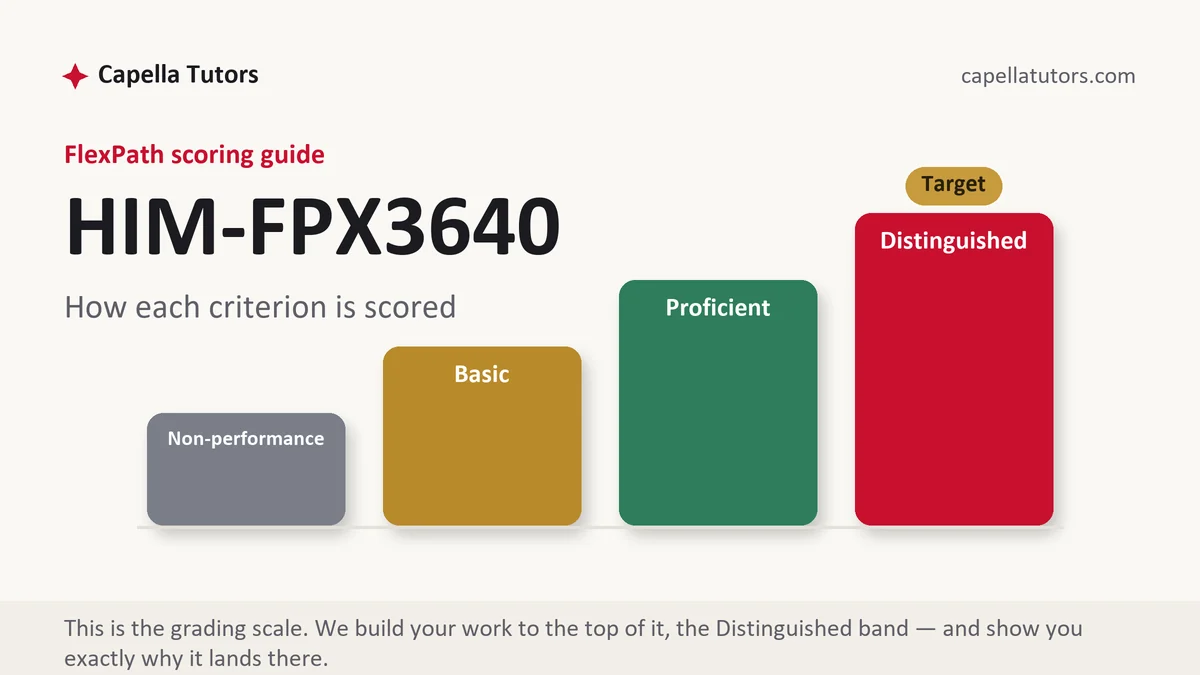
What HIM FPX 3640 actually grades
This course assumes the electronic record already exists and marks whether you can run one. The criteria point at operating decisions rather than at product features: who is permitted to open which part of a chart and how that permission is enforced, what clinicians write on during the three hours a server is unavailable, how a result arriving from a laboratory system is matched to the right patient, and what evidence would convince an administrator that last quarter's upgrade was worth the money. Vendor literature is not that evidence. A named measure, taken before the change and taken again after it, is.
Access is the first strand and the one most easily written badly. Role-based access control attaches permissions to a job rather than to a person, so a registration clerk inherits a registration profile on the day they start and loses it on the day they transfer, and nobody spends an afternoon assembling a bespoke set of checkboxes for each new hire. The HIPAA Security Rule requires the organization to limit access to the minimum necessary for the work, which is a design instruction rather than a slogan, because it decides whether a scheduler can open a behavioral health note and whether a nurse on one unit can read a chart on another. Break-the-glass access exists for the situation the role model never anticipated, and it is defensible only when every use writes an audit entry somebody actually reads. A paper that lists access levels and never says who reviews the logs, on what cycle, and what happens when a review finds an unexplained lookup has described a control without operating it.
The second strand is what happens when two systems have to agree about a patient. Interoperability at this level is a stack rather than a switch. HL7 version 2 messages still move most admissions, discharges and laboratory results between departmental systems, consolidated CDA documents carry a summary of care from one organization to another, and FHIR interfaces expose discrete elements to applications through an API. Learning the acronyms is the easy half. The graded half is understanding that none of it works without patient matching, since a message is useless if the receiving system cannot decide which record it belongs to. A duplicate is one person holding two identities in the master patient index. An overlay is worse, two people sharing one identity, which means somebody's allergy list now sits in a stranger's chart. Report the size of that problem the way a data professional would, with the base attached. Four thousand two hundred suspected duplicates against an index of 210,000 identities is two percent of the file; the same 4,200 against 2.1 million identities is a tenth of that, and the two figures justify very different remediation budgets.
Continuity is the third strand and the one most students treat as a formality. Availability is contractual and it is arithmetic. A service level agreement promising 99.9 percent uptime still permits roughly 43 minutes of outage across a 30-day month, and 99.5 percent stretches that allowance to about three and a half hours, which is the difference between an inconvenience and a shift spent on paper. A downtime plan earns its criterion by being specific about sequence: which read-only copy of the record clinicians consult while the live system is gone, which paper forms are pre-printed and where they are kept, who declares the downtime and who declares it over, and in what order the accumulated paper is entered once the system returns. Recovery is where records are actually lost, because backfilled documentation entered without its original date and time silently rewrites the clinical timeline.
The last strand is optimization, meaning the work that begins at go-live and never finishes. Copy-forward saves a clinician thirty seconds and produces a progress note in which a resolved problem reappears for nine consecutive days, which is a documentation integrity failure before it is an annoyance. Templates that fire the same normal examination whether or not an examination happened create the same exposure. Governance decides who may build an order set, who tests it and who retires it, and an assessment that proposes a change without naming that body has proposed a change nobody can approve. Adoption is measured rather than felt: the share of orders entered directly by the ordering clinician, the proportion of notes closed within twenty four hours, help desk tickets per hundred users per month, and time spent in the record outside scheduled hours all say something that the phrase user satisfaction does not.
How we help in this course
Drafts for 3640 are built around your organization rather than around a generic hospital. Tell us the vendor, the setting, the size of the department and any figures you can share about tickets, outages or duplicate volumes, and the plan in the paper will name workflows and roles that exist where you work. Where nothing can be shared, we construct a facility with stated parameters, label it as constructed in the first paragraph, and then keep every later number consistent with those parameters so an evaluator can follow the arithmetic from one section into the next.
The commercial terms match the rest of the studio. One premium original deliverable inside 24 to 48 hours, eight people between the brief and the file you download, one of whom reads the finished draft against your guide criterion by criterion and does nothing else, and unlimited revision at no charge until the score lands where you wanted it. Faculty comments return into the same cycle free. Since an evaluator has two business days to grade a submitted attempt, we work backwards from the date you need the point rather than from the date you happened to be ready.
The assessments, one by one
Assessment 1
Assessment 1 opens Managing Electronic Health Records Systems, and it usually asks for something that sounds easy and is not: an account of how a record system behaves inside one real organization today, with the problem you picked described in counts rather than in complaints. Read the full Assessment 1 manual.
Assessment 2
Assessment 2 moves from describing a record system to proposing how it should be operated, and the assessment usually asks for a recommendation somebody could act on: a change to how the system is configured or governed, with the roles, the approval path and the monitoring written down. Read the full Assessment 2 manual.
Assessment 3
Assessment 3 is the synthesis deliverable of the course, and the assessment usually asks you to judge something rather than propose it: whether a change to the record system worked, what the evidence supports, and what should happen next. Read the full Assessment 3 manual.
How to actually write HIM FPX 3640: where to begin
Let the scoring guide dictate your outline before you read a word about the system. Lift each criterion into its own heading, paste the Distinguished language directly beneath it, then attach every paragraph you write to one of those headings or cut it. The assessments in this course usually ask you to analyze a system decision for a named organization and recommend a course of action, with your scoring guide setting the form it takes, whether that is a report to leadership, a project plan, a policy or a briefing. Read the verb each criterion uses. Describe, analyze, evaluate and recommend are four different levels of work, and a paper that describes a system where the row asked for an evaluation has already capped itself two columns down.
Then fix the scope, because this is where undergraduate papers about technology come apart. A record system touches everything, so a student who never chooses a boundary writes four shallow pages about interfaces, security, training and cost and satisfies no criterion fully. Pick one decision. Replacing a legacy departmental system. Rolling out a patient portal. Cutting duplicate creation at registration. Describe the current state with something countable in it, propose the change, then say what will be measured afterwards. A single well-bounded problem carried through to a measurable result reads as competence. Four topics introduced and abandoned reads as a summary of a textbook chapter.
Write the current state as evidence rather than as complaint. Registration is slow is an opinion. The average registration takes eleven minutes against a departmental target of six, and 38 of the 412 accounts created in March were later flagged as possible duplicates, is a finding, and only the second version gives your recommendation something to move. If your figures are estimated, use the word estimated and show how you reached them. Faculty penalize invented precision far more reliably than they penalize an honest approximation, and a stated assumption is the cheapest way to protect every number that depends on it.
Close with an evaluation plan, since the criterion that separates the top two columns usually asks how anyone will know the recommendation worked. Name the measure, the source system it comes from, the baseline, the target, the review interval and the person accountable by role. If the proposal is to reduce duplicate creation, the measure is new duplicates per thousand registrations rather than a raw count, because registration volume moves month to month and a raw count will fall in February for reasons that have nothing to do with your project. Adding that base is a one-line change and it tells an evaluator you understand what you are measuring.
| Section | What goes in it | What Distinguished looks like |
|---|---|---|
| Organization and system context | The facility, its size, the record system in use, the department that owns it, and the scope of the paper. | Enough operational detail that the recommendation could only apply to this organization. |
| Current state | What happens today, described with counts, rates or elapsed times rather than adjectives. | Figures sourced or openly labeled as estimates, with the workflow traced end to end. |
| Governance, access and privacy | Who approves changes, how job roles map to permissions, and how audit logs are reviewed. | Minimum necessary applied to named roles, with a review cadence and an escalation path. |
| Data flow and integrity | Where data enters, which interfaces carry it, and the checks that catch matching and duplication errors. | Standards named accurately, and the matching risk quantified against the size of the index. |
| Continuity and training | Downtime, recovery, and the plan for getting staff competent on the change. | A sequenced downtime procedure, plus training differentiated by role instead of one class for everyone. |
| Evaluation and references | Measures, baselines, targets and review dates, with current APA in text and in the list. | Metrics tied to reports the organization already produces, on a stated schedule. |
Developing the analysis
The judgment this course rewards is the ability to hold two true things at once about health information technology. Computerized order entry with decision support removes the handwriting error and the missing-dose question, and the research supporting that is substantial. The same systems introduce failure modes paper never had: a selection made one row too low in a picklist, a warning dismissed for the four hundredth time that week, a default value accepted because it was already filled in. Published override rates for interruptive alerts are routinely high enough to make the alerts close to decorative, and the mechanism is not carelessness, it is volume. An undergraduate paper treating implementation as a straight upgrade misses the criterion, and a paper treating technology as the villain misses it from the other side. The defensible position is that a system moves risk rather than removing it, and that management earns its name by deciding where the remaining risk should sit. Then separate your claims: say which rest on published research and which rest on the situation in front of you, because an evaluator can tell the difference and the top column expects you to have drawn the line yourself.
Citations that survive faculty review
Four kinds of source carry a health information systems paper. Federal health IT material is the backbone, since the Office of the National Coordinator publishes the certification criteria that decide what a certified record system must be able to do, HealthIT.gov carries implementation guidance written for exactly this audience, and the information blocking provisions of the 21st Century Cures Act govern when a request for electronic health information may lawfully be refused. Regulatory sources cover privacy and payment, principally the HIPAA Security Rule for administrative, physical and technical safeguards, Office for Civil Rights enforcement summaries for what real failures looked like, and CMS program documentation wherever a reporting requirement drives the decision. Standards bodies supply precision, so cite HL7 when you name a message type, a document class or a FHIR resource rather than describing them from memory. Professional organizations frame practice, with AHIMA for information governance and data integrity and HIMSS for adoption and workforce material. Peer-reviewed informatics journals carry any claim about effect, and a sentence asserting that an intervention cut errors or saved time needs a study behind it rather than a product page. Two rules keep the list defensible. Vendor marketing may be cited as a description of a product and never as evidence of a benefit, and current APA runs in both directions so no citation lacks an entry and no entry sits unused.
The mistakes that land Basic instead of Distinguished
- Scope left open. Covering security, training, interfaces and cost in four pages gives every criterion the same thin paragraph.
- Counts reported with no base. Two hundred duplicate records is a number rather than a rate, and only a rate can be compared to anything.
- A downtime section with no sequence. Naming paper forms without saying who declares the outage or how the backlog is entered leaves the plan unexecutable.
- Standards used loosely. Calling every interface FHIR, or every summary document a CCD, tells a reader the terms were skimmed.
- No evaluation plan. A recommendation with no measure, no baseline and no review date cannot be judged and will not reach the top column.
HIM FPX 3640 questions students actually ask
Do I need access to a real EHR to write these assessments?
No, and most learners in this specialization do not have one. What the criteria examine is your reasoning about how a system is governed, and that reasoning can be assembled from public material. Vendor documentation and demonstration environments show you screens and workflows, ONC certification criteria tell you what functions a certified system must include, and published implementation case reports describe real projects in enough detail to analyze. Where the assessment needs an organization, construct one and describe it precisely: a 96-bed community hospital with two affiliated clinics, a registration desk running two shifts, a health information department of nine. Label it a constructed scenario in your opening paragraph, then hold every detail steady for the rest of the paper. Internal consistency is what an evaluator can actually check, and it substitutes for access.
How technical should the writing be?
Technical enough to be accurate, plain enough for a director who does not work in information technology. This is a health care administration degree, so the reader the criteria imagine is a manager deciding whether to fund something rather than an engineer building it. That gives you a usable rule: name the standard or the mechanism correctly, then say in one clause what it does for the organization. An interface that receives HL7 result messages from the reference laboratory, so results post to the chart without a clerk retyping them, satisfies both readers in a single line. Strings of acronyms with no such clause read as copied, and a grader who cannot tell whether you understand a term will not award the column that depends on you understanding it.
What is the difference between interoperability and integration?
Integration is what you build; interoperability is what you get. Integration usually means an interface engine wired between two named systems, translating one vendor's message format into another's, and it holds until either side changes. Interoperability means both systems already speak an agreed standard, so a third system can join later without a fresh custom build. The distinction matters in a paper because the cost lands in different places. An integrated pair carries permanent maintenance and an interface that breaks quietly whenever a field is added, while a standards-based approach costs more to adopt and less to keep. Say which of the two your recommendation is buying, and the criterion asking you to analyze alternatives has largely answered itself.
Records system deliverable due?
Send the prompt, the criteria and whatever you know about the site. We will scope it to one decision and attach the measures. First premium sample free.