Send the prompt, the criteria, and the article your instructor assigned if there is one, and a premium original sample returns inside 24 to 48 hours, written to the Distinguished descriptors and reviewed by a second person before delivery. On a transcript the course reads BHA FPX 3010, Introduction to Healthcare Research Methods, worth 3 program points, an upper-division core requirement of the BS in Health Care Administration offered in FlexPath, and one of the courses that fills the minimum of 27 points at the 3000 level or above within the 90-point degree. In Capella's catalog the course code is written BHA-FPX3010.
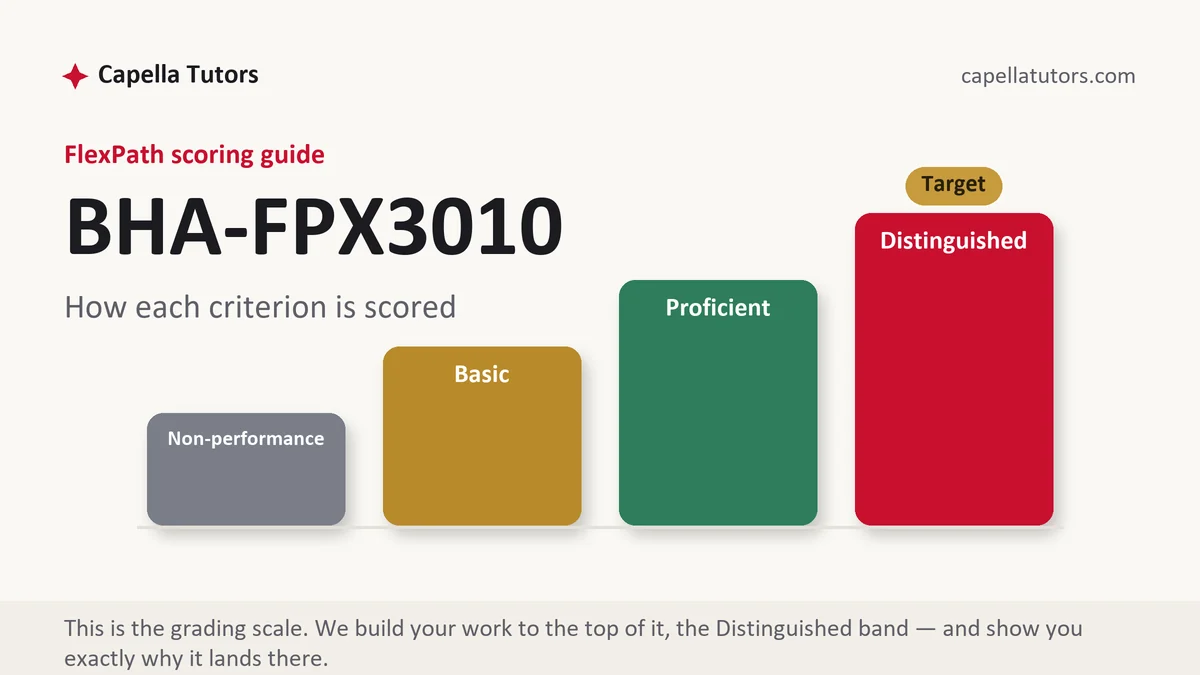
What BHA FPX 3010 actually grades
This course teaches you to be a competent reader of research rather than a producer of it, and the criteria are written for that role. The assessments in this course usually ask you to build an answerable question, find evidence that bears on it, identify what kind of study you are holding, judge how much weight it can carry, and report what it found without saying more than it said. Each of those is graded separately, and the first one is where most of the later damage is done, because a paper that starts from a topic instead of a question can never demonstrate the rest.
Question construction is mechanical once you see it. A concern such as readmissions are too high is not searchable. The same concern expressed as a population, an intervention, a comparison, an outcome, and a time frame becomes a set of search terms: among adults discharged after a heart failure admission, does a pharmacist-led medication review before discharge, compared with usual discharge instructions, reduce readmission within 30 days. That sentence tells you which databases to search, which words to combine, and what a relevant study will look like when you find one. Administrative questions take the same shape even when there is no clinical intervention involved, and getting an administrative question into that form is a reliable way to earn the first criterion outright.
Design identification is the second graded skill and it is a matter of reading the methods rather than the abstract. A cross-sectional survey measures a population at one moment and can establish that two things occur together. A cohort follows a group forward and can establish sequence. A case-control works backward from an outcome and is efficient for rare events. A randomized trial is the only common design that isolates an effect by design rather than by statistical adjustment. A systematic review pools studies against a stated protocol, which is not the same as a review article in which an expert summarizes a field. Qualitative interview and focus group work answers a different question entirely, about how and why something happens, and judging it by sample size is a category error the criteria are often written to catch. Match your verb to your design and the appraisal criterion mostly takes care of itself.
How we help in this course
Our 3010 drafts show their working. The search is documented with the databases used, the terms combined, and the limits applied, so the criterion about locating evidence has something concrete to grade. Each study is described by its design, its setting, and its sample before any finding is reported, and every claim in the paper is written at the strength the underlying design supports. Tell us the topic your instructor approved and any article the course assigned, and the sample will appraise those sources rather than substitute easier ones.
Delivery terms are the same as everywhere else in the studio. Work comes back inside 24 to 48 hours aimed at the top column after eight people have handled it, starting with a research analyst who retrieves the scoring guide and the primary literature, then a subject writer, then a scoring-guide reviewer marking the draft criterion by criterion the way a Capella evaluator would, then an APA and originality reviewer checking that citations and references correspond exactly, then an editor. Revision is free until the work meets the guide, and faculty comments come back into the same cycle at no cost.
The assessments, one by one
Assessment 1
The assessment usually asks you to turn a concern into a question that can actually be searched, then to document the search that follows it: the databases, the terms and how you combined them, the filters, how many results you screened and what you kept. Read the full Assessment 1 manual.
Assessment 2
The assessment usually asks you to hold one study up to the light: name its design from the methods section rather than the abstract, describe who was in it and how they were selected, judge how much weight the result can carry, and say what it does and does not support for a setting like yours. Read the full Assessment 2 manual.
Assessment 3
The assessment usually asks you to report what evidence found and what may be done with it: results stated in absolute as well as relative terms, precision reported rather than implied, an application to a named setting, and an ethics section that addresses the project in front of you rather than. Read the full Assessment 3 manual.
How to actually write BHA FPX 3010: where to begin
Convert the scoring guide to headings, then write the question before anything else and keep it visible while you work. Research assessments drift toward whatever the sources happen to discuss, and a question sitting at the top of the page is what keeps an appraisal from turning into a set of article summaries laid end to end.
Reporting results correctly is the technical move that separates the columns, and it takes one worked example to learn. A study of 1,400 discharged patients reports 12.4 percent readmitted within 30 days under usual care and 9.6 percent under a structured follow-up call program. The weak sentence says the program cut readmissions by 23 percent, which is true as a relative figure and misleading on its own. The complete sentence says the absolute difference was 2.8 percentage points, a relative reduction of about 23 percent, which means roughly 36 patients would need the program for one readmission to be avoided. Add the interval the study reported around that difference, because a wide interval crossing zero tells you the study could not distinguish the effect from chance, and add the design, because the same numbers from a randomized trial and from an observational comparison support different verbs. A significance value is a statement about how unusual the data would be if there were no effect, and it says nothing at all about whether the effect is large enough to matter to a patient or to a budget. Writing that distinction into a paper at this level is unusual and graders notice it.
Ethics carries its own criterion in most versions of this assignment and it is the one most often answered with a paragraph about honesty. Be specific instead. Research involving human participants requires review by an institutional board, informed consent that a participant can actually understand, and the three principles from the national report that governs American research ethics, which are respect for persons, beneficence, and justice. Identifiable health information carries obligations under the federal privacy rule, so a student project using patient data works with a de-identified extract or does not work at all. There is also a live boundary between quality improvement conducted inside an organization and research intended to produce generalizable knowledge, and the honest treatment is to state which side your project falls on and who at the organization makes that determination, since it is not the student's call.
| Section | What goes in it | What Distinguished looks like |
|---|---|---|
| The question | Population, intervention or exposure, comparison, outcome, and a time frame, in one sentence. | A question narrow enough that a search returns relevant studies rather than a field. |
| The search | Databases used, terms and combinations, filters applied, and how many results were screened. | A search another student could repeat and get a comparable set of articles. |
| Design and sample | What kind of study each source is, where it was conducted, and who was in it. | Design named from the methods section, with the sampling method and its limits stated. |
| Findings | What was measured, the size of the difference, its precision, and the authors' own caveats. | Absolute and relative effects both reported, with the interval and the design attached. |
| Application and limits | What the evidence supports for the setting in the question, and what it does not. | Transferability argued from the study setting rather than assumed across settings. |
| Ethics and format | Board review, consent, privacy, and the research versus improvement boundary, in current APA. | Ethics applied to this specific project rather than restated as general principles. |
Developing the synthesis
Peer review is a filter and not a guarantee, and a paper that says so with evidence is writing above its level. Studies with positive results are published faster and more often than studies that found nothing, which means a body of literature can look more favorable than the underlying research is. Journals exist that publish for a fee without meaningful review, and a source found through a general web search is more likely to be one of them than a source retrieved through a university database. Sample size and sampling method matter in different ways: a survey of 4,000 people recruited from a single employer's staff intranet is large and still unrepresentative, while 22 carefully selected interview participants can be entirely adequate for a qualitative question. When two studies disagree, do not average them. Say which one had the stronger design, the more relevant population, or the more recent data, and give your reason. Naming the disagreement and resolving it with a stated criterion is the behavior the top descriptor is describing.
Citations that survive faculty review
Use the library and use primary studies. The Capella databases covering nursing and allied health, biomedical literature, and business sources will return material that an instructor accepts, and they let you filter for peer-reviewed articles and for a publication window in a way that a general search engine does not. Cite the study that made the finding rather than a later paper describing it, because a secondary description cannot be checked and often drops the caveat that mattered. Read past the abstract before citing anything, since an abstract reports the result and omits the sample and the design that qualify it. Federal agencies supply the population data and the methods guidance that supports a question, and professional bodies supply the standards. Recency conventions vary by instructor and the common expectation is roughly five years, with older work acceptable when it is the original source of a method or a framework you are naming. Every source in the text appears in the reference list and every reference is cited somewhere in the text, in current APA.
The mistakes that land Basic instead of Distinguished
- A topic instead of a question. Nurse staffing and outcomes cannot be searched or answered, and every later criterion inherits the problem.
- Citing the abstract. The sample, the design, and the limitations live in the body of the paper, and the criteria are graded on them.
- Writing that a study proves something. Studies support, suggest, and are consistent with, and the verb is checked against the design.
- Reporting only the relative effect. A large percentage change on a small baseline sounds impressive and may be almost nothing.
- Treating the ethics criterion as a formality. Board review, consent, and privacy have to be applied to the project in front of you, by name.
BHA FPX 3010 questions students actually ask
How do I tell whether an article is peer reviewed and primary?
Two separate checks, and both take under a minute. Peer review is a property of the journal, so use the database filter and confirm on the journal's own site that it describes a review process. Primary is a property of the article, and you find it by opening the methods section: a primary study describes participants, a procedure, and an analysis the authors carried out, while a review describes how other studies were located and combined. An article with no methods section is commentary, which can be cited as opinion and not as evidence. Watch for a third case, since a systematic review is secondary and often more useful than any single study, so the right move is to say what kind of source it is rather than to avoid it.
Do I have to run statistics myself in this course?
Usually not, and the criteria are about interpretation rather than computation. What you are expected to do is read a results section and say what it means, which requires knowing that a difference can be statistically detectable and too small to change a decision, that an interval around an estimate tells you how precisely it was measured, and that an adjusted result has had other variables accounted for while an unadjusted one has not. Where a prompt does ask for calculation, it is normally descriptive work a spreadsheet handles: totals, percentages, an average, and a simple rate. Show the formula and the inputs when you do it, because a criterion asking you to apply a method is graded on the working rather than on the answer.
How much of the article should I summarize in a critique?
Less than you think, and let the criteria set the page allocation. A critique spending two pages retelling the study and half a page evaluating it has inverted the assessment. Give the purpose, the design, the setting, the sample, and the main result in one tight paragraph, then spend the rest on judgment: whether the design can support the conclusion the authors drew, whether the sample resembles the population you care about, what the authors listed as limitations and what they left out, and what the study means for an administrator making a decision. Quote sparingly and paraphrase precisely. Evaluation is weighted above description in almost every version of this assignment.
Research assessment to hand in?
Send the prompt, the criteria, and the article if one was assigned. The search gets documented and every claim gets matched to its design. First premium sample free.