Send the capstone prompt and the scoring guide and a premium original sample comes back inside 24 to 48 hours, built against the Distinguished descriptors your evaluator is using, with revision included at no cost until every criterion is met. The course is BHA FPX 4020, Health Care Administration Capstone Project, worth 3 program points, the capstone of Capella's FlexPath BS in Health Care Administration, a degree of at least 90 program points, and it is scheduled in your final quarter. It is a written project rather than a placement, so there are no practicum, residency or field experience hours attached to it, and it cannot be satisfied by transfer credit or by prior learning assessment. In Capella's catalog the course code is written BHA-FPX4020.
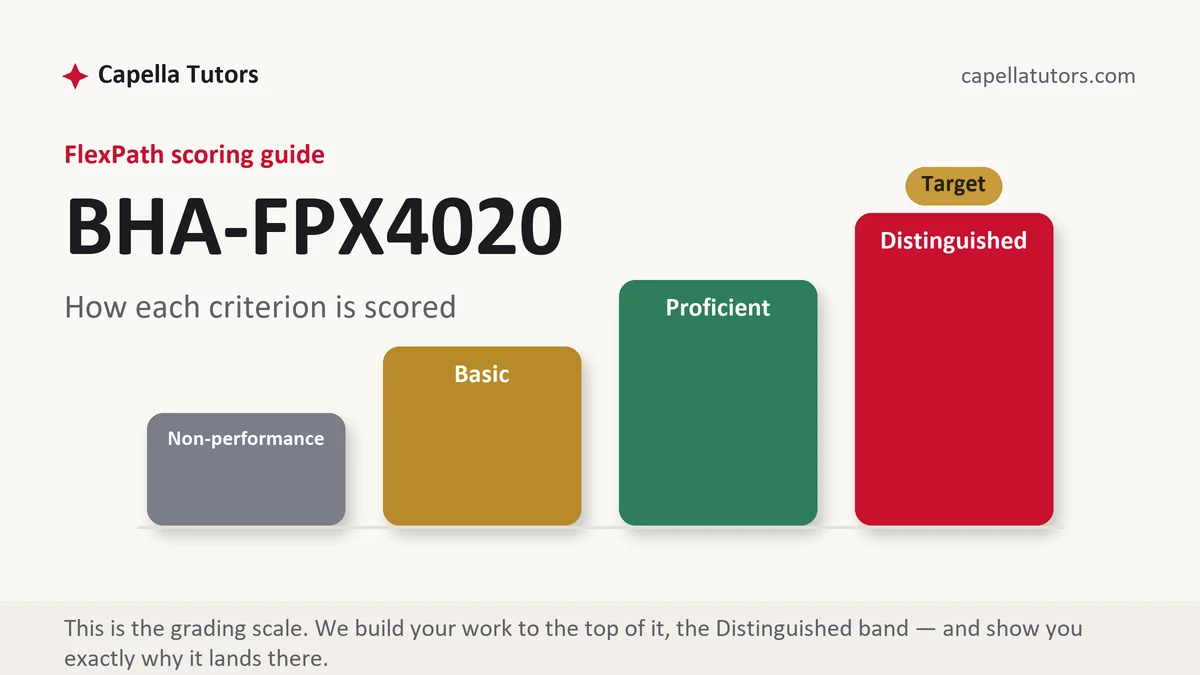
What BHA FPX 4020 actually grades
Start with what this course is not, because the wrong expectation costs students weeks. There is no site to find, no preceptor to secure, no supervisor to sign a timesheet and no hours to accumulate. The BS in Health Care Administration carries no practicum or residency component anywhere in it, and the capstone is a project you write. Two other rules shape the calendar: the course belongs in your final quarter, and it is one of the requirements that cannot be met with transfer credit or through prior learning assessment, so however much administrative experience you brought into the degree, this deliverable has to be produced inside the program.
What the criteria then grade is integration, and that word is doing real work. Every earlier course in the degree assessed one competence in isolation. The capstone assesses whether those competences now operate together, which means a single proposal in which the regulatory constraint, the financial case, the operational design, the information requirements and the population being served all appear in the same document and agree with one another. The failure mode is easy to recognize once you know it: a capstone that is one strong earlier paper stretched to length, with the other domains added as short sections that could be removed without the argument changing. Distinguished work is interlocked instead, so the budget reflects the staffing the operational plan requires, the operational plan respects the regulation named in the compliance section, and the measures come from data the information section says the organization can actually produce.
The problem statement is graded harder here than anywhere else in the degree. A capstone problem needs a site, a magnitude, a period and a source, and it needs to be small enough that one department could deliver the solution and large enough to be worth a director's attention. Reducing readmissions across a health system is not a capstone problem, it is a strategic plan. Reducing thirty day readmissions for heart failure patients discharged from one 32 bed medical unit, currently running at 24.6 percent against a 19.1 percent internal target across the last four quarters, is a capstone problem, and the difference is that a reader can tell when it has been solved.
The last strand is executive communication, and it is scored on form as much as on content. A capstone carries an executive summary that has to work as a standalone document, meaning a reader who never reaches page two still learns the problem, the size of it, what you propose, what it costs, what it returns and what you want approved. Most students write an introduction and label it an executive summary, which is the single most common formatting loss in the course. Below that, the criteria expect the apparatus a real proposal carries: a budget with lines rather than a total, an implementation sequence with dates and owners, a measurement plan, a risk section that names what could go wrong and what you would do about it, and a stakeholder analysis that identifies who can block this and what they need in order not to.
How we help in this course
Capstone work runs differently from single assessment work, so we treat it as a build rather than as a delivery. The first conversation is about scope, because most capstone drafts that go badly went badly at the scoping stage and everything afterward was effort spent in the wrong place. Once the problem is sited and sized, we assemble the sections in the order the argument needs them, meaning the problem and its evidence first, then the intervention, then the budget, then implementation, measurement and risk, with the executive summary written last because it can only summarize something that already exists. If your program requires the work in stages, we work to those stages.
Terms hold as they do everywhere in the studio, at capstone length. Each piece you send returns as a premium original sample inside 24 to 48 hours, eight people are involved between the outline and the file that arrives, and one entire pass is spent checking internal consistency, which at this length means confirming that the figure in the budget table matches the figure in the narrative and that the measure named in the evaluation plan is the same measure named in the problem statement. Revision stays free until the scoring guide is met and faculty feedback re-enters the cycle without charge. Because an evaluator has two business days with a submitted attempt and this is the work standing between you and the degree, we plan backward from the date you intend to submit and leave room for one full revision inside it.
The assessments, one by one
Assessment 1
The assessment usually asks you to establish the problem your capstone will solve, which is graded harder here than anywhere else in the degree. Read the full Assessment 1 manual.
Assessment 2
The assessment usually asks for the intervention and what it costs, which means an intervention matched to the cause you identified rather than to the symptom you described, and a budget built as lines rather than as a total. Read the full Assessment 2 manual.
Assessment 3
The assessment usually asks for the three sections that turn a proposal into a plan, and it asks for them separately: implementation as a sequence with dates, owners and dependencies; evaluation with measures fully specified against a baseline taken before the change; and risk as a set of named. Read the full Assessment 3 manual.
Assessment 4
This is the stage where the pieces become one document, and the criteria stop grading sections and start grading whether they interlock: the budget reflecting the staffing the operational plan requires, the operational plan respecting the regulation named in the compliance section, the measures. Read the full Assessment 4 manual.
How to actually write BHA FPX 4020: where to begin
Read the scoring guide as a specification and build the document to it literally, since capstone criteria are long, numerous and unusually explicit about structure. Turn every criterion into a heading, keep them in the order the guide lists them unless the prompt says otherwise, and resist the urge to write the beautiful version that reorganizes everything, because an evaluator scoring criterion by criterion should never have to hunt. The clusters in 4020 usually cover the problem and its evidence, the proposed solution, the resources it needs, implementation, evaluation, and the professional considerations wrapped around all of it. The assessments in this course usually ask you to carry one organizational problem through that whole chain, and your scoring guide decides the format, the length and the required sections.
Then choose the problem against three tests, and apply them before you write a word. Can it be sited, meaning is there one named department or facility where it lives. Can it be sized, meaning is there a figure, a denominator and a period that show it exists at the magnitude you claim. Can it be closed, meaning could the intervention you have in mind plausibly be delivered by the people and budget available inside a year. A problem failing any one of those will produce a capstone that reads as ambitious and scores as unfocused. If the numbers you need are not available to you, construct them from what is observable, label them as constructed, and state the basis, since a transparent estimate is treated far better than a confident figure with no origin.
Then build the budget as lines, because a total is not a budget and the criterion knows the difference. Cost the staffing first and cost it correctly: a role at 0.6 of a full time equivalent working 1,248 hours a year at 27.40 dollars an hour is 34,195 dollars in wages, and adding benefits and payroll taxes at 28 percent brings it to about 43,770 dollars annually, which is the number a finance office would recognize. Then add the one time costs, the recurring non salary costs, and anything the plan needs from another department, which should appear as a real line even when no money changes hands, because borrowed time is a cost to the department lending it. Then state what the organization gets back, in dollars where dollars exist and in operational consequence where they do not, and say plainly which of your figures are firm and which are estimates.
Then write implementation, evaluation and risk as three separate sections, because merging them is how capstones lose criteria they had already earned. Implementation is a sequence with dates, owners and dependencies, and it should say what happens in the first thirty days rather than describing a year in the abstract. Evaluation names the measures with numerators, denominators, sources and a baseline taken before the change, and it names the review date. Risk is where undergraduate work is weakest, so give it real content: what happens if the position is not filled, if the clinical staff will not adopt the new step, if the data turns out not to exist, or if a regulatory review delays the start, and give each one a response rather than a reassurance. Write the executive summary last, on one page, opening with the ask.
| Section | What goes in it | What Distinguished looks like |
|---|---|---|
| Executive summary | Problem, size, proposal, cost, return and the decision you are requesting. | One page that stands alone and leads with the ask rather than with background. |
| Problem and evidence | The sited problem with its figure, denominator, period and source of data. | A magnitude a reader can verify, benchmarked against a target or an external figure. |
| Proposed solution | What changes, drawn from evidence, with the regulatory constraints respected. | An intervention matched to the cause identified rather than to the symptom described. |
| Budget | Salary and non salary lines, one time and recurring, with assumptions stated. | Staffing costed with benefits, borrowed time shown, and the arithmetic checkable. |
| Implementation and risk | The sequence with dates and owners, and what could derail each phase. | First thirty days specified, and each risk carrying a response rather than a hope. |
| Evaluation and references | Measures fully specified, the baseline, the review date, current APA throughout. | Measures drawn from data the organization already collects, with a named reviewer. |
Developing the analysis
The judgment a capstone is really assessing is whether you can hold a recommendation and its limits in the same document without weakening either, and that is a harder balance than it sounds for a student who has spent a degree learning to argue. Two failures sit on either side. The overclaiming capstone promises that the intervention will reduce the outcome by a stated percentage because a published study reported that result somewhere else, which ignores everything about the setting that made the transfer uncertain. The hedging capstone qualifies every sentence until no decision is being requested at all, which fails the criterion asking for a recommendation. The version that scores does both jobs in sequence: this is what the evidence supports, this is why the effect here may be smaller, this is what we will measure to find out, and this is the decision I am asking for now. Say what would make you stop, too, since naming the result that would tell you the intervention is not working reads as competence rather than as doubt. Then check that the domains genuinely interlock, which is best done by testing whether removing any one section would leave the argument intact. If it would, that section is a passenger and the integration criterion has already been lost.
Citations that survive faculty review
A capstone draws on the whole degree, so its reference list should visibly span the domains the argument crosses. Peer-reviewed health services and management research from roughly the last five years, gathered through the Capella library, PubMed, CINAHL and Business Source Complete, supports every claim that an intervention changes an outcome, and each study should enter the text with its design and setting attached. Regulatory sources are cited to the rule where compliance is at issue, whether that is the relevant Conditions of Participation, the HIPAA rules at 45 CFR, or the state statute governing your facility. Payment and program material comes from CMS and should be quoted with the program and the year, since payment rules change annually and a capstone written on last year's rule will be read as careless. Accrediting and professional bodies supply the standards the proposal has to satisfy, principally Joint Commission requirements and the American College of Healthcare Executives competencies. Organizational and public data provides the magnitudes, whether that is an internal report you name and date, a community health needs assessment, or a federal series quoted with its collection year. Then run current APA in both directions, and read the finished document once for numbers alone, because at capstone length the most damaging error is a figure that appears twice with two different values.
The mistakes that land Basic instead of Distinguished
- An earlier paper made longer. The integration criterion is looking for domains that depend on each other, not sections placed side by side.
- An executive summary that is an introduction. It has to carry the ask, the cost and the return, or it has not done its job.
- A budget expressed as a single total. Lines, rates, hours and a benefits load are what make a number reviewable.
- A problem no department could own. Scope that crosses a whole system leaves nobody able to accept the recommendation.
- Risk written as reassurance. Naming what happens if the position stays vacant is the criterion, saying challenges may arise is not.
BHA FPX 4020 questions students actually ask
Does the capstone include a practicum, a placement or field hours?
No. The BS in Health Care Administration has no practicum, residency or field experience requirement, and BHA FPX 4020 is a project course rather than a placement course. Nothing has to be arranged with an employer, no preceptor agreement is needed, no supervisor signs anything, and there are no hours to log or accumulate. Students often arrive expecting otherwise because clinical programs at the same level do require placements, and health administration programs elsewhere sometimes do too. Here the deliverable is written work built around an organizational problem, which you may draw from your own workplace if you have one, from a facility you can research publicly, or from a scenario you construct and label as constructed.
Can I transfer credit for the capstone or use prior learning assessment?
No on both counts, and it is worth planning around early. This requirement has to be completed within the program, so it cannot be met by transferring an equivalent course from another institution and it cannot be met through prior learning assessment however senior your administrative experience is. It is also restricted to your final quarter, which means it sits at the end of the sequence rather than wherever it happens to fit your schedule. The practical consequence is a pacing one: if you intend to finish in a particular quarter, the capstone needs to be inside that quarter with room around it, and anything you were hoping to clear by transfer should be identified much earlier in the degree instead.
How long should the project be, and can I reuse work from earlier courses?
Length is set by your scoring guide and the prompt, so take the requirement from there rather than from any general expectation, since capstone deliverables vary in form and some programs stage the work across several submissions. On reuse, the honest answer is that you may build on your earlier thinking and you may not resubmit earlier text. Reusing your own previously submitted work without disclosure is a recognized academic integrity issue and it is treated seriously at this stage of a degree. What is entirely legitimate is returning to a problem you first examined in an earlier course, going deeper, gathering current data, and writing it fresh, and saying in the paper that the topic builds on earlier coursework removes any ambiguity.
Capstone due in your final quarter?
Send the prompt, the scoring guide and the problem you have in mind. The first premium sample is free, and we will tell you honestly whether the scope will hold before you build on it.