Send the prompt and the scoring guide for anything this course asks you to hand in, and a premium original sample comes back inside 24 to 48 hours, written to the Distinguished descriptors and read by a second person before it reaches you. On a transcript the course reads BHA FPX 2002, Evolution of Healthcare Delivery in the United States, worth 1.5 program points, a lower-division core requirement in the BS in Health Care Administration, taught in FlexPath inside a degree that asks for at least 90 program points with a minimum of 27 of them earned at the 3000 level or above. In Capella's catalog the course code is written BHA-FPX2002.
What BHA FPX 2002 actually grades
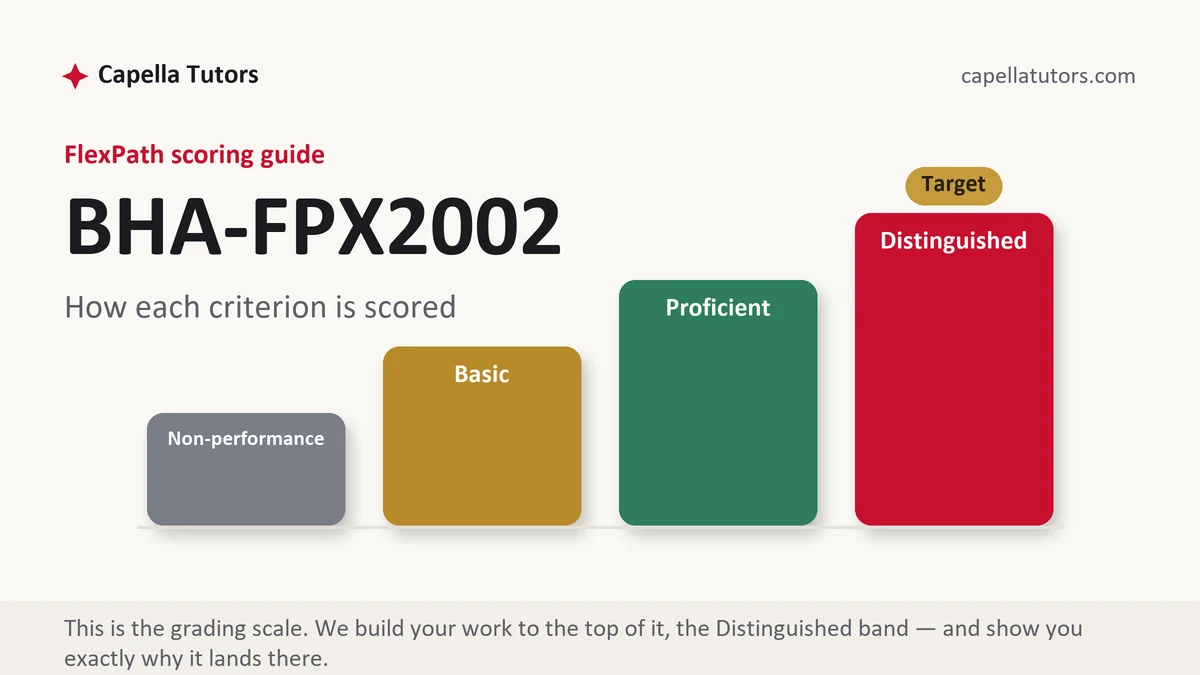
American health care was not designed, it accumulated, and this course grades whether you can show the accumulation happening. The assessments in this course usually hand you a period, a statute, or an institution and ask what it changed, so the criteria read for three things at once: an accurate account of the arrangement that existed before, a specific description of the change itself, and a consequence somebody could have observed afterward. A Basic answer produces correct dates in the correct order. The column above it explains why one event made the next one possible, which is a different skill and the one being tested.
Names and years carry more weight here than in any other lower-division requirement in the degree, because a mechanism you cannot date is a mechanism a reader cannot check. The Flexner Report of 1910 did more than criticize medical schools, it established a university-based, laboratory-grounded standard that closed most proprietary schools within two decades and narrowed who was permitted to enter the profession. The Hospital Survey and Construction Act of 1946 paid for beds in communities that had none and attached a service obligation to the money it handed out. Medicare and Medicaid arrived together in 1965 as Titles XVIII and XIX of the Social Security Act, and the difference between a federal insurance program for older adults and a joint federal and state program for low-income coverage is graded directly, because undergraduate papers merge the two constantly.
The third strand is consequence, and it is where most drafts stall. Employer-sponsored coverage is the clearest case available to you. Wartime wage controls left fringe benefits as one of the few remaining ways for firms to compete for scarce workers, favorable tax treatment made the arrangement permanent, and a country ended up attaching health coverage to employment for reasons that had nothing to do with health. The 1983 shift to paying hospitals a fixed amount per admission by diagnosis related group is the second case worth mastering, because it turned a longer stay from a source of revenue into a source of cost, and the growth of skilled nursing, rehabilitation, and home health follows directly from that reversal. Name the incentive, then name the behavior the incentive produced, and you are writing at the level the guide describes.
How we help in this course
Our 2002 drafts are dated and sourced line by line. Each statute is named in full at first use with its year, the year of enactment is kept apart from the year a program first paid a claim, and every consequence we assert is attached to something a reader can look up rather than to a general impression that care improved. Give us the prompt, the criteria, and the era or policy your instructor assigned, and the sample argues that specific period instead of surveying a century in a page and a half.
The rest of the terms are the same ones we offer on every course we support. A deliverable comes back inside 24 to 48 hours, aimed at the top column, after passing through eight people: a research analyst pulls the scoring guide and the sources, a subject writer drafts, a scoring-guide reviewer marks the draft criterion by criterion the way a Capella evaluator would, an APA and originality pass confirms the citations and the reference list agree, and an editor takes the final look. Revision is free until the work meets the guide, and faculty comments come back into the same cycle at no extra cost.
The assessments, one by one
Assessment 1
Assessment 1 of BHA FPX 2002, Evolution of Healthcare Delivery in the United States, sets the habit the course will grade for the rest of the term. Read the full Assessment 1 manual.
Assessment 2
Assessment 2 of BHA FPX 2002, Evolution of Healthcare Delivery in the United States, moves from describing one change to explaining movement between two fixed points. Read the full Assessment 2 manual.
Assessment 3
Assessment 3 of BHA FPX 2002, Evolution of Healthcare Delivery in the United States, is the synthesis stage of the course. Read the full Assessment 3 manual.
How to actually write BHA FPX 2002: where to begin
Open the scoring guide before you open a single reading, and turn each criterion into a heading in an empty document. Paste the Distinguished wording underneath its heading in brackets, write only under those headings, and strip the brackets at the end. Historical topics tempt you into storytelling, and storytelling is what buries a criterion, because an evaluator hunting for your analysis of access should not have to find it halfway through a narrative about the nineteenth century.
Here is what a scoring paragraph looks like when the subject is hospital construction after the Second World War. The weak version says the federal program built hospitals and improved access to care. The version that earns the top column says the program distributed construction money on a formula weighted toward states with the fewest beds per person, obliged recipients to provide a reasonable volume of care to people who could not pay and to serve everyone in the community, and left a rural hospital footprint that later payment changes made hard to sustain. Same event, three checkable specifics, and a consequence that reaches into the present. The second version also ends on a tension rather than on improvement, which matters, because the buildings that expanded access in one decade became the closures a later chapter of the course has to account for.
Close every historical section with a sentence about now. Assessments in this course almost always carry a criterion about relevance to current practice, and it is the criterion most often answered with a generality about lessons learned. Say which present-day arrangement descends from the policy you just described, and name the mechanism that carried it forward, whether that is a payment rule still using the same classification logic, an agency still running the same survey, or a coverage category still dividing the population the way 1965 divided it.
| Section | What goes in it | What Distinguished looks like |
|---|---|---|
| The baseline | Conditions before the change, described concretely: who paid, who delivered care, who went without. | A starting point specific enough that the change can be measured against it. |
| The change | The act, report, or innovation named in full, dated, and described by what it required or funded. | Enactment, funding, and implementation kept apart, with the operative provision restated in your own words. |
| Drivers | The economic, political, demographic, and technological pressures that made the change possible. | Drivers ranked rather than listed, with the one that mattered most defended. |
| Consequences | Effects on access, cost, quality, and the workforce, written as changes someone observed. | Intended and unintended effects both present, with the unintended ones named specifically. |
| Line to the present | The current arrangement descended from the change, and the mechanism that carried it there. | A traceable connection rather than a claim that history still matters. |
| Sources and format | Government, historical, and peer-reviewed material in current APA, checked both ways. | Primary material used wherever it exists, with secondary summaries kept for orientation only. |
Developing the synthesis
Historians of American health care disagree with each other, and the disagreement is usable even at this level. One account reads the twentieth century as a story of professional authority, in which organized medicine won control over licensure, hospital privileges, and the design of insurance, then gave some of it back to payers and integrated systems after 1980. A second reads the same decades as a financing story, in which whoever held the money determined what got built and where. A third reads it as a story of boundaries, since every program that expanded coverage also drew a line around who qualified, and the residue of those lines is still visible in who is uninsured today. Nobody expects you to settle this in a lower-division paper. You are expected to notice that your source is arguing something, name the interpretation you are following, and add a sentence saying what a reader who preferred a different one would emphasize instead. Two sentences of that reads as reading rather than summarizing, and it lifts a criterion more reliably than another paragraph of detail.
Citations that survive faculty review
Three kinds of source do three separate jobs in this course. Primary government material carries the facts of the policy itself: the text of the act, the agency assigned to administer it, and program documentation published by the Centers for Medicare and Medicaid Services or the Department of Health and Human Services. Peer-reviewed health policy and health services scholarship, retrieved through the Capella library rather than a general web search, carries interpretation and measured effect, and that is where the argument in your paper should come from. Reference works and material from established health policy foundations help you orient yourself and are not a substitute for either of the first two. Two habits protect a history paper specifically. Cite the law rather than a page describing the law, and check whether a figure you are quoting was reported at the time or reconstructed by a later study, because secondary sources blur the two routinely. Then run the check in both directions, every in-text citation present in the reference list and every reference cited somewhere in the text, in current APA.
The mistakes that land Basic instead of Distinguished
- A timeline with no argument. Events in order answer a question nobody asked, and the criterion is asking for a cause.
- Treating the two 1965 programs as one. Different funding, different eligibility, and different administration, and the merge shows up inside a single sentence.
- Undated claims about the past. For many years is not a period, and a reader cannot verify it.
- Judging past decisions by present knowledge. Explain what the actors knew and what constrained them first, then evaluate.
- Nothing but secondary sources. A paper about a statute that never touches the statute reads as assembled from summaries of summaries.
BHA FPX 2002 questions students actually ask
How far back does my paper actually have to go?
Start where the prompt starts, and if it leaves the period open, begin at the point where the arrangement you are explaining first became recognizable. For hospitals that is usually the late nineteenth century, when antisepsis and trained nursing turned an institution for people with nowhere else to go into a place where paying patients expected to recover. For private insurance it is 1929 and the prepaid hospital plan sold to schoolteachers in Dallas that became the template others copied. For federal financing it is 1965. What loses marks is a paper that opens in the colonial almshouse and reaches the present in its final paragraph, since the criteria reward depth inside the assigned period rather than coverage of everything before it.
My assessment is about a trend rather than a single event. How do I structure that?
Turn the trend into three dated snapshots and explain the movement between them. A trend paragraph with no dates is an opinion, and one with three fixed points is an analysis a reader can follow. If the subject is where care is delivered, describe the inpatient-centered arrangement of the mid twentieth century, the movement of surgery and treatment into outpatient settings that followed changes in anesthesia and in payment, and the position today, then say what pushed the system between each pair of snapshots. Give each snapshot its own source. Direction, driver, and evidence are what these criteria are usually asking for, and the snapshot method produces all three without collapsing into a chronology.
Do I need statistics in a history paper?
A few, chosen carefully, each one anchored to a year. Two or three quantities that establish scale improve this kind of writing considerably, such as the number of beds a construction program financed or the share of the population holding hospital coverage in a stated year. Every figure needs the year it describes and a source that either reported it at the time or reconstructed it later. Never carry a percentage across decades without saying which year it belongs to, and never set a dollar amount from one era beside one from another without noting that they are not the same dollars. Those two errors are the ones faculty circle in the margin.
History assessment due?
Send the prompt, the criteria, and the period you were assigned. Every claim comes back dated and sourced. The first premium sample is free.